
Introduction
Have you ever wondered how a large aircraft can remain steady in the sky while carrying hundreds of passengers, fuel, and cargo? An aircraft does not simply stay balanced by moving forward. Its ability to fly smoothly depends on a carefully coordinated relationship between aerodynamic forces, weight distribution, control surfaces, and pilot inputs.
During flight, an aircraft is constantly affected by forces such as lift, weight, thrust, and drag. It can also experience changes caused by wind, turbulence, speed, altitude, and changes in its configuration. To deal with these conditions, aircraft are designed with specific aerodynamic features that help maintain stability and give pilots precise control.
Understanding how aircraft maintain balance in flight provides a useful introduction to the basic principles of aviation. From the position of the center of gravity to the operation of ailerons, elevators, and rudders, several systems work together to keep an aircraft in its intended attitude and flight path.
What Does Aircraft Balance Mean?
Aircraft balance refers to the way an aircraft’s weight and aerodynamic forces are distributed during flight. Proper balance allows the aircraft to maintain a desired attitude and flight path without requiring excessive control inputs.
A balanced aircraft is not necessarily completely motionless. Small changes are constantly occurring because of wind, turbulence, fuel consumption, power changes, and pilot inputs.
The aircraft’s design and flight controls allow these changes to be managed. When the forces and control inputs are properly coordinated, the aircraft can maintain stable and predictable flight.
The Three Axes of Aircraft Movement
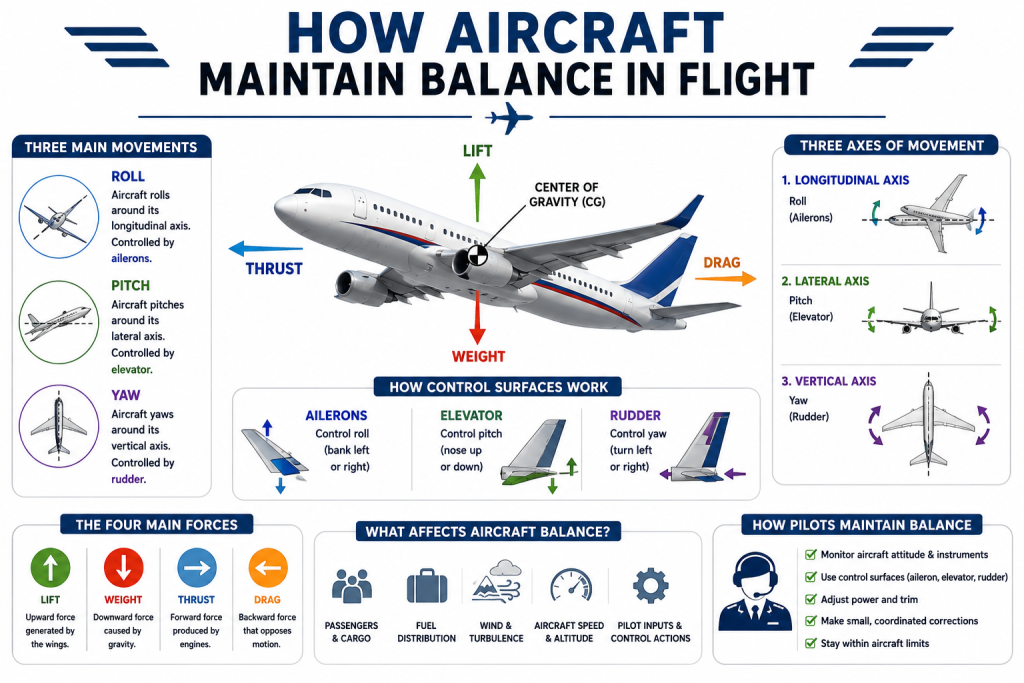
Aircraft can rotate around three imaginary axes. These axes intersect approximately around the aircraft’s center of gravity.
1. Longitudinal Axis
The longitudinal axis extends from the nose toward the tail of the aircraft.
Movement around this axis is called roll. During a roll, one wing moves upward while the other moves downward.
The ailerons are primarily responsible for controlling roll.
2. Lateral Axis
The lateral axis extends from one wing to the other.
Movement around this axis is called pitch. Pitch determines whether the aircraft’s nose moves upward or downward relative to the horizon.
The elevator is primarily used to control pitch.
3. Vertical Axis
The vertical axis extends vertically through the aircraft.
Movement around this axis is called yaw. Yaw occurs when the nose moves to the left or right.
The rudder is primarily used to control yaw.
These three movements are closely connected, and pilots often coordinate them to maintain controlled flight.
The Three Main Aircraft Movements
Roll
Roll is the rotation of an aircraft around its longitudinal axis.
Ailerons control roll by changing the aerodynamic forces produced by the wings. When the ailerons move in opposite directions, they cause one wing to produce more lift than the other, creating a rolling motion.
Roll control is especially important when an aircraft enters or leaves a turn.
Pitch
Pitch is the rotation of the aircraft around its lateral axis.
The elevator affects the aerodynamic forces around the tail and allows the pilot to control the aircraft’s pitch attitude.
Changes in pitch can influence airspeed, altitude, and angle of attack, so pilots must consider these factors when making pitch adjustments.
Yaw
Yaw is the rotation of the aircraft around its vertical axis.
The rudder controls yaw by changing the aerodynamic force generated by the vertical tail.
Yaw control is important for coordinating turns and correcting unwanted sideways movement of the aircraft.
How the Four Main Forces Affect Aircraft Balance
Four fundamental forces are used to describe aircraft flight:
- Lift
- Weight
- Thrust
- Drag
These forces interact continuously during flight.
Lift
Lift is the aerodynamic force that generally acts upward relative to the aircraft’s flight condition.
The wings produce most of the lift on a conventional aircraft. The amount of lift depends on factors such as airspeed, air density, wing design, wing area, and angle of attack.
Without sufficient lift, the aircraft cannot maintain its intended flight condition.
Weight
Weight is the force caused by gravity acting on the aircraft’s mass.
Everything carried by the aircraft contributes to its weight, including passengers, baggage, fuel, cargo, and equipment.
Weight is important not only because it affects performance but also because its distribution influences the aircraft’s center of gravity.
Thrust
Thrust is the forward force produced by an aircraft’s propulsion system.
Jet engines, turboprops, and propellers generate thrust in different ways, but their basic purpose is to provide propulsion and help the aircraft overcome drag.
Drag
Drag is the aerodynamic force that opposes an aircraft’s movement through the air.
Aircraft designers work to reduce unnecessary drag because it affects fuel consumption and performance. During flight, pilots also manage power and aircraft configuration to achieve the required balance between speed, altitude, and efficiency.
How the Center of Gravity Helps Maintain Balance
The center of gravity (CG) is one of the most important factors affecting aircraft balance.
It represents the point where the aircraft’s total weight can be considered to act. The location of the center of gravity affects how the aircraft handles and how much control authority may be needed.
If the CG is too far forward, the aircraft may require greater control forces in certain flight conditions. If the CG is too far aft, the aircraft can become less stable and may be more difficult to control.
For this reason, aircraft have approved center-of-gravity limits.
Passengers, baggage, cargo, and fuel can all affect the CG. Before flight, pilots or operators use weight-and-balance information to ensure that the aircraft is loaded within the appropriate limits.
How Stabilizers Help Maintain Aircraft Stability
Aircraft use stabilizing surfaces to help manage unwanted movements.
Horizontal Stabilizer
The horizontal stabilizer is located near the rear of a conventional aircraft.
It contributes to pitch stability and works with the elevator to influence the aircraft’s movement around its lateral axis.
Elevator
The elevator is a movable control surface associated with the horizontal tail.
It allows the pilot to control pitch by changing aerodynamic forces around the aircraft’s lateral axis.
Vertical Stabilizer
The vertical stabilizer is the fixed vertical surface located at the rear of the aircraft.
It contributes to directional stability and helps the aircraft resist unwanted yawing movements.
Rudder
The rudder is the movable control surface attached to the vertical stabilizer.
It allows the pilot to control yaw and is particularly important for coordinating aircraft movement and managing certain crosswind and asymmetric conditions.
How Ailerons, Elevator, and Rudder Work Together
Aircraft control surfaces do not always operate independently.
During a turn, for example, the ailerons can be used to bank the aircraft. The rudder can help maintain coordination, while elevator and power adjustments may be required to maintain the desired altitude and airspeed.
When an aircraft banks, the direction of the lift force changes. As a result, the pilot may need to make additional adjustments to maintain the desired flight condition.
This interaction demonstrates why aircraft control requires coordination rather than simply moving one control surface at a time.
What Happens When an Aircraft Becomes Unbalanced?
An aircraft can move away from its desired flight condition for many reasons.
Turbulence
Turbulence can cause sudden changes in aircraft attitude and movement. Pilots use appropriate procedures and control inputs to manage these disturbances.
Unwanted Roll
A strong gust can cause one wing to rise or fall relative to the other. Aileron inputs can be used to correct the aircraft’s bank attitude.
Unwanted Yaw
Environmental conditions or aircraft operating factors can produce unwanted yaw. Rudder input can help correct or coordinate this movement.
Pitch Changes
A sudden change in pitch can affect the aircraft’s airspeed and flight path. Pilots respond with appropriate elevator and power adjustments.
Changes in Weight Distribution
Moving passengers, loading cargo, or changes in fuel distribution can affect the aircraft’s center of gravity. Proper weight-and-balance procedures help ensure that the aircraft remains within its approved operating limits.
How Pilots Maintain Aircraft Balance
Pilots continuously monitor important flight parameters such as:
- Airspeed
- Altitude
- Attitude
- Heading
- Vertical movement
- Aircraft configuration
- Engine or power settings
They use the aircraft’s flight controls to make corrections when necessary.
Ailerons are used primarily for roll, the elevator for pitch, and the rudder for yaw. Power adjustments can also influence airspeed and flight performance.
Pilots may also use trim systems to reduce the control force needed to maintain a particular flight condition.
Effective aircraft control generally involves small, deliberate corrections rather than continuous large movements.
How Aircraft Design Provides Stability
Aircraft are designed with stability characteristics that help them respond predictably to disturbances.
Factors such as the location of the center of gravity, wing design, tail configuration, and aerodynamic surfaces all influence stability.
When an aircraft is designed with appropriate stability characteristics, it can resist certain disturbances and may naturally tend to return toward its previous flight condition.
However, stability and maneuverability involve trade-offs. Different aircraft are designed for different purposes, so their handling characteristics can vary.
A passenger aircraft, a training aircraft, and a high-performance aircraft may have different stability and control characteristics based on their intended roles.
How Modern Flight Systems Assist With Stability
Modern aircraft may use automated flight-control systems to assist pilots in maintaining stable flight.
Autopilot systems can maintain selected flight parameters within their operating capabilities. Some aircraft also use flight-control computers that process information from sensors and pilot inputs to control flight surfaces.
These systems can reduce pilot workload and help maintain precise flight conditions.
However, automation and aerodynamic stability are not the same thing. An aircraft can have natural aerodynamic stability without an autopilot, while automated systems can actively make corrections according to their programmed functions and operating limits.
The basic principles of lift, weight, thrust, drag, stability, and control remain essential regardless of the amount of automation available.
Why Aircraft Stability Is Important for Safe Flight
Aircraft stability helps make flight more predictable and manageable.
A properly designed and loaded aircraft should respond to control inputs in a predictable way and resist certain unwanted movements. This allows pilots to maintain the desired flight path without making excessive corrections.
Good stability can also help reduce pilot workload and improve passenger comfort.
However, stability is only one part of safe aircraft operation. Correct loading, proper maintenance, suitable weather assessment, adherence to operating limitations, and appropriate pilot procedures are also essential.
Balance, Stability, and Control: What Is the Difference?
The terms balance, stability, and control are closely related but describe different concepts.
Balance refers to the distribution of forces and weight that allows the aircraft to maintain a desired flight condition.
Stability describes how the aircraft responds when disturbed from that condition.
Control refers to the ability of the pilot or flight-control system to change or maintain the aircraft’s attitude and flight path.
All three work together to make an aircraft controllable and predictable in flight.
Frequently Asked Questions
1. How does an aircraft stay balanced in the air?
An aircraft stays balanced through the interaction of lift, weight, thrust, and drag, along with its center of gravity, aerodynamic design, control surfaces, and pilot inputs.
2. What are the three axes of an aircraft?
The three axes are the longitudinal axis, lateral axis, and vertical axis. They are associated with roll, pitch, and yaw respectively.
3. What controls the roll of an aircraft?
Ailerons are the primary flight controls used to control roll. They change the lift distribution between the wings and cause the aircraft to rotate around its longitudinal axis.
4. What controls pitch in an aircraft?
The elevator is primarily responsible for controlling pitch. It changes the aerodynamic forces around the aircraft’s lateral axis.
5. What controls yaw in an aircraft?
The rudder is the primary control surface used to control yaw. It changes the aerodynamic force produced by the vertical tail.
6. Why is the aircraft’s center of gravity important?
The center of gravity affects aircraft stability, handling, and control requirements. Aircraft must remain within approved CG limits for safe operation.
7. What are the four main forces acting on an aircraft?
The four commonly discussed forces are lift, weight, thrust, and drag. Their interaction determines how an aircraft performs in flight.
8. Can an aircraft automatically maintain its balance?
Some aircraft use autopilot and other flight-control systems to assist with maintaining selected flight conditions. However, these systems operate within specific capabilities and do not eliminate the importance of aircraft stability and pilot oversight.
9. Does turbulence affect aircraft balance?
Yes. Turbulence can temporarily change an aircraft’s attitude, movement, and flight path. Aircraft and pilots are equipped to manage such disturbances within the aircraft’s operating limitations.
10. Why do pilots use trim?
Trim can reduce the amount of continuous control force required to maintain a particular flight condition. It helps make aircraft control more manageable but does not replace the primary flight controls.
Conclusion
Aircraft maintain balance in flight through a combination of aerodynamic forces, weight distribution, aircraft design, stabilizing surfaces, control inputs, and pilot actions.
The four primary forces—lift, weight, thrust, and drag—provide the foundation for understanding flight. At the same time, the aircraft must control movement around its three axes through roll, pitch, and yaw.
The center of gravity plays an especially important role because its position influences stability and handling. Components such as the horizontal and vertical stabilizers, ailerons, elevator, and rudder help the aircraft remain controllable when conditions change.
Whether it is a small training aircraft or a large commercial jet, the basic principles remain the same. Aircraft do not maintain balance by remaining perfectly still. Instead, their design, aerodynamic forces, flight controls, and pilot inputs continuously work together to manage changes and keep the aircraft on its intended flight path.

