
Introduction
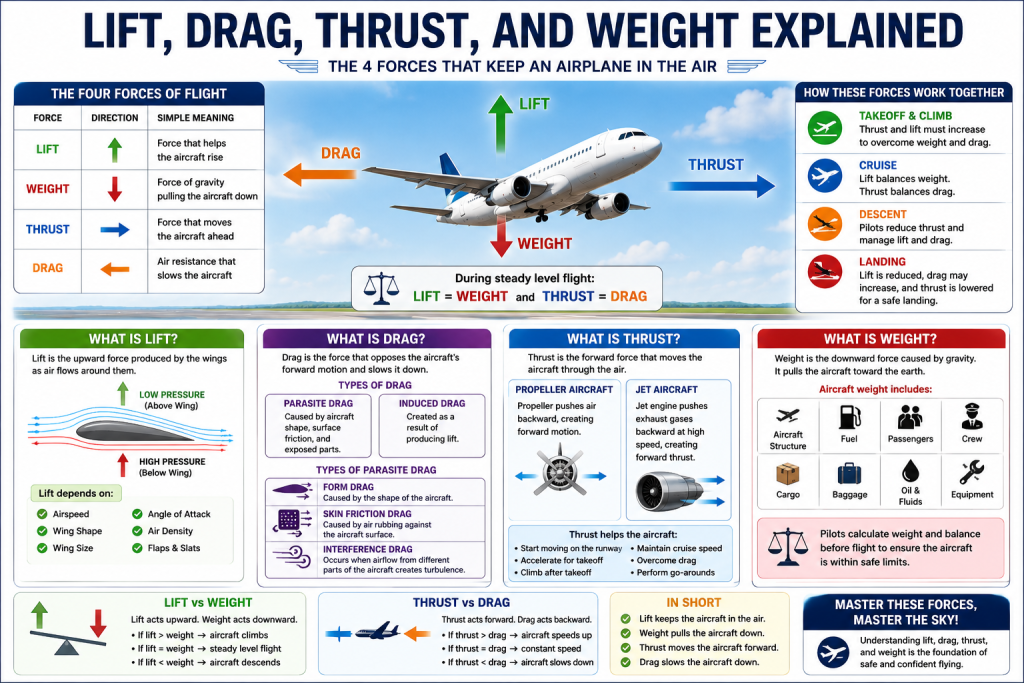
Airplanes are heavy machines, yet they can rise into the sky, travel long distances, and land safely because of four main forces: lift, drag, thrust, and weight. These forces work together during every second of flight.
For student pilots, aviation learners, and aircraft enthusiasts, understanding these four forces is one of the first steps in learning how airplanes fly. Whether an aircraft is taking off, climbing, cruising, turning, descending, or landing, these forces are always present.
This blog explains lift, drag, thrust, and weight in simple language so beginners can understand the basic science behind flight.
What Are the Four Forces of Flight?
The four forces of flight are:
| Force | Direction | Simple Meaning |
|---|---|---|
| Lift | Upward | Force that helps the aircraft rise |
| Weight | Downward | Force of gravity pulling the aircraft down |
| Thrust | Forward | Force that moves the aircraft ahead |
| Drag | Backward | Air resistance that slows the aircraft |
For an aircraft to fly safely, these forces must be managed properly. During steady level flight, lift balances weight, and thrust balances drag. During takeoff and climb, thrust and lift must increase. During descent and landing, pilots carefully reduce power and manage lift and drag.
What Is Lift?
Lift is the upward force that allows an aircraft to overcome weight and stay in the air. It is mainly produced by the wings as air flows around them.
Aircraft wings have a special shape called an airfoil. When air moves over and under the wing, pressure differences and airflow direction help create lift. The wing also pushes air downward, and in response, the aircraft is pushed upward.
Lift depends on several factors:
- Airspeed
- Wing shape
- Wing size
- Angle of attack
- Air density
- Flaps and slats
- Aircraft configuration
The faster the aircraft moves through the air, the more airflow passes over the wings. This usually increases lift, especially during takeoff.
What Is Angle of Attack?
Angle of attack is the angle between the wing and the oncoming airflow. It plays a major role in lift.
When the pilot raises the nose slightly, the wing meets the air at a greater angle. This can increase lift up to a certain point. However, if the angle becomes too high, airflow can separate from the wing, causing a stall.
A stall does not mean the engine has stopped. It means the wing is no longer producing enough smooth lift because airflow has broken away from the wing surface.
What Is Drag?
Drag is the force that opposes the aircraft’s forward motion. It acts backward and slows the aircraft down.
Drag happens because an aircraft moves through air, and air resists that movement. Every part of the aircraft creates some drag, including the wings, fuselage, landing gear, antennas, and control surfaces.
There are two main types of drag:
| Type of Drag | Meaning |
|---|---|
| Parasite Drag | Drag caused by aircraft shape, surface friction, and exposed parts |
| Induced Drag | Drag created as a result of producing lift |
At low speeds, induced drag can be higher because the wing works harder to produce lift. At high speeds, parasite drag increases because the aircraft pushes through more air.
Types of Parasite Drag
Parasite drag has several forms:
Form Drag
Form drag is caused by the shape of the aircraft. A smooth, streamlined aircraft creates less drag than a bulky shape.
Skin Friction Drag
Skin friction drag happens because air rubs against the aircraft surface. Smooth surfaces reduce this drag.
Interference Drag
Interference drag occurs when airflow from different parts of the aircraft meets and creates turbulence, such as where the wing joins the fuselage.
What Is Thrust?
Thrust is the forward force that moves an aircraft through the air. It is produced by the engine or propulsion system.
In a propeller aircraft, the propeller pulls or pushes air backward, creating forward motion. In a jet aircraft, the engine takes in air, compresses it, burns fuel, and pushes exhaust gases backward at high speed. This creates forward thrust.
Thrust helps the aircraft:
- Start moving on the runway
- Accelerate for takeoff
- Climb after takeoff
- Maintain cruise speed
- Overcome drag
- Perform go-arounds
Without enough thrust, the aircraft cannot maintain speed or climb effectively.
What Is Weight?
Weight is the downward force caused by gravity. It pulls the aircraft toward the earth.
Aircraft weight includes:
- Empty aircraft structure
- Fuel
- Passengers
- Crew
- Cargo
- Baggage
- Oil and fluids
- Installed equipment
Weight affects almost every part of aircraft performance. A heavier aircraft needs more lift, more runway, more thrust, and more careful planning.
Pilots calculate weight and balance before flight to ensure the aircraft is within safe limits.
Lift vs Weight
Lift acts upward. Weight acts downward.
For an aircraft to climb, lift must be greater than weight or the aircraft must have enough excess power to climb while maintaining controlled flight. In steady level flight, lift and weight are balanced.
If weight increases, the aircraft needs more lift. This may require higher speed, more runway, or a greater angle of attack.
That is why aircraft loading is important. Too much weight can reduce climb performance and increase takeoff distance.
Thrust vs Drag
Thrust acts forward. Drag acts backward.
When thrust is greater than drag, the aircraft accelerates. When drag is greater than thrust, the aircraft slows down. In steady cruise flight, thrust and drag are balanced.
Pilots use engine power to manage thrust. They also control drag by adjusting flaps, landing gear, speed, and aircraft configuration.
The Four Forces During Takeoff
During takeoff, the aircraft begins at rest. The pilot increases thrust using engine power. As the aircraft accelerates, airflow over the wings increases.
As speed builds:
- Thrust moves the aircraft forward
- Drag increases
- Lift increases
- Weight remains downward
When lift becomes sufficient, the aircraft leaves the runway. The pilot then manages climb speed and power to continue gaining altitude safely.
The Four Forces During Climb
During climb, the aircraft needs enough thrust to overcome drag and gain altitude.
In climb:
- Lift supports the aircraft
- Thrust helps overcome drag and climb
- Weight pulls downward
- Drag resists motion
A steep climb without enough speed can be unsafe because it may increase angle of attack too much. Pilots follow recommended climb speeds for safety and performance.
The Four Forces During Cruise
Cruise is usually the most stable part of flight.
In steady cruise:
- Lift equals weight
- Thrust equals drag
- Aircraft speed remains steady
- Altitude remains constant
Pilots adjust power, pitch, and trim to maintain efficient cruise flight. Good cruise management saves fuel and keeps the aircraft stable.
The Four Forces During Descent
During descent, the aircraft loses altitude in a controlled way.
The pilot may reduce thrust, allowing drag and weight to help the aircraft descend. Lift is still present, but the aircraft is no longer maintaining level altitude.
A safe descent requires proper speed control. Too much speed can increase drag and make the approach unstable. Too little speed can reduce lift and increase stall risk.
The Four Forces During Landing
Landing is one of the best examples of force management.
During landing:
- Thrust is reduced
- Drag increases using flaps and landing gear
- Lift is controlled carefully
- Weight returns the aircraft to the runway
Flaps help increase lift at lower speeds but also increase drag. This allows the aircraft to approach slowly and land safely.
During the final flare, the pilot gently raises the nose to reduce descent rate before touchdown.
How Flaps Affect Lift and Drag
Flaps are movable surfaces on the wings. Pilots extend them during takeoff and landing.
Flaps increase the wing’s curved shape, which helps produce more lift at lower speeds. They also increase drag, helping the aircraft slow down.
Flaps are useful because they allow aircraft to:
- Take off in shorter distances
- Land at slower speeds
- Maintain better control during approach
- Increase descent angle without excessive speed
However, flaps also create drag, so pilots use them according to aircraft procedures.
How Landing Gear Affects Drag
When landing gear is extended, drag increases. This slows the aircraft and helps prepare for landing.
During cruise, retractable landing gear is kept inside the aircraft to reduce drag and improve efficiency. During landing, the gear is lowered so the aircraft can safely touch down.
Fixed-gear aircraft always have landing gear exposed, so they generally create more drag than retractable-gear aircraft.
How Aircraft Shape Affects Drag
Aircraft designers work hard to reduce drag. A streamlined shape helps air flow smoothly around the aircraft.
Drag can be reduced by:
- Smooth aircraft surfaces
- Clean wing design
- Retractable landing gear
- Aerodynamic fairings
- Proper aircraft maintenance
- Removing unnecessary external equipment
Less drag usually means better speed, better fuel efficiency, and improved performance.
How Weight Affects Aircraft Performance
Weight has a major effect on flight.
A heavier aircraft may require:
- Longer takeoff distance
- Higher takeoff speed
- More runway
- Slower climb rate
- More fuel
- Higher landing speed
- Longer landing distance
Pilots must check weight and balance before flight. An aircraft that is too heavy or poorly balanced may become difficult or unsafe to control.
Center of Gravity and Weight Balance
The center of gravity is the point where the aircraft’s weight is balanced.
If the center of gravity is too far forward, the aircraft may be difficult to raise during takeoff or landing. If it is too far back, the aircraft may become unstable and harder to control.
Good weight balance helps the aircraft fly safely and predictably.
How Pilots Control the Four Forces
Pilots manage the four forces using aircraft controls.
| Pilot Control | Main Effect |
|---|---|
| Throttle | Controls thrust |
| Elevator | Controls pitch and angle of attack |
| Ailerons | Control roll |
| Rudder | Controls yaw |
| Flaps | Increase lift and drag |
| Landing Gear | Increases drag when extended |
| Trim | Helps maintain stable control pressure |
A good pilot understands how each control affects aircraft performance.
Everyday Examples of the Four Forces
The four forces of flight can be seen in everyday life.
Paper Airplane
A paper airplane glides because its wings create lift. Drag slows it down, weight pulls it down, and the throw provides thrust.
Kite
A kite rises when wind creates lift. The string controls its angle, while weight and drag affect its movement.
Bird
Birds create lift with their wings and thrust by flapping. They control drag and direction using body position and feathers.
Car
A car does not fly, but it experiences drag while moving through air. Faster cars need more power to overcome air resistance.
Fan
A fan pushes air backward, similar to how a propeller creates thrust.
Common Misconceptions About the Four Forces
| Myth | Fact |
|---|---|
| Engines create lift | Engines create thrust; wings mainly create lift |
| Lift comes from only one airflow effect | Lift results from pressure differences and airflow direction |
| Drag is always bad | Drag helps slow the aircraft during landing |
| Bigger aircraft use different physics | All aircraft follow the same basic force principles |
| Weight prevents flight | Weight must be balanced by lift |
| More thrust always means safer flight | Thrust must be managed with speed, drag, and aircraft limits |
| A stall means engine failure | A stall means the wing is not producing enough lift |
Why Student Pilots Must Understand These Forces
Student pilots study lift, drag, thrust, and weight because these forces affect every flight decision.
Understanding them helps pilots:
- Take off safely
- Maintain proper airspeed
- Avoid stalls
- Plan climbs and descents
- Land smoothly
- Manage fuel efficiently
- Understand aircraft limitations
- Respond better in emergencies
Good aerodynamic knowledge builds safer flying habits.
Frequently Asked Questions
1. What are the four forces of flight?
The four forces of flight are lift, drag, thrust, and weight. Lift acts upward, weight acts downward, thrust moves the aircraft forward, and drag pulls backward against motion.
2. Which force keeps an airplane in the air?
Lift is the force that helps keep an airplane in the air. It is mainly produced by the wings as air flows around them.
3. What creates thrust in an aircraft?
Thrust is created by the aircraft engine or propulsion system. Propellers and jet engines push air backward, which moves the aircraft forward.
4. Why does drag slow an airplane?
Drag is air resistance. As the aircraft moves through the air, the air pushes against it and slows its forward motion.
5. Why is weight important in aviation?
Weight affects takeoff distance, climb rate, fuel use, landing distance, and aircraft control. Pilots must keep aircraft weight within safe limits.
6. Can an aircraft fly without lift?
No, an aircraft cannot fly normally without lift. Lift is needed to balance weight and keep the aircraft airborne.
7. What happens when thrust is greater than drag?
When thrust is greater than drag, the aircraft accelerates. This commonly happens during takeoff and climb.
8. How do flaps affect flight?
Flaps increase lift and drag. They help aircraft fly slower during takeoff and landing while maintaining better control.
9. Does altitude affect lift?
Yes, altitude affects lift because air density changes. At higher altitudes, thinner air can reduce lift and engine performance.
10. Why do pilots study aerodynamics?
Pilots study aerodynamics to understand how aircraft behave in flight. This helps them make safer decisions and control the aircraft more effectively.
Conclusion
Lift, drag, thrust, and weight are the four basic forces that make flight possible. Lift helps an aircraft rise, weight pulls it downward, thrust moves it forward, and drag resists motion. Every phase of flight depends on how these forces are balanced and controlled.
For aviation students and future pilots, mastering these concepts is essential. Once you understand the four forces of flight, aircraft behavior becomes easier to understand. Whether you are learning to fly, studying aerodynamics, or simply curious about airplanes, these principles form the foundation of aviation knowledge.

