
Introduction
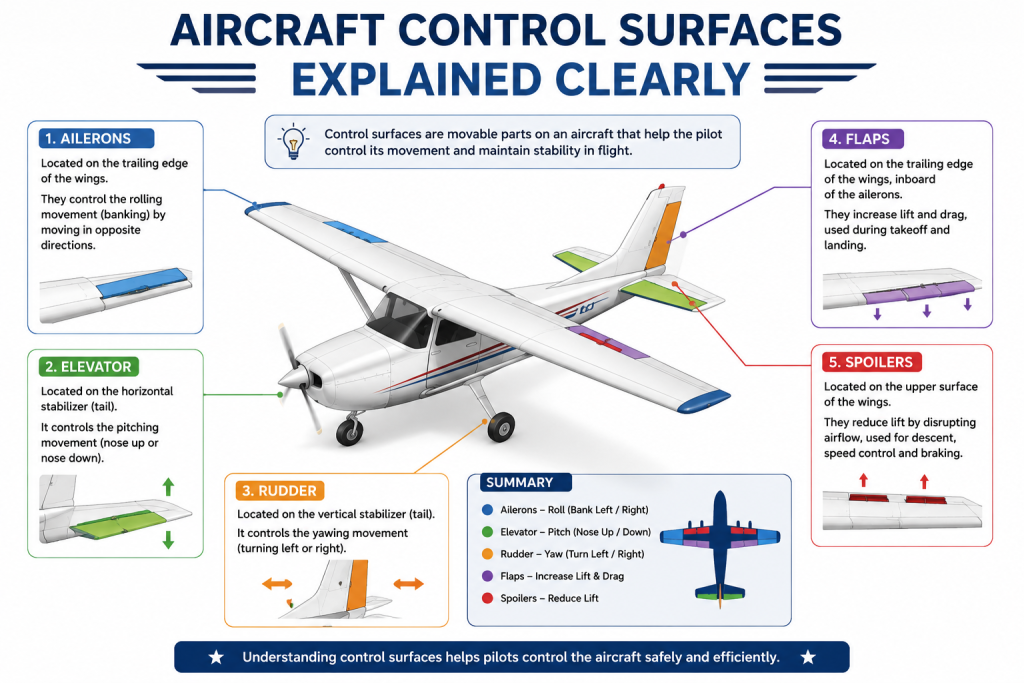
Aircraft control surfaces are among the most important components involved in controlling an aircraft. They allow pilots to change the aircraft’s attitude, direction, speed, and flight path by influencing the aerodynamic forces acting on the aircraft.
For someone beginning to learn aviation, terms such as aileron, elevator, rudder, flap, spoiler, pitch, roll, and yaw can initially seem confusing. However, these concepts become much easier once each control surface is understood in relation to the movement it produces.
The primary flight controls are the ailerons, elevator, and rudder. Together, they allow pilots to control the aircraft around its three principal axes. Other devices, including flaps, slats, spoilers, and trim systems, support aircraft performance and handling in different phases of flight.
Understanding how these surfaces work is an important part of basic aviation knowledge. It helps student pilots connect what they learn in aerodynamics with what they see and experience during flight training.
What Are Aircraft Control Surfaces?
Aircraft control surfaces are movable or adjustable aerodynamic surfaces that influence the forces and moments acting on an aircraft.
When a pilot moves a control, the position of a control surface can change. This alters the airflow around a part of the aircraft and produces an aerodynamic response.
Control surfaces can broadly be divided into:
- Primary flight control surfaces
- Secondary or auxiliary control surfaces
Primary controls are mainly responsible for controlling roll, pitch, and yaw. Secondary systems can change lift, drag, aircraft configuration, or the amount of control force required from the pilot.
The exact design varies between aircraft. A small training aircraft may have a relatively simple mechanical control system, while a modern commercial aircraft may use sophisticated electronic flight controls.
Primary Flight Control Surfaces
The three primary flight control surfaces are:
- Ailerons – control roll
- Elevator – controls pitch
- Rudder – controls yaw
These three controls form the foundation of aircraft control.
Ailerons and Roll Control
Ailerons are generally located on the trailing edges of the wings, toward the outer portions of the wings.
Their primary purpose is to control roll. Roll is the rotation of an aircraft around its longitudinal axis, which runs approximately from the nose to the tail.
Ailerons normally move in opposite directions. When one aileron moves upward, the other generally moves downward. This creates a difference in aerodynamic force between the two wings, producing a rolling moment.
For example, when a pilot commands the aircraft to bank to one side, the ailerons help create the difference in lift needed to produce that roll.
Why Are Ailerons Important?
Ailerons allow pilots to control the aircraft’s bank angle and are an important part of directional maneuvering.
However, ailerons should not be thought of as simply “turning controls.” An aircraft turn involves coordinated aerodynamic effects and may require appropriate rudder and other control inputs.
Elevator and Pitch Control
The elevator is normally positioned at the rear of the aircraft on the horizontal tail.
Its primary function is to control pitch.
Pitch is the rotation of the aircraft around its lateral axis, which generally extends from one side of the aircraft to the other.
When the elevator changes position, it changes the aerodynamic force acting on the tail. This creates a pitching moment that moves the aircraft’s nose upward or downward.
Pitch Is Not the Same as Altitude
A common beginner mistake is to say that the elevator directly controls altitude.
The elevator primarily controls pitch attitude. Changes in altitude or flight path are influenced by several factors, including pitch, airspeed, thrust, aircraft configuration, and aerodynamic forces.
Understanding this distinction becomes increasingly important as students progress through flight training.
Rudder and Yaw Control
The rudder is normally mounted on the vertical tail of an aircraft.
Its primary function is to control yaw, which is the rotation of the aircraft around its vertical axis.
The rudder is commonly controlled using the pilot’s rudder pedals.
When the rudder moves, it changes the airflow around the vertical tail and produces a yawing moment.
Why Is the Rudder Important?
The rudder provides directional control and plays an important role in maintaining coordinated flight.
It is incorrect to think of the rudder simply as the control that “turns the aircraft.” Aircraft maneuvering involves the interaction of roll, pitch, yaw, and aerodynamic forces.
Proper rudder use is particularly important when maintaining coordination during different phases of flight.
Understanding the Three Aircraft Axes
Understanding the three aircraft axes makes control surfaces much easier to remember.
Longitudinal Axis
The longitudinal axis runs approximately from the aircraft’s nose to its tail.
Rotation around this axis is called roll.
Primary control: Ailerons
Lateral Axis
The lateral axis runs approximately from one wing to the other.
Rotation around this axis is called pitch.
Primary control: Elevator
Vertical Axis
The vertical axis runs vertically through the aircraft.
Rotation around this axis is called yaw.
Primary control: Rudder
A simple way to remember the relationship is:
Ailerons → Roll → Longitudinal axis
Elevator → Pitch → Lateral axis
Rudder → Yaw → Vertical axis
Secondary and Auxiliary Control Surfaces
Primary flight controls are not the only surfaces that influence aircraft performance.
Many aircraft also use secondary or auxiliary systems to modify lift, drag, speed, stability, or control forces.
Common examples include:
- Flaps
- Slats
- Spoilers
- Trim systems
- Trim tabs
These systems have different purposes and are not interchangeable.
Flaps
Flaps are generally located along the trailing edge of the wings.
Their purpose is to change the aerodynamic characteristics of the wing. Depending on their design and position, flaps can increase the wing’s lift capability while also increasing drag.
This makes them particularly useful during lower-speed phases such as takeoff and landing.
How Do Flaps Help an Aircraft?
Flaps can help an aircraft:
- Generate more lift at lower speeds
- Increase drag when required
- Support lower-speed flight configurations
- Reduce the speed at which a particular lift condition can be achieved
The exact flap settings and operating procedures vary between aircraft and should always be based on the aircraft’s approved procedures.
Slats
Slats are aerodynamic devices generally positioned along the leading edge of the wing.
They are designed to influence airflow over the wing and improve its low-speed aerodynamic performance.
Under appropriate conditions, slats can help delay airflow separation and allow the wing to continue producing useful lift at lower speeds.
Some aircraft use automatically operated slats, while others use different systems depending on their design.
Spoilers
Spoilers are aerodynamic surfaces usually located on the upper surface of the wing.
When deployed, they disturb the airflow over the wing. This can reduce lift and increase drag.
Spoilers can serve different purposes depending on the aircraft.
They may be used during landing to reduce lift and help transfer the aircraft’s weight onto the wheels. On some aircraft, they can also be used to manage speed or descent.
Because spoiler systems vary, their exact operation should always be understood from the specific aircraft’s documentation.
Trim Systems
Trim is designed to reduce the continuous control force required from the pilot.
For example, if an aircraft requires constant pressure on a control to maintain a particular flight condition, the trim system can be adjusted to reduce that pressure.
Trim therefore does not replace the primary flight controls.
The primary controls change the aircraft’s attitude and movement. Trim helps the pilot maintain the desired condition with less continuous effort.
Different aircraft use different trim arrangements, including conventional trim tabs and more sophisticated mechanical or electronic systems.
How Aircraft Control Surfaces Work Together
Aircraft control surfaces do not always operate independently.
During flight, pilots may use several controls together to achieve the desired aircraft response.
For example, a change in bank may involve aileron input accompanied by appropriate rudder coordination. Changes in pitch may involve elevator and trim adjustments.
Aircraft response is influenced by factors such as:
- Airspeed
- Aircraft weight
- Centre of gravity
- Configuration
- Power setting
- Atmospheric conditions
- Control input
- Aircraft design
This means that the same control movement can produce different responses under different flight conditions.
Roll, Pitch, and Yaw Explained Simply
Roll
Roll is the movement of the aircraft from one bank angle toward another.
It occurs around the longitudinal axis.
Primary control: Ailerons
Pitch
Pitch is the nose-up or nose-down rotation of the aircraft.
It occurs around the lateral axis.
Primary control: Elevator
Yaw
Yaw is the movement of the aircraft’s nose from one side toward the other.
It occurs around the vertical axis.
Primary control: Rudder
These three movements can occur independently or together. During normal flight, pilots often coordinate them to maintain the desired flight path.
Control Surfaces During Different Phases of Flight
During Taxiing
While taxiing, the aircraft is on the ground, so directional control may involve nose-wheel steering, rudder pedals, differential braking, or other aircraft-specific systems.
The exact steering arrangement depends on the aircraft.
During Takeoff
During takeoff, pilots use the primary flight controls to maintain directional control and the desired aircraft attitude.
Flaps or other high-lift devices may be used according to the aircraft’s approved takeoff configuration.
Control inputs must always follow aircraft-specific procedures and flight-training guidance.
During Climb
During climb, pilots manage pitch, roll, and yaw while maintaining the desired flight path.
Trim may be used to reduce control forces once the aircraft is established in the desired condition.
During Cruise
In cruise flight, pilots generally use relatively small control inputs to maintain the desired attitude and flight path.
Trim can help reduce the need for continuous control pressure.
During Descent
During descent, pilots manage the aircraft’s attitude, speed, direction, and flight path.
Depending on the aircraft, configuration changes may involve flaps, spoilers, or other systems.
During Landing
Landing requires careful management of aircraft attitude, direction, speed, and configuration.
High-lift devices such as flaps may be used according to the aircraft’s procedures. The ailerons, elevator, and rudder remain essential for maintaining control throughout the approach and landing.
What Happens Aerodynamically When a Control Surface Moves?
The basic principle behind a control surface is a change in aerodynamic force or moment.
When an aileron moves, the lift distribution between the wings changes, creating a rolling moment.
When an elevator moves, the aerodynamic force around the horizontal tail changes, producing a pitching moment.
When the rudder moves, the aerodynamic force around the vertical tail changes, creating a yawing moment.
Flaps work differently because they modify the wing’s aerodynamic characteristics and can increase both lift and drag.
Therefore, control surfaces work by changing the way air interacts with the aircraft.
Control Surfaces and Aircraft Stability
Aircraft stability and aircraft control are closely connected.
Stability describes how an aircraft tends to respond when disturbed from a particular flight condition. Control refers to the pilot’s ability to deliberately influence the aircraft’s attitude and flight path.
Aircraft designers consider both characteristics when developing an aircraft.
An aircraft intended for training may have handling characteristics that emphasize predictable and manageable responses, while a high-performance aircraft may be designed around different priorities.
Control surfaces provide the pilot with control authority, while the aircraft’s overall aerodynamic design determines how it responds to those inputs.
Conventional and Fly-by-Wire Flight Controls
Aircraft flight-control systems can range from relatively simple mechanical arrangements to highly sophisticated electronic systems.
In a conventional system, pilot controls may be connected to the control surfaces through mechanical components such as cables, rods, pulleys, or linkages.
Modern aircraft may use fly-by-wire technology.
In a fly-by-wire system, pilot commands are transmitted electronically to flight-control computers. The computers process those commands and control the aircraft’s flight-control surfaces or other control mechanisms according to the aircraft’s design.
Although the technology is different, the basic aerodynamic concepts of roll, pitch, and yaw remain fundamental.
Common Aircraft Control Surface Terms
Aileron
A movable wing surface that primarily controls roll.
Elevator
A movable surface on or associated with the horizontal tail that primarily controls pitch.
Rudder
A movable surface on the vertical tail that primarily controls yaw.
Flap
A high-lift device that changes the aerodynamic characteristics of the wing and can increase lift and drag.
Slat
A leading-edge device that influences airflow and can improve low-speed wing performance.
Spoiler
A surface that disrupts airflow over the wing and can reduce lift while increasing drag.
Trim
A system that helps reduce the continuous control force required to maintain a desired flight condition.
Horizontal Stabilizer
A horizontal tail surface that contributes to longitudinal stability and may incorporate an elevator or another control arrangement.
Vertical Stabilizer
The vertical tail surface that contributes to directional stability and commonly carries the rudder.
Aircraft Control Surfaces Comparison
| Control Surface | Typical Location | Main Function | Common Control |
|---|---|---|---|
| Aileron | Wing trailing edge | Roll | Control wheel or stick |
| Elevator | Horizontal tail | Pitch | Control wheel or stick |
| Rudder | Vertical tail | Yaw | Rudder pedals |
| Flaps | Wing trailing edge | Increase lift and drag | Flap control |
| Slats | Wing leading edge | Improve low-speed performance | Aircraft-specific system |
| Spoilers | Upper wing surface | Reduce lift and increase drag | Aircraft-specific system |
| Trim | Varies | Reduce control force | Aircraft-specific trim control |
The actual location, design, and operation of these systems can vary between aircraft.
How Students Can Learn Aircraft Control Surfaces
Study Aircraft Diagrams
Aircraft diagrams are useful for identifying the location of different control surfaces.
Students should practice identifying the ailerons, elevator, rudder, flaps, slats, spoilers, and stabilizers on different aircraft.
Learn the Three Axes First
Start with the basic relationship between the three axes and primary controls.
Once roll, pitch, and yaw are understood, more advanced aerodynamic concepts become easier to follow.
Connect Theory With Practical Training
During appropriate flight training, students can observe how aircraft respond to different control inputs.
This helps connect textbook explanations with actual aircraft behavior.
Compare Different Aircraft
Studying different aircraft can show students that control systems do not all have the same design.
The underlying aerodynamic principles remain useful even when the physical arrangement changes.
Understand the Aerodynamics
Instead of simply memorizing that an aileron controls roll, students should learn why it creates a rolling moment.
Understanding the aerodynamic reason behind a control response provides a much stronger foundation for flight training.
Common Mistakes Beginners Make
Mistaking the Rudder for the Main Turning Control
The rudder controls yaw, but an aircraft turn is not simply a rudder-driven movement. Turning involves coordinated aerodynamic control.
Confusing Pitch With Altitude
The elevator controls pitch, but altitude is influenced by the aircraft’s overall flight path and energy state.
Assuming Flaps Are Used Only for Landing
Flaps can be used in takeoff configurations as well as landing configurations, depending on the aircraft and operating procedures.
Thinking Trim Is a Primary Flight Control
Trim reduces control forces. It does not replace the pilot’s primary flight controls.
Confusing Roll and Yaw
Roll changes the aircraft’s bank angle, while yaw changes its directional orientation.
Assuming Every Aircraft Uses the Same System
Aircraft can use different control-surface arrangements and technologies. Some aircraft also combine functions into specialized control surfaces.
Frequently Asked Questions
1. What are aircraft control surfaces?
Aircraft control surfaces are movable aerodynamic surfaces that allow pilots to influence the aircraft’s attitude, direction, lift, drag, and overall flight behavior.
2. What are the three primary aircraft control surfaces?
The three primary control surfaces are the ailerons, elevator, and rudder.
3. What do ailerons control?
Ailerons primarily control roll, which is the rotation of the aircraft around its longitudinal axis.
4. What does the elevator control?
The elevator primarily controls pitch, which is the rotation of the aircraft around its lateral axis.
5. What does the rudder control?
The rudder primarily controls yaw, which is rotation around the aircraft’s vertical axis.
6. What are flaps used for?
Flaps modify the wing’s aerodynamic characteristics and can increase lift and drag. They are commonly used during takeoff and landing configurations, depending on the aircraft.
7. What is the purpose of spoilers?
Spoilers disturb airflow over the wing and can reduce lift while increasing drag. Their exact functions vary according to aircraft design.
8. What is aircraft trim?
Trim is a system that helps reduce the continuous control force needed to maintain a particular aircraft condition.
9. Do all aircraft have ailerons, elevators, and rudders?
No. Many conventional aircraft use these controls, but aircraft designs vary. Some aircraft use combined or alternative control surfaces.
10. Why should pilots understand control surfaces?
Understanding control surfaces helps pilots understand how their inputs affect aircraft movement. It also provides an important foundation for learning aerodynamics, aircraft handling, and flight procedures.
Conclusion
Aircraft control surfaces are fundamental to understanding how an aircraft moves through the air. The ailerons, elevator, and rudder form the primary flight-control system in many conventional aircraft, allowing pilots to control roll, pitch, and yaw.
Other systems, including flaps, slats, spoilers, and trim, support aircraft performance by modifying lift, drag, airflow, or control forces.

