
Introduction
Aircraft are designed to move in three dimensions, and pilots need precise control over those movements throughout every phase of flight. Whether an aircraft is climbing, turning, descending, or maintaining level flight, different control surfaces help the pilot manage its attitude and direction.
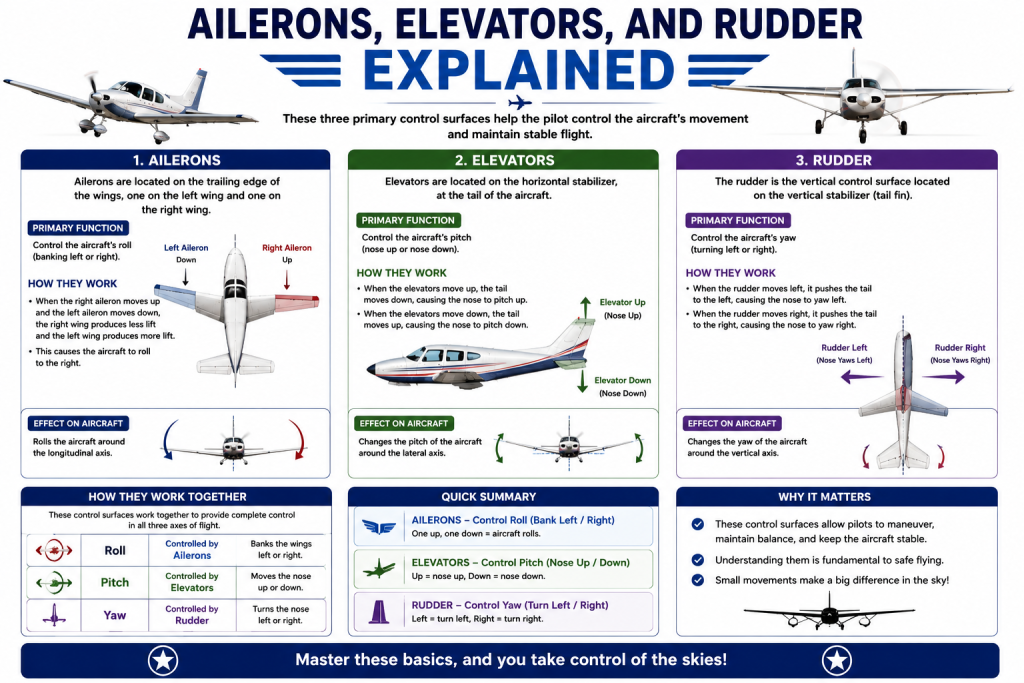
Three of the most important primary flight-control surfaces are ailerons, elevators, and the rudder. Each has a specific function and controls a particular type of aircraft movement.
Ailerons primarily control roll, elevators control pitch, and the rudder controls yaw. These movements occur around the aircraft’s three principal axes: the longitudinal, lateral, and vertical axes.
Understanding how these controls work provides a strong foundation for learning aircraft handling, flight dynamics, and basic aerodynamics.
What Are Aircraft Control Surfaces?
Aircraft control surfaces are movable aerodynamic surfaces that allow pilots to influence the aircraft’s movement and attitude.
When a control surface changes position, it changes the aerodynamic forces acting on part of the aircraft. The resulting forces and moments can cause the aircraft to rotate or change its flight condition.
The primary flight controls are generally:
- Ailerons
- Elevators or an equivalent pitch-control surface
- Rudder
Aircraft also have secondary flight controls, including:
- Flaps
- Slats
- Spoilers
- Trim systems
Primary controls are mainly responsible for controlling the aircraft’s rotational movements, while secondary controls can change lift, drag, aircraft configuration, or reduce the amount of continuous control input required.
Understanding the Three Axes of Aircraft Movement
Before looking at individual control surfaces, it is useful to understand the three axes around which an aircraft rotates.
Longitudinal Axis
The longitudinal axis runs approximately from the nose of the aircraft to its tail.
Rotation around this axis is called roll.
Ailerons primarily control roll.
Lateral Axis
The lateral axis runs approximately from one side of the aircraft to the other through the wings.
Rotation around this axis is called pitch.
Elevators primarily control pitch.
Vertical Axis
The vertical axis runs approximately from the top to the bottom of the aircraft.
Rotation around this axis is called yaw.
The rudder primarily controls yaw.
Quick Comparison
| Control Surface | Main Movement | Axis |
|---|---|---|
| Ailerons | Roll | Longitudinal axis |
| Elevators | Pitch | Lateral axis |
| Rudder | Yaw | Vertical axis |
These three movements can occur independently, but during normal flight they often interact with one another.
Ailerons Explained
What Are Ailerons?
Ailerons are movable control surfaces generally located toward the outer portions of an aircraft’s wings.
Their primary purpose is to control roll, which is the rotation of the aircraft around its longitudinal axis.
Ailerons normally operate in opposite directions. When one moves upward, the other generally moves downward.
This changes the lift produced by the two wings and creates a rolling moment.
How Ailerons Control Roll
The basic process can be understood in a few steps:
- The pilot applies lateral control input.
- The ailerons change position.
- The lift distribution between the two wings changes.
- One wing develops relatively more lift while the other develops relatively less.
- The aircraft begins to roll around its longitudinal axis.
For example, when a pilot commands a roll to one side, the ailerons change the aerodynamic forces on the wings so that one wing rises and the opposite wing lowers.
The aircraft can then establish a bank angle.
What Happens During a Left Roll?
During a left-roll command, the ailerons create a difference in aerodynamic force between the wings.
The resulting moment causes the aircraft to rotate around its longitudinal axis, bringing the left wing down and the right wing up.
Once the desired bank angle is reached, the pilot can reduce or reverse the control input as necessary to stop the rolling motion.
The exact control response depends on the aircraft’s design, speed, configuration, and control system.
Adverse Yaw and Ailerons
Aileron movement can also create an unwanted yawing tendency known as adverse yaw.
When one aileron moves downward, that wing can experience an increase in lift and drag. The additional drag can cause the aircraft to yaw in a direction opposite to the intended turn.
This is why coordinated rudder use can be important in many aircraft.
Aircraft manufacturers use different aerodynamic designs and control systems to reduce adverse yaw, so its characteristics vary between aircraft.
Elevators Explained
What Are Elevators?
Elevators are movable control surfaces associated with the aircraft’s horizontal tail.
On a conventional aircraft, they are generally positioned on the horizontal stabilizer.
Their primary function is to control pitch, which is rotation around the lateral axis.
Pitch changes the aircraft’s nose-up or nose-down attitude.
How Elevators Control Pitch
The basic process is:
- The pilot applies pitch control input.
- The elevator changes position.
- The aerodynamic force at the tail changes.
- This creates a pitching moment.
- The aircraft rotates around its lateral axis.
In a conventional aircraft, upward elevator deflection generally creates a nose-up pitching tendency, while downward elevator deflection generally creates a nose-down pitching tendency.
However, the aircraft’s actual flight response depends on several factors.
These can include:
- Airspeed
- Aircraft weight
- Center of gravity
- Thrust
- Configuration
- Trim
- Atmospheric conditions
Therefore, elevator movement should not simply be understood as a direct command for “climb” or “descend.”
What Happens When the Elevator Moves Up?
When the elevator moves upward on a conventional aircraft, the aerodynamic force acting on the tail changes and generally produces a nose-up pitching moment.
The aircraft’s pitch attitude changes as a result.
Whether the aircraft subsequently climbs, maintains altitude, or changes speed depends on the aircraft’s energy state, thrust, configuration, and other factors.
What Happens When the Elevator Moves Down?
Downward elevator deflection generally creates a nose-down pitching tendency in a conventional aircraft.
Again, the resulting flight path depends on the overall aircraft condition rather than elevator movement alone.
Elevator vs Horizontal Stabilizer
The elevator and horizontal stabilizer have different primary roles.
The horizontal stabilizer contributes to the aircraft’s longitudinal stability, while the elevator provides pitch-control authority.
Some aircraft use different designs. For example, a stabilator is a movable horizontal tail that performs the pitch-control function as a whole rather than using a separate fixed stabilizer and elevator arrangement.
Rudder Explained
What Is a Rudder?
The rudder is a movable control surface located on the aircraft’s vertical tail or vertical stabilizer.
Its primary purpose is to control yaw, which is rotation around the aircraft’s vertical axis.
When the rudder moves, it changes the aerodynamic force acting on the vertical tail and creates a yawing moment.
How the Rudder Controls Yaw
The basic process is:
- The pilot applies rudder-pedal input.
- The rudder deflects.
- Aerodynamic force develops at the vertical tail.
- A yawing moment is created.
- The aircraft’s nose moves toward one side.
The rudder is therefore primarily a directional-control surface.
It does not replace the ailerons as the main means of establishing bank during a normal coordinated turn.
Why Is the Rudder Important?
The rudder can be useful in several situations, including:
- Coordinating turns
- Counteracting adverse yaw
- Maintaining directional control
- Crosswind operations
- Managing asymmetric thrust in some multi-engine aircraft
- Controlling yaw during specific flight conditions
The amount and timing of rudder input depend on aircraft design, speed, configuration, and operating conditions.
Ailerons vs Elevators vs Rudder
| Control Surface | Typical Location | Main Function | Movement | Axis |
|---|---|---|---|---|
| Ailerons | Outer portions of wings | Roll control | Wings move relative to each other | Longitudinal |
| Elevators | Horizontal tail | Pitch control | Nose moves up or down | Lateral |
| Rudder | Vertical tail | Yaw control | Nose moves left or right | Vertical |
The easiest way to remember them is:
Ailerons = Roll
Elevators = Pitch
Rudder = Yaw
This simple relationship is one of the fundamental concepts taught during early pilot training.
How the Three Controls Work Together
Although each control has a primary function, pilots normally use the controls together rather than treating them as completely separate systems.
Consider a basic coordinated turn.
Ailerons Initiate the Roll
The pilot uses aileron input to establish the desired bank angle.
The aircraft begins rotating around its longitudinal axis.
Rudder Helps Coordinate Yaw
As the aircraft rolls, aerodynamic effects can produce yaw.
The rudder can be used as necessary to help maintain coordinated flight.
Elevator Manages Pitch
When an aircraft banks, the pilot may need to adjust pitch to maintain the desired flight condition.
Elevator input helps manage the aircraft’s pitch attitude.
The exact control inputs depend on the aircraft and flight conditions.
What Happens During a Turn?
A turn is a good example of how roll, pitch, and yaw interact.
Step 1: Roll Initiation
Aileron input begins the aircraft’s roll.
Step 2: Bank Establishment
The aircraft reaches the desired bank angle.
Step 3: Yaw Coordination
Rudder may be used to coordinate the aircraft and reduce unwanted yaw.
Step 4: Pitch Management
Elevator input helps maintain the desired flight condition.
Step 5: Roll-Out
Appropriate aileron input is used to reduce the bank and return the aircraft toward the desired attitude.
This demonstrates why pilots need to understand all three primary controls rather than viewing them as independent systems.
Primary vs Secondary Flight Controls
Aircraft have several types of control surfaces and systems.
Primary Flight Controls
The main primary controls are:
- Ailerons
- Elevators or equivalent pitch-control surfaces
- Rudder
They primarily control roll, pitch, and yaw.
Secondary Flight Controls
Examples include:
- Flaps
- Slats
- Spoilers
- Trim systems
These systems have different functions.
For example, flaps can increase lift and drag during certain phases of flight, while spoilers can modify lift and drag. Trim systems help reduce the amount of continuous control force required from the pilot.
How Control Surfaces Affect Aircraft Stability
Aircraft stability and control are closely related, but they are not the same thing.
Stability describes how an aircraft tends to respond after being disturbed from its existing flight condition.
Control describes the pilot’s ability to deliberately change the aircraft’s attitude or flight path.
Aircraft design contributes to stability through components such as:
- Wings
- Horizontal stabilizer
- Vertical stabilizer
- Fuselage
- Center-of-gravity position
Control surfaces give the pilot the ability to influence the aircraft’s movement.
Three important types of stability are:
Longitudinal Stability
This concerns the aircraft’s tendency to maintain or return toward an appropriate pitch condition.
The horizontal stabilizer and elevator are important in this area.
Lateral Stability
This relates to the aircraft’s tendency to respond to rolling disturbances.
Wing design and other aircraft characteristics contribute to lateral stability.
Directional Stability
This concerns the aircraft’s tendency to maintain directional alignment.
The vertical stabilizer plays an important role in directional stability, while the rudder provides directional control.
Ailerons, Elevators, and Rudder During Different Flight Phases
During Takeoff
During takeoff, pilots need to manage all three primary control dimensions.
The controls help with:
- Maintaining directional control
- Establishing the appropriate pitch attitude
- Managing roll
- Responding to crosswind conditions
The exact technique depends on the aircraft and its operating procedures.
During Climb
During climb, pitch control helps establish the desired aircraft attitude and flight condition, while ailerons and rudder help maintain the desired direction and coordination.
During Cruise
At cruise altitude, control inputs are often smaller because the aircraft is generally maintained near a stable flight condition.
Trim systems and, where installed, automated flight-control systems can reduce the amount of continuous manual control required.
During Descent
During descent, pilots continue to manage pitch, roll, and yaw while maintaining the intended flight path.
Aircraft configuration, speed, thrust, and atmospheric conditions all influence the required control inputs.
During Approach
Approach requires precise control because the aircraft must maintain an appropriate flight path and alignment.
Ailerons help manage bank, elevator input helps control pitch, and rudder assists with directional control and coordination.
During Landing
During landing, the primary controls remain essential for managing aircraft attitude and directional alignment.
Crosswind conditions may require particular coordination between aileron and rudder inputs.
The exact landing technique varies by aircraft type and operating procedure.
How Crosswind Affects Rudder and Aileron Use
Crosswind conditions are an important example of why pilots need to understand the difference between roll and yaw.
Wind from the side can cause an aircraft to drift away from the intended ground track.
Aileron and rudder can be used for different purposes during crosswind operations.
The exact technique depends on factors such as:
- Aircraft design
- Wind direction
- Wind speed
- Runway orientation
- Landing technique
- Aircraft operating procedures
The important concept is that maintaining directional alignment and controlling lateral drift are not exactly the same task.
Aircraft Control Surfaces and Aircraft Design
Not every aircraft uses the conventional combination of separate ailerons, elevators, and rudder in exactly the same way.
Aircraft designers use different configurations depending on the aircraft’s purpose and aerodynamic requirements.
Conventional Tail
A conventional aircraft typically has:
- Horizontal stabilizer
- Elevator
- Vertical stabilizer
- Rudder
This is one of the most familiar aircraft configurations.
T-Tail
In a T-tail configuration, the horizontal stabilizer is mounted near the top of the vertical stabilizer.
The control functions remain broadly similar, although the aerodynamic behavior can differ.
V-Tail
A V-tail replaces the conventional horizontal and vertical tail arrangement with two angled surfaces.
Control functions can be combined through specialized control surfaces and control mixing.
Stabilator
A stabilator is a movable horizontal tail that performs the pitch-control function.
Instead of a fixed horizontal stabilizer with a separate elevator, the entire surface can move.
Elevons
Elevons combine the functions of elevators and ailerons.
They are commonly associated with certain tailless aircraft and delta-wing configurations.
They can contribute to both:
- Pitch
- Roll
Ruddervators
Ruddervators combine pitch and yaw functions and are associated with V-tail aircraft.
These examples show that aircraft can achieve the same fundamental control objectives using different aerodynamic arrangements.
How Pilots Control These Surfaces
Pilot controls are connected to aircraft flight-control systems in different ways.
Traditional aircraft may use:
- Cables
- Rods
- Mechanical linkages
- Hydraulic systems
Modern aircraft can also use electronic systems and flight-control computers.
Control Column or Yoke
A control column or yoke is commonly used to provide pitch and roll inputs.
Depending on the aircraft:
- Forward or backward movement controls pitch.
- Left or right movement controls roll.
Control Stick
Some aircraft use a stick rather than a traditional yoke.
The basic pitch and roll functions remain, although the physical control arrangement differs.
Rudder Pedals
Rudder pedals allow the pilot to control the rudder.
Pedal input produces yaw-control movement.
The pedals may also be connected to other systems, such as nose-wheel steering, depending on aircraft design.
Mechanical vs Fly-by-Wire Flight Controls
Conventional Flight Controls
In conventional systems, pilot control inputs may be transmitted through mechanical linkages, cables, rods, hydraulic systems, or combinations of these.
The exact arrangement depends on the aircraft.
Fly-by-Wire
Fly-by-wire systems use electronic signals to interpret pilot inputs and command flight-control actuators.
Flight-control computers can process these inputs according to the aircraft’s control laws.
Depending on the aircraft, fly-by-wire systems may provide features such as:
- Control augmentation
- Flight-envelope protections
- System monitoring
- Automated control-law functions
However, fly-by-wire systems vary considerably between aircraft manufacturers and models.
Common Misunderstandings About Ailerons, Elevators, and Rudder
“Ailerons Make the Aircraft Turn”
Ailerons primarily control roll.
They establish the bank angle that allows an aircraft to turn.
A coordinated turn involves the combined effects of roll, yaw, and pitch.
“The Rudder Turns the Aircraft”
The rudder primarily controls yaw.
Although rudder input changes the aircraft’s direction relative to its longitudinal axis, it is not normally the primary method of establishing bank for a coordinated turn.
“Pulling Back Always Makes the Aircraft Climb”
Elevator input primarily changes pitch attitude.
A climb or descent depends on several factors, including:
- Airspeed
- Thrust
- Aircraft weight
- Configuration
- Energy state
- Flight condition
Therefore, pitch should not simply be equated with climb.
“The Rudder Is Only Used During Takeoff and Landing”
The rudder can be used throughout the flight whenever directional control or yaw coordination is required.
“All Aircraft Have Exactly the Same Controls”
Aircraft designs differ.
Some use conventional ailerons, elevators, and rudders, while others use combined control surfaces such as elevons or ruddervators.
Common Beginner Mistakes
Confusing Roll With Yaw
Roll means the aircraft rotates around its longitudinal axis, while yaw means it rotates around its vertical axis.
Confusing Pitch With Climb
Pitch describes aircraft attitude. Climb describes an increase in altitude.
An aircraft can change pitch without immediately climbing, depending on its energy state and power setting.
Thinking the Rudder Is the Main Turning Control
The rudder primarily controls yaw. Ailerons are normally used to establish the bank required for a coordinated turn.
Applying Excessive Rudder
Large or unnecessary rudder inputs can create unwanted yaw and sideslip.
Ignoring Adverse Yaw
Aileron inputs can produce yawing effects, which is why coordination between aileron and rudder can be important.
Learning Control Movements Without Understanding the Axes
Memorizing “aileron equals roll” is useful, but understanding the three axes makes the concept much easier to apply to real aircraft.
Why Understanding These Controls Is Important for Student Pilots
Understanding primary flight controls is one of the foundations of pilot training.
Students need to understand not only what happens when a control is moved, but also why the aircraft responds that way.
This knowledge helps with:
- Basic aircraft handling
- Flight dynamics
- Coordinated turns
- Aircraft stability
- Takeoff concepts
- Landing concepts
- Crosswind operations
- Emergency procedures
- Aviation theory
A strong understanding of roll, pitch, and yaw also makes it easier to understand more advanced subjects such as aircraft stability, flight-control systems, and autopilot operation.
Comparison of Roll, Pitch, and Yaw
| Movement | Primary Control | Axis | Basic Aircraft Response |
|---|---|---|---|
| Roll | Ailerons | Longitudinal | Wings rotate relative to each other |
| Pitch | Elevators | Lateral | Nose moves up or down |
| Yaw | Rudder | Vertical | Nose moves left or right |
These three rotational movements can occur simultaneously.
For example, during a normal turn, an aircraft may roll into a bank while experiencing yaw and pitch changes. Pilots coordinate the controls to achieve the desired flight condition.
Frequently Asked Questions
1. What are the three primary flight controls?
The three primary flight controls are generally ailerons, elevators, and rudder. They primarily control roll, pitch, and yaw respectively.
2. What do ailerons control?
Ailerons primarily control roll, which is the rotation of an aircraft around its longitudinal axis.
3. What do elevators control?
Elevators primarily control pitch, which is the rotation of an aircraft around its lateral axis.
4. What does the rudder control?
The rudder primarily controls yaw, which is rotation around the aircraft’s vertical axis.
5. Are ailerons used to turn an aircraft?
Ailerons are primarily used to establish and control bank. A coordinated turn involves the combined effects of roll, yaw, and pitch rather than one control surface alone.
6. Can an aircraft fly without a rudder?
Aircraft designs vary. Some aircraft use alternative control arrangements that combine control functions, but directional control remains an essential requirement. The exact consequences of rudder loss also depend on the aircraft’s design and available control systems.
7. What is adverse yaw?
Adverse yaw is a yawing tendency that can occur when ailerons are used. It can cause the aircraft’s nose to initially move opposite to the intended direction of a roll.
8. What is the difference between pitch and altitude?
Pitch describes the aircraft’s attitude or rotation around its lateral axis. Altitude describes the aircraft’s vertical position relative to a reference.
An aircraft can change pitch without immediately changing altitude in the same way.
9. Do all aircraft use conventional ailerons, elevators, and rudders?
No. Some aircraft use alternative arrangements such as elevons, ruddervators, stabilators, or other specialized control systems.
10. Why do pilots need to understand all three controls?
Pilots need to understand how roll, pitch, and yaw interact because aircraft rarely operate using only one type of movement. Understanding these controls is fundamental to safe and effective aircraft handling.
Conclusion
Ailerons, elevators, and rudder form the foundation of primary aircraft control. Although each has a specific function, they work together to allow pilots to control the aircraft’s attitude, direction, and flight path.
Ailerons primarily control roll, elevators primarily control pitch, and the rudder primarily controls yaw. These movements occur around the longitudinal, lateral, and vertical axes respectively.
Understanding these relationships is essential for anyone beginning to study aviation. It helps explain how aircraft turn, climb, descend, maintain direction, and respond to pilot inputs.
At the same time, aircraft are not all designed identically. Some use conventional control surfaces, while others use systems such as stabilators, elevons, or ruddervators. For that reason, pilots must always learn the specific flight-control system of the aircraft they operate.

