
Introduction
Aircraft wings are carefully engineered structures designed to generate lift while carrying significant aerodynamic and structural loads.
Their internal construction combines multiple components that provide strength, stability, and the required aerodynamic shape.
Understanding wing structure helps aviation students learn how aircraft safely withstand forces during flight.
This article explains the main parts, construction methods, materials, and working principles of aircraft wing structures clearly.
What Is an Aircraft Wing Structure?
An aircraft wing structure is the internal and external framework that gives a wing its shape, strength, and ability to withstand forces during flight. Although a wing may appear smooth and simple from the outside, its interior contains several interconnected structural components.
The wing must support aerodynamic loads, the weight of fuel, engines in some aircraft, landing gear attachments, and other equipment. At the same time, engineers must keep the structure as lightweight as possible because excessive weight reduces aircraft efficiency and performance.
A well-designed wing structure therefore balances strength, weight, durability, safety, and aerodynamic performance.
Why Is Wing Structure Important?
The wings of an aircraft perform much more than the basic function of producing lift. They are among the most heavily loaded structures of an aircraft.
During flight, wings experience several forces, including:
- Lift generated by airflow
- Aircraft weight and structural loads
- Drag forces
- Fuel weight
- Engine loads on wing-mounted engines
- Turbulence and gust loads
- Bending and twisting forces
The wing structure must safely transfer and distribute these forces throughout the aircraft.
Without proper structural design, a wing could deform excessively, develop fatigue damage, or fail under extreme operating conditions. For this reason, aircraft wing structures are designed with strict engineering and safety requirements.
Main Components of an Aircraft Wing Structure
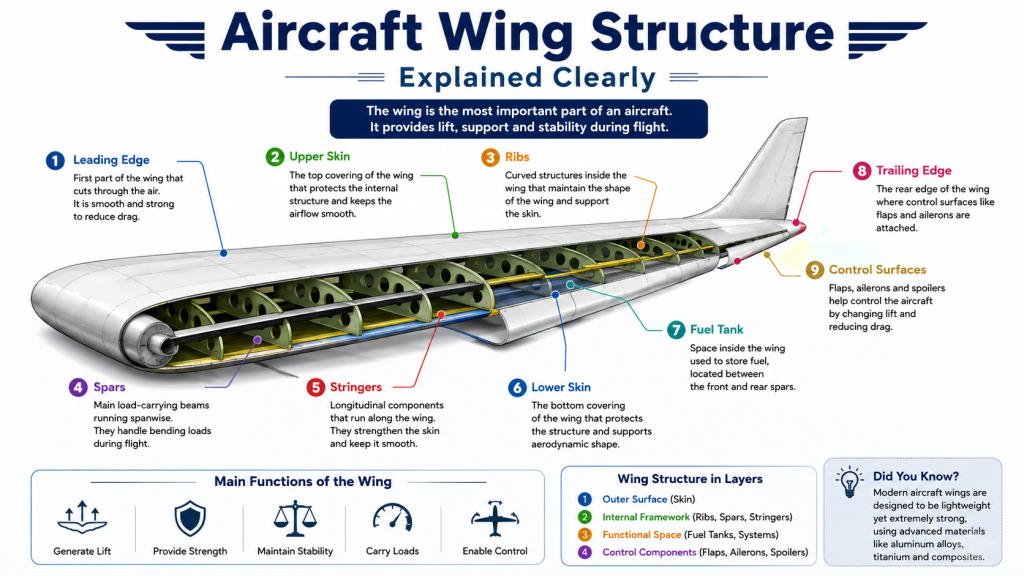
Aircraft wings contain several important structural members. Each component performs a specific function, but all parts work together to create a strong and efficient structure.
| Wing Component | Main Function |
|---|---|
| Spar | Carries major bending loads across the wing |
| Rib | Maintains the aerodynamic shape of the wing |
| Stringer | Provides additional longitudinal strength |
| Wing Skin | Forms the outer aerodynamic surface |
| Wing Box | Creates a strong structural section within the wing |
| Stiffener | Prevents structural panels from bending or buckling |
| Leading Edge | Forms the front section of the wing |
| Trailing Edge | Supports rear aerodynamic surfaces and control components |
Spars and Their Function
Spars are among the most important structural components inside an aircraft wing. They run lengthwise from the wing root toward the wingtip.
A wing normally contains a main spar and may also include front, rear, or additional spars depending on the aircraft design.
The primary purpose of a spar is to carry bending loads. When an aircraft generates lift, the wing tends to bend upward. At the same time, the weight of the aircraft, fuel, and other components creates opposing forces.
The spar helps resist these forces and provides the main structural strength of the wing.
Modern aircraft spars may be manufactured using high-strength aluminum alloys, titanium, composite materials, or combinations of different materials.
Ribs and Their Role
Ribs are structural members positioned across the wing, generally perpendicular to the spars.
Their main purpose is to maintain the correct aerodynamic shape of the wing. Without ribs, the wing skin could deform and lose its intended airfoil shape.
Ribs also help distribute aerodynamic loads between the wing skin and spars.
Different types of ribs may be used depending on their location and purpose. Some ribs are designed mainly for shape retention, while others provide additional strength around highly loaded areas.
Ribs may also contain openings that allow the installation of control systems, wiring, hydraulic lines, or other aircraft components.
Stringers and Stiffeners
Stringers are long structural members that run along the length of the wing. They provide additional support to the wing skin and help prevent structural deformation.
Stiffeners perform a similar function by increasing the strength of structural panels without significantly increasing weight.
Aircraft structures often use thin materials to reduce overall weight. However, thin panels can buckle when subjected to compression forces. Stringers and stiffeners help prevent this problem.
By using multiple lightweight structural members, engineers can create a wing that is both strong and efficient.
Wing Skin and Its Importance
The wing skin is the outer covering of the wing. It creates the smooth aerodynamic surface required for efficient airflow.
However, wing skin is not simply an external covering. In many aircraft designs, the skin is also a structural component.
This type of design is often called stressed-skin construction. The skin helps carry aerodynamic loads and distributes forces across the internal framework.
Wing skin must be strong enough to withstand pressure differences, aerodynamic forces, vibration, and environmental conditions.
Modern aircraft may use aluminum alloys or advanced composite materials for wing skin construction.
Understanding the Wing Box
The wing box is one of the strongest structural sections of an aircraft wing.
It is generally formed by the front spar, rear spar, upper wing skin, and lower wing skin. Together, these components create a closed structural box.
The wing box is particularly important because it resists bending and twisting forces.
In many aircraft, the wing box also serves as a fuel storage area. This allows engineers to use the internal space efficiently while keeping fuel close to the aircraft’s center of lift.
The structural design of the wing box must be extremely reliable because it carries a significant portion of the loads experienced during flight.
Types of Aircraft Wing Structures
Aircraft wing construction has evolved significantly over time. Early aircraft used relatively simple structures, while modern aircraft use advanced materials and highly optimized designs.
| Type of Wing Structure | Characteristics and Typical Use |
|---|---|
| Truss Structure | Uses interconnected members to create a strong framework |
| Monocoque Structure | Relies heavily on the external skin for structural strength |
| Semi-Monocoque Structure | Combines skin with internal structural members |
| Multi-Spar Structure | Uses several spars to distribute structural loads |
| Box Structure | Uses spars and stressed skin to create a strong closed section |
| Composite Wing Structure | Uses advanced composite materials for high strength and low weight |
Semi-monocoque and wing box designs are widely used because they provide an effective balance between structural strength and weight.
Materials Used in Modern Aircraft Wings
Material selection plays a major role in aircraft wing design.
Traditional aircraft structures have widely used aluminum alloys because they provide good strength while remaining relatively lightweight. Aluminum is also easier to manufacture and repair compared with some advanced materials.
Titanium may be used in areas exposed to high stress or temperature.
Modern aircraft increasingly use composite materials such as carbon-fiber-reinforced polymers. These materials offer high strength-to-weight ratios and excellent resistance to corrosion.
However, composite structures also require specialized manufacturing and inspection techniques.
The choice of material depends on factors such as aircraft type, operating environment, manufacturing cost, structural requirements, and maintenance needs.
How Aircraft Wings Handle Aerodynamic Loads
Aircraft wings experience continuous changes in loading conditions.
During normal flight, lift acts upward on the wing. This creates a bending force that tends to flex the wing upward.
During maneuvers, turbulence, or high-speed operations, the loads can become significantly greater.
The structural components work together to handle these forces:
Spars Handle Major Bending Loads
Spars act as the primary load-carrying members and resist much of the wing’s bending force.
Wing Skin Helps Distribute Loads
The stressed skin transfers aerodynamic forces across the wing structure.
Ribs Maintain Shape
Ribs prevent the wing from losing its intended airfoil profile under aerodynamic pressure.
Wing Box Resists Torsion
The closed wing box provides excellent resistance against twisting forces.
This integrated design allows the wing to flex slightly while remaining structurally safe.
Wing Flexibility and Structural Strength
Many people assume that aircraft wings should remain completely rigid during flight. In reality, controlled flexibility is an important part of modern wing design.
Large aircraft wings can visibly bend upward during flight because of the enormous lift forces they experience.
This flexibility does not necessarily indicate weakness. Instead, it can be an expected characteristic of the structural design.
Engineers carefully calculate the amount of flexibility a wing can safely tolerate.
A structure that is too rigid may become unnecessarily heavy. A structure that is too flexible may experience excessive deformation or aerodynamic problems.
The challenge is to achieve the correct balance between flexibility and structural strength.
Fatigue and Wing Structural Safety
Aircraft wings are subjected to repeated loading throughout their operational life.
Every flight can involve cycles of:
- Takeoff loads
- Climb loads
- Cruise conditions
- Turbulence
- Maneuvers
- Landing forces
Repeated loading can eventually lead to material fatigue.
For this reason, aircraft structures undergo detailed fatigue analysis and regular inspection.
Engineers design aircraft components with safety margins and establish maintenance procedures to identify cracks or structural damage before they become dangerous.
Non-destructive inspection methods may be used to examine internal areas without damaging the aircraft structure.
Common Mistakes or Misunderstandings About Aircraft Wing Structures
Thinking the Wing Is Just a Flat Surface
A wing is a complex structural system containing multiple load-bearing components. The smooth external surface represents only one part of the complete structure.
Assuming Bigger Wings Are Always Stronger
Wing size alone does not determine structural strength. Material properties, internal design, load distribution, and engineering calculations are equally important.
Believing Wings Must Never Flex
Aircraft wings are designed to flex within carefully calculated limits. Controlled flexibility can improve structural efficiency.
Confusing Ribs and Spars
Spars generally run along the wing span and carry major loads, while ribs run across the wing and maintain the aerodynamic shape.
Ignoring the Role of Wing Skin
Modern wing skin often contributes directly to structural strength and is not simply an external covering.
Important Considerations in Aircraft Wing Design
Aircraft wing design requires engineers to consider numerous factors simultaneously.
Strength
The wing must safely withstand expected aerodynamic and structural loads.
Weight
Excessive structural weight reduces aircraft efficiency, payload capacity, and performance.
Aerodynamics
The structure must maintain the required airfoil shape for efficient airflow.
Fatigue Resistance
Materials and structural components must withstand repeated loading throughout the aircraft’s service life.
Torsional Strength
The wing must resist twisting caused by aerodynamic forces and control surface movements.
Fuel Storage
Many aircraft store fuel inside the wings, requiring careful structural and sealing design.
Manufacturing Requirements
The wing must be practical to manufacture while meeting strict quality standards.
Inspection and Maintenance
Aircraft structures should allow effective inspection and maintenance throughout their operational life.
Modern Developments in Aircraft Wing Construction
Aircraft wing technology continues to develop as aerospace engineering advances.
Modern engineers are focusing on lighter composite structures, improved aerodynamic shapes, and advanced manufacturing methods.
Computer-based structural analysis allows engineers to simulate loads and predict structural behavior before manufacturing begins.
Advanced sensors can also help monitor structural conditions during aircraft operation.
Another area of development is aerodynamic efficiency. Engineers are exploring flexible structures, advanced wing shapes, and improved materials to reduce fuel consumption while maintaining safety.
Future aircraft wings may become lighter, more adaptable, and increasingly integrated with advanced monitoring technologies.
Why Aviation Students Should Understand Wing Structures
Understanding wing structure provides an important foundation for students studying aviation, aerospace engineering, aircraft maintenance, or pilot training.
Pilots benefit from understanding how aircraft structures respond to turbulence, maneuvering, and different loading conditions.
Maintenance professionals need detailed knowledge of structural components to inspect and identify potential damage.
Engineering students can use wing structures as an excellent example of how materials, aerodynamics, mechanics, and safety requirements work together.
Even beginners can better understand aircraft design by learning the basic functions of spars, ribs, skins, and wing boxes.
FAQs
1. What is the main structural component of an aircraft wing?
The spar is generally considered the primary load-bearing structural component because it carries major bending forces along the wing.
2. What are ribs used for in an aircraft wing?
Ribs maintain the wing’s aerodynamic shape and help distribute loads between the wing skin and other structural components.
3. What is a wing box?
A wing box is a strong closed structural section typically formed by spars and upper and lower wing skins. It helps resist bending and twisting forces.
4. Why do aircraft wings flex during flight?
Wings flex because of aerodynamic lift forces. Modern aircraft are designed to allow controlled flexibility within safe structural limits.
5. What materials are commonly used in aircraft wings?
Common materials include aluminum alloys, titanium, and advanced composite materials such as carbon-fiber-reinforced polymers.
6. Is the wing skin a structural component?
Yes. In many modern aircraft, the wing skin carries loads and contributes directly to the overall structural strength.
7. How do aircraft wings resist twisting forces?
The wing box and other structural components provide torsional strength and help prevent excessive twisting during flight.
8. Why is weight important in wing construction?
Reducing unnecessary weight improves aircraft efficiency, performance, fuel economy, and payload capability.
9. How are aircraft wings inspected for structural damage?
Aircraft wings are inspected through visual checks and specialized non-destructive inspection techniques that can identify cracks, corrosion, or hidden structural defects.
10. What is the difference between a spar and a rib?
A spar generally runs along the length of the wing and carries major bending loads, while a rib runs across the wing and helps maintain its aerodynamic shape.
Conclusion
Aircraft wing structure is a carefully engineered system designed to provide strength, maintain aerodynamic shape, and safely withstand the many forces experienced during flight. Components such as spars, ribs, stringers, wing skin, and wing boxes work together to create a structure that is both lightweight and durable. As aviation technology continues to advance, modern materials and engineering methods are making aircraft wings increasingly efficient, reliable, and capable of meeting demanding operational requirements.

