
Introduction
Aircraft stability is the ability of an aircraft to respond predictably when it is disturbed from its normal flight condition.
It helps the aircraft maintain a controlled attitude and return toward its intended flight path after certain disturbances.
For new aviation learners, understanding stability makes it easier to understand how an aircraft behaves in the air.
This guide explains the basic types, axes, controls, and factors that influence aircraft stability in simple terms.
What Is Aircraft Stability?
Aircraft stability refers to how an aircraft reacts when something causes it to move away from its existing flight condition. A disturbance could come from turbulence, a change in airflow, or a pilot control input.
Imagine an aircraft flying straight and level when a gust of wind slightly raises one wing. A stable aircraft has characteristics that help it respond in a predictable manner rather than continuing to move farther away from its original condition.
Stability does not mean that an aircraft never moves. Aircraft are constantly affected by changing air conditions. Instead, stability describes how the aircraft behaves after a disturbance and whether its motion tends to reduce, remain, or increase.
For beginners, one useful way to think about stability is that it helps determine how naturally an aircraft manages changes during flight.
Why Is Stability Important in Aviation?
An aircraft needs to be controllable and predictable. Without suitable stability characteristics, maintaining a desired flight condition could become much more difficult.
Stability is particularly important because pilots need to manage changes in speed, altitude, direction, and attitude while responding to the surrounding environment. Aircraft designers therefore consider stability when developing the shape, weight distribution, control surfaces, and other features of an aircraft.
The amount of stability required also depends on the aircraft’s purpose. A training aircraft may be designed with characteristics that make it easier to handle, while an aircraft intended for highly responsive maneuvering may use a different balance between stability and maneuverability.
The Three Axes of Aircraft Motion
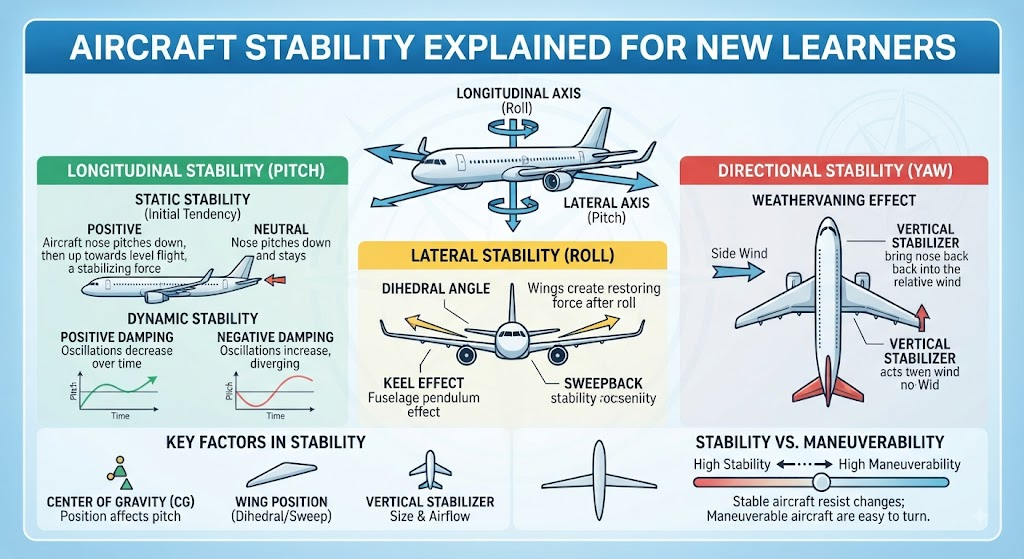
An aircraft can rotate around three imaginary axes that pass through its center of gravity. These axes help explain the basic movements of an aircraft.
| Aircraft Axis | Main Movement | Primary Control Surface |
|---|---|---|
| Longitudinal axis | Roll | Ailerons |
| Lateral axis | Pitch | Elevator |
| Vertical axis | Yaw | Rudder |
Longitudinal Axis
The longitudinal axis runs approximately from the nose to the tail of the aircraft. Movement around this axis is called roll.
During a roll, one wing moves upward while the other moves downward. Ailerons are the primary control surfaces used to control roll.
Lateral Axis
The lateral axis extends from one side of the aircraft to the other. Movement around this axis is called pitch.
Pitch changes the aircraft’s nose-up or nose-down attitude. The elevator, normally located on the horizontal tail, is the main control surface associated with pitch.
Vertical Axis
The vertical axis runs roughly from the top to the bottom of the aircraft. Movement around this axis is called yaw.
Yaw changes the direction in which the aircraft’s nose points from side to side. The rudder, located on the vertical stabilizer, is the primary control surface used for yaw.
Understanding these three axes provides a foundation for learning how aircraft stability works.
Types of Aircraft Stability
Aircraft stability is commonly discussed in terms of static stability and dynamic stability.
| Type of Stability | Simple Explanation | What to Observe |
| Static Stability | Describes the aircraft’s initial tendency after a disturbance | Whether the aircraft initially moves back toward its original condition |
| Dynamic Stability | Describes how the aircraft’s motion develops over time | Whether the resulting oscillations or movements decrease, remain, or increase |
Static Stability
Static stability concerns the aircraft’s initial response after it has been disturbed.
Suppose an aircraft is flying at a particular pitch attitude and a disturbance causes the nose to move upward. If the aircraft initially develops a tendency to move back toward its previous attitude, it has positive static stability in that situation.
Static stability is therefore about the first tendency of the aircraft rather than the complete motion that follows.
Dynamic Stability
Dynamic stability looks at what happens over time after the initial disturbance.
An aircraft might initially move back toward its original condition but continue to oscillate. If those oscillations gradually become smaller, the motion is dynamically stable. If they remain about the same size, the aircraft has neutral dynamic stability for that motion. If they become larger, the motion is dynamically unstable.
This distinction is important because an aircraft can have an initially restoring response without necessarily settling down quickly.
Longitudinal Stability
Longitudinal stability is concerned with an aircraft’s behavior around its lateral axis, particularly its tendency to maintain or restore its pitch condition.
The aircraft’s center of gravity plays an important role in longitudinal stability. Its position affects how the aircraft responds to changes in pitch.
The horizontal stabilizer and elevator are also important. The horizontal stabilizer contributes to the aircraft’s overall pitch stability, while the elevator allows the pilot to change pitch.
For a beginner, the key idea is simple: longitudinal stability helps control how the aircraft responds to nose-up and nose-down disturbances.
Lateral Stability
Lateral stability concerns the aircraft’s tendency to respond to disturbances that cause rolling around the longitudinal axis.
For example, imagine a gust causes one wing to rise. Aircraft design features can influence whether the aircraft develops a tendency to reduce that unwanted bank.
One important design feature is dihedral. With dihedral, the wings are angled slightly upward from the aircraft’s center section toward the wingtips. This arrangement can contribute to a restoring tendency when the aircraft experiences certain rolling disturbances.
Ailerons provide pilot control over roll, but lateral stability is primarily related to the aircraft’s natural response to disturbances.
Directional Stability
Directional stability concerns movement around the vertical axis, or yaw.
The vertical stabilizer, also called the vertical tail, is an important contributor to directional stability. It helps the aircraft maintain a more consistent directional orientation when airflow or other disturbances cause the aircraft’s nose to move sideways.
The rudder allows the pilot to control yaw. While the rudder can deliberately create a yawing movement, the vertical stabilizer helps provide a restoring tendency when the aircraft is displaced from its desired direction.
A simple example is to think of the vertical tail as helping the aircraft behave somewhat like an arrow that naturally tends to align with the airflow.
Factors That Affect Aircraft Stability
Several aircraft characteristics influence stability. These factors work together rather than acting independently.
Center of Gravity
The center of gravity is one of the most important considerations in aircraft stability. Its location affects the aircraft’s response to pitch disturbances and the amount of control authority required.
If the center of gravity is positioned differently, the aircraft can behave differently even when all other design features remain unchanged.
Aircraft Design
The overall shape and configuration of an aircraft have a major effect on its stability. Designers consider the wings, fuselage, tail surfaces, weight distribution, and other characteristics when determining how an aircraft should respond to disturbances.
Wing Configuration
Wing position, shape, and features such as dihedral can influence lateral stability and the aircraft’s response to airflow.
Tail Surfaces
Horizontal and vertical tail surfaces play important roles in pitch and directional stability. Their size, position, and aerodynamic characteristics influence how the aircraft responds during flight.
Speed and Flight Conditions
Stability characteristics can vary with flight conditions. Changes in airspeed, altitude, configuration, and airflow can affect the aircraft’s aerodynamic behavior.
This is why stability should not be viewed as a single fixed characteristic that behaves exactly the same way under every flight condition.
Stability vs. Maneuverability
Stability and maneuverability are related, but they are not the same thing.
Stability describes how an aircraft naturally responds to disturbances and whether its motion tends to return toward a previous condition.
Maneuverability describes how effectively and quickly an aircraft can be controlled to perform changes in attitude, direction, or flight path.
An aircraft designed with strong stability characteristics may naturally resist certain changes. That can make it predictable and easier to manage, but it may also require more control input for certain maneuvers.
On the other hand, an aircraft designed to be highly responsive may react more readily to pilot inputs and disturbances. Such characteristics can be useful for particular types of flying but may require greater pilot attention.
Aircraft design is therefore often a matter of achieving appropriate characteristics for the aircraft’s intended purpose.
A Simple Example of Aircraft Stability
Consider an aircraft flying straight and level when a gust of wind briefly disturbs its attitude.
The aircraft may move slightly away from its original condition. Depending on its stability characteristics, aerodynamic forces and moments can then create a tendency that changes the aircraft’s motion.
If the aircraft has positive stability for that particular disturbance, its response tends to move it back toward the previous condition. The aircraft may overshoot and oscillate before settling, depending on its dynamic response.
This simple example shows why stability is more than simply asking whether an aircraft returns to its original position. We also need to consider how it gets there and what happens during the process.
How Control Surfaces Relate to Stability
Control surfaces and stability should be understood as connected but separate ideas.
An aircraft’s design provides certain natural stability characteristics. The pilot then uses controls to intentionally change the aircraft’s flight condition.
For example, the elevator is used to control pitch, ailerons control roll, and the rudder controls yaw. These controls allow the pilot to make deliberate changes rather than relying only on the aircraft’s natural response.
In practical flying, the pilot continuously balances aircraft stability, control inputs, speed, and changing flight conditions.
Why Beginners Should Learn Aircraft Stability
Aircraft stability is one of the fundamental concepts in aviation because it connects aerodynamics, aircraft design, and flight control.
Once a learner understands the three axes and the basic difference between static and dynamic stability, many other aviation concepts become easier to understand. Topics such as control surfaces, center of gravity, aircraft handling, and aerodynamic forces can then be viewed as parts of the same system.
The subject may seem technical at first, but it becomes much easier when each type of movement and stability is considered separately.
FAQs
1. What does aircraft stability mean?
Aircraft stability describes how an aircraft responds when it is disturbed from its existing flight condition. It helps explain whether the aircraft tends to move back toward its previous condition or continue moving away from it.
2. What are the three axes of an aircraft?
The three axes are the longitudinal, lateral, and vertical axes. Aircraft movement around them is called roll, pitch, and yaw respectively.
3. What is the difference between static and dynamic stability?
Static stability describes the aircraft’s initial tendency after a disturbance. Dynamic stability considers how the aircraft’s motion develops over time after that initial response.
4. Why is the center of gravity important for stability?
The center of gravity affects how forces and moments act on an aircraft. Its position can significantly influence the aircraft’s pitch response and overall handling characteristics.
5. What does the vertical stabilizer do?
The vertical stabilizer contributes to directional stability. It helps the aircraft maintain or regain directional alignment after certain yaw disturbances.
6. Does greater stability always mean a better aircraft?
Not necessarily. Different aircraft have different purposes. The desired balance between stability and maneuverability depends on the aircraft’s design and intended operation.
7. Can an aircraft be stable but still move after a disturbance?
Yes. Stability does not mean that an aircraft remains completely motionless. A stable aircraft can move or oscillate after a disturbance while still having a tendency for those motions to reduce over time.
Conclusion
Aircraft stability is a fundamental part of understanding how an aircraft behaves in flight. By learning about the three axes, static and dynamic stability, and the roles of the center of gravity, wings, and tail surfaces, beginners can build a strong foundation in basic aerodynamics.
The most important point is that stability describes an aircraft’s response to changes, not simply whether it stays perfectly still. Once this concept becomes familiar, more advanced topics in aircraft control, design, and flight dynamics become easier to understand.

