
Introduction
Learning aviation involves more than understanding how an aircraft flies. Students must also become familiar with the words pilots, instructors, engineers, dispatchers, and air traffic controllers use every day.
Terms such as pitch, trim, heading, track, airspeed, flaps, squawk, and go-around may sound technical at first. However, each term describes a specific aircraft control, movement, instrument reading, procedure, or communication instruction.
Using the correct terminology is important because aviation depends on clear and consistent communication. The FAA maintains a Pilot/Controller Glossary specifically to promote a common understanding of terminology used in air traffic control communication.
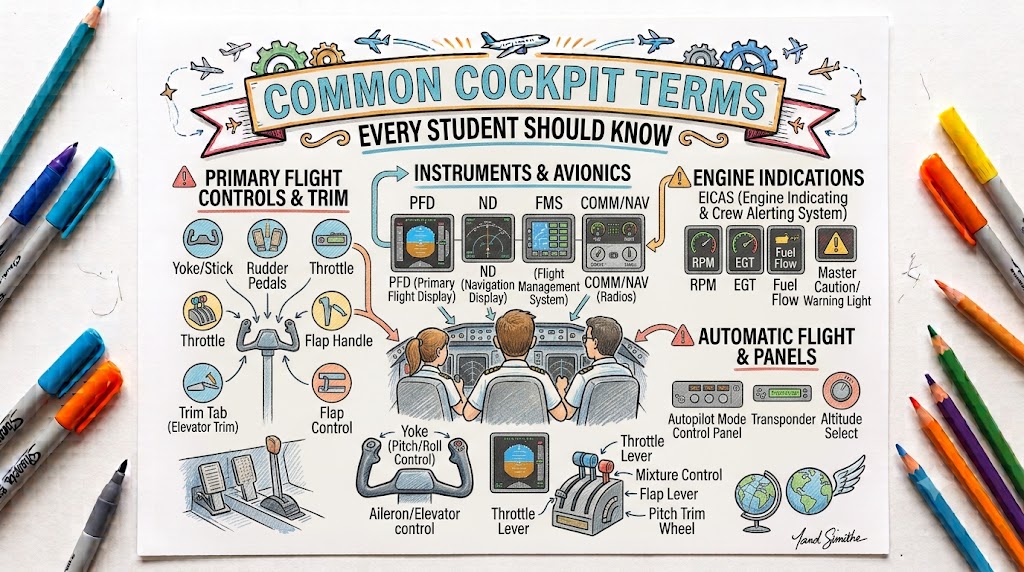
This Aircrafto guide explains common cockpit terms in simple language and groups them by subject so that new learners can study them more easily.
Cockpit and Flight Deck
Cockpit
The cockpit is the area from which pilots operate the aircraft.
It normally contains:
- Flight controls
- Instruments and electronic displays
- Navigation equipment
- Communication radios
- Engine controls
- Warning systems
- Switches and circuit breakers
The term is commonly used for both small and large aircraft.
Flight Deck
Flight deck is another term for the aircraft’s pilot-operating area.
It is used frequently in commercial aviation, especially when referring to airline aircraft. In everyday aviation conversation, cockpit and flight deck often refer to the same general area.
Pilot in Command
The Pilot in Command, or PIC, is the pilot responsible for the aircraft’s operation and safety during the flight.
The PIC has final authority over the operation of the aircraft, subject to the applicable regulations and operating procedures.
Second in Command
The Second in Command, or SIC, is the pilot designated to support the Pilot in Command when the aircraft or operation requires two pilots.
In airline operations, this pilot is commonly called the first officer.
Captain
The captain is normally the Pilot in Command of a multi-crew commercial aircraft.
The captain carries overall operational responsibility for the flight.
First Officer
The first officer is the second pilot in a multi-crew cockpit.
The first officer may operate the aircraft during assigned flight sectors while the captain retains overall command responsibility.
Pilot Flying
The Pilot Flying, or PF, is the pilot currently controlling the aircraft and managing its flight path.
Pilot Monitoring
The Pilot Monitoring, or PM, supports the Pilot Flying by handling duties such as:
- Radio communication
- Checklist reading
- System monitoring
- Navigation verification
- Callouts
- Flight-path cross-checking
These roles may change between different sectors of a flight.
Basic Flight-Control Terms
Yoke
A yoke is a control wheel used to move the aircraft in pitch and roll.
The pilot generally:
- Pulls back to raise the nose
- Pushes forward to lower the nose
- Turns the yoke left or right to bank
Control Stick
A control stick performs functions similar to a yoke but has a different physical shape.
It is common in:
- Training aircraft
- Military aircraft
- Aerobatic aircraft
- Gliders
- Some commercial aircraft
Side-Stick
A side-stick is a control stick positioned to the side of the pilot rather than directly in front.
Some modern aircraft use electronic flight-control systems that interpret side-stick movement and send commands to the aircraft’s control surfaces.
Rudder Pedals
Rudder pedals control the rudder and therefore influence yaw.
In many aircraft, the pedals also operate:
- Nosewheel steering
- Tailwheel steering
- Individual wheel brakes
Throttle
The throttle controls the amount of engine power or thrust requested by the pilot.
Moving it forward usually increases power. Moving it backward usually reduces power.
The exact control logic differs among piston, turboprop, and jet aircraft.
Thrust Lever
In jet aircraft, the engine-power controls are commonly called thrust levers rather than throttles.
They may contain positions or detents for:
- Idle
- Climb thrust
- Takeoff thrust
- Maximum continuous thrust
- Reverse thrust
Mixture Control
The mixture control adjusts the ratio of fuel to air entering a piston engine.
Pilots may adjust mixture according to:
- Altitude
- Engine temperature
- Fuel efficiency
- Aircraft procedure
Mixture-setting techniques must be learned from the approved aircraft manual and instructor.
Propeller Control
The propeller control adjusts the selected propeller RPM on aircraft equipped with a constant-speed propeller.
It is often used together with the throttle or manifold-pressure control.
Carburetor Heat
Carburetor heat directs heated air into the engine’s induction system to help prevent or remove carburetor ice.
The control is found on certain carbureted piston-engine aircraft.
Trim
Trim reduces the continuous control pressure needed to maintain a selected aircraft attitude or condition.
Instead of holding constant backward or forward pressure, the pilot adjusts trim until the aircraft can maintain the desired condition with lighter control force.
Trim does not replace correct attitude and power control.
Trim Tab
A trim tab is a small adjustable surface attached to a larger flight-control surface.
Its movement helps reduce the force required to hold that control surface in position.
Flight Controls
Flight controls allow the pilot to change the aircraft’s direction and attitude.
The primary flight controls are normally:
- Ailerons
- Elevator or stabilator
- Rudder
Secondary controls can include:
- Flaps
- Slats
- Spoilers
- Trim systems
FAA training material identifies pitch, roll, and yaw control as fundamental parts of an aircraft’s directional and attitude-control system.
Aircraft Movement Terms
Pitch
Pitch is the aircraft’s nose-up or nose-down movement around its lateral axis.
Pitch is primarily controlled using the elevator or stabilator.
Roll
Roll is the aircraft’s rotation around its longitudinal axis, which runs from nose to tail.
Roll is primarily controlled using the ailerons.
Yaw
Yaw is the left or right movement of the aircraft’s nose around its vertical axis.
Yaw is primarily controlled using the rudder.
Bank
Bank describes the aircraft’s tilted position during a turn.
A left bank means the left wing is lower than the right. A right bank means the right wing is lower.
Attitude
Aircraft attitude describes the aircraft’s orientation relative to the horizon.
It combines:
- Pitch attitude
- Bank attitude
Attitude should not be confused with altitude.
Altitude
Altitude describes vertical distance measured from a specified reference level.
It may be expressed in relation to:
- Mean sea level
- Ground level
- Standard atmospheric pressure
- A pressure setting selected by the pilot
Climb
A climb occurs when the aircraft gains altitude.
A climb requires a suitable combination of:
- Attitude
- Power
- Airspeed
- Aircraft configuration
Descent
A descent occurs when the aircraft loses altitude.
The pilot controls descent using an appropriate combination of power, pitch, speed, and configuration.
Straight-and-Level Flight
Straight-and-level flight means maintaining:
- A constant heading
- A constant altitude
The aircraft may still require small control corrections because of wind, turbulence, or imbalance.
Coordinated Turn
A coordinated turn is a turn in which the aircraft’s roll and yaw are properly balanced.
The inclinometer ball generally remains near the center when the turn is coordinated.
Slip
A slip occurs when the aircraft is not properly coordinated and moves partly sideways through the airflow.
Pilots sometimes use a controlled forward slip to increase descent rate without greatly increasing airspeed.
Skid
A skid is an uncoordinated condition in which excessive yaw moves the aircraft toward the outside of the turn.
A skid close to a stall can be particularly dangerous because it may contribute to a spin entry.
Adverse Yaw
Adverse yaw is the tendency of the aircraft’s nose to move opposite the intended direction of roll.
For example, when the pilot begins rolling right, the nose may initially tend to yaw left. Coordinated rudder input helps control this effect. The FAA glossary describes adverse yaw as yaw toward the outside of a turn caused by greater induced drag on the rising wing.
Aerodynamic Terms
Lift
Lift is the aerodynamic force acting mainly perpendicular to the relative airflow.
In normal flight, lift helps oppose the aircraft’s weight.
Weight
Weight is the force produced by gravity acting on the aircraft.
Its effect depends on the aircraft’s total mass and distribution.
Thrust
Thrust is the force that moves the aircraft forward.
It may be produced by:
- A propeller
- A jet engine
- A turbofan
- A turboprop
- Another propulsion system
Drag
Drag is aerodynamic resistance acting opposite the aircraft’s movement through the air.
Major categories include:
- Parasite drag
- Induced drag
Angle of Attack
Angle of attack is the angle between an airfoil’s chord line and the relative airflow.
It is one of the most important aerodynamic concepts because an excessive angle of attack can cause a stall.
Stall
A stall occurs when an airfoil exceeds its critical angle of attack and lift decreases significantly.
A stall can occur:
- At any attitude
- At any altitude
- At different airspeeds
- With different power settings
A stall is determined by angle of attack, not by one fixed airspeed alone. FAA aerodynamics guidance discusses how weight, design, stability, and operating conditions affect aircraft performance and control.
Spin
A spin is an aggravated stall involving autorotation and a descending corkscrew flight path.
Spin recovery must follow the procedure approved for the particular aircraft.
Load Factor
Load factor is the ratio between the aerodynamic load acting on the aircraft and its weight.
It is commonly expressed in units of g.
Load factor increases during:
- Steep turns
- Pull-ups
- Abrupt maneuvers
- Turbulence
Center of Gravity
The Center of Gravity, or CG, is the point at which the aircraft’s total weight is considered to act.
The CG must remain within approved limits because it affects:
- Stability
- Control
- Stall behavior
- Takeoff performance
- Landing performance
Flight Instrument Terms
Airspeed Indicator
The airspeed indicator shows the aircraft’s indicated speed through the air.
It receives information from the pitot-static system.
Indicated Airspeed
Indicated Airspeed, or IAS, is the speed shown directly on the airspeed indicator before most corrections.
Pilots use IAS for many aircraft operating speeds.
Calibrated Airspeed
Calibrated Airspeed, or CAS, is indicated airspeed corrected for instrument and position errors.
True Airspeed
True Airspeed, or TAS, is the aircraft’s actual speed relative to the surrounding air mass.
True airspeed usually becomes greater than indicated airspeed as altitude increases, assuming similar indicated speed and normal atmospheric conditions.
Ground Speed
Ground speed is the aircraft’s speed relative to the earth’s surface.
Wind affects the relationship between true airspeed and ground speed.
A tailwind generally increases ground speed, while a headwind generally decreases it.
Altimeter
The altimeter uses atmospheric pressure to display altitude according to the selected pressure setting.
Vertical Speed Indicator
The Vertical Speed Indicator, or VSI, shows the rate at which the aircraft is climbing or descending.
It is commonly displayed in feet per minute.
Attitude Indicator
The attitude indicator shows aircraft pitch and bank relative to the horizon.
Heading Indicator
The heading indicator displays the aircraft’s direction.
Traditional heading indicators may drift and require periodic comparison with the magnetic compass.
Turn Coordinator
The turn coordinator provides information about turn direction and rate. Its inclinometer helps indicate whether the flight is coordinated.
Magnetic Compass
The magnetic compass indicates direction relative to magnetic north.
It is simple and normally independent of the aircraft’s main electrical system, but it is affected by turning, acceleration, magnetic fields, and turbulence.
Six-Pack
The six-pack is the common group of six traditional flight instruments:
- Airspeed indicator
- Attitude indicator
- Altimeter
- Turn coordinator
- Heading indicator
- Vertical Speed Indicator
Primary Flight Display
A Primary Flight Display, or PFD, combines important flight information on an electronic screen.
It normally includes:
- Attitude
- Airspeed
- Altitude
- Heading
- Vertical speed
- Flight-director information
Multifunction Display
A Multifunction Display, or MFD, can present:
- Moving maps
- Weather
- Traffic
- Terrain
- Engine information
- Flight plans
- Aircraft-system pages
Navigation Terms
Heading
Heading is the direction in which the aircraft’s nose is pointing.
It is normally expressed in degrees.
Track
Track is the aircraft’s actual path over the ground.
Wind can cause track to differ from heading.
Course
Course is an intended or selected direction of travel.
A pilot may select a course associated with a route, airway, VOR radial, localizer, or GPS leg.
Bearing
Bearing is the direction from one position to another.
For example, a GPS may display the bearing from the aircraft to the next waypoint.
Waypoint
A waypoint is a defined geographical position used in navigation.
It may represent:
- An airport
- An intersection
- A reporting point
- A procedure fix
- A point defined by coordinates
Flight Plan
A flight plan is the planned route and related flight information.
It can include:
- Departure point
- Destination
- Route
- Altitude
- Estimated time
- Aircraft details
- Fuel endurance
Direct-To
Direct-To is a GPS or FMS function that creates navigation guidance from the aircraft’s present position to a selected waypoint.
Pilots must review terrain, weather, airspace, and fuel before following the new path.
VOR
VOR stands for VHF Omnidirectional Range.
It is a ground-based radio navigation system that allows pilots to determine their bearing or course relative to the station.
DME
DME stands for Distance Measuring Equipment.
It displays slant-range distance between the aircraft and a compatible ground station.
GPS
GPS stands for Global Positioning System.
It uses satellite signals to calculate position, speed, time, and navigation information.
FMS
FMS stands for Flight Management System.
It integrates navigation sensors, databases, route planning, performance calculations, and flight guidance.
CDI
A Course Deviation Indicator, or CDI, shows whether the aircraft is left or right of a selected navigation course.
HSI
A Horizontal Situation Indicator, or HSI, combines heading and navigation-course information into one display.
LNAV
LNAV means Lateral Navigation.
It guides the aircraft along the programmed horizontal flight path.
VNAV
VNAV means Vertical Navigation.
It calculates or provides guidance for climb, cruise, descent, altitude restrictions, and vertical profiles.
Autopilot and Automation Terms
Autopilot
An autopilot automatically controls selected aircraft flight-control functions.
Depending on the system, it may control:
- Heading
- Bank
- Altitude
- Vertical speed
- Navigation tracking
- Approach guidance
Flight Director
A flight director displays pitch and roll guidance for the pilot.
Unlike the autopilot, it does not necessarily move the flight controls. The pilot may manually follow the displayed commands.
Heading Mode
Heading mode instructs the autopilot or flight director to follow the heading selected by the pilot.
Navigation Mode
Navigation mode instructs the automation to follow guidance from a selected navigation source.
Altitude Hold
Altitude-hold mode commands the autopilot to maintain a selected or captured altitude.
Vertical Speed Mode
Vertical-speed mode commands a selected rate of climb or descent.
Pilots must continue monitoring airspeed because the autopilot may alter pitch to maintain the selected vertical rate.
Armed Mode
An armed mode is waiting for certain conditions before it becomes active.
Active Mode
An active mode is currently controlling or guiding the aircraft.
Mode Annunciation
A mode annunciation shows which automatic-flight modes are active or armed.
Pilots should confirm the annunciation after every automation selection.
Aircraft Configuration Terms
Flaps
Flaps are movable surfaces usually located on the trailing edge of the wings.
Extending flaps generally increases lift and drag, allowing lower takeoff or landing speeds.
Slats
Slats are leading-edge devices that help the wing operate at higher angles of attack before stalling.
They are common on larger or higher-performance aircraft.
Spoilers
Spoilers are panels on the wing that reduce lift and increase drag.
They may be used for:
- Descent
- Roll assistance
- Landing rollout
- Lift dumping after touchdown
Speed Brake
A speed brake increases drag to help reduce speed or increase descent rate.
In some aircraft, spoilers also perform the speed-brake function.
Landing Gear
Landing gear supports the aircraft during taxi, takeoff, and landing.
It may be:
- Fixed
- Retractable
- Tricycle configuration
- Tailwheel configuration
Gear Up
Gear up means the retractable landing gear is retracted.
Gear Down and Locked
Gear down and locked means the landing gear is extended and confirmed in a safe landing position.
Configuration
Configuration describes the position or condition of systems affecting flight.
It may include:
- Flap position
- Landing-gear position
- Spoiler position
- Trim setting
- Thrust setting
Clean Configuration
Clean configuration normally means the landing gear, flaps, slats, and speed brakes are retracted, subject to the aircraft’s design.
Takeoff Configuration
Takeoff configuration is the approved arrangement of flaps, trim, controls, and other systems for takeoff.
Landing Configuration
Landing configuration normally includes the selected landing flaps, landing gear, speed, trim, and other required systems.
Engine and System Terms
RPM
RPM means revolutions per minute.
In piston aircraft, it commonly describes engine or propeller rotational speed.
Manifold Pressure
Manifold pressure indicates pressure within a piston engine’s intake manifold.
It is used with RPM to manage power in aircraft with constant-speed propellers.
Oil Pressure
Oil pressure indicates whether the engine lubrication system is operating with sufficient pressure.
Oil Temperature
Oil temperature indicates how hot the engine oil has become.
Fuel Flow
Fuel flow shows the rate at which the engine is consuming fuel.
Fuel Quantity
Fuel quantity indicates the estimated amount of fuel in the aircraft’s tanks.
Pilots should support gauge readings with visual checks, known fuel added, flight time, and consumption calculations.
Alternator
An alternator generates electrical power and normally charges the aircraft battery while the engine is operating.
Generator
A generator performs a similar electrical-power function, though its design differs from an alternator.
Battery
The battery stores electrical energy.
It may provide power during engine start and temporarily support essential equipment after a generating-system failure.
Bus
An electrical bus is a distribution point that supplies power to a group of aircraft systems.
Circuit Breaker
A circuit breaker protects an electrical circuit from excessive current.
A tripped breaker may indicate an overload or electrical fault.
Pitot Heat
Pitot heat electrically heats the pitot tube to reduce the risk of ice blockage.
Anti-Ice
Anti-ice equipment is used to prevent or reduce ice formation.
De-Ice
De-ice equipment removes ice after it has formed on a protected surface.
Airport and Ground-Operation Terms
Runway
A runway is a defined surface prepared for aircraft takeoff and landing.
Runway numbers are based approximately on magnetic direction, rounded to the nearest ten degrees and shown without the final zero.
Taxiway
A taxiway is a designated route connecting runways, aprons, ramps, terminals, and other airport areas.
Ramp
The ramp is an area where aircraft may park, load passengers, receive fuel, or undergo servicing.
Apron
Apron is another commonly used term for an aircraft parking and servicing area.
Holding Position
A holding position is a marked location where an aircraft must stop unless cleared to continue.
Runway Incursion
A runway incursion is an incorrect presence of an aircraft, vehicle, or person within the protected area of a runway used for landing or takeoff.
Taxi
Taxi means moving an aircraft on the ground under its own power.
Backtrack
Backtracking means taxiing along a runway in the direction opposite to normal takeoff or landing movement before turning around or exiting.
Line Up and Wait
A line up and wait clearance authorizes an aircraft to enter the runway and wait for takeoff clearance.
It is not a takeoff clearance.
Cleared for Takeoff
This instruction authorizes the aircraft to begin takeoff on the specified runway.
Cleared to Land
This instruction authorizes the aircraft to land on the specified runway.
Radio and Air Traffic Control Terms
ATC
ATC means Air Traffic Control.
ATC provides services intended to organize and manage aircraft movement in controlled airspace and at controlled airports.
Clearance
A clearance is authorization from air traffic control for an aircraft to proceed under specified conditions.
A clearance may apply to:
- Taxi
- Takeoff
- Departure
- En-route flight
- Approach
- Landing
The current FAA Pilot/Controller Glossary explains that the word clearance may be prefixed by terms such as taxi, takeoff, departure, en route, approach, or landing to identify the relevant phase.
Instruction
An ATC instruction is a directive requiring a pilot to take a particular action.
Readback
A readback is the pilot’s repetition of an ATC clearance or instruction.
It helps both pilot and controller verify that important information was understood correctly.
Roger
Roger means that the complete transmission has been received.
It does not necessarily mean the pilot agrees with or will comply with a request.
Wilco
Wilco means “will comply.”
It indicates that the pilot understands the message and intends to follow it.
Affirm
Affirm means yes.
Negative
Negative means no, permission not granted, or the stated information is incorrect.
Stand By
Stand by means wait, and the controller or pilot will call again.
It does not normally authorize the requested action.
Say Again
Say again is a request for all or part of a message to be repeated.
Unable
Unable means the pilot cannot comply with the clearance or instruction.
A pilot should state “unable” when a request cannot be completed safely or legally.
Mayday
Mayday is the international distress signal used when an aircraft is threatened by serious and immediate danger and requires immediate assistance.
Pan-Pan
Pan-Pan indicates urgency concerning the safety of an aircraft or person but not necessarily immediate grave danger.
Squawk
Squawk means select a specific code or mode on the aircraft’s transponder.
Transponder
A transponder replies to radar or surveillance-system interrogations and can transmit information such as:
- Aircraft identification code
- Pressure altitude
- Additional surveillance data
Ident
Ident is a transponder function that highlights the aircraft’s return on the controller’s display when requested by ATC.
Radio communication is a critical connection between pilots and controllers, so standard phraseology, careful listening, and correct readbacks are fundamental safety habits.
Weather and Operating Terms
VFR
VFR means Visual Flight Rules.
VFR operations are conducted under rules that generally rely on suitable visual conditions and visual references, subject to applicable airspace and weather requirements.
IFR
IFR means Instrument Flight Rules.
IFR operations use instrument procedures, clearances, and navigation requirements that allow flight when visual reference may be limited.
VMC
VMC means Visual Meteorological Conditions.
These are weather conditions meeting the applicable visibility, cloud-clearance, and ceiling criteria for visual operations.
IMC
IMC means Instrument Meteorological Conditions.
These are conditions below the criteria prescribed for visual meteorological conditions.
Ceiling
Ceiling generally refers to the height above the surface of the lowest cloud layer reported as broken or overcast, or the vertical visibility into an obscuration.
Visibility
Visibility is the distance at which objects can be seen and identified.
METAR
A METAR is a routine aviation weather report for an airport or observing location.
It may include:
- Wind
- Visibility
- Weather
- Cloud conditions
- Temperature
- Dew point
- Pressure setting
TAF
A TAF is a Terminal Aerodrome Forecast.
It predicts expected weather conditions at or near an airport during a specified time period.
NOTAM
A NOTAM is a notice containing important information affecting flight operations that may not yet appear in normal aviation publications.
It may concern:
- Runway closures
- Navigation outages
- Airspace restrictions
- Lighting failures
- Hazards
- Temporary procedures
Altimeter Setting
The altimeter setting is the atmospheric-pressure value entered into the altimeter so it indicates altitude according to the applicable reference.
Flight-Phase Terms
Preflight
Preflight includes the checks and preparation completed before flight.
It can involve:
- Weather review
- Route planning
- Aircraft inspection
- Fuel checks
- Weight and balance
- Performance calculation
- Documentation review
Taxi
Taxi is aircraft movement on the ground under its own power.
Takeoff Roll
The takeoff roll begins when takeoff power is applied and the aircraft accelerates along the runway.
Rotation
Rotation is the controlled action of raising the aircraft’s nose at the appropriate takeoff speed.
Liftoff
Liftoff is the moment the aircraft leaves the runway.
Initial Climb
The initial climb is the first climb segment following takeoff.
Cruise
Cruise is the flight phase during which the aircraft proceeds toward its destination at a selected altitude and power setting.
Top of Descent
Top of descent is the calculated or planned point at which the aircraft begins descending from cruise altitude.
Approach
The approach phase positions and configures the aircraft for landing.
It may be visual or instrument-based.
Final Approach
Final approach is the segment aligned generally with the landing runway and leading toward touchdown.
Flare
The flare is the transition near the runway in which the pilot changes pitch to reduce descent rate before touchdown.
Touchdown
Touchdown is the moment the aircraft’s landing gear makes contact with the runway.
Landing Roll
The landing roll is the ground movement after touchdown until the aircraft leaves the runway or stops.
Go-Around
A go-around is the discontinuation of an approach or landing attempt followed by a climb.
It may be required because of:
- Unstable approach
- Runway obstruction
- Traffic conflict
- Poor alignment
- Excessive speed
- Weather
- ATC instruction
A go-around is a normal safety procedure, not a failure.
Missed Approach
A missed approach is the published procedure followed when an instrument approach cannot be completed to a landing.
Cockpit Procedure Terms
Checklist
A checklist is an organized list used to confirm that required actions have been completed.
Flow
A flow is a memorized pattern used to move through cockpit controls in a logical order.
A checklist is commonly used afterward to verify that the flow was completed correctly.
Callout
A callout is a standardized spoken statement that communicates important information.
Examples may relate to:
- Airspeed
- Altitude
- Flight modes
- Runway position
- Aircraft configuration
- Approach stability
Briefing
A briefing is a structured discussion of the planned operation.
A departure or approach briefing may cover:
- Runway
- Route
- Weather
- Threats
- Emergency actions
- Altitudes
- Navigation setup
Sterile Cockpit
Sterile cockpit refers to limiting non-essential conversation and activity during critical phases of flight.
The purpose is to reduce distraction and keep attention on operational duties.
Situational Awareness
Situational awareness means understanding:
- What is happening now
- Where the aircraft is
- What systems are doing
- What hazards exist
- What is likely to happen next
Workload Management
Workload management involves prioritizing, organizing, and sharing tasks so that important duties are completed without losing aircraft control or situational awareness.
Crew Resource Management
Crew Resource Management, or CRM, is the effective use of people, procedures, equipment, communication, leadership, and decision-making resources.
Threat and Error Management
Threat and Error Management, or TEM, involves identifying threats, preventing errors, and managing any errors that occur before they produce an unsafe situation.
Important Word Pairs Students Often Confuse
| Term One | Term Two | Main Difference |
|---|---|---|
| Attitude | Altitude | Aircraft orientation versus vertical height |
| Heading | Track | Nose direction versus actual ground path |
| Course | Bearing | Intended route direction versus direction to a point |
| Airspeed | Ground speed | Speed through air versus speed over ground |
| Pitch | Climb | Nose attitude versus actual gain in altitude |
| Throttle | Mixture | Engine power control versus fuel-air ratio control |
| Autopilot | Flight director | Moves controls versus displays guidance |
| Warning | Caution | Immediate response versus prompt awareness and later action |
| Go-around | Missed approach | General discontinued landing versus published instrument procedure |
| Flaps | Spoilers | Increase lift and drag versus reduce lift and increase drag |
| VFR | VMC | Operating rules versus weather conditions |
| IFR | IMC | Operating rules versus weather conditions |
Best Ways to Learn Cockpit Terminology
Study by Category
Do not try to memorize every word in one session.
Divide the terms into groups such as:
- Flight controls
- Aircraft movement
- Instruments
- Navigation
- Radio communication
- Weather
- Airport operations
Connect Each Term to a Cockpit Item
Sit in a training aircraft or use a cockpit diagram.
Point to the relevant control or instrument while saying its name and purpose.
Use the Terms During Training
Practise speaking accurately:
- “Set heading zero-nine-zero.”
- “Maintain altitude.”
- “Select navigation mode.”
- “Flaps ten.”
- “Gear down and locked.”
Learn the Difference Between Similar Terms
Students often understand individual definitions but confuse related words.
Spend extra time comparing:
- Heading and track
- Attitude and altitude
- Airspeed and ground speed
- Warning and caution
- Go-around and missed approach
Use Official References
Aviation terminology should be checked against current, authoritative material. The FAA publishes the Pilot’s Handbook of Aeronautical Knowledge, Airplane Flying Handbook, Aeronautical Information Manual, and Pilot/Controller Glossary for pilot education and operational reference.
Common Beginner Mistakes
Using Everyday Words Instead of Aviation Terms
Casual language can create uncertainty during training or radio communication.
Confusing Heading With Direction of Travel
Wind can cause the aircraft to travel along a track different from its heading.
Treating Attitude and Altitude as the Same Thing
The aircraft can maintain a nose-high attitude while losing altitude if airspeed and power are insufficient.
Calling Every Cockpit Alert a Warning
Warnings, cautions, advisories, and status messages have different priorities.
Using Roger to Mean Yes
Roger means the transmission was received. Affirm means yes.
Saying Takeoff Without a Clearance Context
Many operators and controllers reserve the word takeoff for actual takeoff clearance or cancellation to reduce misunderstanding.
Memorizing Without Understanding
Students should know not only what a term means but also how it applies during real aircraft operation.
Frequently Asked Questions
What is the difference between a cockpit and flight deck?
Both terms refer to the area where pilots operate the aircraft. Flight deck is especially common in commercial aviation.
What are the three main aircraft movements?
The three main movements are pitch, roll, and yaw.
What is the difference between attitude and altitude?
Attitude describes the aircraft’s orientation relative to the horizon. Altitude describes its vertical position relative to a selected reference.
What is the difference between heading and track?
Heading is the direction the nose points. Track is the path the aircraft follows over the ground.
What does PIC mean?
PIC means Pilot in Command, the pilot with final responsibility and authority for the aircraft’s operation.
What does squawk mean?
Squawk means select or operate a particular transponder code or mode.
What is the difference between a warning and caution?
A warning requires immediate awareness and immediate response. A caution requires immediate awareness followed by an appropriate response.
What does go-around mean?
A go-around means discontinuing an approach or landing and climbing away for another attempt or diversion.
What does VFR mean?
VFR means Visual Flight Rules, a set of operating rules used when applicable visual-flight requirements can be met.
What is the best way to memorize cockpit terms?
Learn them by category, connect them to actual controls and instruments, compare similar terms, and use them regularly during instructor-led training.
Key Takeaways
Every aviation student should understand terminology related to:
- Flight controls
- Aircraft movement
- Aerodynamics
- Instruments
- Navigation
- Automation
- Aircraft configuration
- Airport operations
- Radio communication
- Weather
- Flight phases
- Cockpit procedures
Correct terminology improves communication, learning, checklist use, and situational awareness. It also helps students understand manuals, instructors, air traffic controllers, and cockpit indications more accurately.
Conclusion
Cockpit terminology becomes easier when each term is connected to a real control, instrument, movement, or procedure. New learners should study the words in small groups, practise using them correctly, and verify unfamiliar terminology through official aviation references. Strong vocabulary creates a reliable foundation for flight training, radio communication, aircraft-system study, and safe cockpit operation.

