
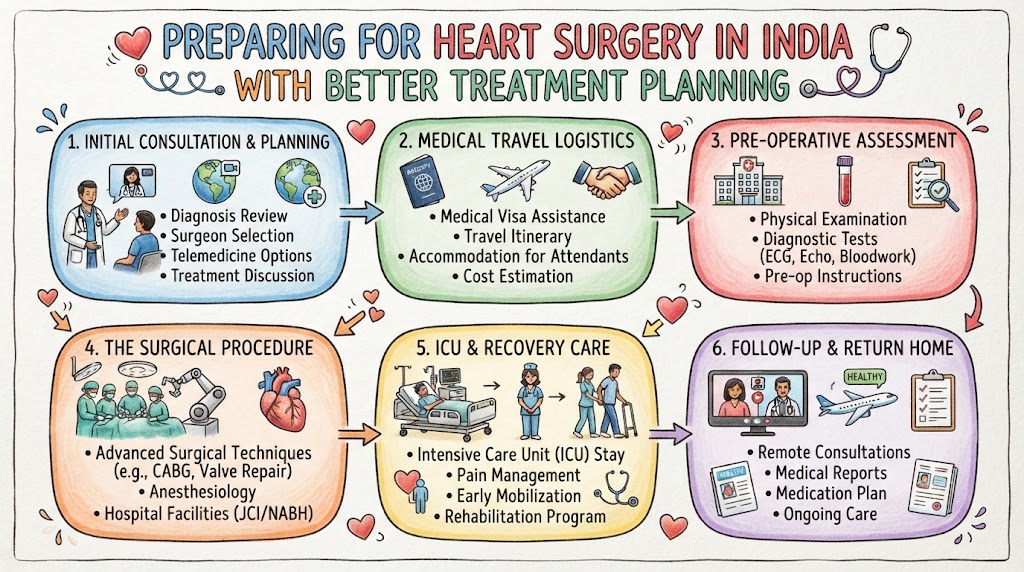
Introduction
Preparing for a heart operation involves more than selecting a hospital and surgery date. Patients may need to understand the diagnosis, compare surgeons, review expenses, organize records, arrange travel, and prepare for recovery. Good planning cannot remove every uncertainty, but it can make decisions clearer and reduce avoidable confusion.
For people considering heart surgery in India, the appropriate plan depends on the heart condition, proposed operation, overall health, urgency, and availability of specialist care. A cardiologist and cardiac surgeon should review the case before treatment is finalized. This guide explains practical steps for organized, patient-focused planning without suggesting that one hospital or treatment is suitable for everyone.
Confirm the Diagnosis and Need for Surgery
Begin by asking the cardiologist to explain the diagnosis, severity of the condition, purpose of surgery, and available alternatives. Heart surgery may be considered for blocked coronary arteries, damaged valves, congenital defects, aortic disease, or other structural heart problems.
However, patients with similar diagnoses may receive different recommendations. Age, symptoms, heart function, previous procedures, diabetes, kidney or lung disease, frailty, and other medical factors can influence treatment suitability.
Request a written clinical summary covering the diagnosis, symptoms, major test results, current medicines, allergies, previous procedures, and reason for surgery. This summary can help when approaching another hospital or requesting a second opinion.
Patients should not stop blood thinners, blood-pressure medicines, diabetes medicines, supplements, or other treatments unless their clinical team provides specific instructions. Preoperative assessment commonly includes a review of medicines and medical conditions that may require attention around the time of surgery.
A second opinion can be helpful for a major, complex, high-risk, or non-emergency procedure. It may confirm the original recommendation, identify alternatives, or explain another surgical approach. Seeking another opinion does not automatically mean changing the original doctor.
Understand the Proposed Heart Procedure
The surgeon should explain what will be repaired, replaced, bypassed, or reconstructed. Patients should ask whether the procedure involves traditional open surgery, minimally invasive surgery, robotic-assisted surgery, or a catheter-based treatment.
A smaller incision is not automatically safer or more appropriate. Suitability depends on the patient’s anatomy, disease complexity, previous operations, urgency, general health, and the treatment team’s experience.
| Procedure | Main purpose | Important planning questions |
|---|---|---|
| Coronary artery bypass grafting | Creates new routes around severely narrowed or blocked coronary arteries | How many grafts may be needed, and what grafts are planned? |
| Heart valve repair or replacement | Treats a severely narrowed or leaking heart valve | Can the valve be repaired? If replacement is needed, which valve type is suitable? |
| Congenital heart surgery | Corrects or improves a heart defect present from birth | Does the team specialize in this defect and the patient’s age group? |
| Aortic surgery | Repairs or replaces a diseased part of the aorta | Which section is affected, and what complex emergency support is available? |
| Minimally invasive cardiac surgery | Performs selected procedures through smaller incisions | Is the patient suitable, and could a larger incision become necessary? |
Patients should receive a balanced explanation of the expected benefits, important risks, available alternatives, and the likely course of the condition without surgery. The discussion should relate to the individual patient rather than relying only on general success rates.
Compare Hospitals and Cardiac Surgeons Carefully
A hospital should be assessed for the required operation, not simply for its public reputation. Important areas include surgeon experience, procedure-specific expertise, cardiac anaesthesia, cardiac ICU capability, emergency support, blood-bank services, infection-control systems, diagnostic facilities, rehabilitation, and follow-up care.
Accreditation is one useful quality indicator, although it cannot guarantee a particular outcome. India’s National Accreditation Board for Hospitals and Healthcare Providers states that its standards focus on quality, patient safety, and patient-centred care. NABH patient guidance also emphasizes transparent communication, informed consent, dignity, privacy, and access to qualified professionals. Patients should verify that a hospital’s accreditation is current.
| Area to compare | What to verify | Why it matters |
|---|---|---|
| Cardiac surgeon | Qualifications, specialization, exact-procedure experience, and complex-case experience | General cardiac experience may not equal expertise in the required operation |
| Cardiac ICU | Specialist staff, monitoring, ventilation, infection control, and emergency response | Early recovery may require continuous specialist care |
| Multidisciplinary team | Cardiologist, surgeon, anaesthetist, intensivist, nurses, and rehabilitation professionals | Coordinated decisions support care before and after surgery |
| Hospital systems | Accreditation, blood bank, diagnostics, pharmacy, and surgical safety processes | Reliable systems help teams respond to changing clinical needs |
| Communication | Named coordinator, consent process, language support, and family updates | Clear communication reduces uncertainty and misunderstanding |
| Follow-up care | Wound review, medicine review, rehabilitation, remote support, and emergency contact | Recovery continues after the patient leaves the hospital |
Patients may ask how often the surgeon and hospital perform the proposed operation and how clinical outcomes are reviewed. Surgical volume can be useful, but it should be considered alongside case complexity, safety practices, team experience, infection-control standards, and communication.
Complete the Preoperative Medical Evaluation
Preoperative testing helps confirm the diagnosis, assess surgical risk, and guide the surgical and anaesthesia teams. Depending on the patient’s condition, tests may include:
- Blood tests
- Electrocardiogram
- Echocardiogram
- Chest imaging
- Coronary angiography
- CT or MRI imaging
- Kidney and liver function tests
- Lung assessment
- Infection screening
Patients should provide a complete list of prescription medicines, over-the-counter products, vitamins, and herbal preparations. They should report allergies, previous anaesthesia problems, bleeding disorders, implanted devices, dental infection, recent fever, cough, skin infection, or worsening symptoms.
Some patients preparing for valve surgery may be asked to have a dental assessment. Patients may also receive individualized advice about smoking, nutrition, physical activity, diabetes control, blood pressure, and skin preparation. These steps should follow the treating team’s instructions rather than general online advice.
The World Health Organization’s Surgical Safety Checklist includes checks related to patient identity, the planned procedure, consent, anaesthesia preparation, and communication among the surgical team. Patients may ask whether the hospital follows a recognized surgical safety process.
Organize Medical Records and Practical Documents
Keep one printed and digital treatment file containing:
- Passport or government identification
- Clinical summaries and consultation notes
- Blood-test reports
- ECG and echocardiogram reports
- Angiography or other imaging files
- Current medicines and doses
- Allergy information
- Details of previous surgeries
- Insurance documents
- Written treatment estimates
- Hospital and emergency contacts
Patients should carry the actual imaging files where possible, not only written reports. Surgeons may need to review the images directly when evaluating the condition.
International patients should ask whether records need translation and whether specialists can review imaging before travel. A remote clinical review may identify missing tests, although the final plan can change after an in-person examination.
Review the Full Treatment Cost
The cost of heart surgery in India can vary significantly according to:
- Type and complexity of surgery
- Surgeon and anaesthesia fees
- Hospital category
- City and location
- Room type
- Diagnostic tests
- Operating-room charges
- Implant or valve type
- Cardiac ICU stay
- Medicines and consumables
- Blood products
- Rehabilitation
- Complications
- Extended hospitalization
Request an itemized written estimate. Confirm whether it includes the surgeon, assistant surgeon, anaesthetist, operating room, ICU, hospital room, investigations, routine medicines, blood products, implants, consumables, physiotherapy, and initial follow-up consultations.
Patients should also ask what is excluded, how complications are billed, what deposit is required, and whether unused advance payments are refundable. A treatment package should be treated as an estimate rather than a guaranteed final bill.
Patients using insurance or employer coverage should confirm hospital-network status, preauthorization requirements, room or implant limits, exclusions, co-payments, and claim-document requirements before admission.
International families should also budget for flights, accommodation, meals, local transportation, visa fees, a caregiver, and possible changes to the return date.
Plan Travel and Accommodation
International patients should allow enough time for consultation, repeat testing, surgery, hospital recovery, local follow-up, and medical clearance before returning home.
India’s official visa system includes medical and medical-attendant categories. Eligibility, required documents, validity, and entry conditions may change, so patients should confirm the current requirements through official government guidance before booking travel.
Choose accommodation reasonably close to the hospital. It should ideally have:
- A lift or minimal stairs
- A clean and accessible bathroom
- Suitable meal options
- Space for a caregiver
- Reliable transport to the hospital
- A nearby pharmacy or basic medical support
Avoid booking an inflexible return ticket. The surgeon should decide when air travel is appropriate, especially following open-heart surgery or when complications, rhythm problems, low oxygen levels, or blood-clot concerns are present.
Prepare for Hospital Admission
Follow the hospital’s personalized instructions about fasting, bathing, admission time, and medicines. Do not apply general fasting or medicine rules without confirming them with the surgical team.
Bring identification, reports, imaging records, insurance documents, a current medicine list, comfortable discharge clothing, and essential personal items. Expensive valuables should normally remain with a family member.
Patients and caregivers should confirm:
- The planned admission date
- Expected surgery date
- Deposit and billing procedure
- Blood-donor requirements, where applicable
- Visiting arrangements
- Family communication procedures
- Contact details for the hospital coordinator
Understand the Early Recovery Period
After major heart surgery, the patient may initially receive care in a cardiac ICU. Monitoring equipment, breathing support, drainage tubes, intravenous lines, urinary catheters, or temporary pacing wires may be used according to clinical need.
The care team gradually reduces this support as the patient becomes stable. The length of ICU and hospital stay varies by procedure, health condition, response to treatment, and the presence of complications. Families should not depend on a fixed recovery timeline.
Before discharge, obtain a written summary explaining:
- The operation performed
- Medicines and doses
- Wound-care instructions
- Activity limitations
- Diet guidance
- Follow-up dates
- Rehabilitation advice
- Warning signs
- Emergency contact details
Patients should understand which medicines are temporary and which may need to continue for longer. They should also know where follow-up blood tests or imaging will be completed.
Plan Recovery Before Surgery
Recovery arrangements should be made before hospital admission. Identify the main caregiver, organize transportation, prepare meals, arrange medicines, create a comfortable sleeping area, and remove household fall hazards.
During early recovery, a patient may need help with bathing, dressing, shopping, appointments, meals, and medicine organization. The level of support required will depend on the operation and the patient’s progress.
Cardiac rehabilitation is a medically supervised programme that may combine exercise guidance, patient education, risk-factor management, emotional support, and medicine review. It is used after several types of cardiac procedures, but eligibility and timing depend on the patient’s condition and the advice of the treating team.
Patients should ask when they may:
- Walk outdoors
- Climb stairs
- Drive
- Return to work
- Lift heavy objects
- Resume sexual activity
- Travel by air
- Begin formal exercise
The discharge team should also explain when to report fever, increasing wound redness, wound discharge, severe breathlessness, fainting, new chest pain, confusion, an irregular heartbeat, or sudden swelling. Emergency symptoms require urgent local medical attention.
Questions to Ask Before Choosing a Hospital or Surgeon
- What is the exact diagnosis, and why is surgery being recommended?
- Are medical, catheter-based, or minimally invasive alternatives appropriate?
- How often does the surgeon perform this specific operation?
- Which surgeon will perform the main parts of the operation?
- What risks apply to this patient’s condition and other illnesses?
- What tests are required before admission?
- What cardiac ICU and emergency support are available?
- Does the hospital follow recognized infection-control and surgical safety practices?
- What is included and excluded in the written cost estimate?
- How long might hospitalization and local recovery take?
- What follow-up and cardiac rehabilitation services are available?
- Who should be contacted after discharge or during an emergency?
Frequently Asked Questions
1. How early should heart surgery planning begin?
Planning should begin once a qualified specialist confirms that surgery may be needed. Medical-record reviews, second opinions, insurance approval, treatment of infections, and travel arrangements can require time. Urgent cases must follow the treating team’s recommended schedule.
2. How can a patient choose a suitable heart surgery hospital?
Compare procedure-specific experience, cardiac ICU capability, accreditation, emergency care, infection-control practices, communication, cost transparency, rehabilitation, and follow-up services. No hospital is automatically best for every heart condition or patient.
3. Is a second opinion necessary before heart surgery?
A second opinion is not required in every case, but it may be valuable for major, complex, high-risk, or non-emergency surgery. It can confirm the treatment plan and clarify alternatives without requiring the patient to change doctors.
4. Can regular medicines be stopped before surgery?
Medicines should be changed or stopped only under the treating team’s instructions. Some medicines may require temporary adjustment, while others should continue. Independently stopping blood thinners, diabetes medicines, heart medicines, or supplements may be unsafe.
5. What should a written cost estimate include?
It should explain professional fees, operating-room charges, ICU and room costs, tests, medicines, blood products, implants, consumables, rehabilitation, follow-up, exclusions, and possible charges for complications or additional hospital days.
6. Is minimally invasive heart surgery suitable for everyone?
No. Suitability depends on the patient’s anatomy, disease complexity, previous surgery, overall health, and the team’s expertise. The selected approach must allow the required repair or treatment to be performed appropriately.
7. How long does recovery take after heart surgery?
There is no single recovery timeline. The procedure, age, fitness, other medical conditions, wound healing, and complications can affect progress. The surgeon should provide individualized milestones and activity instructions.
8. Should an international patient bring a caregiver?
A caregiver can help with communication, transportation, discharge instructions, medicines, and early recovery. International patients should also verify current medical-attendant visa requirements before arranging travel.
9. Is cardiac rehabilitation important after surgery?
Cardiac rehabilitation may support safe physical activity, education, emotional wellbeing, medicine management, and long-term heart-health planning for eligible patients. Its timing should be decided by the treating team.
10. What should patients do if symptoms worsen before surgery?
They should contact their treating team promptly. Severe chest pain, major breathing difficulty, fainting, sudden weakness, confusion, or other emergency symptoms require immediate local emergency care.
Key Takeaways
- Confirm the diagnosis, proposed operation, alternatives, and individual risks.
- Compare procedure-specific expertise, cardiac ICU care, hospital safety systems, and follow-up services.
- Verify the surgeon’s relevant experience and consider a second opinion for complex procedures.
- Obtain an itemized estimate and understand exclusions and possible additional costs.
- Organize medical records, travel documents, caregiver arrangements, and emergency contacts.
- Plan home recovery and cardiac rehabilitation before hospital admission.
- Follow individualized medical advice because treatment needs and recovery timelines differ.
Conclusion
Preparing for heart surgery in India becomes more manageable when patients confirm the medical need, understand the proposed procedure, compare qualified treatment teams, review costs in writing, complete preoperative testing, and plan travel and recovery.
The appropriate choice depends on the individual’s heart condition, overall health, and personal needs. Decisions should be made with qualified cardiac specialists and supported by clear communication, safe hospital systems, cost transparency, and reliable follow-up care.

