
Introduction
Selecting an eye hospital involves more than checking its location, reputation, or available surgical procedures. Patients should also evaluate the quality of diagnostic services, the experience of ophthalmologists, the availability of different eye-care specialties, and the level of support provided before and after treatment.
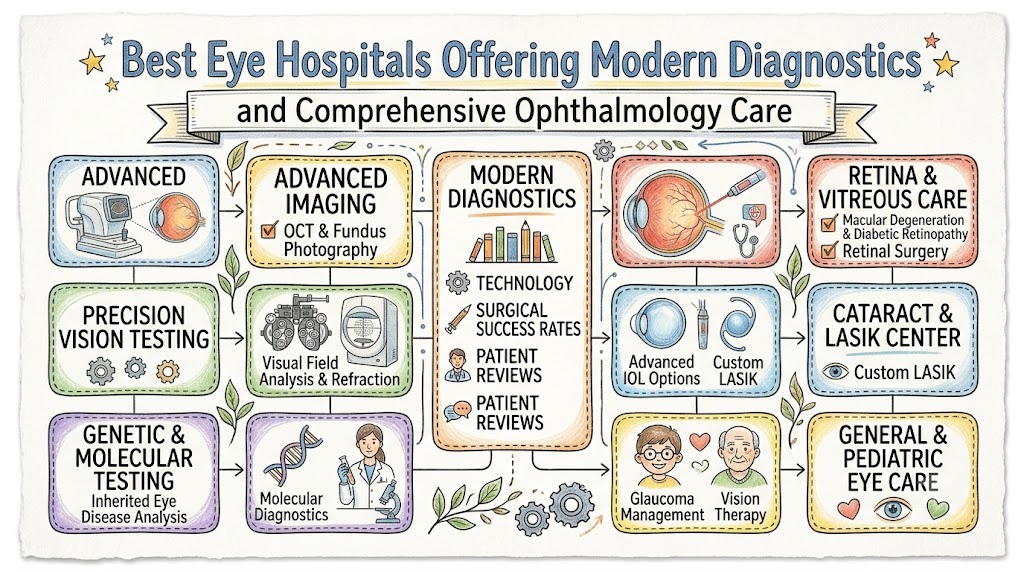
The best eye hospitals combine modern diagnostic equipment with comprehensive ophthalmology care. This approach allows specialists to examine different parts of the eye, identify possible diseases, assess their severity, and create an appropriate treatment or monitoring plan.
Comprehensive care is especially important because several eye conditions may not cause noticeable symptoms during their early stages. Regular, detailed eye examinations can help identify problems that may otherwise remain undetected until vision is affected.
Understanding Modern Eye Diagnostics
Modern eye diagnostics refers to the use of specialized examinations, imaging systems, and measurement tools to evaluate vision and eye health.
A basic vision test may determine how clearly a person can see, but a comprehensive eye examination can provide information about the cornea, lens, retina, optic nerve, eye pressure, peripheral vision, and eye movement.
The exact tests recommended depend on factors such as:
- The patient’s age
- Current symptoms
- Medical and family history
- Previous eye surgery
- Existing eye conditions
- Diabetes or other systemic diseases
- The type of treatment being considered
Not every patient requires every available test. A qualified ophthalmologist should select investigations according to the patient’s clinical needs rather than ordering technology without a clear medical purpose.
Important Diagnostic Technologies Available at Eye Hospitals
Optical Coherence Tomography
Optical coherence tomography, commonly called OCT, is a non-invasive imaging test that uses light waves to create cross-sectional images of the retina. It helps ophthalmologists examine retinal layers and may support the diagnosis or monitoring of conditions affecting the macula, retina, and optic nerve.
OCT may be used when evaluating:
- Glaucoma
- Diabetic retinal changes
- Macular swelling
- Age-related macular degeneration
- Retinal disorders
- Optic nerve conditions
The availability of OCT alone does not establish the quality of an eye hospital. The images must be interpreted by an appropriately trained specialist and considered alongside the patient’s symptoms, examination findings, and medical history.
Digital Fundus Photography
Fundus photography captures detailed images of the retina, optic disc, macula, and retinal blood vessels. These photographs can provide a visual record that allows specialists to compare changes over time.
It may be useful for patients with diabetes, glaucoma risk, retinal disease, or other conditions requiring long-term monitoring.
Tonometry for Eye-Pressure Measurement
Tonometry measures pressure inside the eye. It is commonly included in a complete eye examination and is particularly relevant when assessing glaucoma risk.
Eye pressure is only one part of a glaucoma assessment. A person may require additional examination of the optic nerve, drainage angle, corneal thickness, and visual field. Glaucoma evaluation should therefore not be based on a single pressure reading.
Visual Field Testing
Visual field testing assesses central and peripheral vision. It may help detect areas of reduced vision that patients have not noticed themselves.
This test is frequently used for glaucoma assessment and monitoring. A comprehensive glaucoma examination may include pupil dilation, optic nerve evaluation, eye-pressure measurement, and visual field testing.
Corneal Topography
Corneal topography creates a detailed map of the cornea’s curvature and shape. It may be recommended for:
- LASIK and other refractive surgery assessments
- Keratoconus evaluation
- Irregular astigmatism
- Contact-lens fitting
- Corneal surgery planning
- Monitoring corneal changes
Hospitals providing refractive surgery should perform careful corneal evaluation before deciding whether a patient is suitable for LASIK or another vision-correction procedure.
Pachymetry
Pachymetry measures corneal thickness. This measurement may be relevant during glaucoma assessment, refractive-surgery planning, and evaluation of certain corneal conditions.
Optical Biometry
Optical biometry measures important eye dimensions and assists with intraocular-lens calculations before cataract surgery.
Accurate measurements are important because the selected lens power influences the expected visual result after surgery. However, outcomes can also be affected by corneal health, retinal health, previous refractive surgery, existing eye disease, and individual healing.
Slit-Lamp Examination
A slit lamp allows an ophthalmologist to closely examine structures at the front and, with additional lenses, the back of the eye.
It can support the assessment of:
- Cataracts
- Corneal conditions
- Dry eye
- Eye infections
- Inflammation
- Eyelid disorders
- Retinal and optic-nerve abnormalities
Ocular Ultrasound
Ocular ultrasound uses sound waves to examine internal eye structures. It may be useful when the ophthalmologist cannot clearly view the retina because of a dense cataract, bleeding, trauma, or another obstruction.
Comparison of Common Eye Diagnostic Tests
| Diagnostic Test | Main Area Evaluated | Common Clinical Uses |
|---|---|---|
| OCT | Retina and optic nerve | Glaucoma, macular and retinal conditions |
| Fundus photography | Retina and retinal blood vessels | Disease documentation and monitoring |
| Tonometry | Intraocular pressure | Glaucoma assessment |
| Visual field test | Central and peripheral vision | Glaucoma and neurological assessment |
| Corneal topography | Corneal shape and curvature | LASIK planning and corneal disorders |
| Pachymetry | Corneal thickness | Glaucoma and refractive-surgery evaluation |
| Optical biometry | Eye length and lens calculations | Cataract-surgery planning |
| Ocular ultrasound | Internal eye structures | Cataract, trauma and retinal assessment |
What Comprehensive Ophthalmology Care Includes
Comprehensive ophthalmology care covers diagnosis, medical management, surgical treatment, preventive care, emergency support, rehabilitation, and follow-up services.
Rather than focusing on only one procedure, comprehensive eye hospitals commonly provide access to several ophthalmology specialties.
Cataract Services
Cataract care may include:
- Detailed eye examination
- Cataract grading
- Retina and optic-nerve evaluation
- Biometry and lens-power calculations
- Discussion of intraocular-lens options
- Cataract surgery
- Postoperative monitoring
- Management of associated eye conditions
Cataracts can be identified during a dilated eye examination. Treatment decisions should consider how strongly the cataract affects the patient’s daily activities, overall eye health, medical condition, and personal needs.
Retina Services
Retina specialists diagnose and manage diseases involving the retina, macula, and vitreous.
Patients may require retinal care for:
- Diabetic retinopathy
- Retinal detachment
- Macular degeneration
- Macular swelling
- Retinal vascular disease
- Eye trauma
- Inherited retinal conditions
A hospital offering comprehensive retina care should have appropriate imaging, treatment facilities, emergency support, and follow-up systems.
Glaucoma Care
Glaucoma care may involve pressure testing, optic-nerve examination, visual-field testing, OCT imaging, medication, laser procedures, surgery, and long-term monitoring.
Because some forms of glaucoma may progress without obvious early symptoms, diagnosis should rely on a complete clinical assessment rather than symptoms alone.
Cornea and Refractive Surgery
Cornea services may cover infections, injuries, scarring, keratoconus, corneal dystrophies, dry eye, and corneal transplantation.
Refractive services may include LASIK, PRK, SMILE, implantable lenses, and other vision-correction options. Suitability depends on factors such as corneal thickness, prescription stability, tear-film health, age, lifestyle, and existing eye conditions.
Not every person who wants laser vision correction is a suitable candidate. A responsible hospital should explain both eligibility and reasons for recommending an alternative.
Pediatric Ophthalmology
Children may require specialized care for:
- Squint or strabismus
- Amblyopia
- Childhood cataract
- Refractive errors
- Blocked tear ducts
- Eye injuries
- Genetic eye conditions
Pediatric eye assessment requires age-appropriate testing and professionals experienced in communicating with children and their families.
Oculoplasty Services
Oculoplasty focuses on the eyelids, tear ducts, eye socket, and surrounding facial structures. Services may include treatment for drooping eyelids, eyelid abnormalities, blocked tear ducts, injuries, orbital disease, and selected reconstructive procedures.
Neuro-Ophthalmology
Neuro-ophthalmology addresses visual problems connected with the optic nerve, brain, nervous system, and eye movements.
Patients may be referred for unexplained vision loss, double vision, abnormal eye movements, optic-nerve swelling, or visual-field abnormalities.
Low-Vision and Rehabilitation Services
Some eye conditions cannot be completely corrected through glasses, medication, laser treatment, or surgery. Low-vision services may help patients use their remaining vision through magnification devices, adaptive technology, environmental modifications, and rehabilitation support.
Features to Compare When Choosing an Eye Hospital
Patients should avoid selecting a hospital based only on advertisements, online rankings, or the number of machines listed on its website.
A balanced comparison should include the following factors.
Qualified Ophthalmologists
Check whether the hospital has specialists experienced in the patient’s particular condition. A well-known cataract surgeon may not necessarily be the most appropriate specialist for a complex retinal, corneal, pediatric, or neurological eye problem.
Condition-Specific Diagnostic Facilities
The hospital should have the equipment needed for the suspected condition or planned procedure. More technology is not automatically better; the equipment should be properly maintained, accurately calibrated, and operated by trained staff.
Multidisciplinary Care
Patients with complicated conditions may benefit from coordination between cataract surgeons, retina specialists, glaucoma specialists, cornea specialists, anesthesiologists, physicians, pediatricians, or neurologists.
Infection-Control Standards
Patients should ask how the facility manages sterilization, operating-room safety, medication handling, and infection prevention.
Emergency Eye Services
Hospitals that manage trauma, retinal detachment, sudden vision loss, chemical injuries, or severe infections should have clear emergency evaluation and referral arrangements.
Transparent Treatment Planning
A responsible eye hospital should explain:
- The diagnosis
- Recommended tests
- Available treatment options
- Expected benefits
- Possible limitations
- Important risks
- Recovery requirements
- Alternative treatments
- Estimated costs
- Follow-up schedule
Follow-Up and Recovery Support
Successful treatment does not end when a procedure is completed. Patients may require medication instructions, protective precautions, scheduled examinations, emergency contact information, and management of unexpected symptoms.
Eye Hospital Comparison Checklist
| Evaluation Area | Questions Patients Can Ask |
|---|---|
| Specialist expertise | Is an ophthalmologist experienced in my condition available? |
| Diagnostics | Which tests are necessary, and why are they recommended? |
| Treatment choices | Are non-surgical, laser and surgical options available? |
| Safety | What infection-control and surgical-safety systems are followed? |
| Costs | Does the estimate include tests, medicines and follow-up visits? |
| Emergency care | Who should I contact if symptoms worsen after treatment? |
| Follow-up | How many visits may be required after the procedure? |
| Records | Will I receive copies of reports, scans and prescriptions? |
| Accessibility | Are language, mobility and caregiver-support services available? |
| Second opinions | Can reports be reviewed before making a final decision? |
Why Accurate Diagnosis Matters Before Eye Treatment
Blurred vision does not always have one simple cause. It may result from refractive error, cataract, dry eye, corneal disease, retinal disease, glaucoma, optic-nerve problems, medication effects, or systemic health conditions.
Two patients reporting similar symptoms may therefore require completely different treatment plans.
Accurate diagnosis helps prevent situations such as:
- Performing a procedure that does not address the main problem
- Missing a retinal or optic-nerve condition
- Recommending LASIK to an unsuitable candidate
- Underestimating the need for long-term glaucoma monitoring
- Selecting a cataract lens without considering retinal or corneal health
- Delaying treatment for an urgent eye condition
Modern equipment can support diagnosis, but technology should complement clinical judgment rather than replace it.
Common Mistakes While Comparing Eye Hospitals
Choosing Only by Price
The lowest estimate may exclude diagnostic tests, medicines, upgraded lenses, anesthesia, follow-up visits, or management of complications. Patients should request a written cost breakdown.
Selecting a Hospital Only for Its Technology
Advanced equipment is helpful only when the correct test is selected and the findings are interpreted accurately.
Ignoring the Specialist’s Experience
Patients should consider the ophthalmologist’s training and experience with the relevant condition rather than relying only on the hospital’s overall reputation.
Expecting Guaranteed Results
No ethical hospital should guarantee perfect vision or a complication-free outcome. Results vary according to diagnosis, disease severity, general health, procedure type, and healing response.
Skipping a Second Opinion
A second opinion may be valuable when the diagnosis is uncertain, surgery is complex, multiple treatment choices are available, or the patient does not fully understand the recommendation.
Overlooking Follow-Up Care
Patients travelling for treatment should confirm how follow-up visits and possible complications will be managed after they return home.
Warning Signs That Need Urgent Eye Assessment
Patients should seek urgent medical attention for symptoms such as:
- Sudden loss or significant reduction of vision
- New flashes of light or a sudden increase in floaters
- A curtain-like shadow across the vision
- Severe eye pain
- Chemical exposure
- Eye trauma
- Sudden double vision
- Painful redness with blurred vision
- Sudden halos with nausea or headache
- New vision problems accompanied by weakness, difficulty speaking, or facial drooping
Online information should not be used to delay emergency assessment.
Frequently Asked Questions
1. What makes an eye hospital suitable for comprehensive care?
A suitable hospital generally offers qualified ophthalmologists, condition-specific diagnostic facilities, medical and surgical treatments, emergency support, clear patient communication, and structured follow-up care. The most appropriate hospital depends on the patient’s diagnosis rather than its general popularity.
2. Does every patient require advanced diagnostic testing?
No. Tests should be selected according to symptoms, examination findings, age, medical history, and the suspected condition. Ordering every available investigation may increase costs without improving care. The ophthalmologist should explain why a particular test is necessary.
3. Is OCT required before every eye surgery?
OCT is not automatically required before every operation. It may be recommended when the ophthalmologist needs detailed information about the retina, macula, or optic nerve. Its necessity depends on the procedure and the patient’s eye health.
4. How should patients compare ophthalmologists?
Patients can compare specialist qualifications, area of expertise, experience with the relevant condition, communication quality, treatment approach, hospital support, and follow-up availability. Experience in the patient’s specific condition is often more relevant than general popularity.
5. Are modern diagnostic machines enough to guarantee accurate results?
No. Diagnostic machines produce measurements and images, but trained professionals must collect reliable data and interpret it within the complete clinical picture. Equipment quality, calibration, staff training, and specialist judgment all matter.
6. What tests may be performed before cataract surgery?
Testing may include vision assessment, slit-lamp examination, eye-pressure measurement, pupil dilation, retinal examination, corneal measurements, and optical biometry. Additional tests may be recommended when glaucoma, retinal disease, corneal irregularity, or another condition is suspected.
7. What tests are commonly performed before LASIK?
Evaluation may include prescription measurement, corneal topography, corneal-thickness testing, tear-film assessment, pupil measurement, eye-pressure testing, and retinal examination. The final selection of tests depends on the surgeon’s assessment and the patient’s history.
8. Can a general eye hospital manage complex retinal conditions?
Some general eye hospitals have experienced retina specialists, appropriate imaging, laser facilities, injection services, and vitreoretinal surgery. Patients should confirm whether the required specialist and treatment are available rather than assuming every hospital manages all retinal conditions.
9. Should international patients arrange follow-up care before travelling?
Yes. Patients should understand how long they need to remain near the hospital, which follow-up examinations are required, who will manage care after they return home, and how urgent concerns will be handled.
10. Is a second opinion helpful before eye surgery?
A second opinion can provide additional clarity when surgery is optional, the diagnosis is complex, treatment choices differ, or the expected benefits and risks are unclear. Patients should carry their examination records, scans, prescriptions, and medical history to the consultation.
Conclusion
The best eye hospitals offering modern diagnostics and comprehensive ophthalmology care combine technology, specialist expertise, clinical judgment, patient safety, and organized follow-up services. Equipment such as OCT, corneal topography, visual-field testing, fundus photography, and optical biometry can provide valuable information, but these tools must be used according to the patient’s condition.
Patients should compare hospitals based on specialist availability, diagnostic relevance, safety systems, transparent costs, treatment options, emergency support, and continuity of care. A careful evaluation can help patients choose an eye-care provider that matches their diagnosis, personal needs, and treatment goals rather than relying only on rankings or promotional claims.

