
Introduction
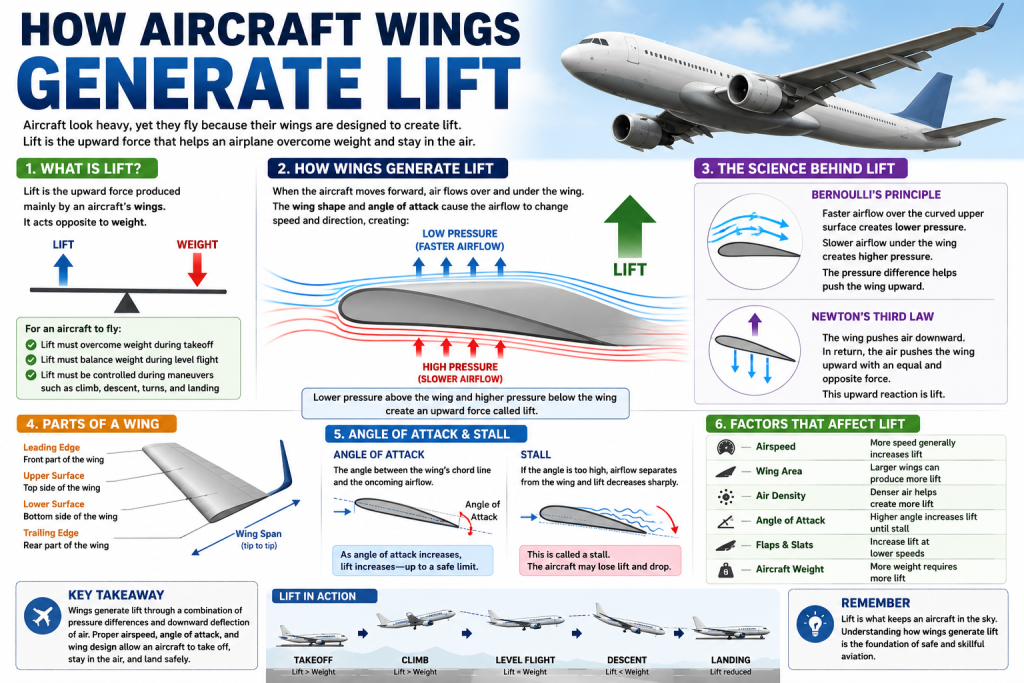
Aircraft look heavy, yet they can rise into the sky because their wings are designed to create lift. Lift is the upward force that helps an airplane overcome weight and stay in the air.
For student pilots, aviation beginners, and aircraft enthusiasts, understanding lift is one of the most important parts of learning how airplanes fly. Wings do not simply “float” in the air. They create lift by shaping airflow, changing air pressure, and pushing air downward.
This blog explains how aircraft wings generate lift in simple language.
What Is Lift?
Lift is the upward force produced mainly by an aircraft’s wings. It acts opposite to weight, which is the downward force caused by gravity.
For an aircraft to fly:
- Lift must overcome weight during takeoff
- Lift must balance weight during level flight
- Lift must be controlled during climb, descent, turns, and landing
Without enough lift, an aircraft cannot leave the ground or remain airborne.
Why Aircraft Need Lift
Aircraft need lift because gravity is always pulling them downward. The heavier the aircraft, the more lift it needs.
Lift helps an aircraft:
- Take off from the runway
- Climb after takeoff
- Maintain level flight
- Turn safely
- Descend in control
- Land at a safe speed
Pilots manage lift using airspeed, angle of attack, flaps, and aircraft configuration.
Understanding Aircraft Wings
Aircraft wings are carefully designed surfaces that guide air around them.
Important wing parts include:
| Wing Part | Meaning |
|---|---|
| Leading Edge | Front part of the wing |
| Trailing Edge | Rear part of the wing |
| Upper Surface | Top side of the wing |
| Lower Surface | Bottom side of the wing |
| Wing Span | Distance from one wingtip to the other |
| Wing Area | Total surface area of the wing |
| Airfoil | Cross-sectional shape of the wing |
Different aircraft use different wing designs depending on speed, purpose, altitude, and performance needs.
What Is an Airfoil?
An airfoil is the shape of a wing when viewed from the side.
Most aircraft wings have a curved upper surface and a flatter lower surface. This shape helps control airflow and pressure around the wing.
Important airfoil terms include:
- Camber: Curvature of the wing
- Chord line: Straight line from leading edge to trailing edge
- Thickness: Distance between upper and lower surfaces
- Angle of attack: Angle between the wing and incoming airflow
The airfoil shape helps the wing generate lift efficiently.
How Wings Generate Lift
Aircraft wings generate lift through a combination of airflow, pressure difference, and downward deflection of air.
When the aircraft moves forward, air flows over and under the wing. The wing shape and angle of attack cause the airflow to change direction and speed.
This creates:
- Lower pressure above the wing
- Higher pressure below the wing
- Downward movement of air behind the wing
- Upward force on the aircraft
Lift is not caused by only one simple effect. It is created by the complete interaction between the wing and moving air.
Bernoulli’s Principle and Lift
Bernoulli’s Principle helps explain part of lift generation.
When air moves faster over the curved upper surface of the wing, pressure above the wing becomes lower. Air pressure below the wing is relatively higher. This pressure difference helps push the wing upward.
In simple words:
- Faster airflow usually means lower pressure
- Slower airflow usually means higher pressure
- Higher pressure below the wing helps lift it upward
Bernoulli’s Principle is useful, but it is not the full explanation of lift.
Newton’s Third Law and Lift
Newton’s Third Law says that for every action, there is an equal and opposite reaction.
Aircraft wings push air downward. In response, the air pushes the wing upward. This upward reaction is lift.
This downward flow of air behind the wing is called downwash.
So, wings generate lift not only because of pressure differences, but also because they change the direction of airflow.
Why Both Principles Matter
A complete explanation of lift includes both pressure and airflow direction.
Bernoulli’s Principle helps explain pressure differences around the wing. Newton’s Third Law helps explain how the wing pushes air downward and receives an upward reaction.
Together, they show that lift comes from:
- Wing shape
- Airflow speed
- Pressure differences
- Angle of attack
- Downward deflection of air
- Aircraft motion through the air
Modern aerodynamics uses both ideas to explain how wings work.
Role of Angle of Attack
Angle of attack is the angle between the wing’s chord line and the oncoming airflow.
When angle of attack increases, lift usually increases up to a safe limit. Pilots use pitch control to change angle of attack.
However, if the angle becomes too high, airflow can separate from the wing. When this happens, lift decreases sharply and the aircraft may stall.
What Is a Stall?
A stall happens when the wing exceeds its critical angle of attack and airflow separates from the wing surface.
A stall does not mean the engine has stopped. It means the wing is no longer producing enough smooth lift.
Common signs of stall may include:
- Loss of lift
- Nose drop
- Buffet or vibration
- Reduced control effectiveness
- Stall warning
Pilots recover by reducing angle of attack and restoring proper airflow over the wing.
Factors That Affect Lift
Several factors affect how much lift a wing can produce.
| Factor | Effect on Lift |
|---|---|
| Airspeed | More speed generally increases lift |
| Wing Area | Larger wings can produce more lift |
| Air Density | Denser air helps create more lift |
| Angle of Attack | Higher angle increases lift until stall |
| Airfoil Shape | Efficient shapes improve lift |
| Flaps | Increase lift at lower speeds |
| Slats | Improve airflow at high angle of attack |
| Altitude | Higher altitude has thinner air |
| Aircraft Weight | More weight requires more lift |
Pilots and engineers must consider all these factors.
How Airspeed Affects Lift
Airspeed is one of the most important factors in lift generation.
When an aircraft moves faster, more air flows over the wings. This usually increases lift.
During takeoff, the aircraft accelerates along the runway. As airspeed increases, lift increases. When lift becomes strong enough, the aircraft leaves the ground.
During landing, pilots reduce speed but use flaps to maintain enough lift at lower speeds.
How Air Density Affects Lift
Air density means how much air is packed into a given space.
Dense air helps wings generate more lift. Thin air produces less lift.
Air density is affected by:
- Altitude
- Temperature
- Humidity
- Weather conditions
At higher altitudes, air is thinner. This can reduce lift and engine performance. That is why aircraft performance changes with altitude and temperature.
How Flaps Increase Lift
Flaps are movable surfaces on the back part of the wing.
When pilots extend flaps, the wing shape becomes more curved. This increases lift at lower speeds. Flaps also increase drag, which helps slow the aircraft during approach and landing.
Flaps are useful during:
- Takeoff
- Approach
- Landing
- Short runway operations
- Low-speed flight
Pilots use flaps according to aircraft procedures.
How Slats Help Lift
Slats are movable surfaces on the front edge of some wings.
They help smooth airflow over the wing at higher angles of attack. This allows the aircraft to fly slower without stalling too early.
Slats are common on many larger aircraft and some high-performance aircraft.
Wing Loading
Wing loading means how much aircraft weight is supported by each unit of wing area.
A simple way to understand it:
- High wing loading means more weight for each area of wing
- Low wing loading means less weight for each area of wing
Aircraft with lower wing loading can often fly slower and take off in shorter distances. Aircraft with higher wing loading may fly faster but may require higher takeoff and landing speeds.
Lift Coefficient
Lift coefficient is a number used in aerodynamics to describe how effectively a wing produces lift.
It depends on:
- Airfoil shape
- Angle of attack
- Flap position
- Wing condition
- Airflow behavior
Beginners do not need to calculate lift coefficient immediately, but it helps engineers and pilots understand aircraft performance.
Different Wing Designs
Aircraft wings are not all the same. Wing design depends on aircraft mission.
| Wing Design | Common Use |
|---|---|
| Straight Wing | Training aircraft and slower aircraft |
| Swept Wing | Jet aircraft and high-speed flight |
| Delta Wing | High-speed military aircraft |
| High Wing | Better ground visibility and stability in some aircraft |
| Low Wing | Common in trainers, business aircraft, and airliners |
| Elliptical Wing | Efficient lift distribution, used in some classic designs |
Each wing type balances lift, drag, speed, stability, and structural needs.
Lift During Takeoff
During takeoff, the aircraft accelerates on the runway. As airspeed increases, airflow over the wings increases.
The wing begins producing more lift. When lift becomes enough to overcome weight, the aircraft rotates and leaves the ground.
Pilots use correct takeoff speed and angle of attack to ensure safe lift generation.
Lift During Climb
During climb, the aircraft continues to generate lift while also gaining altitude.
The pilot must maintain proper airspeed and pitch. If the nose is raised too much, angle of attack may become too high and the aircraft may approach a stall.
Lift During Cruise
During steady level cruise, lift equals weight.
The aircraft is not climbing or descending. It maintains altitude because lift and weight are balanced.
Efficient cruise flight depends on proper speed, trim, engine power, and aircraft configuration.
Lift During Turns
During a turn, lift is tilted because the aircraft banks.
Some lift supports the aircraft vertically, while some helps turn the aircraft. Because of this, the aircraft may need more total lift during a turn to maintain altitude.
If pilots turn too steeply without enough speed or lift, stall risk can increase.
Lift During Descent
During descent, lift is still present, but the aircraft is managed to lose altitude in a controlled way.
Pilots adjust power, pitch, and configuration to maintain safe speed and descent rate.
Lift During Landing
During landing, the aircraft flies at a lower speed. Pilots use flaps to increase lift and control drag.
The goal is to maintain enough lift for a stable approach, then gradually reduce lift during the flare so the aircraft settles onto the runway safely.
Everyday Examples of Lift
Lift is not limited to airplanes.
Birds
Birds create lift with their wings. They adjust wing shape and angle to climb, glide, and land.
Paper Airplanes
A paper airplane glides because its wings create lift while weight pulls it downward.
Kites
A kite rises when wind flows around it and creates lift.
Frisbee
A Frisbee creates lift as it spins and moves through the air.
Racing Cars
Some racing cars use inverted wings to create downforce, which is like lift pushing downward for better grip.
Common Myths About Lift
| Myth | Fact |
|---|---|
| Lift is caused only by Bernoulli’s Principle | Lift involves pressure differences and downward airflow |
| Air must meet at the trailing edge | This is an oversimplified and incorrect explanation |
| Engines create lift | Wings mainly create lift; engines create thrust |
| Heavy aircraft cannot fly | Heavy aircraft can fly if wings produce enough lift |
| Lift exists only during takeoff | Lift exists during almost all phases of flight |
| A stall means engine failure | A stall means loss of smooth airflow over the wing |
Why Student Pilots Must Understand Lift
Understanding lift helps student pilots fly more safely.
It improves knowledge of:
- Takeoff performance
- Airspeed control
- Angle of attack
- Stall prevention
- Climb performance
- Turning flight
- Landing technique
- Aircraft limitations
- Emergency handling
A pilot who understands lift can better understand how the aircraft responds in different situations.
Frequently Asked Questions
1. What is lift?
Lift is the upward force that helps an aircraft overcome weight and fly. It is mainly produced by the wings as air flows around them.
2. How do aircraft wings create lift?
Wings create lift by shaping airflow, creating pressure differences, and deflecting air downward. This produces an upward force on the aircraft.
3. Does Bernoulli’s Principle explain all lift?
No. Bernoulli’s Principle explains pressure differences, but lift also involves Newton’s Third Law and downward deflection of air.
4. What is an airfoil?
An airfoil is the cross-sectional shape of a wing. It is designed to guide airflow and help produce lift efficiently.
5. Why does angle of attack matter?
Angle of attack affects how the wing meets the airflow. Increasing it can increase lift, but too much can cause a stall.
6. What causes a stall?
A stall occurs when the wing exceeds its critical angle of attack and airflow separates from the wing, reducing lift.
7. How do flaps increase lift?
Flaps change the wing shape and increase camber. This helps the wing create more lift at slower speeds, especially during takeoff and landing.
8. Does altitude affect lift?
Yes. Higher altitude usually means thinner air, which can reduce lift. Pilots must consider altitude and temperature during performance planning.
9. Why are wings curved?
Wings are curved to help guide airflow, create pressure differences, and produce lift efficiently.
10. Why do pilots study aerodynamics?
Pilots study aerodynamics to understand how aircraft fly, how stalls happen, how performance changes, and how to operate aircraft safely.
Conclusion
Aircraft wings generate lift by interacting with moving air. Their shape, angle, speed, and design create pressure differences and push air downward, producing the upward force needed for flight. Lift is not created by one single idea, but by the combined effect of airflow, pressure, and momentum.
For aviation learners, understanding lift is essential. It helps explain takeoff, climb, cruise, turns, descent, landing, stalls, and aircraft performance. Once you understand how wings generate lift, the science of flying becomes much clearer and more exciting.

