
Introduction
Aircraft flight is one of the most fascinating achievements in human engineering. Every time an airplane takes off, climbs into the sky, cruises above the clouds, and lands safely, it follows a set of scientific principles that make controlled flight possible.
For student pilots, aviation learners, aircraft enthusiasts, and engineering students, understanding the basic principles of aircraft flight is very important. These principles explain how airplanes stay in the air, how pilots control them, and why aircraft are designed in specific shapes.
Flight may look simple from the outside, but it depends on careful balance between air, motion, force, control, and safety.
What Is Aircraft Flight?
Aircraft flight is the movement of an aircraft through the air in a controlled and stable way. For an airplane to fly, it must produce enough lift to overcome its weight, enough thrust to move forward, and enough control to stay balanced.
A fixed-wing aircraft uses wings to generate lift. As the aircraft moves forward, air flows around the wings. The wing shape and angle help create an upward force that supports the airplane in the air.
Aircraft flight depends on:
- Airflow
- Wing design
- Engine power
- Aircraft weight
- Control surfaces
- Stability
- Pilot input
In simple words, an airplane flies because its wings create lift, its engine produces thrust, and its control systems help guide movement.
The Four Fundamental Forces of Flight
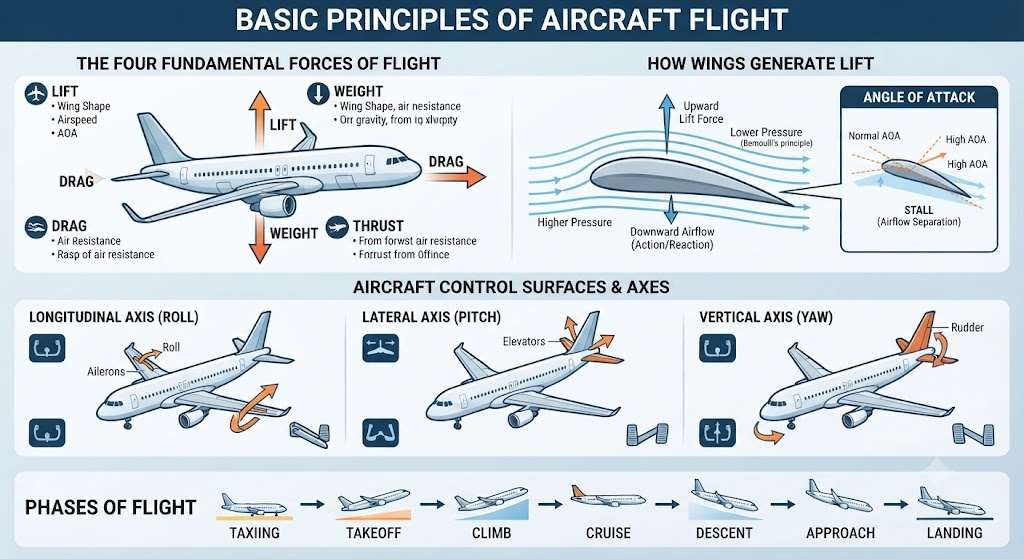
Every aircraft in flight is affected by four main forces. These forces work together during takeoff, climb, cruise, descent, and landing.
The four forces of flight are:
- Lift
- Weight
- Thrust
- Drag
A safe and stable flight depends on how these forces balance each other.
Lift
Lift is the upward force that allows an aircraft to rise into the air and stay there. It is mainly produced by the wings.
Aircraft wings are shaped like airfoils. When air flows over and under the wing, pressure differences and airflow direction help create lift. The wing also pushes air downward, and in response, the aircraft is pushed upward.
Lift is affected by:
- Wing shape
- Airspeed
- Air density
- Angle of attack
- Wing surface area
- Aircraft weight
During takeoff, the aircraft must reach enough speed for the wings to generate the lift needed to leave the runway. During cruise, lift usually balances the aircraft’s weight.
Weight
Weight is the downward force caused by gravity. It pulls the aircraft toward the Earth. The total weight of an aircraft includes the aircraft structure, fuel, passengers, cargo, and equipment.
Weight affects aircraft performance. A heavier aircraft needs more lift, more runway distance, and more engine power. This is why pilots must carefully calculate weight and balance before flight.
Important weight-related factors include:
- Total aircraft weight
- Fuel load
- Passenger load
- Cargo distribution
- Center of gravity
- Maximum takeoff weight
If weight is not properly managed, the aircraft may become difficult or unsafe to control.
Thrust
Thrust is the forward force that moves an aircraft through the air. It is produced by engines. Without thrust, the aircraft cannot maintain forward speed, and without forward speed, the wings cannot produce enough lift.
Different aircraft produce thrust in different ways:
- Propeller aircraft use rotating blades to pull or push air backward.
- Jet aircraft use powerful engines to accelerate air and gases backward.
- Turboprop aircraft combine turbine engines with propellers.
- Turbofan engines are commonly used in modern commercial airplanes.
Thrust is especially important during takeoff and climb because the aircraft needs strong forward motion to gain speed and altitude.
Drag
Drag is the force that opposes the aircraft’s forward motion. It acts backward against thrust. Drag is caused by air resistance as the aircraft moves through the atmosphere.
There are different types of drag:
- Parasite drag
- Induced drag
- Form drag
- Skin friction drag
- Interference drag
Aircraft designers try to reduce drag by creating smooth, streamlined shapes. Lower drag improves fuel efficiency, speed, and performance.
During flight, thrust must overcome drag. In level cruise flight, thrust and drag are usually balanced.
How Wings Generate Lift
Wings are the most important part of a fixed-wing aircraft when it comes to lift generation. The cross-section shape of a wing is called an airfoil.
An airfoil is designed to guide airflow smoothly. When an aircraft moves forward, air travels around the wing. The wing’s shape, angle, and speed help create a pressure difference and downward airflow, both of which contribute to lift.
Angle of Attack
Angle of attack is the angle between the wing and the oncoming airflow. Increasing the angle of attack can increase lift up to a certain point.
However, if the angle becomes too high, airflow can separate from the wing surface. This causes a sudden loss of lift known as a stall.
Student pilots must understand angle of attack because it affects takeoff, climb, turns, slow flight, and landing.
Stall
A stall happens when the wing no longer produces enough lift due to excessive angle of attack. A stall does not mean the engine has stopped. It means the airflow over the wing has become disturbed and lift has decreased.
Common causes of stalls include:
- Flying too slowly
- Pulling the nose up too much
- Turning steeply at low speed
- Improper landing approach
- Poor aircraft control
Pilots are trained to recognize and recover from stalls safely.
Aircraft Control Surfaces
Aircraft control surfaces help pilots control movement around three axes. These surfaces move airflow and change the aircraft’s attitude.
Ailerons
Ailerons are located on the outer trailing edges of the wings. They control roll. When one aileron moves up and the other moves down, the aircraft rolls left or right.
Ailerons are used during turns and banked flight.
Elevators
Elevators are usually located on the horizontal tail. They control pitch, which is the up-and-down movement of the aircraft’s nose.
When the pilot pulls back on the control column, the elevator changes position and the nose rises. When the pilot pushes forward, the nose lowers.
Rudder
The rudder is located on the vertical tail. It controls yaw, which is the left-and-right movement of the aircraft’s nose.
The rudder helps coordinate turns, maintain directional control, and manage certain engine-related effects.
Flaps
Flaps are located on the trailing edges of the wings. They increase lift and drag, allowing the aircraft to fly safely at lower speeds.
Flaps are commonly used during takeoff and landing.
Slats
Slats are located on the leading edge of some wings. They help improve airflow over the wing at high angles of attack and low speeds.
Slats are useful during takeoff, approach, and landing.
Spoilers
Spoilers are panels on the wings that reduce lift and increase drag. They are used during descent, landing, and sometimes during turns.
After landing, spoilers help the aircraft settle firmly on the runway.
Trim Tabs
Trim tabs are small adjustable surfaces that help reduce pilot workload. They allow the aircraft to maintain a desired attitude without constant control pressure.
Trim is especially useful during long flights.
Three Axes of Aircraft Movement
An aircraft moves around three main axes:
- Longitudinal axis
- Lateral axis
- Vertical axis
Each axis is controlled by a specific control surface.
Roll
Roll is movement around the longitudinal axis, which runs from the nose to the tail. Ailerons control roll.
Roll is used when the aircraft banks into a turn.
Pitch
Pitch is movement around the lateral axis, which runs from wingtip to wingtip. Elevators control pitch.
Pitch affects climb, descent, and airspeed.
Yaw
Yaw is movement around the vertical axis. The rudder controls yaw.
Yaw helps align the aircraft’s nose and coordinate movement during flight.
Phases of Flight
Aircraft flight is divided into several phases. Each phase requires different pilot actions and aircraft performance.
Taxiing
Taxiing is the movement of the aircraft on the ground before takeoff or after landing. During taxi, pilots use engine power, brakes, and steering controls to move safely.
Takeoff
Takeoff begins when the aircraft accelerates along the runway. As speed increases, the wings generate more lift. When enough lift is produced, the aircraft leaves the ground.
Climb
During climb, the aircraft gains altitude. The pilot manages pitch, power, airspeed, and direction to reach the desired altitude safely.
Cruise
Cruise is the main part of the flight where the aircraft flies at a steady altitude and speed. During cruise, lift balances weight, and thrust balances drag.
Descent
Descent is when the aircraft reduces altitude. The pilot adjusts power, pitch, and speed to descend safely and efficiently.
Approach
Approach is the phase before landing. The aircraft lines up with the runway and slows down. Flaps and landing gear are often used during this phase.
Landing
Landing is when the aircraft touches down on the runway and slows to taxi speed. This phase requires careful control of speed, descent rate, and alignment.
Aircraft Stability and Control
Aircraft stability means the aircraft’s ability to return to a balanced condition after being disturbed. Good stability helps make flight smoother and safer.
Longitudinal Stability
Longitudinal stability relates to pitch movement. It helps prevent the aircraft nose from moving too far up or down.
Lateral Stability
Lateral stability relates to roll movement. It helps the aircraft resist unwanted rolling motion.
Directional Stability
Directional stability relates to yaw movement. It helps keep the aircraft pointed in the correct direction.
Static and Dynamic Stability
Static stability is the aircraft’s first reaction after being disturbed. Dynamic stability is how the aircraft behaves over time after that disturbance.
A well-designed aircraft should be stable enough for safe flight but still responsive enough for control.
Factors That Affect Aircraft Flight
Many external and internal factors affect how an aircraft performs.
Air Density
Air density affects lift, engine performance, and propeller efficiency. Dense air helps aircraft perform better, while thin air reduces performance.
Weather
Weather has a major impact on flight. Wind, rain, storms, clouds, and turbulence can affect safety and comfort.
Temperature
High temperature reduces air density. This can increase takeoff distance and reduce climb performance.
Altitude
At higher altitudes, the air becomes thinner. Aircraft engines and wings may perform differently in thin air.
Aircraft Weight
A heavier aircraft needs more lift and more runway distance. Proper weight planning is essential for safe flight.
Wind
Headwinds, tailwinds, and crosswinds affect takeoff, landing, and navigation. Pilots must understand wind direction and speed before flight.
Runway Conditions
Wet, icy, short, or rough runways affect aircraft performance. Pilots must calculate whether the aircraft can take off and land safely.
Aircraft Engines and Their Role in Flight
Engines produce the thrust needed for flight. Different aircraft use different types of engines depending on size, speed, range, and purpose.
Piston Engines
Piston engines are commonly used in small training aircraft. They work similarly to car engines and usually drive a propeller.
Turboprop Engines
Turboprop engines use a turbine to drive a propeller. They are efficient for short and medium-distance flights.
Turbojet Engines
Turbojet engines produce thrust by accelerating air through a turbine system. They are powerful but less common in modern passenger aircraft compared to turbofans.
Turbofan Engines
Turbofan engines are widely used in commercial airplanes. They are efficient, powerful, and suitable for high-speed flight.
Importance of Aerodynamics
Aerodynamics is the study of how air moves around objects. In aviation, aerodynamics explains how aircraft generate lift, reduce drag, and remain stable.
Important aerodynamic concepts include:
- Air pressure
- Airflow
- Wing shape
- Drag reduction
- Lift generation
- Streamlined design
- Flight efficiency
A good understanding of aerodynamics helps pilots fly more safely and helps engineers design better aircraft.
Common Flight Instruments
Flight instruments help pilots understand aircraft position, speed, altitude, direction, and performance.
Airspeed Indicator
The airspeed indicator shows how fast the aircraft is moving through the air. It helps pilots maintain safe speeds during all phases of flight.
Altimeter
The altimeter shows aircraft altitude above sea level. It is essential for navigation, terrain clearance, and air traffic control instructions.
Vertical Speed Indicator
The vertical speed indicator shows whether the aircraft is climbing or descending and how quickly.
Attitude Indicator
The attitude indicator shows the aircraft’s position compared to the horizon. It is very useful during poor visibility or instrument flight.
Heading Indicator
The heading indicator shows the aircraft’s direction. It helps pilots navigate accurately.
Turn Coordinator
The turn coordinator shows the rate and coordination of a turn. It helps pilots make smooth and balanced turns.
Magnetic Compass
The magnetic compass provides basic direction using Earth’s magnetic field. It is simple but important as a backup instrument.
Safety Principles in Aircraft Flight
Safety is the foundation of aviation. Every flight depends on preparation, discipline, maintenance, and correct decision-making.
Important safety principles include:
- Pre-flight inspection
- Weather planning
- Weight and balance calculation
- Fuel planning
- Aircraft maintenance
- Pilot training
- Emergency procedures
- Air traffic communication
- Checklist usage
Pilots use checklists to reduce mistakes and ensure that important steps are not missed.
Common Misconceptions About Aircraft Flight
Heavy Airplanes Cannot Fly
Large aircraft can fly because their wings generate enough lift to support their weight. Size alone does not prevent flight.
Engines Keep Airplanes in the Air
Engines provide thrust, but wings generate lift. If an engine fails, many aircraft can still glide for a period of time.
Airplanes Fly Only Because Air Moves Faster Over the Wing
Airflow speed is part of the explanation, but lift also depends on pressure differences, wing angle, and downward airflow.
Bigger Wings Always Mean Better Performance
Bigger wings can create more lift, but they may also create more drag. Aircraft design must balance lift, drag, speed, and efficiency.
Flying Is Completely Automated
Modern aircraft have advanced automation, but pilots are still essential. They manage systems, make decisions, communicate, and handle unexpected situations.
Tips for Student Pilots
Student pilots should build strong fundamentals from the beginning. Understanding how aircraft fly makes training easier and safer.
Helpful tips include:
- Study the four forces of flight
- Understand angle of attack
- Learn aircraft control surfaces
- Practice with flight simulators
- Build strong communication skills
- Study weather basics
- Use checklists carefully
- Ask questions during training
- Review flight lessons regularly
- Prioritize safety over speed
Good pilots are not only skilled at flying. They are also disciplined learners and safe decision-makers.
Future of Aircraft Flight
Aircraft flight is continuing to evolve. New technologies are changing how aircraft are designed, powered, and operated.
Future developments may include:
- Electric aircraft
- Hybrid propulsion
- Sustainable aviation fuels
- Advanced cockpit systems
- Autonomous flight technology
- Improved flight simulators
- Smart maintenance systems
- More efficient wing designs
- Artificial intelligence in aviation
Even as aviation technology changes, the basic principles of aircraft flight will remain important. Lift, weight, thrust, drag, stability, and control will continue to form the foundation of safe flying.
FAQs
1. What are the four forces of flight?
The four forces of flight are lift, weight, thrust, and drag. Lift pushes the aircraft upward, weight pulls it downward, thrust moves it forward, and drag resists forward motion. Safe flight depends on balancing these forces correctly.
2. How do airplanes generate lift?
Airplanes generate lift mainly through their wings. As air flows around the wing, the wing shape and angle create pressure differences and direct air downward. This produces an upward force that allows the aircraft to fly.
3. Why is thrust important in flight?
Thrust moves the aircraft forward through the air. Without enough thrust, the aircraft cannot maintain the airspeed needed for lift. Engines produce thrust using propellers, turbines, or jet systems.
4. What causes drag on an aircraft?
Drag is caused by air resistance as the aircraft moves through the atmosphere. It depends on aircraft shape, speed, surface smoothness, and wing design. Reducing drag improves performance and fuel efficiency.
5. What is an airfoil?
An airfoil is the curved shape of a wing when viewed from the side. It is designed to manage airflow and help produce lift. Airfoils are important in wings, propellers, and some control surfaces.
6. What happens during a stall?
A stall happens when the wing exceeds its safe angle of attack and airflow separates from the wing surface. This reduces lift and can cause the aircraft to descend. Pilots are trained to recognize and recover from stalls.
7. How do aircraft control surfaces work?
Control surfaces change airflow around the aircraft. Ailerons control roll, elevators control pitch, and the rudder controls yaw. Other surfaces like flaps, slats, and spoilers help during takeoff, landing, and descent.
8. Why is aircraft balance important?
Aircraft balance affects stability and control. If weight is not distributed properly, the aircraft may become difficult to fly. Pilots calculate weight and balance before flight to ensure safe operation.
9. What role does aerodynamics play in aviation?
Aerodynamics explains how air moves around an aircraft. It helps determine lift, drag, stability, speed, and fuel efficiency. Good aerodynamic design makes aircraft safer and more efficient.
10. Can large aircraft really stay in the air?
Yes, large aircraft can stay in the air because their wings are designed to create enough lift for their weight. Powerful engines provide thrust, while flight controls and stable design help maintain safe flight.
Conclusion
The basic principles of aircraft flight explain how airplanes rise, move, turn, climb, descend, and land safely. These principles are built around the four forces of flight: lift, weight, thrust, and drag. Along with aerodynamics, control surfaces, stability, engines, instruments, and pilot decision-making, they form the foundation of aviation.
For student pilots and aviation learners, understanding these fundamentals is the first step toward safe and confident flying. Technology may continue to change aircraft design and cockpit systems, but the science of flight will always remain at the heart of aviation.

