
Introduction
The heading indicator is one of the key flight instruments that helps pilots know the direction of the aircraft. For beginner pilots, it is an important instrument because it supports navigation, turns, and communication with air traffic control.
This guide explains the Heading Indicator Explained for Beginners topic in simple language. You will learn what a heading indicator is, how it works, how to read it, and why it is important during flight training.
What Is a Heading Indicator?
A heading indicator is a cockpit instrument that shows the aircraft’s heading. Heading means the direction in which the nose of the aircraft is pointing.
The heading is usually shown in degrees from 000 to 360.
For example:
- 000 or 360 degrees means north
- 090 degrees means east
- 180 degrees means south
- 270 degrees means west
The heading indicator is also called a directional gyro or DG in many training aircraft.
Why Is the Heading Indicator Important for Beginners?
Beginner pilots must learn the heading indicator because flying is not only about altitude and speed. Direction control is equally important.
The heading indicator helps pilots:
- Maintain a selected direction
- Make accurate turns
- Follow navigation routes
- Fly assigned headings from ATC
- Improve situational awareness
- Reduce confusion during training
- Support safe cross-country flying
Without good heading control, a student pilot may drift away from the planned route, miss checkpoints, or become confused during navigation.
How Does a Heading Indicator Work?
Traditional heading indicators work with a gyroscope. A gyroscope stays stable while the aircraft turns around it. This allows the instrument to show changes in aircraft direction.
However, a traditional heading indicator does not automatically know magnetic north. That is why pilots must align it with the magnetic compass before flight and check it during flight.
Over time, the heading indicator may slowly become inaccurate. This is called gyro drift. Because of this, pilots must cross-check and reset it when needed.
Modern glass cockpit aircraft may use electronic heading displays. These systems may get heading information from magnetometers, sensors, or advanced navigation systems.
What Does the Heading Indicator Show?
The heading indicator shows the direction the aircraft nose is pointing.
It commonly displays:
- Aircraft heading
- Direction in degrees
- North, east, south, and west references
- Turn movement
- Selected heading, if a heading bug is available
Some heading indicators also have a small movable marker called a heading bug. Pilots can set it to a desired heading as a reminder.
Main Parts of a Heading Indicator
A beginner pilot should know the basic parts of the heading indicator.
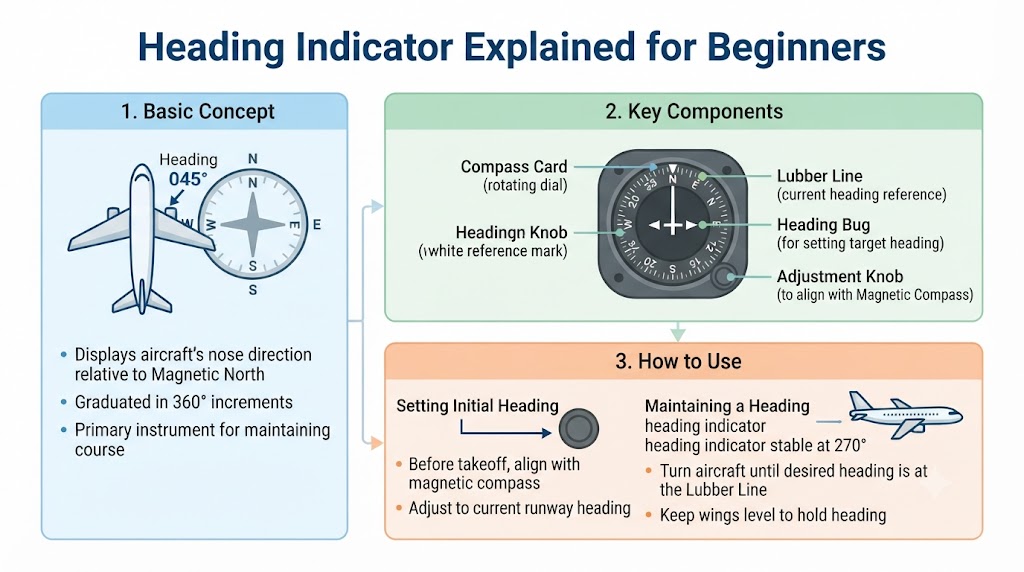
Compass Card
The compass card shows numbers and direction markings. It rotates as the aircraft turns.
Aircraft Symbol
The aircraft symbol usually stays fixed in the center. It helps the pilot see the aircraft’s current heading.
Lubber Line
The lubber line is the reference mark at the top of the instrument. The heading under this line is the current aircraft heading.
Direction Markings
The markings show directions such as north, east, south, and west. Numbers are used to show headings in degrees.
Adjustment Knob
The adjustment knob is used to align the heading indicator with the magnetic compass.
Heading Bug
Some aircraft have a heading bug that can be moved to mark a desired heading.
Digital Heading Display
Modern aircraft may show heading information on a digital flight display.
How to Read a Heading Indicator
Reading a heading indicator is simple with practice.
First, look at the number under the lubber line. That number is the aircraft’s current heading.
For example:
- If the lubber line points to 090, the aircraft is heading east.
- If it points to 180, the aircraft is heading south.
- If it points to 270, the aircraft is heading west.
- If it points to 360 or 000, the aircraft is heading north.
During turns, the compass card moves to show the changing heading. The pilot stops the turn when the desired heading reaches the lubber line.
Heading Indicator Use During Different Flight Phases
The heading indicator is useful throughout flight.
Pre-Flight Checks
Before flight, the pilot checks that the heading indicator is working and aligns it with the magnetic compass.
Taxi and Run-Up
During taxi, the pilot may check that the heading indicator moves correctly during turns.
Takeoff
After takeoff, the heading indicator helps the pilot maintain runway heading or follow a departure direction.
Climb
During climb, the pilot uses it to maintain the assigned or planned heading.
Cruise
During cruise, the heading indicator helps with route navigation and direction control.
Turns
During turns, the pilot uses it to roll out on the correct heading.
Navigation
For cross-country flying, the heading indicator helps the pilot follow planned headings between checkpoints.
Approach and Landing
During approach, it helps maintain correct direction, especially when following ATC instructions or instrument procedures.
Heading Indicator vs Magnetic Compass
The heading indicator and magnetic compass both help with direction, but they are not the same.
The magnetic compass points toward magnetic north. It is simple and does not need electrical or vacuum power in many aircraft. However, it can be harder to read during turns, acceleration, or turbulence.
The heading indicator is easier to read and more stable during normal flight. But it can drift over time and must be aligned with the magnetic compass.
So, the magnetic compass is the reference, and the heading indicator is the easier instrument to use during flight.
Heading Indicator vs Turn Coordinator
The heading indicator shows the aircraft’s direction.
The turn coordinator shows the rate and coordination of a turn.
For example, if a pilot turns left, the heading indicator shows the changing heading. The turn coordinator helps show whether the turn is smooth and coordinated.
Beginner pilots should use both instruments as part of a full scan.
Common Mistakes Beginner Pilots Make
New pilots often make small mistakes while using the heading indicator.
Forgetting to Align It
A common mistake is forgetting to align the heading indicator with the magnetic compass before takeoff.
Ignoring Gyro Drift
Traditional heading indicators can drift over time. If the pilot does not check it, the displayed heading may become inaccurate.
Confusing Heading With Track
Heading is where the aircraft nose points. Track is the actual path over the ground. Wind can make these different.
Over-Controlling During Turns
Some students turn too fast or make sudden corrections. Smooth control is better.
Ignoring Wind Correction
A pilot may maintain the correct heading but still drift off course because of wind.
Staring Only at the Heading Indicator
Pilots must also scan the altimeter, airspeed indicator, attitude indicator, VSI, and outside references.
Safety Tips for Using the Heading Indicator
Here are simple safety tips for beginner pilots:
- Align the heading indicator before takeoff
- Cross-check it with the magnetic compass
- Recheck during cruise flight
- Understand gyro drift
- Use smooth turns to reach assigned headings
- Do not confuse heading with track
- Apply wind correction when needed
- Use it as part of a full instrument scan
- Follow instructor and ATC guidance
Good direction control comes from both instrument knowledge and regular practice.
Real-Life Example for Beginner Pilots
Imagine a beginner pilot is flying east on a heading of 090 degrees. The instructor says, “Turn right heading 180.”
The student checks the heading indicator, starts a smooth right turn, and watches the numbers change. As the heading approaches 180, the student begins to level the wings and stops the turn on the new heading.
This simple exercise teaches direction control, smooth turning, and heading awareness.
Why Practice Builds Better Navigation Skills
Practicing with the heading indicator helps beginner pilots improve navigation and cockpit confidence.
Regular practice helps students:
- Maintain accurate headings
- Make smoother turns
- Improve route awareness
- Follow ATC instructions better
- Understand wind correction
- Build stronger instrument scan habits
- Prepare for cross-country flights
The heading indicator may look simple, but it plays a big role in safe and accurate flying.
FAQs About Heading Indicator
1. What is a heading indicator in an aircraft?
A heading indicator is a flight instrument that shows the direction the aircraft nose is pointing, usually in degrees from 000 to 360.
2. Why is the heading indicator important for beginner pilots?
It helps beginner pilots maintain direction, make turns, follow navigation routes, and respond to ATC heading instructions.
3. What does a heading indicator show?
It shows aircraft heading, direction in degrees, and sometimes a selected heading if the aircraft has a heading bug.
4. How does a heading indicator work?
A traditional heading indicator uses a gyroscope to show direction changes. It must be aligned with the magnetic compass.
5. What is the difference between heading indicator and magnetic compass?
The magnetic compass points to magnetic north. The heading indicator is easier to read during flight but can drift and must be corrected.
6. Why must pilots align the heading indicator?
Pilots align it because traditional heading indicators can drift and do not automatically stay matched with magnetic north.
7. What is gyro drift in a heading indicator?
Gyro drift is the gradual error that develops in a gyroscope-based heading indicator over time.
8. What is the difference between heading and track?
Heading is where the aircraft nose points. Track is the actual path the aircraft follows over the ground. Wind can make them different.
9. How do pilots use the heading indicator during turns?
Pilots watch the heading change during the turn and stop the turn when the desired heading reaches the reference mark.
10. How can aviation students practice heading indicator reading?
They can practice during simulator sessions, flight lessons, heading-change exercises, navigation training, and instructor-guided turns.
Final Thoughts
The Heading Indicator Explained for Beginners topic is important for every new pilot learning aircraft instruments. The heading indicator shows the direction the aircraft nose is pointing and helps pilots fly accurate headings.
Beginner pilots should learn how to read it, align it, cross-check it, and use it during turns and navigation.
When used correctly with the magnetic compass and other flight instruments, the heading indicator helps pilots fly with better control, accuracy, and confidence.

