
Introduction
The attitude indicator is one of the most important cockpit instruments for new pilots. It helps a pilot understand the aircraft’s position in relation to the horizon.
In simple words, it shows whether the aircraft nose is up, nose is down, wings are level, or the aircraft is banking left or right. This makes it very useful during climb, descent, turns, and instrument flying.
This Attitude Indicator Guide for New Pilots explains what the instrument is, how it works, how to read it, and why every aviation student should learn it carefully.
What Is an Attitude Indicator?
An attitude indicator is a flight instrument that shows the aircraft’s attitude. In aviation, “attitude” means the position of the aircraft in relation to the horizon.
It mainly shows two things:
- Pitch: whether the aircraft nose is up or down
- Bank: whether the aircraft is turning or tilted left or right
The attitude indicator is also called the artificial horizon because it gives pilots a horizon reference even when the real horizon is not visible.
Why Is the Attitude Indicator Important for New Pilots?
New pilots must understand the attitude indicator because aircraft control depends on pitch and bank awareness.
This instrument helps pilots:
- Maintain level flight
- Control climbs and descents
- Make smooth turns
- Avoid unusual aircraft positions
- Fly safely in poor visibility
- Improve instrument scanning
- Build confidence during flight training
When clouds, haze, darkness, or poor visibility hide the outside horizon, the attitude indicator becomes very important for safe aircraft control.
How Does an Attitude Indicator Work?
Traditional attitude indicators use a gyroscope. A gyroscope stays stable while the aircraft moves around it. This allows the instrument to show the aircraft’s pitch and bank position.
Modern aircraft may use electronic systems instead of a mechanical gyroscope. These systems display attitude information on a digital flight screen.
The basic purpose is the same in both types: to show the pilot how the aircraft is positioned compared to the horizon.
Main Parts of an Attitude Indicator
A standard attitude indicator has several parts that new pilots should recognize.
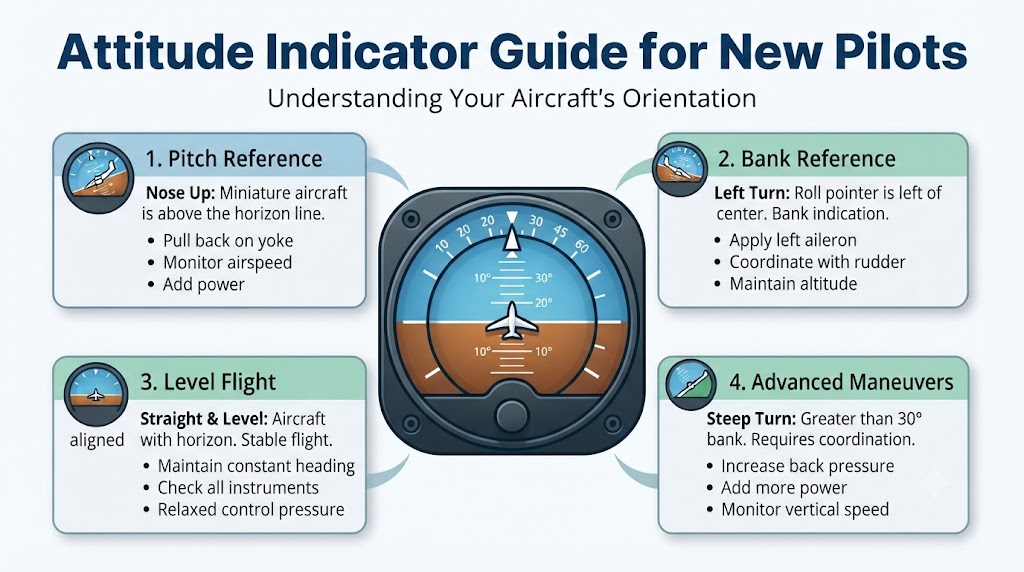
Artificial Horizon Line
This line separates the sky and ground display. It represents the horizon.
Aircraft Symbol
The small aircraft symbol stays in the center. Pilots compare this symbol with the horizon line to understand pitch and bank.
Pitch Scale
The pitch scale shows nose-up or nose-down attitude. It helps the pilot control climb and descent.
Bank Scale
The bank scale shows how much the aircraft is banking left or right.
Sky and Ground Display
The upper part usually represents the sky, and the lower part represents the ground. This helps pilots quickly understand aircraft attitude.
Adjustment Knob
Some attitude indicators have a knob to adjust the aircraft symbol for pilot comfort and correct reference.
How to Read an Attitude Indicator
- Reading the attitude indicator becomes easy with practice.
- If the aircraft symbol is aligned with the horizon line, the aircraft is usually in level flight.
- If the nose is above the horizon line, the aircraft is in a nose-up attitude. This is often seen during climb.
- If the nose is below the horizon line, the aircraft is in a nose-down attitude. This is often seen during descent.
- If the wings are tilted left, the aircraft is banking left. If the wings are tilted right, the aircraft is banking right.
Attitude Indicator During Different Flight Phases
The attitude indicator is useful during almost every phase of flight.
Pre-Flight Checks
Before flight, pilots check that the attitude indicator is working correctly and shows a normal level position when the aircraft is parked.
Takeoff
During takeoff, pilots use outside references first, but the attitude indicator helps confirm correct pitch after rotation.
Climb
In climb, the attitude indicator helps maintain a steady nose-up position.
Cruise
During cruise, it helps maintain level flight and avoid unwanted bank or pitch changes.
Turns
During turns, the attitude indicator shows bank angle and helps the pilot make smooth, controlled turns.
Descent
During descent, it helps control nose-down attitude and maintain a stable descent.
Approach and Landing
During approach, pilots use the attitude indicator along with airspeed, altimeter, VSI, and outside references to maintain a stable approach.
Attitude Indicator vs Altimeter
New pilots often confuse attitude and altitude because the words sound similar.
The attitude indicator shows the aircraft’s position compared to the horizon. It tells whether the nose is up, nose down, or the aircraft is banking.
The altimeter shows the aircraft’s current altitude. It tells how high the aircraft is above a reference level.
So, the attitude indicator answers: What position is the aircraft in?
The altimeter answers: How high is the aircraft?
Attitude Indicator vs Turn Coordinator
The attitude indicator and turn coordinator are also different.
The attitude indicator shows pitch and bank. The turn coordinator shows the rate and quality of turn.
For example, during a left turn, the attitude indicator shows that the aircraft is banking left. The turn coordinator helps show whether the turn is coordinated or not.
New pilots should learn to use both instruments together.
Common Mistakes New Pilots Make
New pilots often make small mistakes while learning this instrument.
Staring Only at the Attitude Indicator
The attitude indicator is important, but pilots should not focus only on it. They must scan all important instruments.
Ignoring Airspeed and Altitude
A correct attitude does not always mean correct airspeed or altitude. Pilots must cross-check with the airspeed indicator and altimeter.
Over-Controlling the Aircraft
New pilots may make large control inputs after seeing small pitch or bank changes. Smooth corrections are better.
Confusing Attitude With Altitude
Attitude means aircraft position. Altitude means height. These are different concepts.
Poor Instrument Scan
A weak scan can cause pilots to miss changes in heading, altitude, or airspeed.
Safety Tips for Using the Attitude Indicator
New pilots can use these simple tips during training:
- Use the attitude indicator as part of a full instrument scan
- Cross-check it with airspeed, altimeter, VSI, and heading indicator
- Make small and smooth control corrections
- Do not stare at one instrument for too long
- Learn normal pitch attitudes for climb, cruise, and descent
- Practice with instructor guidance
- Trust instruments during poor visibility
- Avoid sudden control movements
Good flying comes from understanding the full aircraft picture, not just one instrument.
Real-Life Training Example
Imagine a new pilot is flying during a basic training lesson. The instructor asks the student to maintain level flight.
The student checks the attitude indicator and sees that one wing is slightly low. The aircraft is banking right. The student gently corrects the bank and brings the aircraft symbol back level with the horizon line.
Later, during climb practice, the student uses the attitude indicator to hold a steady nose-up attitude while also checking airspeed and altitude.
This simple example shows how the attitude indicator supports safe and smooth aircraft control.
Why Practice Builds Better Flying Skills
Regular practice with the attitude indicator helps new pilots become more confident.
It improves:
- Aircraft control
- Instrument scan
- Pitch awareness
- Bank awareness
- Smooth turns
- Stable climbs and descents
- Safety during poor visibility
The more a student uses the attitude indicator correctly, the easier it becomes to understand aircraft movement.
FAQs About Attitude Indicator
1. What is an attitude indicator in an aircraft?
An attitude indicator is a flight instrument that shows the aircraft’s pitch and bank position compared to the horizon.
2. Why is the attitude indicator important for new pilots?
It helps new pilots control the aircraft, maintain level flight, make turns, and fly safely when the real horizon is not visible.
3. What does an attitude indicator show?
It shows whether the aircraft nose is up, nose down, wings level, or banking left or right.
4. How does an attitude indicator work?
Traditional attitude indicators use a gyroscope. Modern systems may use electronic sensors and digital displays.
5. What is the artificial horizon?
The artificial horizon is another name for the attitude indicator. It gives pilots a horizon reference inside the cockpit.
6. What is the difference between attitude and altitude?
Attitude means aircraft position in relation to the horizon. Altitude means aircraft height above a reference level.
7. How do pilots use the attitude indicator in turns?
Pilots use it to check bank angle and keep the turn smooth and controlled.
8. Can pilots fly safely without checking the attitude indicator?
In visual conditions, pilots may use outside references, but the attitude indicator remains important. In poor visibility, it becomes essential.
9. What mistakes do new pilots make with the attitude indicator?
Common mistakes include staring at it too long, over-controlling, ignoring other instruments, and confusing attitude with altitude.
10. How can aviation students practice reading the attitude indicator?
They can practice during flight lessons, simulator sessions, instrument scan exercises, and instructor-guided cockpit training.
Final Thoughts
The Attitude Indicator Guide for New Pilots is an important topic for every aviation student. This instrument helps pilots understand pitch, bank, level flight, climb, descent, and turns.
It is simple to read, but very important for safe flying. New pilots should use it with other instruments, not alone.
When practiced properly, the attitude indicator helps pilots fly smoothly, stay aware, and build strong cockpit confidence.

