
Introduction
Have you ever looked at a large airplane flying high above the clouds and wondered how something so heavy can stay in the sky? Aircraft may look massive, but they fly because of science, design, speed, and carefully balanced forces.
An aircraft does not fly by magic. It flies because its wings, engines, shape, and control systems work together to move air in a useful way. The basic idea behind flight is simple: an aircraft must create enough lift to overcome its weight and enough thrust to move forward through the air.
In this blog, we will explain how aircraft fly in the sky in simple language. You will learn about the four forces of flight, how wings generate lift, how engines create thrust, and how pilots control an aircraft during takeoff, flight, and landing.
What Makes Aircraft Flight Possible?
Aircraft flight is possible because of a few important factors:
Air is the medium through which aircraft move. Even though air is invisible, it has weight and pressure. When an aircraft moves through air at high speed, the air flows around its wings and body.
Wings are specially shaped to create lift. They are not flat boards. Their curved design helps air move in a way that produces upward force.
Engines provide thrust. Thrust moves the aircraft forward, allowing air to flow over the wings.
Speed is important because wings need airflow to generate lift. Without enough speed, the aircraft cannot stay in the air.
Gravity pulls the aircraft downward, so the aircraft must produce enough lift to balance or overcome that downward pull.
These elements work together through the four forces of flight.
The Four Forces of Flight
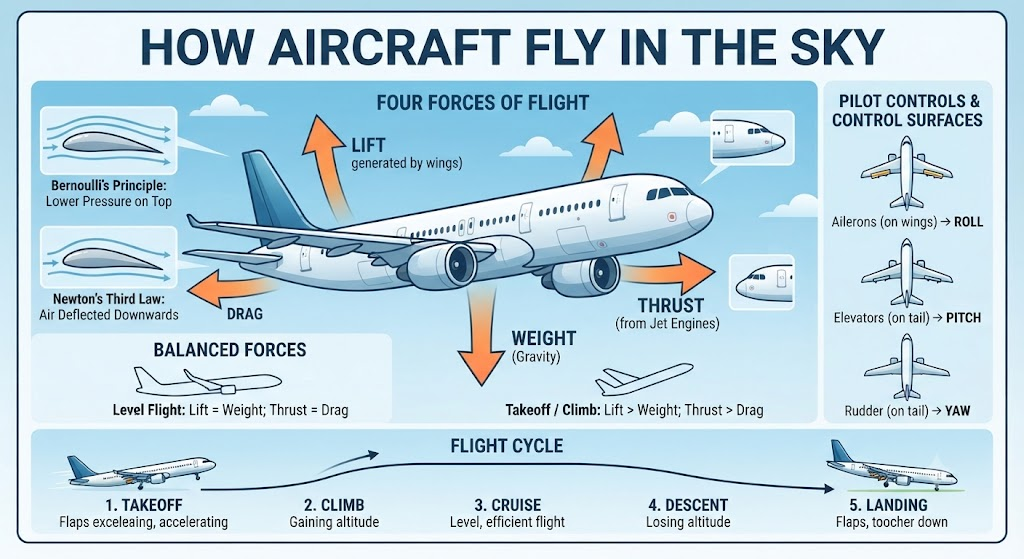
Every aircraft in the sky is affected by four main forces:
1- Lift
2- Weight
3- Thrust
4- Drag
For smooth flight, these forces must be balanced properly.
1- Lift
Lift is the upward force that helps an aircraft rise into the sky and stay there. It is mainly produced by the wings.
When an aircraft moves forward, air flows over and under the wings. Because of the wing’s shape, air moves differently on the upper and lower surfaces. This creates a pressure difference. Lower pressure above the wing and higher pressure below the wing help push the aircraft upward.
Lift must be strong enough to overcome the aircraft’s weight. During takeoff, the aircraft accelerates until the wings produce enough lift to leave the ground.
2- Weight
Weight is the downward force caused by gravity. It includes the weight of the aircraft, passengers, fuel, cargo, and equipment.
Gravity always pulls the aircraft toward Earth. To fly, the aircraft must create lift that is equal to or greater than its weight.
This is why aircraft design is so important. Engineers try to make aircraft strong but not unnecessarily heavy. Lighter materials, efficient structures, and smart design help improve flight performance.
3- Thrust
Thrust is the forward force that moves an aircraft through the air. It is created by engines.
Jet aircraft use jet engines or turbofan engines to push air backward at high speed. According to Newton’s Third Law, when air is pushed backward, the aircraft moves forward.
Propeller aircraft use spinning propellers to pull or push air backward. This also creates forward motion.
Without thrust, an aircraft would slow down. If it slows too much, the wings may not produce enough lift.
4- Drag
Drag is air resistance. It acts opposite to the direction of motion and tries to slow the aircraft down.
Every aircraft experiences drag because it moves through air. The faster it moves, the more drag it faces.
Aircraft engineers reduce drag by designing smooth bodies, streamlined shapes, clean wings, retractable landing gear, and winglets. Less drag means better speed, fuel efficiency, and performance.
How Aircraft Wings Generate Lift
The wing is one of the most important parts of an aircraft. Its shape is called an airfoil.
An airfoil usually has a curved upper surface and a flatter lower surface. As air flows around the wing, the airflow over the top surface often moves faster than the airflow below. Faster-moving air creates lower pressure above the wing. Higher pressure below the wing pushes upward.
This upward force is lift.
A simple way to understand it is this: the wing guides air in a way that creates upward force. The aircraft moves forward, the wings interact with air, and lift is produced.
Bernoulli’s Principle in Simple Words
Bernoulli’s Principle helps explain part of how lift works.
It says that when air moves faster, its pressure becomes lower. On an aircraft wing, air moving over the curved top surface can move faster than air below the wing. This creates lower pressure above and higher pressure below.
The pressure difference helps lift the aircraft upward.
However, Bernoulli’s Principle is not the only explanation. Newton’s laws also play an important role.
Newton’s Third Law and Flight
Newton’s Third Law says: for every action, there is an equal and opposite reaction.
Aircraft wings push air downward as they move forward. In return, the air pushes the wings upward. This upward reaction contributes to lift.
So, aircraft fly because of both pressure differences and the downward movement of air. Bernoulli’s Principle and Newton’s Third Law work together to explain flight.
Role of Aircraft Engines
Engines do not directly “hold” the aircraft in the sky. Their main job is to create thrust.
Thrust moves the aircraft forward. Forward movement creates airflow over the wings. The wings then generate lift.
Different aircraft use different engines:
Jet Engines
Jet engines take in air, compress it, mix it with fuel, burn it, and push hot gases backward. This creates powerful forward thrust.
Turbofan Engines
Turbofan engines are common in commercial aircraft. They are efficient, powerful, and quieter than older jet engines.
Turboprop Engines
Turboprop engines use a turbine to drive a propeller. They are often used in regional aircraft and are efficient for shorter routes.
Piston Engines
Piston engines are common in small training aircraft. They work somewhat like car engines and turn a propeller to create thrust.
Why Aircraft Do Not Fall During Flight
Aircraft do not fall during normal flight because lift balances weight and thrust keeps the aircraft moving forward.
As long as the aircraft maintains enough speed and proper wing angle, airflow over the wings continues to produce lift.
During steady level flight:
Lift balances weight.
Thrust balances drag.
If these forces remain balanced, the aircraft flies smoothly.
How Pilots Control an Aircraft
Pilots control aircraft using control surfaces. These are movable parts on the wings and tail.
Ailerons
Ailerons are located on the wings. They help the aircraft roll left or right.
Elevators
Elevators are on the horizontal tail. They control the aircraft’s nose-up and nose-down movement.
Rudder
The rudder is on the vertical tail. It helps control the aircraft’s left and right yaw movement.
Flaps
Flaps are used during takeoff and landing. They increase lift at lower speeds.
Spoilers
Spoilers reduce lift and help slow the aircraft, especially during landing.
Together, these control surfaces allow pilots to guide the aircraft safely.
What Happens During Takeoff?
Takeoff is the process of getting the aircraft from the runway into the air.
First, the engines produce high thrust.
The aircraft accelerates along the runway.
Air begins flowing faster over the wings.
The wings generate more lift.
At the correct speed, the pilot gently raises the nose.
The aircraft leaves the ground and begins climbing.
This moment is called rotation.
What Happens During Landing?
Landing is the process of safely returning the aircraft to the ground.
The pilot reduces speed gradually.
Flaps are extended to increase lift at lower speed.
Landing gear is lowered.
The aircraft descends toward the runway.
The wheels touch the runway.
Brakes, spoilers, and reverse thrust help slow the aircraft.
A good landing requires careful control of speed, altitude, and aircraft attitude.
Why Aircraft Fly at High Altitudes
Commercial aircraft often fly at high altitudes because the air is thinner there. Thinner air creates less drag, which helps improve fuel efficiency.
High-altitude flight also allows aircraft to avoid much of the bad weather found closer to the ground. It can make the flight smoother and more comfortable for passengers.
Flying higher also helps aircraft travel faster and more efficiently over long distances.
Can Aircraft Fly Without Engines?
Yes, aircraft can glide without engine power for some time.
If engines fail, the aircraft does not simply drop from the sky. Its wings can still create lift as long as it moves forward through the air.
Pilots are trained to glide the aircraft and choose a safe landing area. Modern aircraft are designed with safety systems and procedures for such situations.
Can Aircraft Fly in Bad Weather?
Aircraft are designed to fly in many weather conditions, including clouds, rain, wind, and turbulence.
Modern aircraft use advanced navigation systems, weather radar, autopilot, communication tools, and strong structures to handle different weather situations.
However, severe weather such as strong thunderstorms may be avoided for safety. Pilots and air traffic controllers work together to select safe routes.
Common Myths About Aircraft Flight
Myth 1: Engines Keep Aircraft in the Air
Engines provide thrust, but wings create lift. The engines help the aircraft move forward so the wings can do their job.
Myth 2: Heavy Aircraft Cannot Fly
Heavy aircraft can fly if they generate enough lift. Large wings, powerful engines, and proper speed make this possible.
Myth 3: Aircraft Can Stop in Mid-Air
Most fixed-wing aircraft cannot stop in mid-air. They need forward motion to keep airflow over the wings.
Myth 4: Turbulence Is Very Dangerous
Turbulence can feel uncomfortable, but aircraft are built to handle it. Pilots also try to avoid strong turbulence when possible.
Myth 5: Airplanes Fly Because They Are Light
Aircraft fly because of lift, thrust, and aerodynamic design, not simply because they are light.
Interesting Facts About Aircraft Flight
Aircraft wings are flexible and can bend during flight.
Commercial aircraft often fly above most clouds.
A large airplane can glide for a long distance without engine power.
Winglets help reduce drag and improve fuel efficiency.
Pilots use flaps to help aircraft fly safely at slower speeds.
Aircraft are tested carefully before they are approved for passenger service.
The shape of the aircraft body helps reduce air resistance.
Modern aircraft use advanced computers to support smooth flight.
Autopilot can assist pilots but does not replace them completely.
Aircraft tires are designed to handle high speed and heavy landing forces.
Modern Technologies That Improve Flight
Aircraft technology continues to improve. Modern aircraft are safer, more efficient, and more comfortable than older designs.
Fly-by-Wire Systems
Fly-by-wire systems use electronic signals instead of direct mechanical links to control the aircraft. This improves precision and safety.
Winglets
Winglets are small upward extensions at the wing tips. They help reduce drag and improve fuel efficiency.
Composite Materials
Many modern aircraft use strong, lightweight composite materials. These materials reduce weight and improve performance.
Advanced Engines
Newer engines are more fuel-efficient, quieter, and cleaner than older engines.
Autopilot
Autopilot helps maintain altitude, direction, and speed during flight. Pilots still monitor and control the aircraft.
Artificial Intelligence in Aviation
AI is being used in aircraft maintenance, route planning, safety analysis, and performance monitoring.
Environmental Future of Aircraft Flight
Aviation is also moving toward cleaner technologies. The industry is exploring ways to reduce fuel use and emissions.
Some important developments include:
Sustainable aviation fuel
Electric aircraft
Hybrid-electric aircraft
Hydrogen-powered aircraft
Lightweight materials
More efficient engines
Improved aircraft designs
These innovations may help make future aircraft cleaner, quieter, and more sustainable.
FAQs
1- How do aircraft fly in the sky?
Aircraft fly because their wings create lift and their engines create thrust. Lift pushes the aircraft upward, while thrust moves it forward. When lift balances weight and thrust balances drag, the aircraft can fly smoothly.
2- What are the four forces of flight?
The four forces of flight are lift, weight, thrust, and drag. Lift moves the aircraft upward, weight pulls it downward, thrust moves it forward, and drag slows it down.
3- What creates lift in an aircraft?
Lift is mainly created by the wings. As air flows over and under the wing, pressure differences and downward airflow create an upward force.
4- Why do aircraft need engines?
Aircraft need engines to create thrust. Thrust moves the aircraft forward, allowing air to flow over the wings and produce lift.
5- Can an aircraft fly without engines?
An aircraft can glide without engines for some distance. It still needs forward movement through the air so the wings can create lift.
6- Why are aircraft wings curved?
Aircraft wings are curved to guide airflow and create lift. The airfoil shape helps produce pressure differences around the wing.
7- What is drag in flight?
Drag is air resistance that slows the aircraft down. Engineers reduce drag by designing aircraft with smooth and streamlined shapes.
8- Why do aircraft fly so high?
Aircraft fly high because thinner air creates less drag. This helps save fuel, increase speed, and avoid much of the weather near the ground.
9- How do pilots turn an aircraft?
Pilots turn an aircraft using ailerons, rudder, and elevators. These control surfaces change the aircraft’s movement in the air.
10- Is aircraft flight safe?
Modern aircraft are designed with strong structures, advanced systems, and strict safety standards. Pilots are highly trained, and aircraft are regularly inspected.
Conclusion
Aircraft fly in the sky because of science, engineering, and carefully balanced forces. The wings create lift, the engines create thrust, gravity creates weight, and air resistance creates drag.
When these forces work together correctly, even large aircraft can take off, climb, cruise, and land safely.
Understanding how aircraft fly makes aviation easier to appreciate. Every flight is a powerful example of aerodynamics, technology, and human innovation working together in the sky.

