
Introduction
The Vertical Speed Indicator, also called the VSI, is one of the important flight instruments used in an aircraft cockpit. For aviation students, it helps answer one simple question: Is the aircraft climbing, descending, or flying level?
This guide explains the Vertical Speed Indicator simply for beginner pilots, aviation students, flight school learners, and anyone studying aircraft instruments. By the end, you will understand what the VSI does, how it works, how to read it, and why it is useful during different phases of flight.
What Is a Vertical Speed Indicator?
A Vertical Speed Indicator is an aircraft instrument that shows the aircraft’s rate of climb or rate of descent.
In simple words, it tells the pilot how fast the aircraft is going up or down. The reading is usually shown in feet per minute, also written as FPM.
For example:
- If the VSI shows +500 FPM, the aircraft is climbing at 500 feet per minute.
- If the VSI shows -700 FPM, the aircraft is descending at 700 feet per minute.
- If the VSI shows 0 FPM, the aircraft is flying level.
The VSI does not show the aircraft’s current altitude. It only shows how quickly the altitude is changing.
Why Is the VSI Important for Aviation Students?
Aviation students need to understand the VSI because smooth altitude control is a basic flying skill. During pilot training, students must learn how to climb, descend, and maintain level flight safely.
The VSI helps student pilots:
- Maintain a steady climb after takeoff
- Control descent during approach
- Avoid sudden altitude changes
- Improve passenger comfort
- Build a better instrument scan
- Understand aircraft performance
- Follow instructor and ATC instructions more accurately
A good pilot does not only look at one instrument. The VSI must be used along with the altimeter, airspeed indicator, attitude indicator, and outside visual references.
How Does a Vertical Speed Indicator Work?
The VSI works by sensing changes in air pressure.
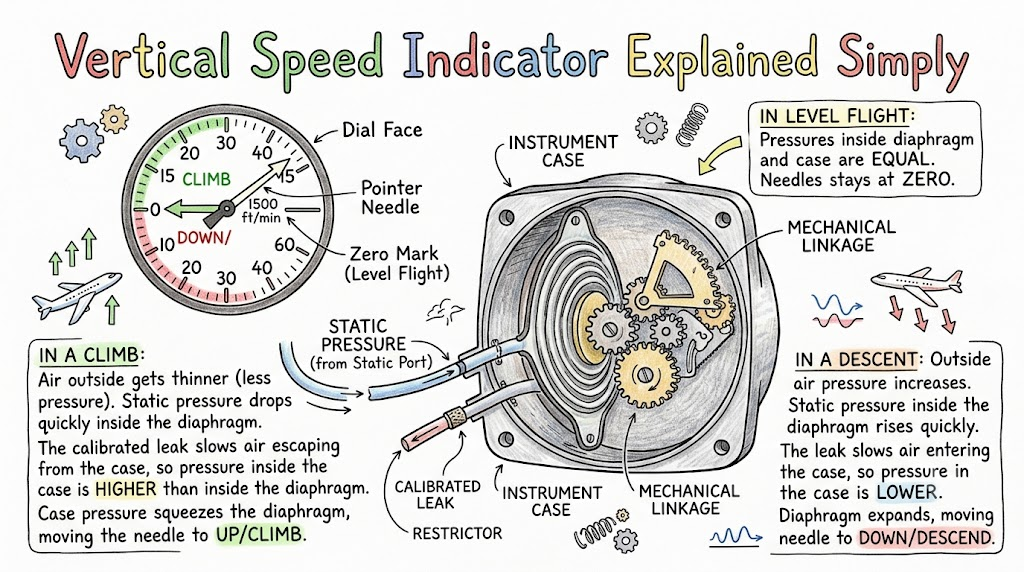
As an aircraft climbs, the outside air pressure decreases. As the aircraft descends, the outside air pressure increases. The VSI measures this pressure change and converts it into a climb or descent rate.
Inside a traditional VSI, there is a pressure-sensitive system connected to the aircraft’s static port. When the aircraft changes altitude, the pressure difference moves the needle on the instrument face.
The needle then shows whether the aircraft is climbing, descending, or flying level.
One important point for students to remember is that many VSIs have a slight delay. The instrument may take a few seconds to show the correct rate after the aircraft starts climbing or descending.
What Does the VSI Show?
The Vertical Speed Indicator usually shows three basic conditions.
1. Positive Reading
A positive reading means the aircraft is climbing.
For example, if the needle points to +500 FPM, the aircraft is climbing at 500 feet per minute.
2. Negative Reading
A negative reading means the aircraft is descending.
For example, if the needle points to -600 FPM, the aircraft is descending at 600 feet per minute.
3. Zero Reading
A zero reading means the aircraft is not climbing or descending. It is maintaining level flight.
However, students should still cross-check the altimeter because the VSI may have a small delay.
Main Parts of a Vertical Speed Indicator
A traditional round-dial VSI has simple parts that students should understand.
Needle or Pointer
The needle shows the rate of climb or descent. If it moves upward, the aircraft is climbing. If it moves downward, the aircraft is descending.
Zero Mark
The zero mark is usually in the center of the instrument. It shows level flight.
Climb Scale
The upper side of the VSI shows climb rate, usually marked in feet per minute.
Descent Scale
The lower side of the VSI shows descent rate, also in feet per minute.
Feet-Per-Minute Markings
These markings help pilots read the rate of vertical movement. Common values may include 500, 1000, 1500, or 2000 feet per minute.
Digital Display
Modern aircraft may show vertical speed on a digital screen. Digital VSI displays are easier to read, but students should still understand the basic concept.
How to Read a Vertical Speed Indicator
Reading the VSI is simple once students understand the scale.
First, look at the needle position. If the needle is above zero, the aircraft is climbing. If it is below zero, the aircraft is descending.
Second, read the number where the needle is pointing. This tells the climb or descent rate in feet per minute.
For example:
- Needle at +500 means climbing at 500 feet per minute.
- Needle at -500 means descending at 500 feet per minute.
- Needle at 0 means level flight.
In modern glass cockpit aircraft, the vertical speed may appear as a number or tape-style display. The meaning remains the same.
Use of VSI During Different Flight Phases
The Vertical Speed Indicator is useful throughout a flight. Pilots do not look at it only once. They monitor it regularly as part of their instrument scan.
Pre-Flight Check
Before flight, the pilot checks that the VSI is showing near zero when the aircraft is parked. A small error may be noted and handled according to training or aircraft procedures.
Takeoff
After takeoff, the VSI helps confirm that the aircraft is climbing. However, student pilots should not depend only on the VSI because it may lag slightly. The altimeter and outside view should also confirm the climb.
Climb
During climb, the VSI helps the pilot maintain a steady climb rate. For example, an instructor may ask the student to maintain a 500 feet per minute climb.
Cruise
During cruise, the VSI helps confirm level flight. If the VSI shows a climb or descent, the pilot may need to adjust pitch or power.
Descent
During descent, the VSI helps control the rate of descent. This is important for comfort, safety, and approach planning.
Approach
During approach, pilots use the VSI to maintain a stable descent. A smooth and controlled descent helps prepare the aircraft for a safe landing.
Landing
Near landing, pilots mostly use outside visual references, airspeed, attitude, and runway position. Still, the VSI can help support a stable approach, especially during instrument training.
VSI vs Altimeter
Many aviation students confuse the VSI with the altimeter. Both instruments are related to altitude, but they do different jobs.
The altimeter shows the aircraft’s current altitude. It tells the pilot how high the aircraft is.
The VSI shows how fast the aircraft is gaining or losing altitude. It tells the pilot the rate of climb or descent.
For example, the altimeter may show that the aircraft is at 3,000 feet. The VSI may show that the aircraft is climbing at 500 feet per minute.
So, the altimeter answers: How high are we?
The VSI answers: How fast are we going up or down?
VSI vs Airspeed Indicator
The VSI is also different from the airspeed indicator.
The airspeed indicator shows how fast the aircraft is moving through the air.
The Vertical Speed Indicator shows how fast the aircraft is moving vertically.
For example, an aircraft may be flying forward at 100 knots while climbing at 500 feet per minute. These are two different measurements.
Student pilots must learn to watch both instruments because airspeed and vertical speed are closely connected during climb and descent.
Common Mistakes Student Pilots Make With the VSI
Student pilots often make mistakes when learning to use the VSI. These mistakes are normal in early training, but they should be corrected with practice.
Chasing the VSI Needle
This means making too many control movements just to keep the needle at a certain point. Since the VSI may lag, chasing the needle can make the aircraft unstable.
Ignoring the Altimeter
The VSI only shows rate of climb or descent. It does not show exact altitude. Students must always cross-check the altimeter.
Forgetting Airspeed
During climb or descent, students may focus too much on the VSI and forget airspeed. This can affect aircraft control and safety.
Over-Controlling the Aircraft
Large control inputs can create sudden climbs or descents. Smooth and small corrections are better.
Depending Only on the VSI
The VSI is helpful, but it should never be the only instrument used. Pilots must scan all important instruments.
Not Understanding VSI Lag
Traditional VSIs may react slowly. Students should understand that the instrument may take a few seconds to show the correct rate.
Important Safety Tips for Using the VSI
The VSI becomes more useful when students use it correctly. Here are some simple safety tips:
- Use the VSI with the altimeter and attitude indicator
- Do not chase the needle
- Make smooth control inputs
- Maintain proper airspeed during climb and descent
- Cross-check all flight instruments
- Understand that the VSI may have a small delay
- Follow instructor guidance during training
- Use outside visual references when flying visually
- Practice stable climbs and descents regularly
A safe pilot does not depend on one instrument only. Good flying comes from understanding the full aircraft picture.
Real-Life Example for Aviation Students
Imagine a student pilot has just taken off during a training flight. The instructor asks the student to maintain a steady climb at 500 feet per minute.
The student checks the attitude, airspeed, altimeter, and VSI. The VSI needle moves to +500 FPM. This confirms that the aircraft is climbing at the desired rate.
Later, during approach, the instructor asks the student to descend smoothly. The student reduces power, adjusts attitude, checks airspeed, and watches the VSI show a controlled descent rate.
This simple example shows how the VSI helps students manage climbs and descents safely.
Why VSI Practice Builds Better Flying Skills
Practicing with the VSI helps aviation students improve their cockpit awareness. It teaches them how aircraft attitude, power, airspeed, and altitude are connected.
Regular VSI practice helps students:
- Fly smoother climbs
- Make safer descents
- Improve instrument scanning
- Avoid sudden altitude changes
- Understand aircraft performance better
- Prepare for advanced instrument flying
The VSI may look like a simple instrument, but it plays an important role in building good flying habits.
FAQs About Vertical Speed Indicator
1. What is a Vertical Speed Indicator in an aircraft?
A Vertical Speed Indicator is a flight instrument that shows whether the aircraft is climbing, descending, or flying level. It usually displays the rate in feet per minute.
2. What does a VSI show?
A VSI shows the aircraft’s rate of climb or descent. A positive reading means climb, a negative reading means descent, and zero means level flight.
3. How does a Vertical Speed Indicator work?
It works by sensing changes in air pressure as the aircraft climbs or descends. These pressure changes are converted into a vertical speed reading.
4. Why is the VSI important for pilots?
The VSI helps pilots control climbs and descents smoothly. It also helps during approach planning, altitude control, and instrument training.
5. What does feet per minute mean in aviation?
Feet per minute means how many feet the aircraft climbs or descends in one minute. For example, 500 FPM means 500 feet per minute.
6. What is the difference between VSI and altimeter?
The altimeter shows current altitude. The VSI shows how fast the altitude is changing.
7. Can pilots fly safely without checking the VSI?
Pilots should not ignore the VSI, but they also should not depend only on it. Safe flying requires cross-checking all important instruments.
8. Why does the VSI sometimes react slowly?
Traditional VSIs may have a slight delay because they measure pressure changes over a short time. This is why pilots should avoid chasing the needle.
9. How do student pilots practice VSI reading?
They practice during climb, descent, level flight, simulator sessions, and instructor-led training exercises.
10. Is the VSI used during landing?
Yes, it can support a stable approach, but pilots also use outside references, airspeed, attitude, and runway position during landing.
Final Thoughts
The Vertical Speed Indicator Explained Simply is a key topic for every aviation student learning aircraft instruments. The VSI helps pilots understand whether the aircraft is climbing, descending, or flying level.
It shows the rate of climb or descent in feet per minute and supports better altitude control during takeoff, climb, cruise, descent, approach, and landing.
For student pilots, the most important lesson is this: use the VSI as part of a complete instrument scan. Do not depend on it alone. Cross-check it with the altimeter, airspeed indicator, attitude indicator, and outside references.

