
Introduction
For every aviation student, understanding cockpit instruments is an important step toward safe and confident flying. Among all basic flight instruments, the altimeter is one of the most essential because it tells the pilot how high the aircraft is flying.
This Altimeter Guide for Aviation Students explains what an aircraft altimeter is, how it works, how to read it, why correct settings matter, and what common mistakes student pilots should avoid. Whether you are starting pilot training, learning aircraft instruments, or preparing for flight school lessons, this guide will help you understand the altimeter in a simple and practical way.
What Is an Altimeter in an Aircraft?
An altimeter is an aircraft instrument that shows the altitude of the aircraft. In simple words, it helps pilots know how high the aircraft is above a reference level.
In most normal flight operations, the altimeter shows altitude above mean sea level. This helps pilots maintain assigned altitude, avoid terrain, follow air traffic control instructions, and fly safely in controlled airspace.
The altimeter is usually found on the aircraft instrument panel along with other important flight instruments such as the airspeed indicator, vertical speed indicator, attitude indicator, heading indicator, and turn coordinator.
Why Altimeter Knowledge Is Important for Aviation Students
Aviation students must understand the altimeter because altitude control is a major part of flying. A pilot must always know whether the aircraft is climbing, descending, or maintaining level flight.
The altimeter is important because it helps with:
- Maintaining safe height above terrain
- Following air traffic control altitude instructions
- Staying clear of restricted or controlled airspace
- Flying safely during climb, cruise, descent, and landing
- Understanding aircraft position in relation to other traffic
- Avoiding altitude-related mistakes during training flights
For student pilots, a small misunderstanding of altimeter readings can create confusion, especially during approach, landing, or navigation exercises. That is why flight instructors give special attention to altimeter reading during basic instrument training.
How Does an Aircraft Altimeter Work?
Most aircraft use a pressure altimeter. It works by measuring air pressure outside the aircraft.
As an aircraft climbs higher, air pressure decreases. As the aircraft descends, air pressure increases. The altimeter senses this pressure change and converts it into an altitude reading.
Inside a traditional pressure altimeter, there are sealed capsules that expand or contract as air pressure changes. These movements operate the pointers on the instrument face. In modern aircraft, digital systems may show the same information on electronic displays.
The basic idea is simple:
When air pressure decreases, the altimeter shows a higher altitude.
When air pressure increases, the altimeter shows a lower altitude.
This is why correct pressure setting is very important. If the pressure setting is wrong, the altitude shown on the altimeter may also be wrong.
Main Parts of an Altimeter
A traditional aircraft altimeter has several important parts that students should recognize.
Altitude Pointers
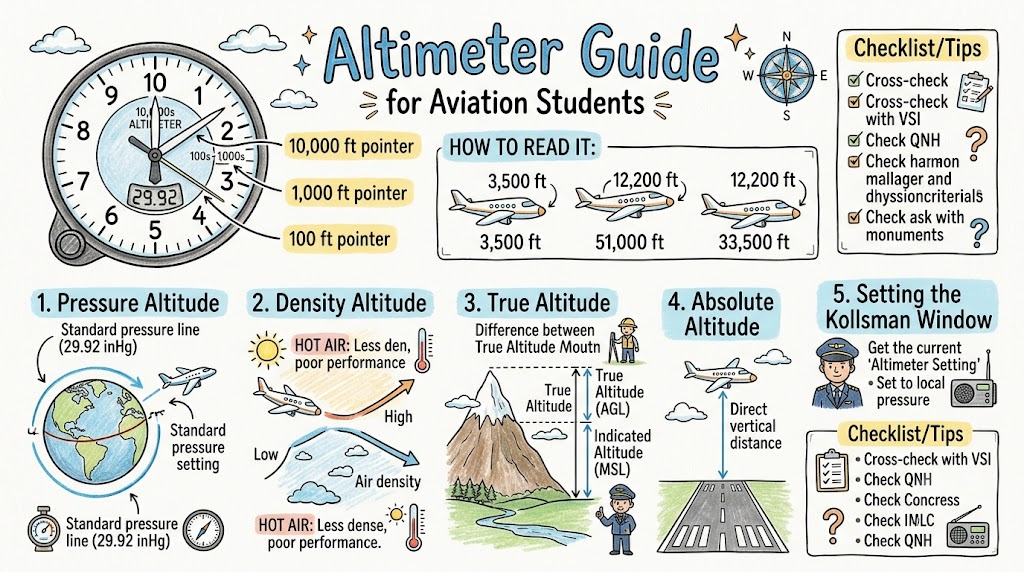
Older altimeters may have two or three pointers. These pointers show hundreds, thousands, and sometimes tens of thousands of feet. Student pilots must practice reading them carefully because misreading a pointer can lead to altitude errors.
Altitude Scale
The instrument face has numbers arranged in a circular pattern. These numbers help the pilot read altitude in feet.
Pressure Setting Window
This small window shows the selected barometric pressure setting. It is sometimes called the Kollsman window.
Barometric Setting Knob
This knob is used to adjust the pressure setting. Before flight and during certain phases of flight, pilots set the correct pressure value provided by weather reports or air traffic control.
Digital Display
Modern aircraft may show altitude on a digital screen instead of traditional pointers. Digital altimeters are usually easier to read, but students still need to understand the basic working principle.
Types of Altimeters Used in Aviation
Aviation students may hear about different types of altimeters during training. Each has a specific use.
1. Pressure Altimeter
This is the most common type used in training aircraft. It measures air pressure and displays altitude. Student pilots use it during almost every phase of flight.
2. Radio Altimeter
A radio altimeter measures the aircraft’s height above the ground directly below it. It is commonly used in larger aircraft, especially during approach and landing.
Unlike a pressure altimeter, which uses air pressure, a radio altimeter sends radio signals toward the ground and measures the return time.
3. Digital Altimeter
A digital altimeter displays altitude on an electronic screen. Many modern glass cockpit aircraft use digital displays instead of traditional round instruments.
4. GPS-Based Altitude Display
Some navigation systems show GPS altitude. However, GPS altitude is not always used as the primary altitude source for normal flight operations. Pilots still depend on approved aircraft instruments and correct procedures.
How to Read an Altimeter
Reading an altimeter is an important skill for aviation students. Traditional altimeters may look confusing at first, but with practice they become easier to understand.
A typical three-pointer altimeter may show:
- One pointer for hundreds of feet
- One pointer for thousands of feet
- One pointer for tens of thousands of feet
For example, if the thousands pointer is near 3 and the hundreds pointer is near 5, the aircraft may be around 3,500 feet.
Students should not rush while reading an altimeter. During flight training, it is better to read carefully and cross-check with the instructor until the habit becomes natural.
In modern aircraft, digital altimeters show altitude in numbers, such as 3,500 feet. These are easier to read, but students must still understand altitude trends and pressure settings.
Understanding Altimeter Settings
Altimeter setting is one of the most important parts of using the instrument correctly. Since pressure changes with weather and location, the altimeter must be adjusted to the correct pressure reference.
QNH
QNH is the pressure setting that allows the altimeter to show altitude above mean sea level. This is commonly used during normal flight operations near airports and in controlled airspace.
For example, if a pilot sets the correct QNH before takeoff, the altimeter should show the airport elevation when the aircraft is on the ground.
QFE
QFE is a pressure setting that makes the altimeter show height above a specific airport or airfield. When QFE is set on the ground at that airfield, the altimeter shows zero.
QFE is not used everywhere, but students should understand the concept.
Standard Pressure Setting
At higher altitudes, pilots may use a standard pressure setting. This allows aircraft to fly using flight levels instead of local altitude references.
Student pilots should learn when to use local pressure settings and when standard pressure setting applies, based on flight rules and instructor guidance.
Altimeter Use During Different Flight Phases
The altimeter is used throughout the entire flight. It is not only checked once; pilots monitor it continuously.
Pre-Flight Checks
Before takeoff, pilots check the altimeter setting. When the correct pressure is set, the altimeter should show the airport elevation within an acceptable range.
Takeoff
During takeoff, the pilot checks that the aircraft is climbing properly. The altimeter confirms that altitude is increasing after liftoff.
Climb
During climb, the pilot uses the altimeter to reach the planned or assigned altitude. The vertical speed indicator may show the climb rate, but the altimeter confirms actual altitude.
Cruise
In cruise flight, the pilot uses the altimeter to maintain level flight at the correct altitude. This is important for traffic separation and navigation.
Descent
During descent, the altimeter helps the pilot monitor altitude loss and follow descent instructions. A controlled descent helps avoid unstable approaches.
Approach
During approach, altitude awareness becomes very important. Pilots must follow published procedures, instructor guidance, or air traffic control instructions carefully.
Landing
Near landing, the pilot continues monitoring altitude, especially during training flights and approach practice. In some aircraft, other instruments and visual references are also used.
Common Altimeter Mistakes Made by Student Pilots
Student pilots often make small altimeter mistakes in the early stages of training. These mistakes are normal during learning, but they must be corrected through practice.
Forgetting to Set the Correct Pressure
One of the most common mistakes is forgetting to update the altimeter setting. Weather pressure changes can affect the reading, so the altimeter must be set correctly.
Misreading the Pointer
Traditional altimeters require careful reading. A student may confuse hundreds and thousands of feet if they do not scan properly.
Confusing Altitude and Height
Altitude usually refers to height above mean sea level, while height may refer to distance above the ground or a specific point. This difference is important.
Not Cross-Checking Instruments
The altimeter should be part of a full instrument scan. Pilots should also check the vertical speed indicator, attitude indicator, and outside visual references when appropriate.
Ignoring ATC Instructions
When air traffic control assigns an altitude, the pilot must read back and follow it accurately. Poor altitude awareness can create safety issues.
Poor Instrument Scan
Some students focus too much on one instrument and forget others. A good pilot scans all key instruments smoothly and regularly.
Safety Tips for Using an Altimeter
Good altimeter habits help build safer flying skills. Aviation students should practice these habits from the beginning.
- Always set the correct pressure before flight
- Confirm airport elevation during pre-flight checks
- Listen carefully to pressure updates from ATC
- Cross-check altitude with other instruments
- Read traditional altimeters slowly and carefully
- Practice instrument scan during every flight lesson
- Ask the instructor immediately if the reading seems confusing
- Never ignore unexpected altitude changes
- Understand the difference between altitude, height, and flight level
A safe pilot does not simply look at the altimeter; a safe pilot understands what the reading means in the current flight situation.
Difference Between Altitude, Height, and Flight Level
Aviation students often hear the words altitude, height, and flight level. These terms are related, but they are not exactly the same.
Altitude
Altitude usually means the vertical distance of the aircraft above mean sea level. For example, if an aircraft is flying at 3,000 feet altitude, it is 3,000 feet above sea level.
Height
Height usually means the vertical distance above a specific point, such as the ground, runway, or airport. For example, an aircraft may be 500 feet above the runway during approach.
Flight Level
Flight level is used when aircraft fly with a standard pressure setting. It helps maintain separation between aircraft at higher altitudes.
Understanding these differences helps students communicate clearly and avoid confusion during flight training.
Altimeter and Other Flight Instruments
The altimeter does not work alone. Pilots use it together with other flight instruments.
The airspeed indicator shows how fast the aircraft is moving through the air. The vertical speed indicator shows whether the aircraft is climbing or descending and at what rate. The attitude indicator shows the aircraft’s pitch and bank position. The heading indicator helps maintain direction.
Together, these instruments give the pilot a complete picture of the aircraft’s condition. For example, if the altimeter shows increasing altitude and the vertical speed indicator shows a climb, the pilot can confirm that the aircraft is climbing.
Good pilots do not depend on one instrument only. They cross-check all important instruments during flight.
Real-Life Example for Aviation Students
Imagine a student pilot is preparing for a training flight. The aircraft is parked at an airport where the field elevation is 800 feet. Before takeoff, the instructor asks the student to set the correct altimeter pressure.
If the correct setting is entered, the altimeter should show around 800 feet while the aircraft is still on the ground.
Now imagine the student forgets to update the pressure setting. The altimeter may show 1,100 feet or 500 feet instead of the correct airport elevation. During flight, this wrong reading may create confusion, especially during descent or approach.
This example shows why altimeter setting is not just a small checklist item. It is a serious part of safe flight preparation.
Why Aviation Students Should Practice Altimeter Reading Regularly
Altimeter reading becomes easier with regular practice. At first, students may need extra time to understand the pointer positions or pressure settings. With repeated training, reading the altimeter becomes part of a natural cockpit scan.
Students can practice by:
- Studying cockpit instrument diagrams
- Using flight simulator exercises
- Reading altimeter examples on the ground
- Asking instructors for correction during training
- Comparing altimeter readings with flight phases
- Practicing complete instrument scan habits
The goal is not only to read numbers. The goal is to understand what those numbers mean for aircraft safety.
FAQs About Altimeters for Aviation Students
1. What is an altimeter in an aircraft?
An altimeter is an aircraft instrument that shows how high the aircraft is flying. In most cases, it displays altitude above mean sea level.
2. How does an aircraft altimeter work?
A pressure altimeter works by sensing air pressure. As the aircraft climbs, air pressure decreases, and the altimeter converts that pressure change into an altitude reading.
3. Why is the altimeter important for pilots?
The altimeter helps pilots maintain safe altitude, follow air traffic control instructions, avoid terrain, and manage climb, cruise, descent, and landing phases safely.
4. What does a pressure altimeter measure?
A pressure altimeter measures outside air pressure and uses that pressure to estimate aircraft altitude.
5. What is the difference between altitude and height?
Altitude usually means distance above mean sea level. Height usually means distance above the ground, runway, or another specific reference point.
6. What is QNH in aviation?
QNH is a pressure setting that allows the altimeter to show altitude above mean sea level. It is commonly used in normal flight operations.
7. What happens if the altimeter setting is wrong?
If the altimeter setting is wrong, the displayed altitude may also be wrong. This can create confusion and may affect flight safety.
8. How do student pilots practice altimeter reading?
Student pilots practice by studying instrument diagrams, using simulators, reading altimeters during lessons, and building a regular cockpit scan habit.
9. Is a radio altimeter the same as a pressure altimeter?
No. A pressure altimeter uses air pressure to show altitude, while a radio altimeter measures height above the ground using radio signals.
10. Why should pilots cross-check the altimeter?
Pilots cross-check the altimeter with other instruments to confirm the aircraft’s flight condition. This helps improve accuracy, awareness, and safety.
Final Thoughts
This Altimeter Guide for Aviation Students gives beginners a clear understanding of one of the most important aircraft instruments. The altimeter helps pilots know their altitude, maintain safe flight levels, follow air traffic control instructions, and avoid terrain-related risks.
For aviation students, learning the altimeter is not just about passing an exam. It is about developing safe cockpit habits. When students understand how the altimeter works, how to read it, and how to set it correctly, they become more confident and better prepared for real flight training.
Mastering the altimeter is a basic but powerful step toward becoming a skilled and responsible pilot.

