
Introduction
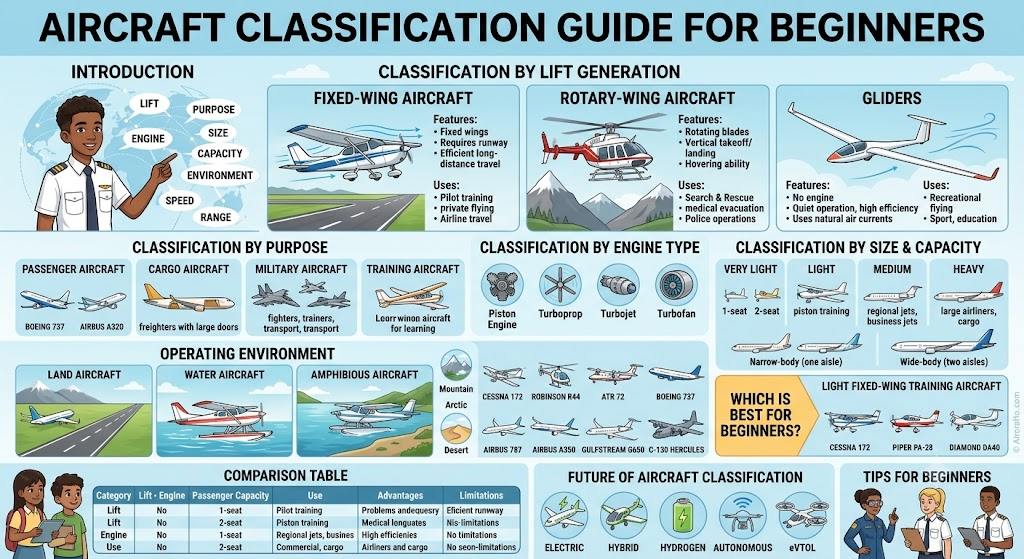
Aircraft classification helps beginners understand the aviation world in a clear and organized way. When new students first see airplanes, helicopters, jets, gliders, and cargo aircraft, everything may look confusing. But each aircraft is designed for a specific purpose, operating condition, speed, size, and mission.
Aircraft are not classified only by appearance. They can be grouped by how they fly, what engines they use, how many people they carry, where they operate, and what job they perform. This classification helps pilots, engineers, airlines, maintenance teams, aviation students, and authorities work with aircraft safely and efficiently.
For beginners, learning aircraft classification is one of the best ways to build a strong aviation foundation. It makes it easier to understand flight training, aircraft design, aviation careers, aircraft systems, and the different roles aircraft play in modern transportation.
In this guide, Aircrafto.com explains aircraft classification in simple language for new aviation learners.
What Is Aircraft Classification?
Aircraft classification means grouping aircraft based on their design, function, performance, and operation. It helps identify what an aircraft is, how it flies, what it is used for, and what rules may apply to it.
Aircraft can be classified by:
- Lift generation
- Aircraft design
- Engine type
- Mission or purpose
- Size and weight
- Passenger capacity
- Operating environment
- Speed and range
For example, a Cessna 172 is usually classified as a light fixed-wing piston-engine training aircraft. A Boeing 737 is a commercial narrow-body turbofan airliner. A helicopter is a rotary-wing aircraft because it uses rotating blades to create lift.
This system makes aviation easier to understand and manage.
Why Aircraft Classification Is Important
Aircraft classification is important because different aircraft behave differently. A small training aircraft, a helicopter, a business jet, and a cargo aircraft all require different operating skills, maintenance procedures, and safety considerations.
Flight Training
Student pilots must learn on aircraft suitable for their license and training level. Most beginners start with small fixed-wing training aircraft because they are stable, reliable, and easier to operate.
Aircraft Safety
Each aircraft category has specific safety rules, operating limits, emergency procedures, and performance requirements. Classification helps pilots understand these differences.
Aircraft Certification
Aviation authorities classify aircraft for certification, registration, and operational approval. This ensures aircraft meet safety and performance standards.
Maintenance Planning
Maintenance depends on aircraft type. A piston-engine training aircraft requires different servicing than a turbofan business jet or a military helicopter.
Air Traffic Management
Air traffic controllers need to understand aircraft type, speed, size, and performance to manage safe spacing and routing.
Pilot Licensing
Pilots may need different ratings or qualifications depending on the aircraft category, class, and type.
Aircraft Selection
Operators choose aircraft based on mission. A flight school may choose light training aircraft, while an airline may choose fuel-efficient airliners.
Main Methods of Aircraft Classification
Aircraft can be classified in many ways. The most common methods include:
- Classification by lift generation
- Classification by purpose
- Classification by engine type
- Classification by size
- Classification by operating environment
- Classification by passenger capacity
Each method helps explain a different part of aircraft design and operation.
Aircraft Classification by Lift Generation
1- Fixed-Wing Aircraft
Fixed-wing aircraft are aircraft with wings that remain fixed in position during flight. These wings generate lift as air flows over them while the aircraft moves forward.
Most airplanes are fixed-wing aircraft.
How Fixed-Wing Aircraft Create Lift
A fixed-wing aircraft needs forward movement. As the aircraft moves through the air, the wings create lift. The engine provides thrust, and the wings support the aircraft in flight.
Key Features
- Fixed wings
- Usually require a runway
- Efficient for long-distance travel
- Used in many aviation sectors
- Available in small and large sizes
Common Uses
- Pilot training
- Private flying
- Airline travel
- Cargo transport
- Business aviation
- Military aviation
Examples
- Cessna 172
- Piper PA-28
- Diamond DA40
- Boeing 737
- Airbus A320
- Boeing 787
Fixed-wing aircraft are the most common aircraft type and are often the first category beginners study.
2- Rotary-Wing Aircraft
Rotary-wing aircraft use rotating blades, called rotors, to create lift. Helicopters are the most common rotary-wing aircraft.
Unlike fixed-wing aircraft, helicopters can take off and land vertically. They can also hover in one place.
Key Features
- Rotating blades
- Vertical takeoff and landing
- Hovering ability
- Can operate in limited spaces
- Useful where runways are not available
Common Uses
- Search and rescue
- Medical evacuation
- Police operations
- Military missions
- Tourism
- Offshore transport
- News reporting
Examples
- Robinson R44
- Bell 407
- Airbus H125
- Sikorsky helicopters
- Apache helicopter
Rotary-wing aircraft are valuable because they can operate in places where airplanes cannot.
3- Gliders
Gliders are aircraft designed to fly without an engine. They use natural air currents and aerodynamic efficiency to stay airborne.
Gliders are useful for learning basic flight principles because students must understand lift, drag, speed, altitude, and energy management.
Key Features
- No engine
- Long narrow wings
- Lightweight structure
- Quiet operation
- Excellent aerodynamic efficiency
Common Uses
- Recreational flying
- Sport aviation
- Aerodynamics training
- Flight education
Examples
- Schleicher ASK 21
- DG gliders
- Schempp-Hirth gliders
Gliders teach students how aircraft fly without relying on engine power.
Aircraft Classification by Purpose
1- Passenger Aircraft
Passenger aircraft are designed to carry people. They range from small private aircraft to large commercial airliners.
Types of Passenger Aircraft
- Private aircraft
- Regional aircraft
- Narrow-body airliners
- Wide-body airliners
Common Uses
- Domestic travel
- International travel
- Business travel
- Charter flights
- Regional connectivity
Examples
- Airbus A320
- Boeing 737
- ATR 72
- Boeing 787
- Airbus A350
Passenger aircraft are designed for safety, comfort, efficiency, and reliable operation.
2- Cargo Aircraft
Cargo aircraft are designed to carry goods instead of passengers. They transport packages, machinery, vehicles, medical supplies, mail, and emergency relief materials.
Key Features
- Large cargo doors
- Strong floors
- High payload capacity
- Loading systems
- Long-range capability
Common Uses
- Freight transport
- Logistics
- E-commerce delivery
- Humanitarian aid
- Military supply
Examples
- Boeing 747 Freighter
- Boeing 777 Freighter
- Airbus A330 Freighter
- C-130 Hercules
Cargo aircraft are essential for global trade and emergency response.
3- Military Aircraft
Military aircraft are built for defense, surveillance, training, transport, and combat missions. They are designed for performance, strength, and mission-specific roles.
Types of Military Aircraft
- Fighter aircraft
- Trainer aircraft
- Transport aircraft
- Surveillance aircraft
- Refueling aircraft
- Military helicopters
Common Uses
- Combat
- Pilot training
- Troop movement
- Air defense
- Intelligence gathering
- Rescue operations
Examples
- F-16 Fighting Falcon
- C-130 Hercules
- Hawk trainer
- Apache helicopter
- P-8 maritime aircraft
Military aircraft are not limited to fighter jets. They include many specialized aircraft types.
4- Training Aircraft
Training aircraft are used to teach students how to fly. They are usually stable, simple, and forgiving compared with advanced aircraft.
Key Features
- Simple controls
- Good visibility
- Stable handling
- Lower operating cost
- Reliable systems
Common Uses
- Basic pilot training
- Navigation training
- Instrument training
- Flight school operations
Examples
- Cessna 172
- Piper PA-28
- Diamond DA40
- Tecnam P2008
Training aircraft are one of the most important categories for new aviation students.
5- Agricultural Aircraft
Agricultural aircraft are used in farming and crop management. They help spray crops, spread fertilizer, and support agricultural operations.
Key Features
- Low-level flying capability
- Strong structure
- Large chemical or fertilizer tanks
- Good maneuverability
Common Uses
- Crop spraying
- Fertilizer spreading
- Pest control
- Farm monitoring
Agricultural aircraft are designed for practical work rather than passenger comfort.
6- Rescue and Medical Aircraft
Rescue and medical aircraft are designed for emergency response. They help transport patients, reach remote areas, and support search and rescue missions.
Types
- Air ambulances
- Rescue helicopters
- Medical evacuation aircraft
- Search aircraft
Common Uses
- Emergency patient transport
- Disaster response
- Mountain rescue
- Ocean rescue
- Remote area medical support
Helicopters are especially useful in this category because they can land near accident sites.
7- Firefighting Aircraft
Firefighting aircraft help control wildfires by dropping water or fire retardant over affected areas.
Key Features
- Large water or retardant tanks
- Low-altitude flying capability
- Strong structure
- Specialized release systems
Common Uses
- Wildfire control
- Forest fire support
- Emergency response
- Fire line protection
Examples include water bombers, converted cargo aircraft, and helicopters with water buckets.
Aircraft Classification by Engine Type
1- Piston Engine Aircraft
Piston engine aircraft use engines similar in principle to car engines, although aviation engines are specially designed for flight. These aircraft are common in training and private flying.
Advantages
- Lower cost
- Simple operation
- Good for training
- Easy to understand for beginners
Common Uses
- Flight training
- Private flying
- Recreational aviation
Examples
- Cessna 172
- Piper PA-28
- Diamond DA40
2- Turboprop Aircraft
Turboprop aircraft use turbine engines to drive propellers. They are efficient for short and regional flights.
Advantages
- Fuel efficient at lower speeds
- Good short runway performance
- Reliable for regional routes
- Useful for cargo and utility work
Examples
- ATR 72
- Pilatus PC-12
- Beechcraft King Air
- Twin Otter
Turboprops are common in regional aviation and remote area operations.
3- Turbojet Aircraft
Turbojet aircraft use jet engines that produce thrust mainly from high-speed exhaust gases. Turbojets were important in early jet aviation and high-speed aircraft.
Advantages
- High-speed performance
- Simple jet propulsion concept
- Suitable for fast aircraft
Limitations
- Higher fuel consumption
- More noise
- Less efficient at lower speeds
Turbojets are now less common in commercial aviation but remain important in jet engine history.
4- Turbofan Aircraft
Turbofan engines are the most common engines in modern commercial airliners and business jets. They use a large fan to move air, while the engine core produces additional thrust.
Advantages
- Fuel efficient
- Quieter than older jet engines
- Strong thrust
- Suitable for long-distance flights
Examples
- Boeing 737
- Airbus A320
- Boeing 787
- Airbus A350
- Gulfstream business jets
Turbofan aircraft dominate modern airline and business aviation.
5- Electric Aircraft
Electric aircraft use electric motors powered by batteries or other electrical systems. This is an emerging area in aviation.
Advantages
- Lower emissions during operation
- Lower noise
- Fewer moving parts
- Potentially lower operating costs
Current Uses
- Experimental aircraft
- Short training flights
- Urban mobility concepts
- Research programs
Electric aircraft are expected to become more important in future aviation.
6- Hybrid Aircraft
Hybrid aircraft combine traditional engines with electric propulsion. They are being developed to reduce fuel burn, emissions, and noise.
Potential Benefits
- Better fuel efficiency
- Reduced emissions
- Flexible power management
- Suitable for future regional aviation
Hybrid aircraft may become a bridge between conventional aircraft and fully electric aviation.
Aircraft Classification by Size
Very Light Aircraft
Very light aircraft are small aircraft used for recreation, basic training, and personal flying. They usually carry one or two people.
Light Aircraft
Light aircraft are widely used in flight schools, private aviation, and short-distance travel. They are often piston-engine aircraft.
Examples include the Cessna 172 and Piper PA-28.
Medium Aircraft
Medium aircraft include regional aircraft, small business jets, and special mission aircraft. They carry more passengers and have greater range than light aircraft.
Heavy Aircraft
Heavy aircraft include large airliners, cargo aircraft, and military transport aircraft. They require advanced systems, longer runways, and professional crew operations.
Narrow-Body Aircraft
Narrow-body aircraft have one aisle and are commonly used for short and medium airline routes.
Examples include the Boeing 737 and Airbus A320.
Wide-Body Aircraft
Wide-body aircraft have two aisles and are used for long-distance international flights.
Examples include the Boeing 787, Boeing 777, Airbus A350, and Airbus A380.
Aircraft Classification by Operating Environment
Land Aircraft
Land aircraft operate from runways. Most airplanes belong to this group.
Water Aircraft
Water aircraft, also known as seaplanes, are designed to take off and land on water.
Amphibious Aircraft
Amphibious aircraft can operate on both land and water. They may use floats or special hull designs.
Examples include the Twin Otter amphibian and ICON A5.
Mountain Operations Aircraft
Some aircraft are designed or adapted for high-altitude airports, short runways, and challenging terrain.
Arctic Operations Aircraft
Aircraft used in Arctic environments may need skis, special equipment, and cold-weather systems.
Desert Operations Aircraft
Aircraft used in desert areas must handle heat, dust, and rough operating conditions.
Aircraft Classification by Passenger Capacity
Single-Seat Aircraft
These aircraft carry one person. They are often used in sport aviation, military training, or experimental flying.
Two-Seat Aircraft
Two-seat aircraft are common in beginner flight training and recreational flying.
Small Private Aircraft
Small private aircraft usually carry two to six people and are used for personal or business travel.
Regional Aircraft
Regional aircraft carry more passengers and connect smaller cities to larger airports.
Commercial Airliners
Commercial airliners carry large numbers of passengers on scheduled routes.
Large Passenger Aircraft
Large passenger aircraft are wide-body jets used for long-haul international travel.
Passenger capacity affects aircraft size, cabin design, runway requirements, fuel load, and operating cost.
Popular Aircraft Examples by Category
Cessna 172
The Cessna 172 is a light fixed-wing piston-engine aircraft widely used for flight training.
Piper PA-28
The Piper PA-28 is another popular training and private flying aircraft.
Robinson R44
The Robinson R44 is a rotary-wing helicopter used for training, tourism, and private operations.
ATR 72
The ATR 72 is a turboprop regional aircraft used for short and medium routes.
Boeing 737
The Boeing 737 is a narrow-body commercial airliner used worldwide for passenger flights.
Airbus A320
The Airbus A320 is a popular commercial airliner used by airlines for short and medium routes.
Boeing 787
The Boeing 787 is a wide-body long-range commercial aircraft.
Airbus A350
The Airbus A350 is a modern wide-body aircraft designed for efficient long-distance travel.
Gulfstream G650
The Gulfstream G650 is a long-range business jet used for premium private travel.
C-130 Hercules
The C-130 Hercules is a military transport aircraft used for cargo, troops, and special missions.
Aircraft Classification Comparison Table
| Aircraft Category | Lift Type | Engine Type | Passenger Capacity | Primary Use | Advantages | Limitations |
|---|---|---|---|---|---|---|
| Fixed-Wing Aircraft | Wings | Piston, turboprop, turbofan | 1 to 500+ | Training, travel, cargo | Efficient, versatile | Usually needs runway |
| Rotary-Wing Aircraft | Rotors | Piston or turbine | 1 to 20+ | Rescue, medical, military | Can hover, vertical landing | Slower, complex controls |
| Gliders | Wings | No engine | 1 to 2 | Sport, training | Quiet, efficient | Needs launch method |
| Training Aircraft | Wings | Piston/electric | 2 to 4 | Pilot training | Stable, affordable | Limited speed/range |
| Cargo Aircraft | Wings | Turboprop/turbofan | Cargo focused | Freight | High payload | Expensive operation |
| Business Jets | Wings | Turbofan | 4 to 20+ | Private travel | Fast, comfortable | High operating cost |
| Airliners | Wings | Turbofan/turboprop | 50 to 500+ | Passenger transport | Efficient mass travel | Needs major airport support |
| Amphibious Aircraft | Wings | Piston/turboprop | Varies | Land and water operations | Flexible operation | More complex design |
Which Aircraft Category Is Best for Beginners?
For most beginners, light fixed-wing training aircraft are the best starting point. They are widely available, stable, affordable, and easier to learn compared with complex aircraft.
Good beginner aircraft include:
- Cessna 172
- Piper PA-28
- Diamond DA40
- Tecnam training aircraft
For students interested in helicopters, a small rotary-wing training aircraft may be suitable. For students interested in pure aerodynamics, gliders are also excellent learning platforms.
Future airline pilots usually begin with light fixed-wing aircraft before progressing to more advanced aircraft.
Common Misconceptions About Aircraft Classification
All Airplanes Are the Same
Airplanes vary greatly in size, design, engine type, purpose, and performance. A training aircraft and a wide-body airliner are both airplanes, but they are very different.
Helicopters Are Just Airplanes
Helicopters are not airplanes. They are rotary-wing aircraft that use spinning rotors instead of fixed wings.
Bigger Aircraft Always Fly Faster
Aircraft speed depends on design, engine type, mission, weight, and aerodynamic efficiency. Bigger does not always mean faster.
Military Aircraft Are Only Fighter Jets
Military aviation includes transport aircraft, trainers, helicopters, surveillance aircraft, tankers, and special mission aircraft.
Small Aircraft Are Unsafe
Small aircraft can be safe when properly maintained and operated by trained pilots. Safety depends on training, maintenance, weather judgment, and operational discipline.
Cargo Aircraft Cannot Carry Passengers
Some aircraft can be configured for cargo, passengers, or mixed operations depending on design and certification.
Future of Aircraft Classification
Aircraft classification will continue to evolve as new technology develops.
Emerging aircraft categories include:
- Electric aircraft
- Hybrid-electric aircraft
- Hydrogen-powered aircraft
- Autonomous aircraft
- eVTOL aircraft
- Urban Air Mobility vehicles
- Sustainable aviation aircraft
Electric aircraft may become useful for short training flights and local travel. eVTOL aircraft may support future city transportation. Hydrogen and hybrid aircraft may help reduce emissions in regional and commercial aviation.
New technology may create new aircraft classes that students will need to understand in the future.
Tips for Beginners Learning Aircraft Classification
- Start by learning fixed-wing, rotary-wing, and glider categories.
- Understand the four forces of flight.
- Study simple aircraft diagrams.
- Learn basic engine types.
- Compare aircraft by purpose.
- Visit an aviation museum if possible.
- Observe aircraft at airports.
- Use flight simulators.
- Read beginner aviation guides.
- Learn aircraft names and their roles.
- Watch educational aviation videos.
- Keep a simple notebook of aircraft categories.
Aircraft classification becomes easier when you connect each aircraft type with its real-world purpose.
Key Takeaways
- Aircraft classification helps beginners understand different aircraft types.
- Aircraft can be classified by lift, purpose, engine, size, environment, and capacity.
- Fixed-wing aircraft are the most common aircraft type.
- Rotary-wing aircraft include helicopters.
- Gliders fly without engines.
- Training aircraft are commonly used in flight schools.
- Turbofan aircraft dominate commercial aviation.
- Cargo aircraft support global logistics.
- Amphibious aircraft can operate on land and water.
- Future aircraft may include electric, hybrid, hydrogen, and eVTOL designs.
Frequently Asked Questions
1. What is aircraft classification?
Aircraft classification is the process of grouping aircraft based on design, purpose, engine type, lift method, size, operating environment, and passenger capacity. It helps students, pilots, engineers, and aviation authorities understand how different aircraft work and where they are used. Classification makes aviation easier to study and manage.
2. Why are aircraft classified?
Aircraft are classified because different aircraft have different roles, systems, performance levels, and safety requirements. Classification helps with pilot training, aircraft certification, maintenance planning, air traffic control, and aircraft selection. It also helps beginners understand aviation in an organized way.
3. What is the difference between fixed-wing and rotary-wing aircraft?
Fixed-wing aircraft have wings that remain fixed and create lift when air flows over them. Airplanes are fixed-wing aircraft. Rotary-wing aircraft use rotating blades to create lift. Helicopters are rotary-wing aircraft and can hover, take off vertically, and land in small spaces.
4. What are the main aircraft categories?
The main aircraft categories include fixed-wing aircraft, rotary-wing aircraft, gliders, passenger aircraft, cargo aircraft, military aircraft, training aircraft, business aircraft, agricultural aircraft, rescue aircraft, and amphibious aircraft. These categories may overlap depending on aircraft design and mission.
5. Which aircraft are used for pilot training?
Pilot training usually begins with light fixed-wing aircraft such as the Cessna 172, Piper PA-28, Diamond DA40, or Tecnam training aircraft. These aircraft are stable, reliable, and suitable for learning basic flying skills. Helicopter students may train on smaller rotary-wing aircraft.
6. What is a turbofan aircraft?
A turbofan aircraft is powered by turbofan engines. These engines use a large fan and a gas turbine core to produce thrust. Turbofan engines are common in commercial airliners and business jets because they are efficient, powerful, and quieter than older jet engine types.
7. What aircraft are used for cargo transport?
Cargo transport uses freighter aircraft such as the Boeing 747 Freighter, Boeing 777 Freighter, Airbus freighter aircraft, and military cargo aircraft like the C-130 Hercules. Cargo aircraft are designed with strong floors, large doors, and systems for loading heavy goods.
8. What are amphibious aircraft?
Amphibious aircraft are aircraft that can operate on both land and water. They may have floats, retractable landing gear, or boat-shaped hulls. These aircraft are useful for island travel, remote area access, tourism, rescue missions, and operations where runways are limited.
9. How do aviation authorities classify aircraft?
Aviation authorities classify aircraft based on safety, certification, design, weight, operation, and performance. Classification helps determine pilot licensing requirements, maintenance standards, operating rules, and aircraft certification procedures. Exact rules may vary by country.
10. Which aircraft category is best for beginners?
Light fixed-wing training aircraft are usually best for beginners. They are simple, stable, widely available, and commonly used in flight schools. Examples include the Cessna 172, Piper PA-28, and Diamond DA40. Gliders are also helpful for learning pure flying skills.
Conclusion
Aircraft classification is one of the most important basics for new aviation students. It helps learners understand how different aircraft are designed, powered, operated, and used.
From fixed-wing airplanes and helicopters to gliders, cargo aircraft, business jets, training aircraft, and future electric aircraft, every category has a purpose. Some aircraft are built for learning, some for carrying passengers, some for rescue missions, and some for military or cargo operations.
For beginners, learning aircraft classification makes aviation easier to understand. It supports better knowledge of aircraft systems, pilot training, flight safety, and aviation careers.
Aircrafto.com helps new learners explore aircraft, aviation basics, and the exciting world of modern flight.

