
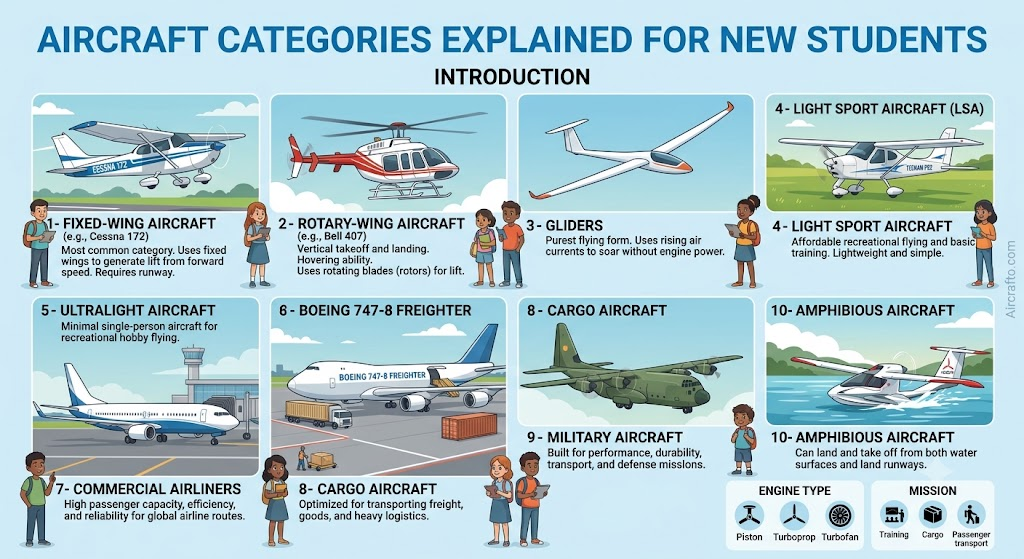
Introduction
Aviation can feel exciting and confusing at the same time, especially for new students. When beginners first start learning about aircraft, they often think all flying machines are simply “planes.” But in reality, aviation includes many different aircraft categories, each designed for a specific purpose, speed, range, passenger capacity, mission, and operating environment.
Understanding aircraft categories is one of the first steps in building a strong aviation foundation. Whether you want to become a pilot, study aircraft engineering, work in aviation management, or simply learn more about flying, knowing the different types of aircraft helps you understand how the aviation world works.
Some aircraft are built for training. Some are designed to carry hundreds of passengers. Some can land on water. Some are used for rescue missions, cargo transport, agriculture, military operations, or private travel. Each category has its own design, performance, strengths, and limitations.
In this guide, Aircrafto.com explains the major aircraft categories in simple language for new aviation students.
What Are Aircraft Categories?
Aircraft categories are groups used to classify aircraft based on their design, purpose, method of lift, engine type, size, and operation. These categories help pilots, engineers, students, regulators, and aviation professionals understand what an aircraft is built to do.
Aircraft may be classified by:
- How they generate lift
- Whether they use wings or rotors
- Their engine type
- Their size and weight
- Their mission
- Their passenger capacity
- Their operating environment
- Their speed and range
For example, an airplane uses fixed wings to generate lift, while a helicopter uses rotating blades. A commercial airliner is designed to carry passengers over long distances, while a training aircraft is built to help students learn basic flying skills.
Aircraft classification makes aviation easier to study, operate, maintain, and regulate.
Why Aircraft Classification Matters
Aircraft categories are important because each type of aircraft behaves differently in flight. A student pilot training on a small single-engine aircraft will not fly it the same way a helicopter pilot controls a rotary-wing aircraft.
Aircraft classification matters for several reasons:
Pilot Training
Different aircraft require different skills. A student learning on a fixed-wing training aircraft must understand takeoff, landing, stalls, turns, and navigation. A helicopter student must learn hovering, vertical takeoff, rotor control, and autorotation.
Safety
Each aircraft category has specific safety procedures. Knowing the category helps pilots understand limitations, emergency actions, and performance expectations.
Maintenance
Aircraft maintenance depends heavily on aircraft type. A piston-engine training aircraft, a turboprop cargo aircraft, and a jet airliner all require different inspection and servicing methods.
Regulations
Aviation authorities classify aircraft for licensing, certification, operation, and safety rules. Pilots often need specific ratings or endorsements to fly certain aircraft.
Aircraft Selection
Understanding categories helps students, buyers, airlines, and operators choose the right aircraft for the right mission.
Major Aircraft Categories Explained
1- Fixed-Wing Aircraft
Fixed-wing aircraft are the most common aircraft category. These aircraft have wings that stay in a fixed position and generate lift as air flows over them during forward movement.
Most airplanes belong to this category.
Fixed-wing aircraft include:
- Training airplanes
- Private aircraft
- Business jets
- Commercial airliners
- Cargo aircraft
- Military airplanes
How Fixed-Wing Aircraft Work
A fixed-wing aircraft needs forward speed to create lift. As the aircraft moves through the air, its wings generate lift, allowing it to fly. Engines provide thrust, while control surfaces help the pilot manage direction and altitude.
Key Features
- Fixed wings
- Usually require a runway
- Efficient for long-distance travel
- Available in many sizes
- Used widely in civil and military aviation
Common Uses
- Flight training
- Passenger transport
- Cargo movement
- Private flying
- Business travel
- Military operations
Examples
- Cessna 172
- Piper PA-28
- Boeing 737
- Airbus A320
- Gulfstream business jets
Fixed-wing aircraft are usually the first category new aviation students study because they form the foundation of modern aviation.
2- Rotary-Wing Aircraft
Rotary-wing aircraft use rotating blades, called rotors, to generate lift. Helicopters are the best-known example of rotary-wing aircraft.
Unlike airplanes, helicopters can take off and land vertically. They can also hover in one place, making them extremely useful for missions where runways are not available.
How Rotary-Wing Aircraft Work
A helicopter’s rotor blades spin rapidly and create lift. The pilot controls the rotor system to move upward, downward, forward, backward, or sideways.
Key Features
- Vertical takeoff and landing
- Hovering ability
- Can operate in small spaces
- Useful in difficult terrain
- More complex controls than fixed-wing aircraft
Common Uses
- Medical evacuation
- Search and rescue
- Police operations
- News reporting
- Tourism
- Offshore transport
- Military missions
Examples
- Robinson R22
- Robinson R44
- Bell 407
- Airbus H125
- Sikorsky helicopters
Rotary-wing aircraft are ideal for operations where flexibility and vertical movement are more important than speed or long-range efficiency.
3- Gliders
Gliders are aircraft designed to fly without an engine. They use natural air currents, rising warm air, and aerodynamic efficiency to stay in the air.
Gliding is one of the purest forms of flying because it teaches students how lift, drag, speed, and altitude work without relying on engine power.
How Gliders Work
A glider is usually launched by a tow aircraft, winch, or vehicle. Once airborne, it disconnects and uses rising air currents to continue flying.
Key Features
- No engine
- Long wings
- Lightweight structure
- Very efficient design
- Quiet operation
Common Uses
- Flight training
- Recreational flying
- Aerodynamics education
- Sport aviation
Examples
- Schleicher ASK 21
- DG Flugzeugbau gliders
- Schempp-Hirth gliders
For new students, gliders are excellent for understanding the basics of flight, energy management, and smooth aircraft control.
4- Light Sport Aircraft
Light Sport Aircraft, often called LSA, are small, simple aircraft used mainly for recreational flying and basic flight training.
These aircraft are designed to be affordable, easy to operate, and suitable for beginner-level flying.
Key Features
- Lightweight design
- Simple controls
- Lower operating cost
- Usually two seats
- Used for recreational aviation
Common Uses
- Beginner flight training
- Private recreational flying
- Short local flights
- Aviation hobby flying
Examples
- Flight Design CTLS
- Tecnam P92
- Evektor SportStar
- Pipistrel aircraft
Light Sport Aircraft are popular among students who want an affordable introduction to flying.
5- Ultralight Aircraft
Ultralight aircraft are very small, lightweight aircraft designed mainly for recreational flying. They usually carry one person and have simple structures.
Rules for ultralight aircraft vary by country, but they are generally less complex than standard certified aircraft.
Key Features
- Very lightweight
- Simple design
- Low operating cost
- Limited speed and range
- Usually for personal recreation
Common Uses
- Recreational flying
- Short-distance personal flight
- Aviation hobby activities
Limitations
Ultralight aircraft are not usually used for professional pilot training, passenger transport, or commercial operations. They are best suited for hobby flying under suitable weather conditions.
6- Business Jets
Business jets are aircraft designed for private, corporate, and executive travel. They are faster, more comfortable, and more flexible than many commercial airline options.
Business jets allow passengers to fly directly to smaller airports and avoid the delays often associated with large airline terminals.
Key Features
- High speed
- Comfortable cabins
- Private travel experience
- Flexible scheduling
- Medium to long range
Common Uses
- Corporate travel
- Executive transport
- Private aviation
- Charter flights
- Government travel
Examples
- Cessna Citation series
- Embraer Phenom
- Bombardier Challenger
- Gulfstream G series
- Dassault Falcon jets
Business jets are important in aviation because they support fast and flexible travel for business professionals and private clients.
7- Commercial Airliners
Commercial airliners are large aircraft used by airlines to transport passengers and baggage. These aircraft are designed for safety, efficiency, reliability, and high passenger capacity.
They are one of the most visible aircraft categories in the world.
Key Features
- Large passenger capacity
- Long operating range
- Multiple crew members
- Advanced systems
- Designed for airline operations
Common Uses
- Domestic flights
- International flights
- Passenger transport
- Airline networks
Examples
- Airbus A320
- Boeing 737
- Boeing 787
- Airbus A350
- Airbus A380
Commercial airliners are highly advanced machines built to operate safely across thousands of flights and different weather conditions.
8- Cargo Aircraft
Cargo aircraft are designed to transport goods instead of passengers. They may carry packages, vehicles, machinery, medical supplies, mail, or emergency relief materials.
Some cargo aircraft are built specifically for freight, while others are converted from passenger aircraft.
Key Features
- Large cargo doors
- Reinforced floors
- High payload capacity
- Long-range capability
- Specialized loading systems
Common Uses
- Air freight
- Logistics
- Military supply
- Humanitarian relief
- Express delivery
Examples
- Boeing 747 Freighter
- Airbus A330 Freighter
- Antonov cargo aircraft
- Lockheed C-130
- Boeing 777 Freighter
Cargo aircraft play a major role in global trade and emergency response.
9- Military Aircraft
Military aircraft are designed for defense, surveillance, transport, training, and combat missions. They are built for performance, durability, and mission-specific operations.
Military aviation includes many subcategories.
Types of Military Aircraft
- Fighter aircraft
- Transport aircraft
- Trainer aircraft
- Surveillance aircraft
- Refueling aircraft
- Helicopters
- Unmanned aerial vehicles
Common Uses
- Air defense
- Combat missions
- Pilot training
- Troop transport
- Search and rescue
- Intelligence gathering
Examples
- F-16 Fighting Falcon
- C-130 Hercules
- Boeing KC-46
- Hawk trainer aircraft
- Apache helicopter
Military aircraft are often more specialized than civilian aircraft and are designed for demanding operating conditions.
10- Amphibious Aircraft
Amphibious aircraft can operate from both land and water. They are useful in regions with lakes, rivers, islands, and remote areas where runways may not be available.
Key Features
- Can land on water
- Can also use runways
- Often equipped with floats or boat-like hulls
- Useful in remote operations
Common Uses
- Tourism
- Island transport
- Rescue missions
- Remote area access
- Firefighting support
Examples
- Cessna Caravan Amphibian
- Viking Air Twin Otter
- ICON A5
- Canadair water bomber aircraft
Amphibious aircraft are unique because they combine the abilities of landplanes and seaplanes.
Aircraft Categories Based on Engine Type
Aircraft can also be classified by the type of engine they use.
Piston Engine Aircraft
Piston engine aircraft are common in flight training and private aviation. They are usually smaller, affordable, and easier for students to understand.
Examples include the Cessna 172 and Piper PA-28.
Turboprop Aircraft
Turboprop aircraft use turbine engines connected to propellers. They are efficient for short and regional routes.
Examples include the ATR 72 and Pilatus PC-12.
Turbojet Aircraft
Turbojet engines are mainly associated with high-speed aircraft. They are less common in modern commercial airliners compared to turbofan engines.
Turbofan Aircraft
Turbofan engines are widely used in commercial airliners and business jets. They provide strong thrust, better efficiency, and quieter operation compared to older jet engine types.
Examples include Boeing and Airbus airliners.
Electric Aircraft
Electric aircraft are an emerging category. They use electric motors and batteries instead of traditional fuel engines. These aircraft may become important for short training flights, urban mobility, and sustainable aviation.
Hybrid Aircraft
Hybrid aircraft combine conventional engines with electric propulsion. They are being explored as a way to reduce fuel consumption and emissions.
Aircraft Categories Based on Mission
Aircraft are often designed for specific missions.
Passenger Transport Aircraft
These aircraft carry people from one place to another. Commercial airliners and regional aircraft fall into this group.
Cargo Transport Aircraft
Cargo aircraft move goods, packages, and equipment.
Flight Training Aircraft
Training aircraft are simple, stable, and reliable. They are used by student pilots to learn basic flying skills.
Agricultural Aircraft
Agricultural aircraft are used for crop spraying, seeding, and farm support.
Medical Evacuation Aircraft
Medical aircraft transport patients quickly, especially during emergencies.
Firefighting Aircraft
These aircraft drop water or fire retardant on wildfires.
Search and Rescue Aircraft
Search and rescue aircraft help locate and assist people in danger.
Tourism Aircraft
Tourism aircraft are used for sightseeing flights, scenic tours, and adventure flying.
Scientific Research Aircraft
Research aircraft collect data for weather, climate, mapping, and environmental studies.
Aircraft Categories Based on Size
Aircraft size also affects classification.
Very Light Aircraft
These are small aircraft used for private flying, training, and recreation.
Light Aircraft
Light aircraft are commonly used in flight schools and personal aviation.
Medium Aircraft
Medium aircraft may include regional aircraft, small business jets, and special mission aircraft.
Heavy Aircraft
Heavy aircraft are large, powerful aircraft used for airline, cargo, or military transport.
Narrow-Body Aircraft
Narrow-body aircraft usually have one aisle and are used for short to medium airline routes.
Examples include the Boeing 737 and Airbus A320.
Wide-Body Aircraft
Wide-body aircraft have two aisles and are used for long-distance international travel.
Examples include the Boeing 787, Boeing 777, Airbus A350, and Airbus A380.
Aircraft Category Comparison Table
| Aircraft Category | Lift Type | Common Engine Type | Passenger Capacity | Typical Use |
|---|---|---|---|---|
| Fixed-Wing Aircraft | Wings | Piston, turboprop, jet | 1 to 500+ | Training, travel, airlines |
| Rotary-Wing Aircraft | Rotors | Piston or turbine | 1 to 20+ | Rescue, transport, tourism |
| Gliders | Wings | No engine | 1 to 2 | Sport, training |
| Light Sport Aircraft | Wings | Small piston/electric | 1 to 2 | Recreation, basic training |
| Ultralight Aircraft | Wings | Small engine | 1 | Hobby flying |
| Business Jets | Wings | Turbofan | 4 to 20+ | Private and corporate travel |
| Commercial Airliners | Wings | Turbofan/turboprop | 50 to 500+ | Passenger transport |
| Cargo Aircraft | Wings | Turboprop/turbofan | Cargo focused | Freight and logistics |
| Military Aircraft | Wings/rotors | Various | Varies | Defense and training |
| Amphibious Aircraft | Wings | Piston/turboprop | Varies | Water and land operations |
Which Aircraft Category Is Best for Beginners?
For most new aviation students, the best aircraft category to start with is a light fixed-wing training aircraft. These aircraft are stable, affordable, and widely used in flight schools.
Good beginner aircraft include:
- Cessna 172
- Piper PA-28
- Diamond DA40
- Tecnam training aircraft
Students interested in helicopter flying may start with small rotary-wing aircraft such as the Robinson R22 or R44.
Students who want to understand pure flying skills may also benefit from glider training because gliders teach energy management, smooth control, and aerodynamic awareness.
For most future airline pilots, fixed-wing training aircraft are the normal starting point.
Common Misconceptions About Aircraft Categories
All Aircraft Are the Same
This is not true. A helicopter, glider, business jet, and commercial airliner are very different in design and operation.
Bigger Aircraft Are Always Faster
Large aircraft can be fast, but speed depends on engine type, design, mission, and performance requirements.
Helicopters Are Just Small Airplanes
Helicopters operate very differently from airplanes. They use rotors instead of fixed wings and can hover, take off vertically, and land in small areas.
Small Aircraft Are Unsafe
Small aircraft are not automatically unsafe. Safety depends on maintenance, pilot training, weather conditions, and proper operation.
Military Aircraft Are Only Fighter Jets
Military aviation includes trainers, transport aircraft, helicopters, surveillance aircraft, and refueling aircraft, not just fighters.
Future of Aircraft Categories
Aviation is changing quickly. New technology is creating new aircraft categories and improving old ones.
Future aircraft may include:
- Electric training aircraft
- Hybrid regional aircraft
- Hydrogen-powered aircraft
- Autonomous aircraft
- eVTOL aircraft
- Urban air mobility vehicles
- More efficient business jets
- Sustainable commercial aircraft
Electric and hybrid aircraft may become especially important for short-distance flying and training. eVTOL aircraft may also change how people travel inside cities.
For aviation students, understanding traditional aircraft categories is important before studying these future technologies.
Tips for New Aviation Students
Here are some simple tips for learning aircraft categories:
- Start with the difference between fixed-wing and rotary-wing aircraft.
- Learn how wings and rotors create lift.
- Study common training aircraft first.
- Visit airports and observe different aircraft.
- Use flight simulators to understand controls.
- Read beginner aviation books.
- Watch aircraft takeoff and landing videos.
- Learn basic engine types.
- Understand aircraft missions.
- Compare aircraft by size, range, and purpose.
The more you observe aircraft, the easier classification becomes.
Key Takeaways
- Aircraft categories help students understand aviation more clearly.
- Fixed-wing aircraft are the most common aircraft type.
- Rotary-wing aircraft include helicopters and can hover.
- Gliders fly without engines and teach pure flying skills.
- Light Sport Aircraft are useful for beginner and recreational flying.
- Commercial airliners carry passengers on airline routes.
- Cargo aircraft move goods and supplies.
- Military aircraft serve defense, training, transport, and surveillance roles.
- Amphibious aircraft can operate on both land and water.
- Future aviation will include electric, hybrid, hydrogen, and autonomous aircraft.
Frequently Asked Questions
1. What are aircraft categories?
Aircraft categories are groups used to classify aircraft based on their design, purpose, lift system, engine type, size, and mission. These categories help students understand how different aircraft work and why they are used for specific operations. For example, airplanes, helicopters, gliders, business jets, and cargo aircraft all belong to different categories.
2. What is the most common aircraft category?
Fixed-wing aircraft are the most common aircraft category. They include small training airplanes, private aircraft, business jets, cargo aircraft, and commercial airliners. These aircraft use fixed wings to generate lift and usually require a runway for takeoff and landing.
3. What is the difference between fixed-wing and rotary-wing aircraft?
Fixed-wing aircraft have wings that remain in one position and need forward speed to generate lift. Rotary-wing aircraft use spinning rotor blades to create lift. Airplanes are fixed-wing aircraft, while helicopters are rotary-wing aircraft.
4. Which aircraft are best for student pilots?
Student pilots usually begin with light fixed-wing training aircraft such as the Cessna 172, Piper PA-28, Diamond DA40, or similar aircraft. These airplanes are stable, reliable, and widely used in flight schools.
5. Are gliders considered aircraft?
Yes, gliders are aircraft. They do not have engines, but they are designed to fly using aerodynamic lift and rising air currents. Gliders are often used for sport flying and aviation training.
6. What aircraft do airlines use?
Airlines mainly use commercial airliners such as the Airbus A320, Boeing 737, Boeing 787, Airbus A350, and similar aircraft. These aircraft are designed to carry passengers safely and efficiently over short, medium, and long distances.
7. What is a Light Sport Aircraft?
A Light Sport Aircraft is a small, lightweight aircraft often used for recreational flying and beginner training. These aircraft are simple to operate, usually have two seats, and are more affordable than many larger aircraft.
8. Which aircraft can land on water?
Seaplanes and amphibious aircraft can land on water. Amphibious aircraft are especially useful because they can operate from both water and land runways.
9. What aircraft are used for cargo transport?
Cargo aircraft are used to transport goods, packages, equipment, and supplies. Examples include the Boeing 747 Freighter, Boeing 777 Freighter, Airbus freighter aircraft, and military cargo aircraft such as the C-130 Hercules.
10. Which aircraft category has the brightest future?
Electric aircraft, hybrid aircraft, hydrogen-powered aircraft, and eVTOL aircraft are expected to play an important role in the future of aviation. These categories may help reduce emissions, lower operating costs, and support new forms of air travel.
Conclusion
Aircraft categories are an important part of aviation education. For new students, understanding these categories makes it easier to learn how different aircraft are designed, operated, maintained, and used.
From fixed-wing airplanes and helicopters to gliders, business jets, cargo aircraft, and future electric aircraft, every category has a unique role in aviation. Some aircraft are built for training, some for speed, some for comfort, some for cargo, and some for special missions.
If you are beginning your aviation journey, start by learning the basic aircraft categories. Once you understand the differences between aircraft types, you will find it much easier to study flying, aircraft systems, aviation careers, and modern aerospace technology.
Aircrafto.com is a helpful place for new aviation students to continue exploring aircraft, aviation basics, and the exciting world of flight.

