
Introduction
Understanding aerodynamics is one of the most important parts of aviation training. Among all aerodynamic concepts, angle of attack is one of the fundamental principles that every aviation student must understand because it directly influences lift, aircraft performance, and flight safety.
Many beginners assume that an aircraft climbs, descends, or stalls only because of its speed or nose position. However, the actual aerodynamic condition of the aircraft depends greatly on the relationship between the aircraft wing and the airflow moving around it. This relationship is known as the angle of attack.
Pilots use their understanding of angle of attack to control aircraft performance during every phase of flight, including takeoff, climb, cruise, approach, and landing. A proper understanding of this concept helps pilots maintain safe flight conditions and avoid dangerous situations such as aerodynamic stalls.
For aviation students, learning angle of attack creates a strong foundation for understanding aircraft control, flight dynamics, and advanced pilot training concepts.
Real-world examples
- A student pilot increases aircraft pitch during takeoff while carefully managing angle of attack to generate enough lift for a safe climb.
- During landing practice, a trainee pilot adjusts aircraft attitude and speed to maintain the correct angle of attack for a smooth approach.
- An experienced pilot prevents a stall situation by recognizing excessive angle of attack and reducing it before airflow separation occurs.
Evaluation Criteria for Understanding Angle of Attack
Aviation students should focus on several important areas when learning angle of attack:
Understanding Aerodynamic Principles
Students should understand how airflow interacts with aircraft wings and how this interaction creates lift.
Connecting Theory With Aircraft Behavior
The concept becomes easier when students connect classroom knowledge with real flight situations.
Learning Aircraft Control Techniques
Pilots must understand how control inputs affect aircraft attitude and aerodynamic conditions.
Understanding Stall Prevention
Knowing the relationship between angle of attack and stalls helps pilots maintain safer flight operations.
Applying Knowledge During Different Flight Phases
Students should understand how angle of attack changes during takeoff, climb, cruise, descent, and landing.
What Is Angle of Attack?
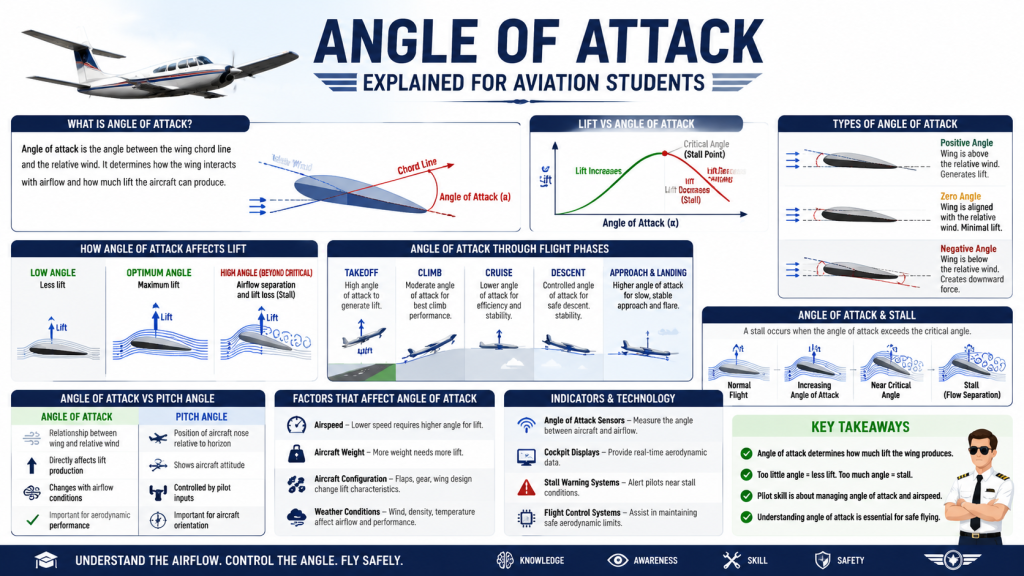
Angle of attack is the angle between the wing chord line and the relative wind direction.
In simple words, it describes how the aircraft wing meets the airflow coming toward it.
The wing does not create lift only because the aircraft moves forward. Lift is produced because the wing interacts with moving air. The angle at which the wing meets that airflow determines how effectively it can generate lift.
A small change in angle of attack can significantly affect aircraft performance.
For example:
- Increasing angle of attack can increase lift.
- Reducing angle of attack decreases lift.
- Excessive angle of attack can cause a stall.
Understanding this relationship helps pilots manage aircraft safely.
Understanding the Aerodynamics Behind Angle of Attack
Aircraft flight depends on the interaction between the wing and airflow. The angle of attack plays a major role in controlling aerodynamic forces.
Wing Chord Line
The chord line is an imaginary straight line drawn from the leading edge of the wing to the trailing edge.
It provides a reference point for measuring the angle between the wing and the airflow.
The angle between this chord line and the relative wind determines the aircraft’s angle of attack.
Relative Wind
Relative wind is the airflow direction experienced by the aircraft as it moves through the atmosphere.
It is opposite to the aircraft’s flight direction.
For example:
- If an aircraft moves forward, the relative wind appears to come from the front.
- During certain flight conditions, changes in aircraft movement can change the direction of relative airflow.
Pilots must understand relative wind because angle of attack depends on airflow direction, not just aircraft position.
Lift Production
The wing generates lift by creating aerodynamic pressure differences as air moves around it.
Angle of attack affects:
- Airflow behavior
- Pressure distribution
- Lift generation
- Aircraft performance
When the angle of attack increases within a safe range, lift generally increases. However, after reaching a certain point, airflow begins to separate from the wing, causing lift reduction.
Angle of Attack and Lift Relationship
Angle of attack has a direct relationship with lift production.
When an aircraft increases its angle of attack:
- The wing meets the airflow at a greater angle.
- More lift can be generated.
- Aircraft performance changes.
However, increasing angle of attack does not always improve flight performance.
There is a limit known as the critical angle of attack.
Beyond this point:
- Smooth airflow over the wing decreases.
- Lift reduces.
- The aircraft may enter a stall condition.
This is why pilots must manage angle of attack carefully.
Positive, Zero, and Negative Angle of Attack
Positive Angle of Attack
A positive angle of attack occurs when the wing chord line is positioned above the relative wind.
This condition is common during:
- Takeoff
- Climb
- Normal flight operations
It usually helps generate lift.
Zero Angle of Attack
A zero angle of attack occurs when the wing chord line aligns with the relative wind.
At this condition, the wing produces minimal lift depending on its design.
Negative Angle of Attack
A negative angle of attack occurs when the wing meets airflow from the opposite direction.
This condition may occur during certain aircraft maneuvers or flight situations.
Critical Angle of Attack
The critical angle of attack is the maximum angle at which a wing can produce effective lift.
When the aircraft exceeds this angle:
- Airflow separation occurs.
- Lift decreases.
- Drag increases.
- The aircraft may stall.
The critical angle is important because it depends on the aircraft wing design and aerodynamic characteristics.
Pilots are trained to recognize and manage situations involving high angles of attack.
Angle of Attack and Aircraft Stall
One of the biggest misconceptions among beginners is that aircraft stalls only happen because of low speed.
In reality, a stall occurs when the aircraft exceeds its critical angle of attack.
An aircraft can stall at different speeds depending on factors such as:
- Aircraft weight
- Configuration
- Flight conditions
- Angle of attack
How a Stall Develops
A stall usually occurs through the following process:
- The aircraft increases angle of attack.
- Airflow over the wing becomes disturbed.
- Smooth airflow separation begins.
- Lift decreases.
- Aircraft performance changes.
Stall Recovery Basics
General stall recovery involves:
- Reducing angle of attack.
- Allowing airflow to reconnect with the wing.
- Following aircraft-specific recovery procedures.
Pilot training focuses heavily on recognizing and recovering from stall conditions safely.
Angle of Attack During Different Flight Phases
Takeoff
During takeoff, pilots increase aircraft angle of attack to generate sufficient lift.
Important considerations include:
- Proper rotation technique
- Smooth control movement
- Maintaining safe climb performance
A correct angle of attack helps the aircraft transition from ground movement to flight.
Climb
During climb, pilots manage angle of attack to maintain:
- Safe climb rate
- Aircraft performance
- Engine efficiency
Too much angle of attack can reduce performance and increase stall risk.
Cruise
During cruise flight, aircraft usually operate at efficient angles of attack.
The goal is to maintain:
- Stable flight
- Fuel efficiency
- Passenger comfort
Descent
During descent, pilots adjust aircraft attitude and power settings while maintaining appropriate aerodynamic conditions.
A controlled angle of attack helps maintain safe descent performance.
Landing
Landing requires careful angle of attack management.
During approach:
- Pilots maintain proper aircraft attitude.
- They control speed and descent rate.
- They prepare for a safe touchdown.
During the flare phase, pilots adjust aircraft attitude to reduce descent speed before landing.
Difference Between Angle of Attack and Pitch Angle
Many aviation students confuse angle of attack with pitch angle. Although they are related, they are different concepts.
| Angle of Attack | Pitch Angle |
|---|---|
| Relationship between wing and airflow | Position of aircraft nose relative to horizon |
| Directly affects lift production | Shows aircraft attitude |
| Changes with airflow conditions | Controlled by pilot inputs |
| Important for aerodynamic performance | Important for aircraft orientation |
A pilot can have a high pitch angle with a low angle of attack or a low pitch angle with a higher angle of attack depending on airflow conditions.
Factors That Affect Angle of Attack
Several factors influence aircraft angle of attack.
Aircraft Speed
Aircraft speed affects the amount of lift generated.
At lower speeds, pilots generally require higher angles of attack to maintain lift.
Aircraft Weight
A heavier aircraft requires different aerodynamic management because more lift is needed to support the aircraft.
Aircraft Configuration
Aircraft components can affect aerodynamic behavior.
Examples include:
- Flaps
- Wing design
- Landing gear position
Weather Conditions
Environmental conditions can influence aircraft performance.
Factors include:
- Wind
- Air density
- Temperature
- Atmospheric changes
Angle of Attack Indicators and Aviation Technology
Modern aircraft use technology to help pilots understand aerodynamic conditions.
Angle of Attack Sensors
These sensors measure the relationship between aircraft movement and airflow.
Cockpit Displays
Advanced aircraft may provide pilots with information related to aerodynamic conditions.
Stall Warning Systems
Aircraft use warning systems to alert pilots when they approach unsafe aerodynamic conditions.
Flight Control Systems
Modern aircraft systems can assist pilots by improving aircraft handling and safety.
Importance of Angle of Attack for Pilot Training
Aviation students study angle of attack because it helps them understand:
Aircraft Control
Pilots learn how control inputs affect aerodynamic performance.
Flight Safety
Understanding angle of attack helps prevent unsafe flight conditions.
Better Decision-Making
Pilots can make better choices when managing aircraft performance.
Strong Aerodynamic Knowledge
A strong understanding of angle of attack helps students progress toward advanced aviation training.
Common Mistakes Aviation Students Make
Confusing Pitch With Angle of Attack
Students often assume these concepts are identical. Understanding their difference is essential for proper aircraft control.
Ignoring Airspeed Relationship
Angle of attack and airspeed work together. Focusing on only one factor can lead to incorrect assumptions.
Overcontrolling the Aircraft
Smooth control movements are important because sudden changes can create unstable aerodynamic conditions.
Memorizing Instead of Understanding
Students should understand why aircraft behave in certain ways instead of only memorizing procedures.
Practical Learning Tips for Aviation Students
- Study aerodynamic diagrams regularly.
- Observe aircraft behavior during flight training.
- Connect theoretical concepts with practical flying lessons.
- Ask instructors about aerodynamic situations.
- Practice understanding aircraft attitude and airflow relationships.
Angle of Attack Concepts Comparison Table
| Concept | Meaning | Importance in Flight |
|---|---|---|
| Angle of Attack | Relationship between wing and airflow | Controls lift generation |
| Pitch Angle | Aircraft nose position | Shows aircraft attitude |
| Critical Angle | Maximum effective angle of attack | Helps prevent stalls |
| Relative Wind | Direction of airflow around aircraft | Determines aerodynamic forces |
Frequently Asked Questions
1. What is angle of attack in aviation?
Angle of attack is the angle between the aircraft wing chord line and the direction of relative airflow. It determines how effectively the wing produces lift.
2. Why is angle of attack important for pilots?
It helps pilots understand aircraft performance, maintain control, and prevent dangerous stall conditions.
3. Is angle of attack the same as pitch angle?
No. Pitch angle describes aircraft nose position, while angle of attack describes the relationship between the wing and airflow.
4. How does angle of attack affect lift?
Increasing angle of attack generally increases lift until the aircraft reaches its critical angle.
5. What is critical angle of attack?
It is the maximum angle at which a wing can produce effective lift before airflow separation occurs.
6. Why does an aircraft stall at high angle of attack?
A stall happens because excessive angle of attack disrupts airflow over the wing, reducing lift.
7. How do pilots control angle of attack?
Pilots manage angle of attack through aircraft controls, speed management, and proper flight techniques.
8. Why do aviation students learn angle of attack?
It provides essential aerodynamic knowledge needed for safe aircraft operation and professional pilot training.
9. How do modern aircraft measure angle of attack?
Aircraft use specialized sensors and flight systems to monitor aerodynamic conditions.
10. What is the relationship between airspeed and angle of attack?
Airspeed and angle of attack work together to maintain lift and aircraft performance. Changes in one can affect the other.
Conclusion
Angle of attack is one of the most important aerodynamic concepts for aviation students. It explains how aircraft wings interact with airflow and how pilots control lift, performance, and safety during flight.
A strong understanding of angle of attack helps student pilots develop better aircraft awareness, improve decision-making, and build confidence during flight training. By understanding this fundamental concept, aviation students create a strong foundation for becoming skilled and safety-focused pilots.

