
Introduction
Aircraft aerodynamics is the foundation of aviation that explains how airplanes move through the air, generate lift, maintain stability, and achieve controlled flight. Every aircraft, from small training airplanes to large commercial jets and advanced military aircraft, depends on aerodynamic principles to fly safely and efficiently.
Understanding aerodynamics helps beginners discover why aircraft have specific shapes, why wings are designed differently, how pilots control movement, and how engineers improve aircraft performance. Although aerodynamics involves scientific concepts such as airflow, pressure, and forces, the basic principles can be understood easily with the right approach.
This guide introduces the fundamentals of aircraft aerodynamics for students, aviation enthusiasts, aspiring pilots, and anyone interested in understanding how airplanes fly.
Real-world examples:
- Pilots use aerodynamic knowledge to control aircraft during takeoff, cruising, and landing.
- Aircraft engineers use aerodynamic principles to design faster and more fuel-efficient airplanes.
- Airlines depend on aerodynamic improvements to reduce fuel consumption and improve passenger safety.
- Drone manufacturers apply aerodynamics to create stable and efficient unmanned aircraft.
What Is Aircraft Aerodynamics?
Aircraft aerodynamics is the study of how air interacts with an aircraft while it is moving. It focuses on understanding airflow patterns, forces acting on the aircraft, and design features that allow an airplane to fly efficiently.
When an aircraft moves through the atmosphere, air flows around its wings, fuselage, and control surfaces. These interactions create forces that determine how the aircraft moves.
Aerodynamics helps answer important aviation questions:
- How does an aircraft generate lift?
- Why does a plane stay stable in the air?
- How do pilots control direction and altitude?
- How can engineers reduce fuel consumption?
- Why do different aircraft have different wing designs?
Aircraft design is a balance between generating enough lift, producing sufficient thrust, reducing drag, and maintaining stability.
How Do Aircraft Fly?
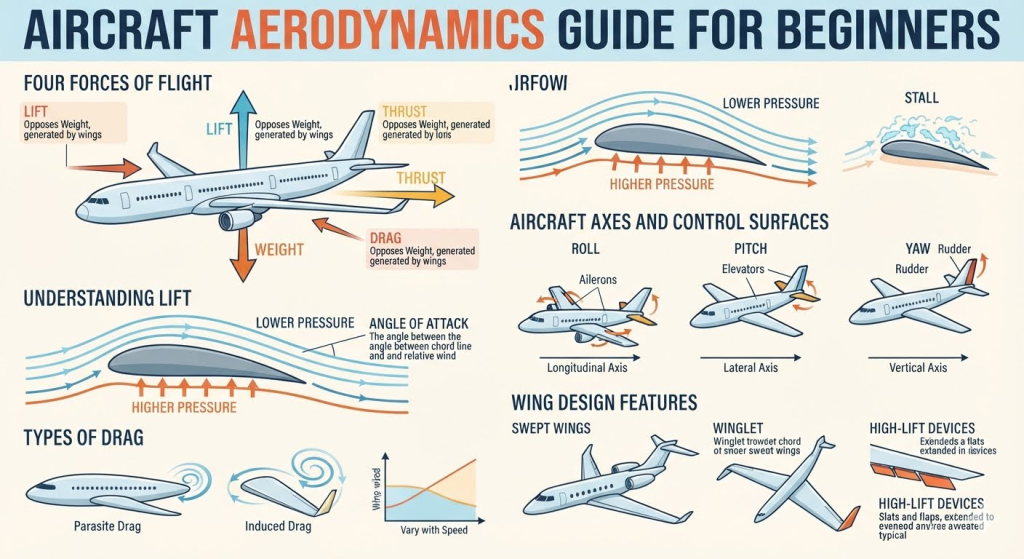
Aircraft fly because four major forces work together:
- Lift
- Weight
- Thrust
- Drag
These forces constantly interact during every stage of flight.
Lift
Lift is the upward force that allows an aircraft to leave the ground and remain airborne.
Aircraft wings are designed with special shapes called airfoils. As air flows over and under the wing, pressure differences are created, producing an upward force.
Factors affecting lift include:
- Wing shape
- Wing size
- Airspeed
- Air density
- Angle of attack
When lift becomes greater than the aircraft’s weight, the airplane can climb or maintain altitude.
Weight
Weight is the force created by gravity pulling the aircraft toward Earth.
Every aircraft has a specific weight limit because weight affects:
- Takeoff distance
- Fuel efficiency
- Climb performance
- Landing requirements
A heavier aircraft requires more lift and thrust compared with a lighter aircraft.
Pilots and engineers carefully calculate weight distribution to maintain safe flight conditions.
Thrust
Thrust is the forward force that moves an aircraft through the air.
Aircraft engines generate thrust using different technologies:
- Jet engines
- Turbofan engines
- Turboprop engines
- Piston engines
Thrust allows the aircraft to overcome drag and achieve the required speed for flight.
During takeoff, aircraft require high thrust to accelerate along the runway. During cruise flight, engines provide enough thrust to maintain speed efficiently.
Drag
Drag is the resistance created when an aircraft moves through the air.
Although drag cannot be completely eliminated, engineers work to reduce it because excessive drag increases fuel consumption.
Common types of drag include:
Parasite Drag
This is caused by the aircraft’s shape and surface resistance.
Examples:
- Fuselage shape
- Landing gear
- Antennas
Induced Drag
This drag is created when wings produce lift.
Aircraft designers balance wing design to reduce unnecessary induced drag.
Understanding Aircraft Wings and Wing Design
The wing is one of the most important components of an aircraft because it generates lift and contributes to stability.
Different aircraft use different wing designs based on their purpose.
Airfoil Design
An airfoil is the cross-sectional shape of a wing.
A good airfoil design helps:
- Increase lift generation
- Reduce drag
- Improve aircraft efficiency
- Maintain stability
The upper and lower surfaces of a wing are designed to control airflow movement.
Wing Span
Wing span is the distance from one wingtip to the other.
A larger wingspan can improve aerodynamic efficiency because it helps create lift with reduced drag.
Examples:
- Gliders use long wings for efficient flight.
- Fighter aircraft often use smaller wings for high-speed maneuverability.
Winglets
Winglets are small vertical structures placed at the ends of wings.
They help reduce wingtip vortices, which are swirling air movements that create additional drag.
Benefits of winglets include:
- Improved fuel efficiency
- Reduced drag
- Better aircraft performance
Swept Wings
Swept wings are angled backward and are commonly found on high-speed aircraft.
They help aircraft:
- Reduce aerodynamic resistance at high speeds.
- Improve performance during faster flight.
Commercial jet aircraft often use swept wings because they operate at high cruising speeds.
Important Aerodynamic Concepts Beginners Should Know
Angle of Attack
Angle of attack is the angle between the aircraft wing and the incoming airflow.
It directly affects lift production.
Increasing angle of attack can increase lift, but if it becomes too high, the wing may experience a stall.
Stall
A stall occurs when a wing cannot generate enough lift due to excessive angle of attack.
A stall does not mean the engine stops working. It means the wing has lost its ability to produce sufficient lift.
Pilots are trained to recognize and recover from stall conditions safely.
Boundary Layer
The boundary layer is the thin layer of air that moves directly along the aircraft surface.
Managing airflow in this region helps engineers reduce drag and improve efficiency.
Bernoulli’s Principle
Bernoulli’s principle explains the relationship between air speed and pressure.
In simple terms, changes in airflow speed around a wing contribute to pressure differences that help create lift.
Center of Gravity
The center of gravity is the point where the aircraft’s weight is considered to act.
Proper balance is important because incorrect weight distribution can affect:
- Stability
- Control
- Flight performance
Aircraft Control Surfaces and Their Role
Aircraft use control surfaces to change direction and maintain stability.
Ailerons
Ailerons are located on the wings and control aircraft roll movement.
They allow aircraft to:
- Turn left
- Turn right
- Maintain wing balance
Elevators
Elevators are located on the horizontal tail section.
They control pitch movement, allowing the aircraft to:
- Climb
- Descend
Rudder
The rudder controls yaw movement.
Pilots use it to maintain directional control, especially during takeoff and landing.
Flaps
Flaps are movable wing surfaces used during slower flight conditions.
They help by:
- Increasing lift during takeoff
- Increasing drag during landing
- Allowing safer low-speed operations
Slats
Slats are located on the front edge of wings.
They improve airflow over the wing at lower speeds and help delay stall conditions.
Spoilers
Spoilers reduce lift and increase drag.
They are mainly used during:
- Landing
- Speed reduction
- Ground operations
Aerodynamics During Different Phases of Flight
Taxiing
During taxiing, aircraft move slowly on the ground.
Aerodynamic forces are limited, and pilots mainly control movement using steering systems and brakes.
Takeoff
During takeoff:
- Engines produce high thrust.
- Wings generate increasing lift.
- Control surfaces help maintain direction.
When lift becomes greater than weight, the aircraft leaves the runway.
Climb
During climb:
- Aircraft gains altitude.
- Engines provide additional thrust.
- Pilots adjust pitch and speed.
Cruise
Cruise is the most efficient phase of flight.
Aircraft maintain:
- Stable speed
- Balanced lift and weight
- Efficient engine operation
Descent and Landing
During descent:
- Thrust is reduced.
- Aircraft gradually loses altitude.
- Pilots use flaps and landing gear to control speed.
Landing requires careful management of lift, drag, and speed.
Subsonic and Supersonic Aerodynamics
Aircraft performance changes significantly when approaching the speed of sound.
Subsonic Flight
Most commercial aircraft operate below the speed of sound.
Characteristics include:
- Efficient operation
- Stable airflow
- Lower aerodynamic challenges
Supersonic Flight
Supersonic aircraft travel faster than sound.
They experience:
- Shock waves
- Increased drag
- Higher heating effects
Designing supersonic aircraft requires advanced aerodynamic engineering.
How Aircraft Designers Improve Aerodynamics
Modern aircraft manufacturers continuously improve aerodynamic performance through:
Computer Simulations
Engineers use advanced software to analyze airflow before building aircraft.
Wind Tunnel Testing
Scaled aircraft models are tested in controlled airflow environments.
Lightweight Materials
Modern materials reduce aircraft weight while maintaining strength.
Efficient Aircraft Shapes
Engineers design smoother aircraft surfaces to reduce drag and improve fuel efficiency.
Real-World Applications of Aircraft Aerodynamics
Commercial Aircraft
Passenger airplanes use aerodynamics to improve:
- Fuel economy
- Passenger comfort
- Flight stability
Fighter Aircraft
Military aircraft focus on:
- High-speed performance
- Maneuverability
- Stability during complex movements
Private Jets
Business aircraft use aerodynamic designs for:
- Faster travel
- Improved efficiency
- Comfortable flight
Drones
Small unmanned aircraft rely on aerodynamic principles for:
- Stability
- Battery efficiency
- Controlled movement
Spacecraft
Space vehicles use aerodynamic concepts during atmospheric entry and landing phases.
Common Aerodynamics Mistakes Beginners Make
“Aircraft Fly Only Because of Engines”
Engines provide thrust, but wings generate lift. Both systems work together.
“Bigger Wings Always Create More Lift”
Wing size matters, but aircraft performance depends on many factors including speed, design, and weight.
“Higher Speed Always Means Better Flight”
Aircraft are designed for specific operating speeds. Excessive speed can create safety and efficiency problems.
How Beginners Can Learn More About Aircraft Aerodynamics
Beginners can improve their understanding through:
- Aviation textbooks and learning materials.
- Flight simulation programs.
- Aircraft observation activities.
- Pilot training courses.
- Aerospace engineering resources.
- Aviation communities and discussions.
Practical learning helps connect aerodynamic theory with real aircraft behavior.
Frequently Asked Questions
1. What is aircraft aerodynamics?
Aircraft aerodynamics is the study of how air interacts with airplanes and how aerodynamic forces help aircraft fly safely and efficiently.
2. How do airplanes stay in the air?
Airplanes stay airborne because wings generate lift that balances the aircraft’s weight while engines provide the thrust needed for movement.
3. What creates lift on an aircraft?
Lift is created when air flows around the wings, producing aerodynamic forces that push the aircraft upward.
4. Why do airplanes have wings?
Aircraft have wings because wings create lift and provide stability during flight.
5. What happens during an aircraft stall?
A stall occurs when a wing loses its ability to generate enough lift due to excessive angle of attack.
6. Why are winglets used on aircraft?
Winglets reduce drag caused by wingtip airflow and improve fuel efficiency.
7. How does drag affect aircraft performance?
Drag slows aircraft movement and increases fuel requirements, so engineers design aircraft to minimize unnecessary resistance.
8. What is the angle of attack?
The angle of attack is the angle between the aircraft wing and the incoming airflow.
9. Do pilots need to understand aerodynamics?
Yes, pilots need aerodynamic knowledge to understand aircraft behavior and make safe flight decisions.
10. How does aerodynamics improve fuel efficiency?
Better aerodynamic designs reduce drag, allowing aircraft to use less fuel while maintaining performance.
Conclusion
Aircraft aerodynamics is one of the most important concepts in aviation because it explains the science behind flight. From wing design and airflow management to aircraft control and stability, every part of an airplane is influenced by aerodynamic principles.
For beginners, understanding the basics of lift, weight, thrust, and drag provides a strong foundation for exploring aviation, pilot training, and aerospace engineering. As aircraft technology continues to improve, aerodynamics will remain essential for creating safer, faster, and more efficient aircraft.
Learning aerodynamics is the first step toward understanding the incredible science that allows humans to fly.

