
Introduction
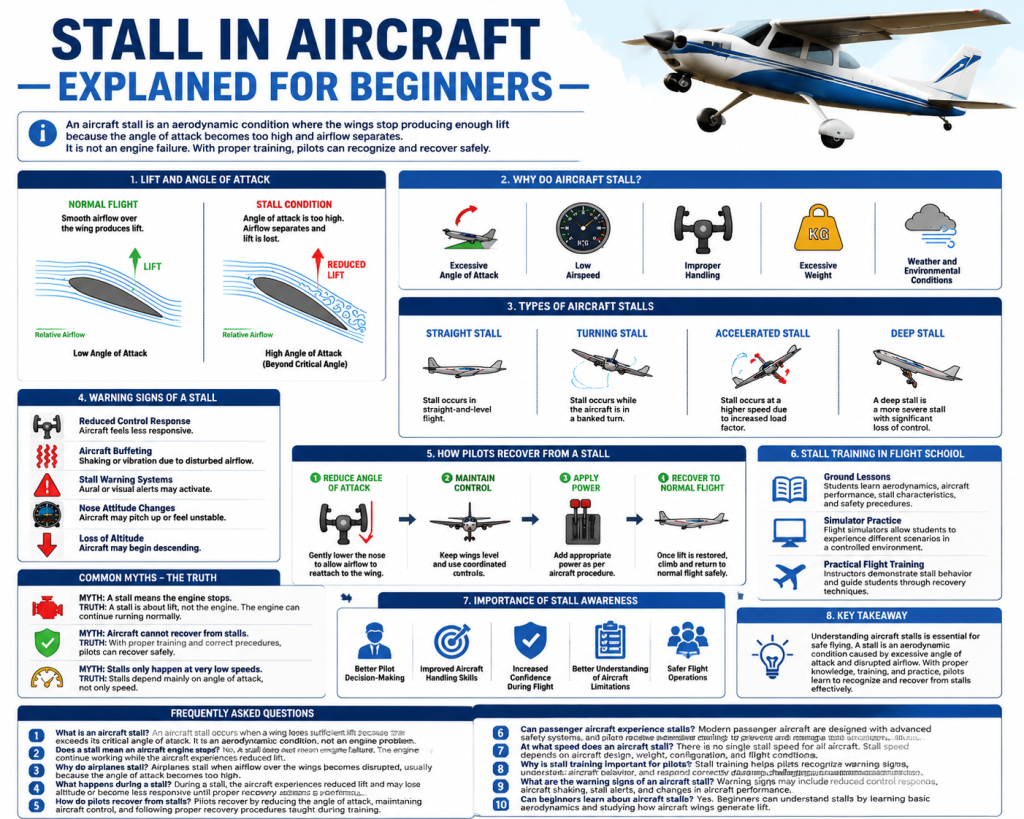
For anyone learning about aviation, the term aircraft stall can sound confusing or alarming. Many beginners assume that a stall means the aircraft engine stops working or the airplane suddenly falls from the sky. However, an aircraft stall is not related to engine failure. It is an aerodynamic condition where an aircraft wing is unable to produce enough lift because it exceeds its critical angle of attack.
Understanding stalls is one of the most important parts of pilot training because it helps pilots recognize dangerous situations, maintain aircraft control, and make better flight decisions. Every aircraft is designed to operate safely within certain performance limits, and pilots learn how to identify and manage conditions that may lead to a stall.
A proper understanding of aircraft stalls helps aviation students, aircraft enthusiasts, and beginners understand how airplanes fly and how pilots maintain safety during different flight conditions.
This guide explains what an aircraft stall is, why stalls happen, different types of stalls, warning signs, recovery methods, and why stall training is an essential part of aviation education.
What Is an Aircraft Stall?
An aircraft stall is an aerodynamic condition where the wings stop producing sufficient lift because the airflow over the wing becomes disrupted.
Aircraft wings generate lift by controlling the movement of air around their surfaces. When air flows smoothly over the wings, the aircraft can maintain flight. However, when the angle of attack becomes too high, airflow begins to separate from the wing surface, reducing lift production.
A stall occurs when the aircraft exceeds its critical angle of attack, which is the maximum angle where the wing can continue producing effective lift.
Important points about aircraft stalls:
- A stall is caused by airflow separation over the wings.
- It is not caused by engine failure.
- It can happen at different speeds depending on aircraft conditions.
- Proper pilot training allows safe recognition and recovery.
Understanding this concept helps beginners understand that aircraft stalls are related to aerodynamics rather than mechanical failure.
Understanding Lift and Angle of Attack
To understand aircraft stalls, beginners first need to understand two important aviation concepts: lift and angle of attack.
What Is Lift?
Lift is the force that allows an aircraft to rise and remain in the air. Aircraft wings are designed to create pressure differences and control airflow, producing an upward force.
Several factors influence lift, including:
- Wing design
- Airspeed
- Air density
- Aircraft weight
- Angle of attack
When lift is greater than the aircraft’s weight, the aircraft can climb or maintain altitude. When lift decreases significantly, the aircraft may begin to lose altitude.
What Is Angle of Attack?
The angle of attack is the angle between the aircraft wing and the airflow approaching the wing.
It plays an important role in lift generation.
When the angle of attack increases:
- Lift initially increases
- The wing produces more aerodynamic force
- Airflow continues moving over the wing
However, if the angle becomes too high:
- Airflow separates from the wing surface
- Lift decreases
- The aircraft enters a stall condition
The point where the wing can no longer maintain effective airflow is called the critical angle of attack.
Why Do Aircraft Stalls Happen?
Aircraft stalls can occur for several reasons. Understanding these causes helps pilots prevent unsafe flight conditions.
1. Excessive Angle of Attack
The most common cause of a stall is exceeding the critical angle of attack.
This can happen when a pilot pulls the aircraft nose upward too aggressively or tries to maintain altitude at very low speeds.
When the wing angle becomes too steep:
- Smooth airflow is disrupted
- Lift decreases
- Aircraft control may become reduced
Proper aircraft handling helps pilots avoid reaching this condition.
2. Low Airspeed
Many people believe that stalls only happen because an aircraft is moving slowly, but speed alone does not cause a stall.
Low airspeed can increase the risk because the wings may not receive enough airflow to generate required lift.
Examples include:
- During takeoff if aircraft speed is insufficient
- During landing when aircraft slows down
- During improper slow-flight operations
Pilots carefully monitor airspeed to maintain safe flight conditions.
3. Improper Aircraft Handling
Incorrect control inputs can contribute to stall situations.
Examples include:
- Sudden aggressive climbs
- Excessive banking during turns
- Incorrect recovery techniques
Smooth and controlled aircraft handling is an important pilot skill.
4. Excessive Weight or Loading Conditions
Aircraft weight affects flight performance.
A heavily loaded aircraft requires more lift to remain airborne. This can influence stall speed and aircraft handling characteristics.
Factors affecting aircraft loading include:
- Passenger weight
- Cargo weight
- Fuel quantity
- Aircraft balance
Pilots calculate weight and balance before flight to ensure safe operation.
5. Weather and Environmental Conditions
Weather conditions can influence aircraft performance.
Factors such as:
- Turbulence
- Strong winds
- Changing air density
- Mountain wave conditions
can affect aircraft behavior.
Pilots use weather information and training knowledge to manage these conditions safely.
Types of Aircraft Stalls
Different flight situations can create different types of stalls.
1. Straight Stall
A straight stall occurs when an aircraft loses lift during normal straight flight.
This is one of the basic stall situations taught during pilot training.
During training, pilots learn:
- How to recognize stall indications
- How the aircraft responds
- How to safely recover
2. Turning Stall
A turning stall occurs when a stall happens during a banked turn.
During turns:
- The aircraft experiences additional aerodynamic forces
- More lift may be required
- Incorrect control inputs can increase stall risk
Pilots practice coordinated turns to reduce the possibility of turning stalls.
3. Accelerated Stall
An accelerated stall happens when an aircraft stalls at a higher speed than its normal stall speed due to increased load factors.
This may occur during:
- Sharp turns
- Sudden maneuvers
- High-performance flight operations
Understanding accelerated stalls is important for advanced pilot training.
4. Deep Stall
A deep stall is a more complex aerodynamic condition where recovery becomes difficult because airflow over control surfaces may be reduced.
This type of stall is more commonly associated with specific aircraft designs rather than normal training aircraft.
Aircraft manufacturers consider stall behavior during design and testing.
Warning Signs of an Aircraft Stall
Pilots are trained to recognize early stall indicators before the situation becomes serious.
Common warning signs include:
Reduced Aircraft Control Response
The aircraft may feel less responsive to control inputs.
Aircraft Buffeting
The aircraft may experience shaking or vibration caused by disturbed airflow.
Stall Warning Systems
Modern aircraft may include warning systems that alert pilots when approaching stall conditions.
Nose Attitude Changes
The aircraft may require proper control adjustments to maintain safe flight.
Loss of Altitude
If a stall develops, the aircraft may begin losing altitude.
Recognizing these signs early allows pilots to respond effectively.
How Pilots Recover From an Aircraft Stall
Stall recovery training teaches pilots how to regain normal airflow and restore aircraft control.
The general recovery concept involves:
Reducing Angle of Attack
The first priority is reducing the wing angle so airflow can return over the wing surface.
Maintaining Aircraft Control
Pilots focus on controlling aircraft movement and preventing excessive roll or unwanted movement.
Applying Appropriate Power
Depending on the aircraft and situation, pilots may use engine power to help regain flight performance.
Returning to Normal Flight
After recovery, pilots gradually return the aircraft to a stable flight condition.
The exact recovery procedure depends on aircraft type and approved pilot training procedures.
Stall Training During Flight School
Stall training is an important part of becoming a skilled pilot.
Flight schools teach students how to:
- Understand stall theory
- Recognize stall symptoms
- Practice controlled stall situations
- Perform proper recovery procedures
- Develop confidence in aircraft handling
Training usually includes:
Ground Lessons
Students learn:
- Aerodynamics
- Aircraft performance
- Stall characteristics
- Safety procedures
Simulator Practice
Flight simulators allow students to experience different scenarios in a controlled environment.
Practical Flight Training
Instructors demonstrate stall behavior and guide students through recovery techniques.
This training helps pilots understand aircraft limits and improve safety awareness.
Common Myths About Aircraft Stalls
Myth 1: A Stall Means the Engine Stops
Fact:
A stall is an aerodynamic problem involving wing lift. The aircraft engine can continue operating normally during a stall.
Myth 2: Aircraft Cannot Recover From Stalls
Fact:
With proper training and correct procedures, pilots can recover from stall conditions safely.
Myth 3: Stalls Only Happen at Very Low Speeds
Fact:
Stalls depend mainly on angle of attack, not only speed. Aircraft can stall at different speeds depending on conditions.
How Beginners Can Understand Aircraft Stalls Better
Beginners can improve their understanding of aircraft stalls by:
- Learning basic aerodynamics
- Understanding aircraft controls
- Studying flight principles
- Using flight simulators
- Watching professional aviation training materials
- Learning from certified flight instructors
A strong foundation in aviation concepts helps students become better pilots.
Importance of Stall Awareness in Aviation Safety
Stall awareness is a critical part of aviation safety because it helps pilots understand aircraft behavior and prevent loss-of-control situations.
Benefits of stall awareness include:
- Better pilot decision-making
- Improved aircraft handling skills
- Increased confidence during flight
- Better understanding of aircraft limitations
- Safer flight operations
Professional pilots continue practicing and improving their knowledge throughout their careers.
Frequently Asked Questions
1. What is an aircraft stall?
An aircraft stall occurs when a wing loses sufficient lift because the aircraft exceeds its critical angle of attack. It is an aerodynamic condition, not an engine problem.
2. Does a stall mean an aircraft engine stops?
No. A stall does not mean engine failure. The engine may continue working while the aircraft experiences reduced lift.
3. Why do airplanes stall?
Airplanes stall when airflow over the wings becomes disrupted, usually because the angle of attack becomes too high.
4. What happens during a stall?
During a stall, the aircraft experiences reduced lift and may lose altitude or become less responsive until proper recovery actions are performed.
5. How do pilots recover from stalls?
Pilots recover by reducing the angle of attack, maintaining aircraft control, and following proper recovery procedures taught during training.
6. Can passenger aircraft experience stalls?
Modern passenger aircraft are designed with advanced safety systems, and pilots receive extensive training to prevent and manage stall situations.
7. At what speed does an aircraft stall?
There is no single stall speed for all aircraft. Stall speed depends on aircraft design, weight, configuration, and flight conditions.
8. Why is stall training important for pilots?
Stall training helps pilots recognize warning signs, understand aircraft behavior, and respond correctly during challenging situations.
9. What are the warning signs of an aircraft stall?
Warning signs may include reduced control response, aircraft shaking, stall alerts, and changes in aircraft performance.
10. Can beginners learn about aircraft stalls?
Yes. Beginners can understand stalls by learning basic aerodynamics and studying how aircraft wings generate lift.
Conclusion
Understanding aircraft stalls is an essential part of aviation learning. A stall is not an engine failure but an aerodynamic condition caused by excessive angle of attack and reduced airflow over the wings.
For beginner aviation students, learning about stalls provides a better understanding of how aircraft operate and why pilot training focuses heavily on safety, awareness, and proper decision-making.
With proper knowledge, training, and practice, pilots learn how to recognize stall conditions and manage them effectively. Understanding stalls is an important step toward becoming a skilled and safety-focused aviation professional.

