
Introduction
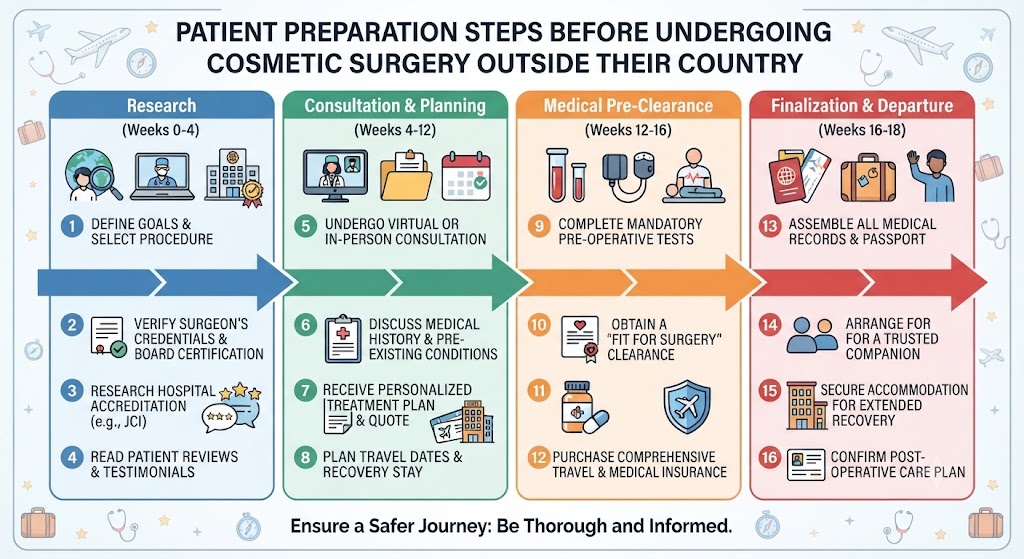
Travelling to another country for cosmetic surgery involves two major decisions at the same time: undergoing an operation and managing international travel. Patients must therefore prepare for more than the procedure itself.
The plan should cover medical suitability, surgeon qualifications, hospital standards, travel risks, communication, costs, recovery accommodation and access to follow-up care after returning home.
Health authorities warn that the safety of international treatment can depend on the patient’s health, destination, medical facility and treating professional. Possible concerns include infection, communication difficulties, blood clots, differences in regulation and limited continuity of care after the patient returns home.
A recent CDC review also highlighted infections and other serious adverse outcomes linked to travel-associated cosmetic procedures, reinforcing the importance of speaking with healthcare professionals and preparing carefully before travelling.
BestCosmeticHospitals.com can provide a structured starting point for comparing cosmetic hospitals, specialists, destinations, procedures and estimated costs. However, patients must independently confirm all medical credentials and treatment information before paying or travelling.
Why Preparation for Cosmetic Surgery Abroad Is Different
Preparing for surgery near home usually involves a familiar healthcare system and easier access to follow-up appointments. International treatment adds several practical challenges.
Patients may need to manage:
- A different language
- Unfamiliar medical regulations
- Long-distance flights
- Visa and passport requirements
- Recovery in temporary accommodation
- Limited family support
- Currency differences
- Unfamiliar medicines
- Emergency treatment in another healthcare system
- Follow-up after returning home
Professional guidance notes that normal postoperative care can become more difficult when patients travel long distances and cannot easily return to their operating surgeon for routine reviews or treatment of complications.
Preparation should therefore begin before a hospital package, flight or hotel is booked.
Patient Preparation Steps Before Cosmetic Surgery Abroad
1. Confirm That the Procedure Is Appropriate for You
Begin by understanding the exact cosmetic procedure being considered.
Ask the surgeon to explain:
- What the procedure can realistically achieve
- What it cannot change
- Available surgical and non-surgical alternatives
- Possible scars
- Expected recovery
- Short-term and long-term risks
- Whether revision surgery may eventually be needed
Do not choose an operation only because it is popular, discounted or included in a medical travel package.
A qualified surgeon should evaluate whether the procedure matches your anatomy, health, expectations and personal reasons for seeking treatment.
2. Consult a Doctor Before Making Travel Arrangements
Arrange an appointment with your regular doctor or an appropriate medical professional before committing to overseas surgery.
Discuss:
- Existing medical conditions
- Previous operations
- Allergies
- Regular medication
- Previous anesthesia problems
- Smoking or nicotine use
- Pregnancy plans where relevant
- Personal or family history of blood clots
- Previous wound-healing problems
- The planned operation and travel schedule
CDC travel guidance recommends obtaining a pre-travel consultation several weeks before departure so that personal health risks, destination-related concerns and travel before and after the procedure can be reviewed.
A patient should not hide medical conditions from the overseas surgeon because they fear that surgery may be refused. Proper patient selection is part of safe care.
3. Complete the Required Medical Assessment
The overseas surgical team should provide written instructions about the medical assessment and tests needed before surgery.
Depending on the procedure and individual health, assessment may include:
- Medical history review
- Physical examination
- Blood tests
- Blood pressure measurement
- Heart assessment
- Pregnancy testing where appropriate
- Imaging
- Anesthesia consultation
- Medication and allergy review
- Infection screening
- Blood-clot risk assessment
Do not assume that approval based only on photographs or online messages is a complete medical assessment.
Patients should know who reviewed their information and whether the operating surgeon personally approved the treatment plan.
4. Review Your Medicines with Qualified Professionals
Provide the surgeon and anesthetist with a complete list of:
- Prescription medicines
- Non-prescription medicines
- Vitamins
- Herbal products
- Hormonal medicines
- Weight-management products
- Allergies and previous reactions
Some medicines or supplements can affect bleeding, anesthesia or recovery. However, patients should never stop prescribed treatment without instructions from the clinician who manages it and the surgical team.
Carry medicines in their original packaging and bring enough for the full journey, including extra supplies for unexpected delays. Public health guidance also recommends carrying copies of prescriptions and a written list of drug names and doses.
Check the destination country’s rules before travelling with controlled or restricted medicines.
5. Verify the Plastic Surgeon Independently
A website profile or social media account is not enough to confirm professional qualifications.
Check the surgeon through:
- The destination country’s official medical register
- The national plastic surgery society
- Recognized specialist certification systems
- The hospital where the surgeon operates
- Professional disciplinary records where available
Confirm:
- Full professional name
- Medical registration number
- Current licence status
- Recognized specialty
- Plastic surgery training
- Experience with the exact procedure
- Hospital privileges
- Who will perform each part of the operation
ISAPS advises patients to verify that an overseas surgeon is properly certified, or holds the national equivalent, and is trained and experienced in the planned procedure. It also advises patients to communicate with the surgeon and medical team rather than relying only on a travel agent.
6. Verify the Hospital or Surgical Facility
Patients should investigate the exact location where the surgery will take place.
Confirm:
- Legal licence
- Current accreditation or certification
- Operating-room standards
- Sterilization procedures
- Qualified anesthesia staff
- Recovery-room monitoring
- Overnight-care availability
- Emergency equipment
- Blood support where relevant
- Intensive-care access
- Emergency transfer arrangements
ISAPS recommends verifying that the surgical setting is authorized under the country’s regulatory system and has trained staff and emergency procedures. It also identifies accreditation as an important indicator that a facility has undergone a structured safety evaluation.
Accreditation is useful, but it does not guarantee a successful result. Confirm that any certificate applies to the exact branch and location where your surgery is scheduled.
7. Ask About the Surgical Safety Checklist
Ask whether the surgeon, anesthetist and nursing team use the World Health Organization Surgical Safety Checklist or an equivalent protocol.
The WHO checklist was designed to reduce errors and adverse events while improving communication and teamwork. It includes checks at three important stages:
- Before anesthesia
- Before the incision
- Before the patient leaves the operating room
The team should confirm matters such as patient identity, planned procedure, allergies, sterility, equipment concerns and recovery arrangements.
A checklist should be used actively by the full team rather than being treated as paperwork completed from memory.
8. Speak Directly with the Operating Surgeon
A patient coordinator can arrange appointments, hotels and transport, but medical decisions should come from qualified clinical professionals.
Before travelling, speak directly with the surgeon and ask:
- Are you personally performing my operation?
- Which technique do you recommend and why?
- What are the risks in my case?
- Who will provide anesthesia?
- How long will the operation take?
- Will I remain in hospital overnight?
- What happens if surgery must be cancelled?
- How do you manage complications?
- When can I safely travel home?
- Who will provide follow-up care?
Communication should be clear enough for you to understand the procedure, risks, alternatives and recovery instructions.
ISAPS specifically advises patients to confirm that key clinical personnel can communicate fluently with them because language difficulties can create misunderstandings during treatment and recovery.
9. Review the Written Consent Documents
Request the consent documents in a language you understand before travelling whenever possible.
They should explain:
- Name of the procedure
- Planned technique
- Expected benefits
- Important limitations
- Common risks
- Serious but less common risks
- Anesthesia plan
- Implant information where relevant
- Alternatives
- Possibility of revision surgery
- Use of medical photographs
- Responsibility for complication treatment
Do not sign documents that you cannot read or that are presented only shortly before anesthesia without sufficient time for questions.
Consent should be informed and voluntary. Paying a deposit does not remove the patient’s right to reconsider treatment.
10. Understand the Complete Treatment Cost
A low advertised price may cover only the operation.
Request an itemized quotation showing:
| Cost Category | Questions to Ask |
|---|---|
| Surgeon’s fee | Does it include consultations and routine follow-up? |
| Hospital charges | Are the theatre, recovery room and overnight stay included? |
| Anesthesia | Is the anesthetist’s fee included? |
| Medical tests | Which tests are included and which are additional? |
| Implants or materials | Are the manufacturer, model and warranty identified? |
| Medication | Are discharge medicines included? |
| Garments and supplies | Are compression garments or wound supplies included? |
| Accommodation | How many nights are covered? |
| Local transport | Are airport and hospital transfers included? |
| Complication care | Who pays for emergency tests, treatment or extra hospital nights? |
| Revision surgery | What is covered medically and financially? |
| Extended travel | Who pays when recovery delays the return flight? |
CDC guidance advises patients to determine exactly which services are included because follow-up treatment may be charged separately. Complication-related care may also be expensive and may not be covered by normal insurance.
Plastic surgery cost by country comparisons should therefore be used as general research, not as guaranteed personal quotations.
11. Review Insurance and Emergency Financial Protection
Standard travel insurance often contains exclusions relating to planned medical treatment.
Ask the insurer in writing whether the policy covers:
- Travel cancellation caused by medical findings
- Emergency care unrelated to the procedure
- Complications from planned surgery
- Extra accommodation
- Changed flights
- Medical evacuation
- Repatriation
- Treatment after returning home
- Travel for a companion
- Revision procedures
Public health guidance recommends considering international travel health insurance and checking whether medical evacuation and follow-up emergencies are covered.
Do not assume that private health insurance or a national health service will pay for complications from elective treatment abroad.
Set aside an emergency fund for expenses not included in the package.
12. Create a Safe Travel Schedule
Do not schedule surgery immediately after a tiring journey unless the clinical team has specifically planned enough time for assessment and rest.
A safer itinerary should allow time for:
- Travel recovery
- In-person consultation
- Physical examination
- Medical tests
- Surgeon and anesthesia review
- Questions and decision-making
- Required cooling-off time where applicable
- Postoperative appointments
- Unexpected delays in healing
Avoid booking a non-refundable return flight before the treating team has explained when you may be medically fit to travel.
Surgery and prolonged immobility during travel can both increase blood-clot risk. CDC guidance notes that postoperative air travel adds risk because patients may remain seated for long periods while recovering.
The correct flying interval depends on the procedure, medical history and recovery. Follow individualized instructions from the treating surgeon and anesthetist.
13. Do Not Plan Surgery as a Normal Holiday
Cosmetic surgery abroad is sometimes advertised as a treatment holiday, but early recovery should focus on medical care.
Activities such as swimming, sunbathing, drinking alcohol, strenuous exercise and long sightseeing tours may interfere with healing or conflict with postoperative instructions. CDC guidance specifically warns that normal holiday activities during recovery can delay or impede healing.
Keep the schedule flexible and prioritize:
- Rest
- Short safe movement as advised
- Medication
- Wound care
- Hydration and nutrition
- Follow-up appointments
- Immediate reporting of warning signs
Tourism should not determine the discharge or return-flight date.
14. Choose Suitable Recovery Accommodation
The cheapest hotel may not be appropriate after an operation.
Consider whether the accommodation has:
- Easy access without long stairs
- A lift
- A private and clean bathroom
- Space for a companion
- Climate control
- Safe drinking water
- Food suitable for recovery
- Reliable transport to the hospital
- Nearby pharmacy access
- Communication with the surgical team
- Flexible booking in case the stay must be extended
Confirm whether a recovery house is medically staffed or is simply accommodation using a healthcare-related name.
Ask who will help with wound care, drains, mobility, medication and emergency communication.
15. Travel with a Responsible Adult When Possible
Some procedures may make it difficult to walk, prepare meals, collect medicine or communicate during the first days of recovery.
A trusted companion can help by:
- Listening during consultations
- Keeping copies of instructions
- Assisting with transport
- Collecting medication
- Watching for warning signs
- Contacting the hospital
- Helping with meals and daily activities
- Communicating with family at home
The companion should understand that they are providing support, not replacing trained nurses.
Confirm whether the hospital requires a responsible adult to remain with you after discharge.
16. Prepare and Carry Your Medical Records
Take printed and digital copies of relevant records, including:
- Medical history
- Recent test results
- Current medication list
- Allergy information
- Previous surgical reports
- Implant details
- Relevant scans
- Doctor contact information
- Emergency contact details
- Insurance documents
CDC guidance recommends bringing records and informing the destination team of allergies. It also advises obtaining a complete copy of records from the overseas facility before returning home.
Store the digital copies securely and make sure a trusted person can access them during an emergency.
17. Arrange Follow-Up Care Before Departure
Do not wait until a complication occurs to search for help at home.
Before travelling, determine:
- Whether your regular doctor knows about the surgery
- Which local professional could assess a wound
- Which hospital can provide urgent care
- Whether a local plastic surgeon will accept follow-up cases
- How records will be transferred
- How the overseas surgeon will conduct remote reviews
- Who will manage drains, stitches or dressings
- What happens when revision surgery is recommended
Medical tourism guidance emphasizes arranging local follow-up before travel because patients may be unable to return to the original surgeon and complication treatment may be costly.
A promise of support through messaging applications is not a complete follow-up plan.
18. Learn the Warning Signs Requiring Medical Attention
Ask the surgical team to provide written instructions describing normal recovery symptoms and warning signs.
Seek urgent medical attention when instructed for symptoms such as:
- Difficulty breathing
- Chest pain
- Fainting
- Severe or increasing pain
- Heavy bleeding
- Sudden swelling
- One-sided leg pain or swelling
- High fever
- Spreading redness
- Pus or unusual wound discharge
- Wound separation
- Confusion
- Persistent vomiting
- Rapid deterioration
Infection is one of the most frequently reported complications among medical tourists, and unusual or drug-resistant infections can be difficult to diagnose and treat.
Do not delay care while waiting for an overseas coordinator to reply.
19. Clarify Implant and Medical-Device Information
For procedures involving breast implants or other medical devices, request:
- Manufacturer’s name
- Product name
- Model and serial number
- Size
- Regulatory status
- Warranty information
- Implant identification card
- Monitoring recommendations
- Replacement or removal policy
Keep this information permanently with your medical records.
Regulatory oversight of medicines and devices may differ between countries. CDC guidance notes that patients should examine the standards applying to pharmaceuticals, laboratory services and medical devices at the destination.
20. Understand Your Rights and Legal Options
Medical laws, complaint systems and compensation processes differ between countries.
Before paying, find out:
- Which country’s law governs the agreement
- How complaints are submitted
- Whether the hospital has a patient-relations department
- Which regulator oversees the surgeon
- Whether malpractice insurance exists
- Whether mediation is available
- What happens if the surgeon changes
- Whether refunds are available
- Which court has jurisdiction
- Whether medical records can be requested after treatment
Do not rely on verbal promises.
Keep copies of advertisements, emails, messages, receipts, quotations, consent forms and treatment agreements.
21. Check Destination and Entry Requirements
Review the practical travel requirements for the destination, including:
- Passport validity
- Visa type
- Medical travel documentation
- Entry and exit rules
- Customs rules for medication
- Local emergency numbers
- Embassy or consular information
- Travel advisories
- Local transport safety
- Accessibility needs
These requirements may change, so verify them through official government sources shortly before travelling.
Never misrepresent the purpose of travel when a country requires a specific visa or medical-treatment declaration.
22. Prepare Emotionally and Keep Expectations Realistic
Cosmetic surgery may improve a particular physical concern, but it cannot guarantee confidence, relationships, employment or happiness.
Take time to consider:
- Why you want the procedure
- Whether the decision is voluntary
- Whether someone is pressuring you
- Whether expectations are realistic
- How you may react to temporary swelling or bruising
- Whether you have emotional support
- Whether you are prepared for an imperfect result
ISAPS advises patients receiving treatment for a mental health condition to discuss the planned cosmetic procedure with the professional managing that condition and to inform the plastic surgeon of relevant history.
Postpone treatment when you feel rushed, uncertain or unable to accept the possible risks.
Suggested Preparation Timeline
| Preparation Period | Main Actions |
|---|---|
| Early research stage | Understand the procedure, compare countries, shortlist hospitals and check general costs |
| Before paying a deposit | Verify the surgeon, facility, accreditation, complication policy and complete quotation |
| Several weeks before travel | Consult your doctor, complete health assessments, review medicines and arrange insurance |
| Before departure | Confirm tests, accommodation, companion support, records, emergency funds and follow-up care |
| At the destination | Attend an in-person consultation, meet the anesthetist and review consent documents |
| Before surgery | Confirm the procedure, surgeon, facility, safety checklist, costs and discharge plan |
| During recovery | Follow instructions, attend reviews and report warning signs promptly |
| Before flying home | Obtain medical clearance, records, prescriptions, implant details and follow-up instructions |
| After returning | Inform local professionals about the surgery and maintain contact with the operating team |
The timeline should be adjusted according to the procedure, destination and individual medical advice.
Common Preparation Mistakes
Patients should avoid:
- Paying before verifying credentials
- Choosing only by the lowest price
- Hiding medical conditions
- Stopping medication without professional advice
- Communicating only with a sales representative
- Accepting surgery without direct surgeon consultation
- Travelling alone without adequate support
- Booking a return flight too early
- Planning tourism during early recovery
- Ignoring insurance exclusions
- Assuming complications will be treated free
- Returning home without medical records
- Having no local follow-up plan
- Treating accreditation as a guarantee
- Combining several operations mainly to save travel costs
Good preparation cannot remove every surgical risk, but it can help patients identify unsafe arrangements and make more informed decisions.
How BestCosmeticHospitals.com Supports Patient Preparation
BestCosmeticHospitals.com helps patients begin structured research into:
- The best cosmetic hospitals in the world
- The best cosmetic surgeons in the world
- Cosmetic surgery abroad
- The best countries for plastic surgery
- Plastic surgery cost by country
- Procedure options
- Hospital facilities
- Recovery expectations
- International-patient services
- Safety and consultation questions
Patients can also research topics such as rhinoplasty cost by country, liposuction cost by country, breast augmentation cost by country, tummy tuck cost by country and hair transplant cost by country.
These comparisons should help users prepare better questions. They should not replace direct medical consultations or independent checks through official regulators.
Final Pre-Travel Checklist
Before leaving your country, confirm that you have:
- Received an individual medical assessment
- Discussed the procedure with an appropriate local professional
- Verified the surgeon’s registration and specialty
- Verified the hospital’s licence and accreditation
- Spoken directly with the operating surgeon
- Identified the anesthesia professional
- Reviewed the surgical risks
- Received written consent information
- Received an itemized quotation
- Checked insurance exclusions
- Created an emergency budget
- Planned safe accommodation
- Arranged companion support
- Prepared medical records and prescriptions
- Confirmed the recovery schedule
- Understood flying restrictions
- Arranged follow-up at home
- Reviewed the complication and revision policies
- Saved hospital and emergency contacts
- Prepared to postpone surgery when safety information remains unclear
Frequently Asked Questions
1. How early should patients begin preparing for cosmetic surgery abroad?
Preparation should begin before paying a deposit or booking flights. Medical consultations, credential checks, insurance reviews and follow-up planning may require several weeks.
2. Should patients tell their local doctor about overseas cosmetic surgery?
Yes. A local professional can review health conditions, medication and travel risks. They may also help plan suitable care after the patient returns home.
3. Is an online consultation enough before travelling?
An online consultation can support early planning, but it may not replace an in-person physical examination, medical testing and anesthesia assessment before surgery.
4. How can patients confirm that an overseas surgeon is qualified?
Check the surgeon through the destination’s official medical regulator and national plastic surgery society. Confirm current registration, recognized specialty and procedure-specific experience.
5. What documents should patients carry?
Carry medical records, test results, prescriptions, medicine lists, allergy details, insurance documents, treatment agreements and emergency contacts in printed and secure digital forms.
6. Does normal travel insurance cover cosmetic surgery complications?
Many standard policies exclude planned medical treatment. Patients should obtain written confirmation about complication care, medical evacuation, extended stays and changed flights.
7. Should a family member travel with the patient?
A responsible companion is often helpful, particularly after procedures that affect movement or daily activities. Patients should follow the hospital’s discharge and support requirements.
8. How long should a patient remain abroad after surgery?
The required stay depends on the operation, health status and recovery. Return travel should be based on individualized medical clearance rather than package dates.
9. What happens if complications appear after returning home?
The patient should contact the overseas team and seek timely local medical assessment. A follow-up plan and complete medical records should already be available before travel.
10. Can careful preparation guarantee safe cosmetic surgery abroad?
No preparation can guarantee a complication-free outcome. It can, however, help patients identify risks, verify providers and arrange faster access to appropriate care.
Conclusion
Patient preparation before cosmetic surgery outside their country should begin long before the flight.
A responsible plan includes medical screening, independent surgeon verification, hospital checks, clear communication, complete cost information, travel-risk assessment, recovery accommodation, insurance and local follow-up after returning home.
Patients should never allow a package discount, travel deadline or sales representative to rush a medical decision. The safest choice may sometimes be to delay treatment, select another facility or undergo the procedure closer to home.
BestCosmeticHospitals.com can help patients compare hospitals, specialists, procedures, destinations and cost factors. Final treatment decisions should be based on independently verified information and consultations with qualified healthcare professionals.

