
Introduction
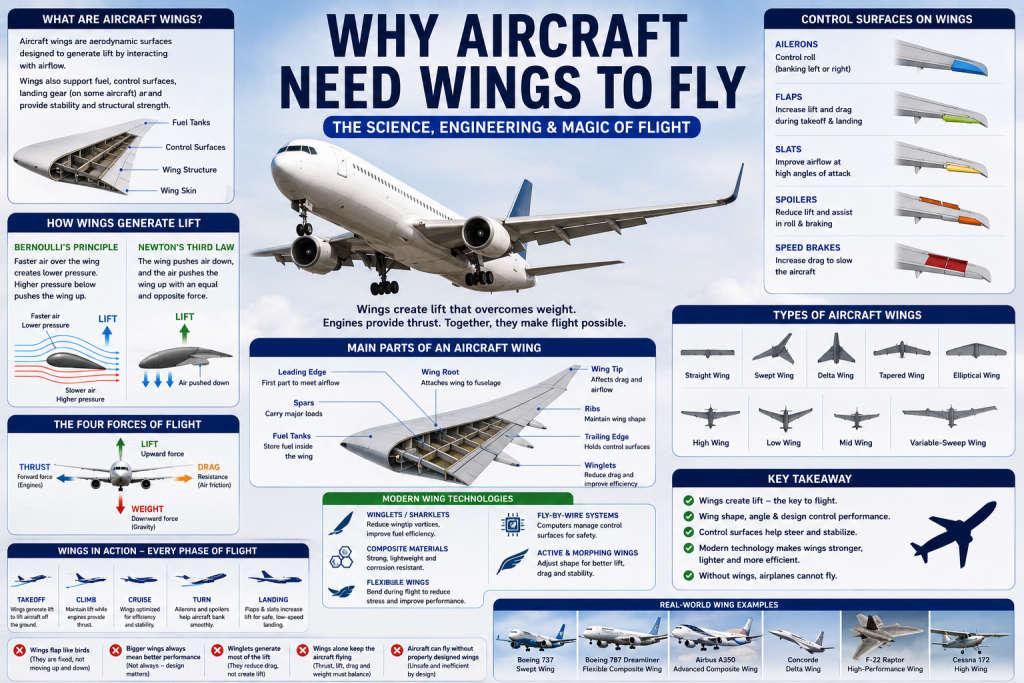
Aircraft wings are one of the most important parts of any airplane. Without wings, an aircraft cannot create enough lift to rise, stay in the air, turn safely, or land smoothly. Engines help move an aircraft forward, but wings make flight possible by turning that forward motion into lift.
Whether it is a small training airplane, a commercial passenger jet, a business aircraft, or a military fighter, every aircraft depends on wing design. Wings are not just flat surfaces attached to the fuselage. They are carefully engineered aerodynamic structures designed to manage airflow, balance forces, improve stability, and support safe flight.
Understanding why aircraft need wings to fly helps us understand the basic science behind aviation.
What Are Aircraft Wings?
Aircraft wings are aerodynamic surfaces attached to the body of an aircraft. Their primary purpose is to generate lift, the upward force that helps an aircraft overcome its weight.
A wing is designed with a special shape called an airfoil. This shape allows air to move around the wing in a way that creates pressure differences and redirects airflow. These effects help produce lift.
Wings also support other important aircraft systems, including:
- Fuel storage
- Control surfaces
- Landing gear on some aircraft
- Navigation lights
- Structural support
- Flight stability systems
Over time, wing design has changed greatly. Early aircraft had simple wooden and fabric wings. Modern aircraft use advanced metal alloys, composites, computer-designed airfoils, winglets, flexible structures, and highly efficient aerodynamic profiles.
How Wings Generate Lift
Wings generate lift by interacting with the air as the aircraft moves forward. When air flows over and under the wing, the wing shape and angle guide the airflow in a way that creates an upward force.
There are two major ideas that help explain lift: Bernoulli’s Principle and Newton’s Third Law.
Bernoulli’s Principle
Bernoulli’s Principle explains that faster-moving air usually has lower pressure. Many aircraft wings have a curved upper surface and a flatter lower surface. As air moves over the curved top of the wing, it travels faster than the air below the wing.
This creates lower pressure above the wing and higher pressure below it. The higher pressure underneath helps push the wing upward.
This pressure difference is one important part of lift generation.
Newton’s Third Law
Newton’s Third Law says that for every action, there is an equal and opposite reaction.
A wing pushes air downward as it moves through the sky. In response, the air pushes the wing upward. This upward force contributes to lift.
So, wings create lift through both pressure differences and airflow deflection.
Angle of Attack
The angle of attack is the angle between the wing and the oncoming air. When the angle of attack increases, the wing can create more lift up to a limit.
During takeoff and landing, pilots use a higher angle of attack to generate lift at lower speeds. However, if the angle becomes too high, airflow can separate from the wing, causing a stall.
This is why wing design and pilot control are both important.
Airfoil Design
An airfoil is the cross-sectional shape of a wing. Different aircraft use different airfoil shapes depending on their purpose.
A training aircraft may use a wing designed for stability and low-speed handling. A fighter jet may use a wing designed for speed and maneuverability. A commercial jet uses a wing designed for efficiency, lift, stability, and fuel economy.
The Four Forces of Flight
Aircraft fly because four forces work together:
| Force | Meaning | Role in Flight |
|---|---|---|
| Lift | Upward force created mainly by wings | Helps aircraft overcome weight |
| Weight | Downward force caused by gravity | Pulls aircraft toward Earth |
| Thrust | Forward force created by engines | Moves aircraft through air |
| Drag | Resistance caused by air | Slows aircraft down |
For an aircraft to fly steadily, these forces must be balanced. Wings mainly create lift, while engines create thrust. The aircraft structure, shape, and controls help manage drag and stability.
Main Parts of an Aircraft Wing
Aircraft wings contain many important parts. Each part has a specific role in strength, lift, control, and efficiency.
| Component | Function | Importance |
|---|---|---|
| Wing Root | Area where the wing attaches to the fuselage | Provides structural support |
| Wing Tip | Outer end of the wing | Affects drag and airflow |
| Leading Edge | Front edge of the wing | First part to meet airflow |
| Trailing Edge | Rear edge of the wing | Holds many control surfaces |
| Spars | Main internal beams | Carry major loads |
| Ribs | Internal structural shapes | Maintain wing shape |
| Skin | Outer covering of the wing | Provides smooth airflow surface |
| Fuel Tanks | Storage inside wing structure | Helps balance aircraft weight |
| Winglets | Upward or angled tips | Reduce drag and improve efficiency |
Aircraft Control Surfaces on Wings
Wings do more than generate lift. They also help control the aircraft.
Ailerons
Ailerons are located near the outer trailing edges of the wings. They control roll. When one aileron moves up and the other moves down, the aircraft banks left or right.
Flaps
Flaps are located on the trailing edge of the wing. They increase lift and drag during takeoff and landing. Flaps allow aircraft to fly safely at lower speeds.
Slats
Slats are located on the leading edge of the wing. They help airflow stay attached to the wing at higher angles of attack. This improves low-speed performance.
Spoilers
Spoilers reduce lift and increase drag. They are used during descent, landing, and sometimes during turns. After touchdown, spoilers help the aircraft settle onto the runway.
Speed Brakes
Speed brakes help slow the aircraft by increasing drag. On many jets, spoilers also act as speed brakes.
Types of Aircraft Wings
Different aircraft need different wing designs. The wing shape depends on speed, mission, weight, range, altitude, and handling requirements.
| Wing Type | Advantages | Disadvantages | Common Aircraft |
|---|---|---|---|
| Straight Wing | Good low-speed lift and simple design | Less efficient at high speed | Training aircraft, small planes |
| Swept Wing | Better for high-speed flight | More complex low-speed handling | Commercial jets |
| Delta Wing | Strong at high speed and high angles | Higher landing speeds | Supersonic aircraft |
| Tapered Wing | Efficient lift distribution | More complex manufacturing | Many modern aircraft |
| Elliptical Wing | Excellent aerodynamic efficiency | Difficult to build | Historic aircraft |
| Variable-Sweep Wing | Adjustable for speed range | Heavy and complex | Some military aircraft |
| High Wing | Good stability and ground visibility | May create more drag in some designs | Trainers, utility aircraft |
| Low Wing | Good performance and structure | Less natural roll stability | Jets, business aircraft |
| Mid Wing | Balanced performance | Structural complexity | Some fighter aircraft |
Why Wing Shape Matters
Wing shape affects almost everything about how an aircraft flies.
Airfoil Profile
The airfoil profile determines how efficiently the wing creates lift. A thicker wing may provide strength and fuel space, while a thinner wing may reduce drag at high speed.
Wing Loading
Wing loading means aircraft weight divided by wing area. Lower wing loading generally helps low-speed flight and shorter takeoff distances. Higher wing loading may improve speed and ride comfort but requires higher takeoff and landing speeds.
Aspect Ratio
Aspect ratio compares wingspan to wing width. Long, narrow wings are efficient for gliders and long-range aircraft. Shorter wings are often used for fast and maneuverable aircraft.
Wing Sweep
Swept wings help aircraft fly efficiently at higher speeds. This is why most commercial jets have swept wings.
Dihedral Angle
A wing with a slight upward angle from the fuselage has dihedral. This improves roll stability and helps the aircraft return toward level flight after a disturbance.
Wing Flexibility
Modern wings are designed to flex. Wing flexibility helps absorb aerodynamic loads, reduce stress, and improve efficiency. Large commercial aircraft wings may bend noticeably during flight, but this is normal and expected.
How Wings Perform During Different Flight Phases
Takeoff
During takeoff, wings must generate enough lift at increasing speed. Flaps are often extended to increase lift, allowing the aircraft to leave the runway safely.
Climb
During climb, wings continue producing lift while engines provide thrust. The aircraft climbs by maintaining the right speed, pitch, and lift balance.
Cruise
Cruise flight is where wings are optimized for efficiency. At high altitude, wings must generate enough lift in thinner air while keeping drag low.
Turns
During turns, the aircraft banks using ailerons and sometimes spoilers. Wings must create enough lift not only to support weight but also to provide turning force.
Turbulence
In turbulence, wings absorb changes in airflow. Their structure and flexibility help reduce stress and maintain controlled flight.
Descent
During descent, wings continue supporting the aircraft while pilots manage speed and altitude. Spoilers may be used to increase drag and reduce lift.
Landing
During landing, flaps and slats help the wings create lift at lower speeds. This allows the aircraft to approach and touch down safely.
Modern Wing Technologies
Modern aviation uses advanced wing technologies to improve safety, comfort, and efficiency.
Winglets
Winglets reduce wingtip vortices, which are swirling air patterns that create drag. By reducing drag, winglets improve fuel efficiency and range.
Sharklets
Sharklets are a type of wingtip device used on some modern aircraft. They serve a similar purpose to winglets by reducing drag and improving efficiency.
Composite Materials
Modern aircraft use composite materials that are strong and lightweight. These materials allow more flexible and efficient wing designs.
Flexible Wings
Flexible wings can bend during flight to reduce stress and improve aerodynamic performance. This is especially useful in large commercial aircraft.
Fly-by-Wire Integration
Fly-by-wire systems connect pilot controls to flight computers. These computers help manage control surfaces on the wings for smoother and safer flight.
Active Wing Technology
Some modern research focuses on wings that can adjust surfaces automatically to improve lift, drag, and stability.
Morphing Wings
Morphing wings are advanced designs that can change shape during flight. These are still developing, but they may become important in future aircraft.
Factors That Affect Wing Performance
Wing performance depends on several factors:
- Airspeed
- Altitude
- Air density
- Aircraft weight
- Center of gravity
- Weather
- Wind direction
- Ice accumulation
- Wing contamination
- Aircraft configuration
Ice on wings is especially dangerous because it changes the airfoil shape and reduces lift. This is why aircraft use anti-ice and de-icing systems.
Common Myths About Aircraft Wings
Myth 1: Wings Flap Like Birds
Aircraft wings do not flap like bird wings. They are fixed structures that generate lift through forward motion and aerodynamic design.
Myth 2: Bigger Wings Always Mean Better Performance
Bigger wings can create more lift, but they can also create more drag and weight. The best wing size depends on the aircraft’s mission.
Myth 3: Wings Alone Keep Aircraft Flying
Wings create lift, but flight also requires thrust, control, stability, and proper aircraft design.
Myth 4: Winglets Generate Most of the Lift
Winglets mainly reduce drag. They improve efficiency but are not the main source of lift.
Myth 5: Aircraft Can Fly Without Properly Designed Wings
Aircraft need properly designed lifting surfaces. Poor wing design can cause unstable, inefficient, or unsafe flight.
Real-World Examples of Aircraft Wing Designs
Boeing 737
The Boeing 737 uses swept wings designed for efficient short and medium-distance flights. Its wing design supports reliable performance, good cruise efficiency, and safe low-speed handling with flaps and slats.
Boeing 787 Dreamliner
The Boeing 787 uses long, flexible composite wings. These wings improve fuel efficiency, reduce weight, and provide smoother performance during long-haul flights.
Airbus A320
The Airbus A320 uses swept wings with advanced control surfaces and wingtip devices. Its wing design supports efficient commercial operations and stable handling.
Airbus A350
The Airbus A350 uses advanced composite wings with efficient aerodynamics. Its wings are designed for long-range performance and fuel savings.
Concorde
Concorde used a delta wing for supersonic flight. This wing shape helped the aircraft fly at very high speeds but required higher landing speeds.
Lockheed Martin F-22 Raptor
The F-22 uses wings designed for speed, maneuverability, and stealth. Its design supports high-performance military operations.
Cessna 172
The Cessna 172 uses a high-wing design. This provides good stability, visibility, and low-speed handling, making it popular for pilot training.
Gulfstream G700
The Gulfstream G700 uses advanced swept wings designed for speed, range, and passenger comfort in business aviation.
How Engineers Design Aircraft Wings
Designing aircraft wings requires careful engineering. Aerospace engineers must balance lift, drag, weight, strength, fuel efficiency, stability, and manufacturing cost.
The wing design process includes:
- Computer simulations
- Wind tunnel testing
- Structural load testing
- Material analysis
- Flight testing
- Safety certification
- Performance optimization
Engineers test wings under extreme conditions to ensure they can handle real-world flight loads, turbulence, pressure changes, and emergency situations.
Frequently Asked Questions
1. Why do airplanes need wings?
Airplanes need wings to generate lift. Lift is the upward force that allows the aircraft to overcome gravity and stay in the air. Without wings or another lifting surface, an airplane cannot fly in a controlled and efficient way.
2. How do wings generate lift?
Wings generate lift by shaping and directing airflow. Air moving over and under the wing creates pressure differences, while the wing also pushes air downward. These effects create an upward force called lift.
3. Can airplanes fly without wings?
Traditional airplanes cannot fly without wings. Some aircraft, such as helicopters, use rotating blades instead of fixed wings. Rockets can move through the air without wings, but they do not fly like airplanes.
4. Why are wings curved?
Wings are curved because the airfoil shape helps create efficient airflow and pressure differences. The curved shape helps produce lift while reducing unnecessary drag.
5. What is an airfoil?
An airfoil is the cross-sectional shape of a wing. It is designed to create lift as air flows around it. Different aircraft use different airfoils depending on speed, weight, and mission.
6. Why do wings have winglets?
Winglets reduce drag caused by wingtip vortices. By improving airflow near the wingtip, winglets help increase fuel efficiency and range.
7. How do flaps help during landing?
Flaps increase the wing’s lift and drag. This allows the aircraft to fly at lower speeds during landing while maintaining control and stability.
8. Why are fighter jet wings different?
Fighter jet wings are designed for speed, agility, and maneuverability. They often use swept, delta, or specialized wing shapes that support high-speed performance and sharp turns.
9. Do larger wings create more lift?
Larger wings can create more lift, but they also add weight and drag. Aircraft designers choose wing size based on the aircraft’s purpose, speed, range, and weight.
10. How are aircraft wings tested?
Aircraft wings are tested through computer modeling, wind tunnel experiments, structural load tests, and real flight testing. These tests confirm that the wings are safe, strong, efficient, and reliable.
Conclusion
Aircraft need wings because wings create the lift required for flight. Engines provide forward motion, but wings transform that motion into the upward force that keeps the aircraft in the sky.
Modern wings are the result of advanced aerodynamics, engineering, materials science, and safety testing. Their shape, structure, control surfaces, and technology all work together to make flight stable, efficient, and safe.
From small training airplanes to large commercial jets and advanced fighter aircraft, wings remain the heart of aviation. Understanding how they work gives us a deeper appreciation of the science and engineering behind every flight.

