
Introduction
The turn coordinator is an important cockpit instrument that helps pilots make smooth and balanced turns. For aviation students, it is useful because it shows whether the aircraft is turning properly or slipping/skidding during a turn.
This Turn Coordinator Guide for Aviation Students explains the instrument in simple language. You will learn what a turn coordinator is, how it works, how to read it, and why it matters in flight training.
What Is a Turn Coordinator?
A turn coordinator is a flight instrument that shows the aircraft’s rate of turn and turn coordination.
In simple words, it helps the pilot understand two things:
- How fast the aircraft is turning
- Whether the turn is balanced or unbalanced
The turn coordinator is especially helpful during instrument flying, basic turns, and training exercises.
Why Is the Turn Coordinator Important?
Aviation students must learn this instrument because safe turning is a basic flying skill. A turn is not only about banking the aircraft. The pilot must also use correct rudder pressure to keep the turn coordinated.
The turn coordinator helps students:
- Make smoother turns
- Avoid slips and skids
- Improve rudder control
- Maintain better aircraft balance
- Learn standard-rate turns
- Build a stronger instrument scan
- Fly more safely during poor visibility
How Does a Turn Coordinator Work?
A traditional turn coordinator uses a gyroscope. This gyroscope senses aircraft roll and turn movement.
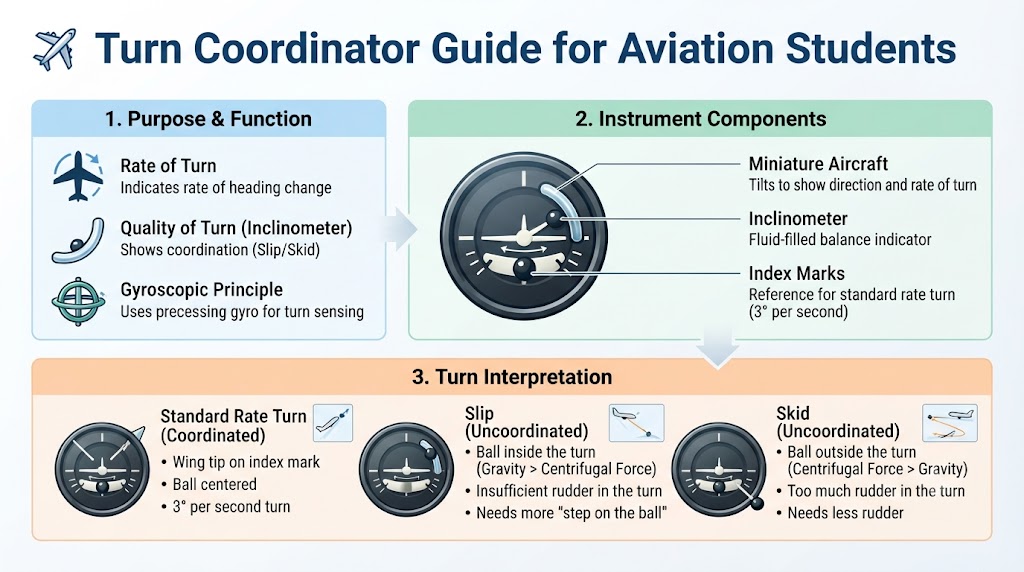
The instrument also has a small ball inside a curved glass tube. This is called the slip/skid indicator or inclinometer.
If the ball stays in the center, the turn is coordinated. If the ball moves left or right, the aircraft is slipping or skidding.
Main Parts of a Turn Coordinator
A turn coordinator usually has these main parts:
Miniature Aircraft Symbol
This small aircraft symbol tilts left or right to show turn direction.
Turn Rate Marks
These marks help the pilot understand the rate of turn.
Standard-Rate Turn Marks
These marks show the position for a standard-rate turn.
Slip/Skid Ball
The ball shows whether the turn is coordinated. A centered ball means balanced flight.
Curved Glass Tube
The ball moves inside this curved tube during slips or skids.
What Does the Turn Coordinator Show?
The turn coordinator gives several useful indications.
Left Turn
If the miniature aircraft tilts left, the aircraft is turning left.
Right Turn
If the miniature aircraft tilts right, the aircraft is turning right.
Standard-Rate Turn
A standard-rate turn means the aircraft turns at 3 degrees per second. At this rate, the aircraft completes a 360-degree turn in two minutes.
Coordinated Flight
If the ball is centered, the aircraft is in coordinated flight.
Slip or Skid
If the ball moves away from the center, the aircraft is not properly coordinated.
How to Read a Turn Coordinator
Reading the turn coordinator becomes easy with practice.
First, look at the miniature aircraft. If it tilts left, the aircraft is turning left. If it tilts right, the aircraft is turning right.
Next, check the turn rate marks. These help you know whether the aircraft is turning slowly, quickly, or at a standard rate.
Then, check the ball. If the ball is centered, the turn is coordinated. If the ball is not centered, rudder correction may be needed.
A common training phrase is: “Step on the ball.” This means apply rudder pressure on the side where the ball has moved.
Slip and Skid Explained Simply
A slip or skid happens when the aircraft is not properly balanced in a turn.
Slip
A slip usually means the aircraft is not turning enough for the bank angle. The ball moves toward the inside of the turn.
Skid
A skid usually means the aircraft is turning too much for the bank angle. The ball moves toward the outside of the turn.
Both conditions show poor coordination. Skids can be especially dangerous near stall conditions, so aviation students must learn to avoid them.
Turn Coordinator Use During Flight
The turn coordinator is useful in many flight phases.
Pre-Flight Check
Before flight, pilots check that the instrument appears normal and the ball is free to move.
Taxi
During taxi turns, the ball and aircraft symbol may move. This helps confirm the instrument is responding.
Takeoff and Climb
After takeoff, the turn coordinator helps confirm coordinated flight and proper rudder use.
Cruise
During cruise, it helps maintain balanced flight and supports instrument scanning.
Turns
During turns, it helps pilots maintain a proper turn rate and keep the ball centered.
Instrument Flying
In instrument flying, the turn coordinator becomes very important because pilots may not have outside visual references.
Approach and Landing
During approach, it helps support coordinated control, especially during turns toward final approach.
Turn Coordinator vs Attitude Indicator
The attitude indicator shows the aircraft’s pitch and bank position compared to the horizon.
The turn coordinator shows the aircraft’s rate of turn and whether the turn is coordinated.
For example, the attitude indicator may show the aircraft is banking left. The turn coordinator shows how fast it is turning and whether the ball is centered.
Turn Coordinator vs Heading Indicator
The heading indicator shows the direction the aircraft nose is pointing.
The turn coordinator shows how the aircraft is turning.
For example, if a pilot turns from heading 090 to heading 180, the heading indicator shows the changing direction, while the turn coordinator helps control the turn rate and coordination.
Common Mistakes Aviation Students Make
Aviation students often make these mistakes while learning turns.
Ignoring the Ball
Some students focus only on the aircraft symbol and forget the slip/skid ball.
Using Too Much Rudder
Too much rudder can cause a skid. This is unsafe, especially at low speed.
Using Too Little Rudder
Too little rudder can cause a slip and make the turn unbalanced.
Over-Controlling
Large control inputs can make the aircraft unstable. Smooth control is better.
Depending Only on the Turn Coordinator
Pilots should also check the attitude indicator, heading indicator, airspeed indicator, altimeter, and outside view.
Misunderstanding Standard-Rate Turns
Students may not understand that a standard-rate turn is based on turn rate, not bank angle alone.
Safety Tips for Using the Turn Coordinator
Use these simple tips during training:
- Keep the ball centered
- Use smooth rudder inputs
- Avoid sudden control movements
- Cross-check with other instruments
- Practice standard-rate turns
- Do not stare at one instrument
- Follow instructor guidance
- Avoid skidding turns, especially near low speed
- Build a steady instrument scan
Good coordination makes flying smoother, safer, and more comfortable.
Real-Life Training Example
Imagine a student pilot is flying straight and level. The instructor says, “Make a standard-rate left turn to heading 270.”
The student gently banks left and checks the turn coordinator. The miniature aircraft moves left toward the standard-rate mark. The student then checks the ball and applies light rudder pressure to keep it centered.
As the heading approaches 270, the student rolls out smoothly and returns to level flight.
This simple exercise teaches turn control, rudder coordination, and instrument awareness.
Why Practice Builds Better Flying Skills
Regular practice with the turn coordinator helps aviation students become better pilots.
It improves:
- Rudder control
- Turn coordination
- Instrument scanning
- Direction control
- Situational awareness
- Confidence in training flights
- Safety during instrument conditions
A well-coordinated turn feels smoother and keeps the aircraft under better control.
FAQs About Turn Coordinator
1. What is a turn coordinator in an aircraft?
A turn coordinator is a flight instrument that shows turn direction, turn rate, and whether the aircraft is in coordinated flight.
2. What does a turn coordinator show?
It shows left or right turn movement, standard-rate turn indication, and slip or skid using the ball.
3. How does a turn coordinator work?
It uses a gyroscope to sense turn movement and an inclinometer ball to show coordination.
4. Why is the turn coordinator important for aviation students?
It helps students learn smooth turns, correct rudder use, and safe coordinated flight.
5. What is a standard-rate turn?
A standard-rate turn is a turn of 3 degrees per second. At this rate, the aircraft completes a full 360-degree turn in two minutes.
6. What does the slip/skid ball indicate?
The ball shows whether the aircraft is balanced in a turn. A centered ball means coordinated flight.
7. What is the difference between a slip and a skid?
A slip means the aircraft is not turning enough for the bank angle. A skid means the aircraft is turning too much for the bank angle.
8. How is a turn coordinator different from an attitude indicator?
The attitude indicator shows pitch and bank. The turn coordinator shows turn rate and turn coordination.
9. How do pilots use the turn coordinator during instrument flying?
Pilots use it to maintain controlled turns and coordinated flight when outside visual references are limited.
10. How can aviation students practice using a turn coordinator?
Students can practice during flight lessons, simulator sessions, standard-rate turn exercises, and instructor-guided instrument scan practice.
Final Thoughts
The Turn Coordinator Guide for Aviation Students is an important topic for anyone learning aircraft instruments. The turn coordinator helps pilots understand turn direction, turn rate, and coordination.
For aviation students, the key lesson is simple: do not only turn the aircraft; turn it smoothly and keep it coordinated.

