
Introduction
Unmanned aircraft, also known as drones or UAVs (Unmanned Aerial Vehicles), are aircraft that fly without a human pilot onboard. They are controlled either remotely by a pilot or operate autonomously using onboard systems, sensors, and software.
In recent years, unmanned aircraft have become widely accessible and are no longer limited to military or industrial use. Today, they are used in photography, agriculture, mapping, surveillance, delivery systems, and education. For beginners, drones offer an exciting entry point into aviation and modern technology.
This guide explains the fundamentals of unmanned aircraft, how they work, types of drones, and how beginners can start flying safely and confidently.
What Are Unmanned Aircraft?
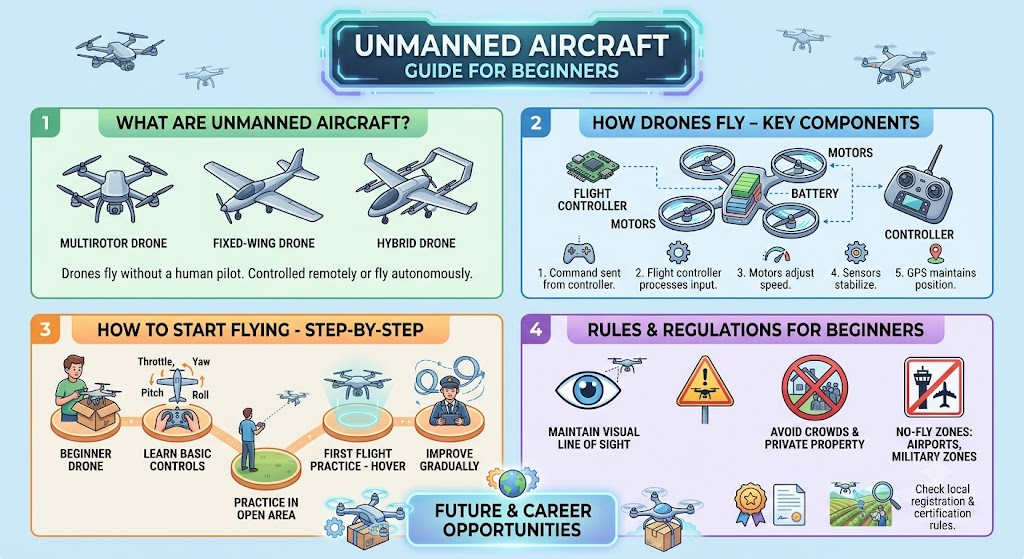
Unmanned aircraft are flying machines that operate without an onboard pilot. They rely on remote control systems or autonomous programming.
Types of Unmanned Aircraft
Multirotor Drones
Most common for beginners
Vertical takeoff and landing capability
Used for photography and general use
Fixed-Wing Drones
Aircraft-like design
Longer flight range and endurance
Used for mapping and surveying
Hybrid Drones
Combine multirotor and fixed-wing features
Can hover and travel long distances efficiently
Basic Working Principle
Unmanned aircraft operate using:
Flight controller as the central system
Motors and propellers for movement
GPS for navigation and positioning
Sensors for stability and obstacle detection
Remote controller or mobile app for commands
How Do Drones Fly?
Drone flight is based on balancing lift, thrust, gravity, and stability through precise motor control.
Key Flight Components
Flight Controller
The main processor that stabilizes the drone and interprets pilot commands.
GPS Module
Helps maintain position, supports navigation, and enables return-to-home functions.
Sensors (IMU)
Measure movement, tilt, and orientation to keep the drone stable.
Electronic Speed Controllers
Regulate motor speed for smooth and controlled flight.
How Flight Works Step by Step
Pilot sends command via controller or app
Flight controller processes the input
Motors adjust speed accordingly
Sensors stabilize the aircraft
GPS maintains position or route
Types of Drones for Beginners
Choosing the right drone is important for learning safely and effectively.
Toy Drones
Small and affordable
Limited features
Best for indoor practice
Camera Drones
Built-in cameras
Stable flight systems
Ideal for beginners in photography
Racing Drones
High speed and agility
Manual control focused
Used for drone racing
Entry-Level Smart Drones
GPS-enabled
Beginner flight modes
Automated safety features
Key Components of a Drone
Understanding drone components helps beginners operate and maintain drones effectively.
Frame
The structure that holds all drone parts together.
Motors and Propellers
Provide lift and control movement.
Battery
Usually lithium polymer batteries that determine flight time.
Controller
Device used to operate the drone manually or through apps.
Camera and Sensors
Used for capturing images and assisting navigation.
How to Start Flying a Drone (Step-by-Step)
Step 1: Choose a Beginner Drone
Select a drone with:
GPS stability
Beginner mode
Auto takeoff and landing
Step 2: Learn Basic Controls
Understand:
Throttle for altitude
Yaw for rotation
Pitch for forward/backward movement
Roll for left/right movement
Step 3: Practice in Open Area
Avoid obstacles and crowds
Fly in calm weather conditions
Maintain visual contact
Step 4: First Flight Practice
Start with hovering
Practice slow movements
Focus on safe landing
Step 5: Improve Gradually
Increase flight distance slowly
Practice directional control
Build confidence step by step
Drone Rules and Regulations
Understanding regulations is important for safe and legal flying.
Basic Safety Guidelines
Always maintain visual line of sight
Avoid restricted and sensitive areas
Do not fly over crowds or private property
No-Fly Zones
Airports and airfields
Military zones
Government buildings
Emergency operation areas
Licensing Basics
Depending on the region, drone operators may need:
Registration for the drone
Pilot certification for advanced drones
Permission for commercial operations
Common Mistakes Beginners Make
Flying in strong winds
Ignoring battery warnings
Not calibrating sensors before flight
Flying too far too soon
Losing orientation during flight
Skipping practice mode
Career Opportunities in UAV Industry
The unmanned aircraft industry offers growing career opportunities.
Drone Pilot Roles
Used in photography, videography, and inspection work.
Agriculture Applications
Crop monitoring, spraying, and soil analysis.
Industrial Inspection
Used in infrastructure, pipelines, and energy sectors.
Media and Entertainment
Cinematic filming and advertising content creation.
Logistics and Delivery
Emerging use in package delivery and transport systems.
Future of Unmanned Aircraft
The future of drones is highly advanced and technology-driven.
Artificial Intelligence Integration
Autonomous navigation
Smart obstacle avoidance
Real-time decision-making
Delivery Automation
Drone-based delivery systems
Faster logistics solutions
Smart City Applications
Traffic monitoring
Emergency response support
Infrastructure inspection
FAQs
- What is an unmanned aircraft?
An unmanned aircraft is a flying machine that operates without a human pilot onboard. It is controlled remotely or autonomously.
- Are drones difficult for beginners to learn?
No, most modern drones come with beginner modes and automated features that make learning simple.
- How long can a drone fly?
Flight time usually ranges from 10 to 30 minutes depending on battery and model.
- Do I need permission to fly a drone?
Yes, in many regions drones require registration and compliance with aviation regulations.
- What is the best drone for beginners?
A GPS-enabled drone with beginner mode and auto landing features is ideal.
- Can drones fly at night?
Some drones can fly at night, but it often requires additional safety measures and permissions.
- What happens if a drone loses signal?
Most drones return automatically to the takeoff point using GPS-based return-to-home features.
- Is drone flying expensive?
Not necessarily. Beginner drones are available at affordable prices.
- How far can beginner drones fly?
Most beginner drones can fly within a range of 100 meters to a few kilometers depending on model.
- Is drone flying safe?
Yes, when operated responsibly and within legal and safety guidelines.
Conclusion
Unmanned aircraft have transformed from complex aviation systems into accessible tools for beginners, learners, and professionals. They offer opportunities in creativity, technology, and multiple industries including agriculture, media, and logistics.
For beginners, understanding the basics of drone components, flight controls, and safety rules is essential before moving to advanced flying. With regular practice and responsible usage, anyone can develop strong drone flying skills.
As technology continues to evolve, drones will play an even greater role in automation, smart cities, and commercial applications, making this the perfect time to start learning.

