
Introduction
Drone aircraft, also known as UAVs (Unmanned Aerial Vehicles), are transforming modern aviation by enabling flight without an onboard pilot. For aviation learners, drones provide a practical and interactive way to understand core aviation concepts such as aerodynamics, navigation systems, flight control, and airspace management.
Unlike traditional aircraft, drone aircraft rely heavily on sensors, automation, and software-based flight systems. This makes them an ideal starting point for beginners who want to enter the aviation and aerospace field. From basic flying skills to advanced autonomous operations, drones help bridge the gap between theory and real-world aviation practice.
This guide explains drone aircraft in a structured and beginner-friendly way so aviation learners can build strong foundational knowledge.
What Are Drone Aircraft?
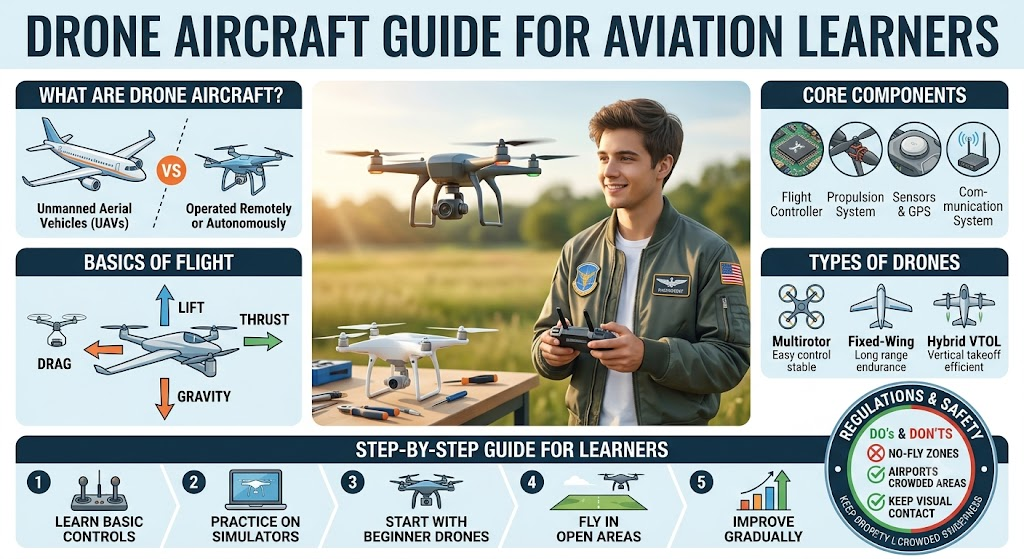
Drone aircraft are unmanned flying systems that operate without a pilot onboard. They can be controlled remotely by an operator or programmed to fly autonomously using onboard systems.
Drone Aircraft vs Traditional Aircraft
Traditional aircraft require a pilot inside the cockpit
Drone aircraft are operated remotely or autonomously
Drones are smaller, more flexible, and cost-efficient
They are widely used in civilian, commercial, and industrial sectors
Drone aircraft are part of a broader category known as unmanned aviation systems, which are becoming increasingly important in modern aerospace development.
Basics of Drone Aviation
To understand drone aircraft, aviation learners must first understand the basic principles of flight.
Four Forces of Flight
Lift: upward force generated by propellers
Thrust: forward or upward motion created by motors
Drag: air resistance opposing movement
Gravity: downward force acting on the aircraft
How Drones Achieve Flight
Drones generate lift using multiple rotating propellers instead of wings. The flight controller continuously adjusts motor speed to maintain balance, stability, and direction. This automated stabilization makes drones easier to fly compared to traditional aircraft.
Types of Drone Aircraft
Understanding drone categories helps aviation learners choose the right system for training.
Multirotor Drones
Most commonly used for beginners
Easy to control and stable in hover
Used for photography and learning
Fixed-Wing Drones
Aircraft-like design
Long flight range and endurance
Used in mapping and surveying
Hybrid VTOL Drones
Combine vertical takeoff with long-distance flight
Efficient for advanced operations
Used in research and industrial applications
Autonomous Drones
Operate using AI-based systems
Require minimal manual control
Used in advanced aviation and logistics
Core Components of Drone Systems
Every drone aircraft consists of essential systems that work together for stable flight.
Flight Controller
Acts as the brain of the drone and manages stability and control.
Propulsion System
Includes motors and propellers that generate lift and movement.
Sensors and GPS
Used for navigation, altitude control, and obstacle detection.
Communication System
Maintains connection between the drone and controller or ground station.
How Drone Navigation Works
Drone navigation relies on multiple technologies working together.
GPS Navigation
Maintains location accuracy
Enables return-to-home features
Supports stable flight paths
Remote Control Systems
Manual control using controllers or apps
Real-time operator commands
Autonomous Navigation
Uses AI-based decision systems
Pre-programmed flight paths
Smart obstacle avoidance capabilities
For aviation learners, these systems form the foundation of modern avionics and unmanned flight technology.
Drone Aviation for Learners: Step-by-Step Guide
Step 1: Learn Basic Controls
Understand throttle, yaw, pitch, and roll for basic movement.
Step 2: Practice on Simulators
Use flight simulators to build confidence before real flying.
Step 3: Start with Beginner Drones
Choose drones with GPS stabilization and beginner flight modes.
Step 4: Fly in Open Areas
Practice in safe, open environments with minimal obstacles.
Step 5: Improve Gradually
Start with hovering, then move to directional control and advanced maneuvers.
Aviation Regulations and Safety
Safety and compliance are critical in drone aviation.
Airspace Rules
Avoid restricted and controlled zones
Stay away from airports and sensitive areas
No-Fly Zones
Airports and aviation zones
Government and military areas
Crowded public spaces
Beginner Guidelines
Always maintain visual contact
Follow altitude limits
Understand local aviation regulations
Applications in Aviation Industry
Drone aircraft are widely used across aviation-related fields.
Mapping and Surveying
Used for terrain mapping and infrastructure planning.
Defense and Surveillance
Used for monitoring and reconnaissance missions.
Cargo and Delivery Systems
Used in modern logistics and transportation systems.
Disaster Management
Helps in rescue operations and emergency response.
Career Opportunities in Drone Aviation
Drone aviation offers multiple career paths for learners.
Drone Pilot
Operates drones for commercial and industrial purposes.
UAV Engineer
Designs and develops drone systems and technologies.
Data Analyst
Processes aerial data collected from drone operations.
Aviation Technology Specialist
Works on integrating drones into aviation systems.
Future of Drone Aircraft
Drone technology is evolving rapidly and shaping the future of aviation.
Artificial Intelligence Integration
Fully autonomous flight systems
Smart navigation and decision-making
Real-time environmental adaptation
Smart City Integration
Traffic monitoring systems
Infrastructure inspection
Urban planning support
Autonomous Aviation Systems
Reduced human intervention
Increased safety and efficiency
Integration into global aviation networks
FAQs
- What are drone aircraft?
Drone aircraft are unmanned flying systems controlled remotely or autonomously without a pilot onboard.
- Why are drones important for aviation learners?
They help learners understand real aviation concepts through practical and hands-on experience.
- Are drones difficult to learn for beginners?
No, modern drones come with beginner modes and automated stabilization features.
- What skills are needed to fly drones?
Basic control understanding, spatial awareness, and knowledge of safety rules.
- What is the difference between drones and aircraft?
Aircraft require onboard pilots, while drones are unmanned and remotely operated or autonomous.
- Can drones be used for aviation careers?
Yes, they are used in surveying, inspection, filmmaking, agriculture, and defense.
- Do drones require certification?
In many regions, certification or registration is required depending on usage and weight.
- How do drones stay stable in the air?
They use sensors, GPS, and flight controllers to maintain balance automatically.
- What is the best drone for beginners?
GPS-enabled drones with auto-stabilization and beginner modes are ideal.
- What is the future of drone aviation?
It includes AI-powered drones, automation, and integration into smart aviation systems.
Conclusion
Drone aircraft are becoming an essential part of modern aviation learning. For aviation learners, they offer a practical way to understand flight mechanics, navigation systems, and aerospace technologies in a real-world environment.
By starting with basic controls, practicing safely, and gradually advancing skills, beginners can build a strong foundation in drone aviation. As technology continues to evolve, drones will play a major role in shaping future aviation careers and smart aerospace systems.

