
Introduction
Seaplane aircraft represent one of the most fascinating branches of aviation, combining the science of flight with the unique challenge of water operations. Unlike conventional airplanes that depend on runways, seaplanes are designed to take off and land on water surfaces such as lakes, rivers, and oceans. This capability opens up access to remote islands, coastal regions, and areas where traditional airports are unavailable or impractical.
For aviation enthusiasts, seaplanes are more than just aircraft—they are a symbol of versatility, adventure, and engineering brilliance. From scenic tourist flights over tropical islands to critical rescue missions in disaster zones, seaplanes continue to play an important role in modern aviation. This guide explores everything you need to know about seaplane aircraft, including their types, working principles, advantages, limitations, and future potential.
What is a Seaplane?
A seaplane is an aircraft that is capable of taking off and landing on water. It is specially designed with either floats attached under a standard aircraft body or a boat-like fuselage that allows it to float.
Seaplanes are broadly categorized into different types, but their core purpose remains the same: enabling aviation operations where runways are not available.
Difference Between Seaplane, Floatplane, and Amphibious Aircraft
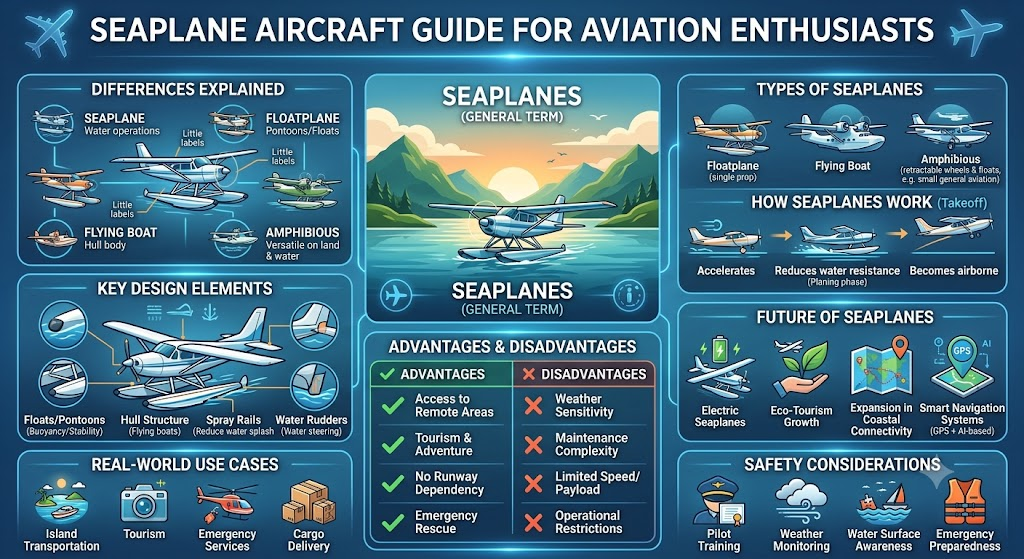
Seaplane: General term for any aircraft that operates on water.
Floatplane: A type of seaplane that uses external floats (pontoons) under the fuselage.
Flying Boat: A seaplane with a hull-shaped body that directly sits on water.
Amphibious Aircraft: A versatile aircraft that can operate on both land runways and water surfaces.
Understanding these differences helps aviation learners appreciate the engineering flexibility behind water-based flight operations.
How Seaplanes Work
Seaplanes operate on the same aerodynamic principles as regular aircraft, but their interaction with water adds additional complexity.
Takeoff from Water
During takeoff, a seaplane accelerates across the water surface. The floats or hull reduce water resistance until enough lift is generated by the wings to become airborne. This phase is called “planing.”
Landing on Water
For landing, the pilot reduces speed and carefully aligns the aircraft with wind and water conditions. The floats or hull absorb the impact as the aircraft touches down gently on the water surface.
Design Elements
Floats (Pontoons): Provide buoyancy and stability
Hull Structure: In flying boats, the fuselage acts like a boat
Spray Rails: Reduce water splash during movement
Water Rudders: Help in steering while on water
Seaplanes require careful balance between aerodynamics (air performance) and hydrodynamics (water performance), making them one of the most technically interesting aircraft designs.
Types of Seaplane Aircraft
Seaplanes are designed in different configurations depending on their mission and environment.
- Floatplanes
These aircraft have floats mounted under a standard airplane body. They are commonly used for short-distance travel and tourism.
- Flying Boats
Flying boats have a hull-shaped fuselage that allows the aircraft to float directly on water. They are often larger and used for long-distance operations.
- Amphibious Seaplanes
These aircraft can operate on both water and land. They feature retractable wheels along with floats or hull designs, offering maximum flexibility.
Each type serves a different purpose, balancing efficiency, range, and operational environment.
Advantages of Seaplanes
Seaplanes offer several unique benefits that make them valuable in both commercial and emergency aviation.
Access to Remote Areas
Seaplanes can reach islands, lakes, and coastal regions where building airports is not feasible.
Tourism and Adventure Travel
They provide breathtaking aerial views and water landings, making them popular in luxury tourism.
No Dependency on Runways
Unlike traditional aircraft, seaplanes do not require paved runways, reducing infrastructure limitations.
Emergency and Rescue Operations
They are widely used in search-and-rescue missions, disaster relief, and medical evacuations in flooded or isolated regions.
Limitations of Seaplanes
Despite their advantages, seaplanes also face certain operational challenges.
Weather Sensitivity
Water conditions such as waves, wind, and storms can significantly impact safety.
Maintenance Complexity
Exposure to saltwater leads to corrosion, requiring frequent maintenance.
Limited Speed and Payload
Compared to modern jets, seaplanes generally have lower speed and cargo capacity.
Operational Restrictions
They require suitable water bodies, which are not always available in urban environments.
Real-World Use Cases of Seaplanes
Seaplanes are actively used across the world in various industries.
Island Transportation
Countries like Maldives, Indonesia, and the Philippines use seaplanes to connect islands.
Tourism Industry
Scenic flights over oceans, glaciers, and tropical regions are a major attraction.
Emergency Services
Used for disaster relief, flood response, and medical evacuations in remote areas.
Cargo and Supply Delivery
Seaplanes deliver essential goods to isolated communities where roads or airports are absent.
Safety Considerations in Seaplane Operations
Safety is a critical aspect of seaplane aviation due to the dual nature of air and water environments.
Pilot Training
Pilots require specialized training in water handling, docking, and water takeoffs/landings.
Weather Monitoring
Wind speed, wave height, and visibility must be carefully assessed before operations.
Water Surface Awareness
Pilots must avoid floating debris, boats, and underwater obstacles.
Emergency Preparedness
Seaplanes are equipped with flotation devices and safety equipment for water survival scenarios.
Future of Seaplane Aviation
The future of seaplane aviation looks promising as technology and global travel needs evolve.
Eco-Tourism Growth
Seaplanes are becoming popular in sustainable tourism models that focus on low-impact travel.
Electric Seaplanes
New developments in electric propulsion may reduce environmental impact and operating costs.
Expansion in Coastal Connectivity
Countries are exploring seaplane routes to improve transportation between coastal cities and islands.
Smart Navigation Systems
Advanced GPS and AI-based navigation systems are improving safety and efficiency in water-based flight operations.
FAQs
- What is a seaplane used for?
Seaplanes are used for transportation, tourism, cargo delivery, and emergency rescue operations in areas without runways.
- Can seaplanes land on normal runways?
Yes, amphibious seaplanes are designed to land on both water and land runways using retractable landing gear.
- Are seaplanes safe?
Yes, when operated by trained pilots under proper weather conditions, seaplanes are considered safe.
- How fast do seaplanes fly?
Seaplane speeds vary by model, but most operate between 100 to 300 km/h depending on size and design.
- Do pilots need special training for seaplanes?
Yes, pilots must undergo specialized training for water operations and handling marine environments.
- What is the difference between a floatplane and a flying boat?
A floatplane uses external floats, while a flying boat has a hull-shaped body that floats directly on water.
- Where are seaplanes commonly used?
They are commonly used in island regions, coastal countries, and remote tourism destinations.
- What limits seaplane operations?
Weather conditions, water surface quality, and maintenance requirements are major limiting factors.
Conclusion
Seaplane aircraft hold a unique place in aviation by bridging the gap between air and water transportation. Their ability to operate without traditional runways makes them essential for remote connectivity, tourism, and emergency services. While they come with certain limitations such as weather dependency and maintenance challenges, their advantages continue to make them valuable in specialized aviation sectors.
As technology advances, especially with electric propulsion and smarter navigation systems, seaplanes are expected to become even more efficient and environmentally friendly. For aviation enthusiasts, understanding seaplanes opens the door to one of the most exciting and visually stunning areas of flight.

