
Introduction
Glider aircraft are one of the most fascinating and peaceful ways to experience aviation. Unlike normal airplanes, gliders do not use engines. Instead, they depend on natural forces like wind, rising air, and gravity to stay in flight. For beginners in aviation, gliders are the perfect starting point to understand how flight actually works in the sky.
This glider aircraft guide for new learners will help you understand everything in a simple way—from what gliders are, how they fly, their types, benefits, challenges, and real-world uses.
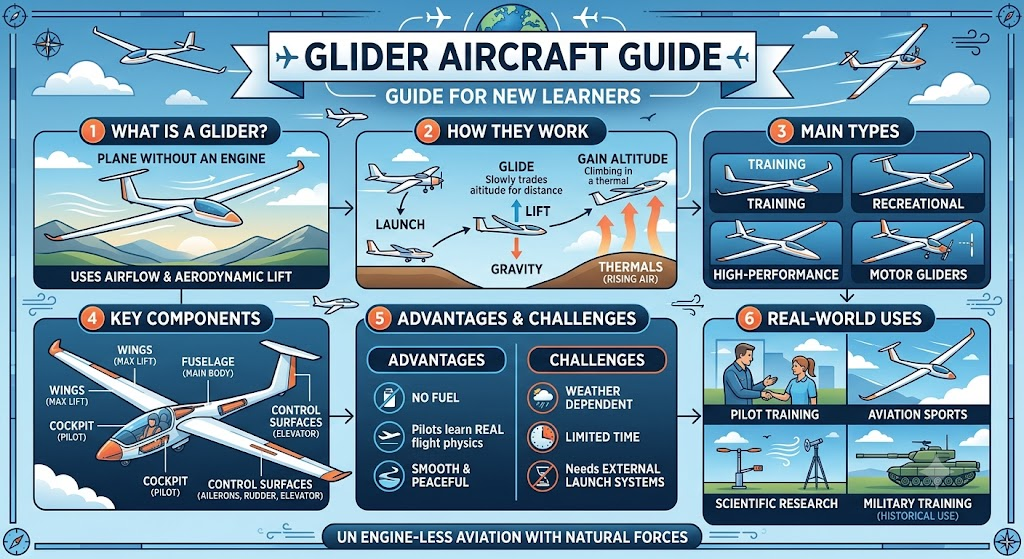
What is a Glider Aircraft?
A glider aircraft is an airplane that flies without an engine. It is designed to stay in the air using airflow and aerodynamic lift.
In simple terms:
A glider is an aircraft that “glides” through the air after being launched, without using fuel during flight.
Gliders are widely used for:
- Flight training
- Aviation sports
- Recreational flying
- Understanding flight basics
They are one of the best tools for beginners to learn how aircraft behave in the sky.
How Glider Aircraft Work (Simple Explanation)
Even without engines, gliders can fly for a long time by using natural air movement.
Lift
Lift is the upward force created when air flows over the wings, keeping the glider in the air.
Gravity
Gravity pulls the glider downward, and the balance between lift and gravity controls flight.
Thermals (Rising Air)
Warm air rises from the ground and forms invisible “air columns” called thermals. Gliders use these to gain height.
Forward Motion
Gliders are first launched using a tow plane or winch. After release, they convert altitude into forward movement.
Simple idea: A glider slowly trades height for distance while using rising air to stay longer in the sky.
Types of Glider Aircraft
Gliders come in different types based on their purpose:
Training Gliders
Used by student pilots to learn basic flying skills.
Recreational Gliders
Used for leisure flying and enjoying the experience of soaring.
High-Performance Gliders
Designed for long-distance and advanced soaring flights.
Motor Gliders
Equipped with small engines that help during takeoff or when air currents are weak.
Key Parts of a Glider
A glider has simple but important components:
Wings
Long, slim wings designed to produce maximum lift.
Fuselage
The main body that holds the pilot and equipment.
Cockpit
Where the pilot sits and controls the glider.
Control Surfaces
Includes ailerons, rudder, and elevator to control direction and balance.
Advantages of Glider Flying
Gliders offer many benefits for aviation learners:
- No fuel required during flight
- Excellent training platform for pilots
- Helps understand real flight physics
- Low operating and maintenance cost
- Smooth and peaceful flying experience
For many pilots, glider flying is the first step in aviation training.
Challenges of Glider Flying
While gliders are amazing, they also have limitations:
- Highly dependent on weather conditions
- Limited flight time without strong air currents
- Requires skill and practice
- Needs external launch systems like tow planes
These challenges make glider flying both exciting and skill-building.
Real-World Uses of Gliders
Glider aircraft are used in many practical areas:
Pilot Training
Flight schools use gliders to teach beginners the basics of flight control.
Aviation Sports
Gliding is a popular competitive air sport worldwide.
Scientific Research
Used to study wind patterns and atmospheric conditions.
🪖 Military Training (Historical Use)
Previously used for silent flight operations and special missions.
Future of Glider Aircraft
The future of glider aviation is becoming more advanced and eco-friendly:
- Electric-assisted launch systems
- Lightweight composite materials
- Smart navigation and tracking systems
- Sustainable and green aviation development
Gliders will continue to play an important role in eco-friendly aviation learning.
FAQs – Glider Aircraft Guide for New Learners
1. What is a glider aircraft?
A glider aircraft is a plane that flies without an engine and depends on air currents to stay in the sky.
2. How does a glider stay in the air?
It stays in the air using lift, thermals, and rising warm air currents.
3. Do gliders use fuel?
No, gliders do not use fuel during flight.
4. How are gliders launched?
They are launched using a tow plane or a winch system from the ground.
5. Is glider flying difficult?
It requires training and practice, but beginners can learn safely with instructors.
6. Can gliders fly long distances?
Yes, experienced pilots can use air currents to fly long distances.
7. What is the main purpose of gliders?
They are used for training, recreation, and aviation education.
8. Are gliders safe?
Yes, when operated under proper training and conditions, gliders are safe.
9. What skills do glider pilots learn?
They learn control, coordination, weather understanding, and flight dynamics.
10. Why are gliders important in aviation?
They help beginners understand the fundamentals of flight in a simple and practical way.
Conclusion
Glider aircraft are a beautiful example of how aviation can work with natural forces instead of relying on engines. They help beginners understand the core principles of flight such as lift, airflow, and balance in the simplest way possible.
This glider aircraft guide for new learners shows that aviation is not just about speed and engines—it is also about understanding how the sky itself helps aircraft fly. For anyone starting their aviation journey, gliders are the perfect foundation for learning.

