
Introduction
Jet aircraft are among the most important inventions in modern aviation. They power everything from international passenger flights to military defense systems and global cargo transport. If you are new to aviation, understanding jet aircraft is the perfect starting point to learn how modern flight really works.
In this beginner-friendly guide, we will break down jet aircraft in the simplest way possible so you can clearly understand what they are, how they work, and why they matter in today’s world of aviation.
✈️ What is a Jet Aircraft?
A jet aircraft is an airplane that uses jet engines to produce thrust instead of propellers. This thrust pushes the aircraft forward at high speed, allowing it to fly long distances efficiently.
In simple words, a jet aircraft is a fast airplane powered by engines that push air backward to move forward.
Jet aircraft are widely used in commercial aviation, military operations, and cargo transportation because of their speed and performance.
✈️ Why Jet Aircraft Are Important
Jet aircraft have completely changed global travel and transportation. Their importance can be understood through a few key points:
- They make long-distance travel much faster
- They connect countries and continents efficiently
- They support global trade and cargo movement
- They enhance national defense capabilities
Without jet aircraft, modern aviation as we know it would not exist.
✈️ Jet Aircraft vs Propeller Aircraft
Understanding the difference helps beginners grasp the concept better.
✈️ Propeller Aircraft
- Uses rotating blades (propellers) for thrust
- Slower speed
- Best for short-distance travel
- More fuel-efficient at low speeds
✈️ Jet Aircraft
- Uses jet engines to generate thrust
- Much faster and more powerful
- Ideal for long-distance and international flights
- Operates efficiently at high altitudes
👉 Key takeaway: Jet aircraft are designed for speed, range, and performance.
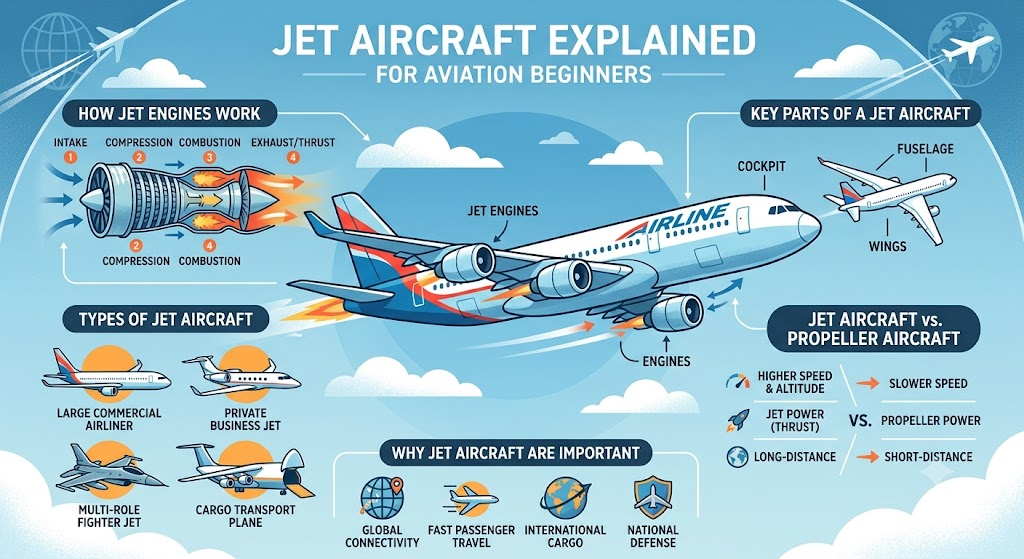
✈️ How Jet Engines Work (Simple Breakdown)
Jet engines may sound complex, but their working process is quite simple. They follow four main steps:
1. Air Intake
Air enters the engine from the front at high speed.
2. Compression
The air is compressed to increase its pressure and temperature.
3. Combustion
Fuel is mixed with compressed air and burned, creating high-energy hot gases.
4. Exhaust and Thrust
These hot gases are pushed out of the back at high speed, producing thrust that moves the aircraft forward.
👉 Simple example: It is similar to releasing air from a balloon—the escaping air pushes the balloon forward.
✈️ Types of Jet Aircraft
Jet aircraft come in different categories based on their use:
✈️ Commercial Jets
Used by airlines to carry passengers across cities and countries.
✈️ Private Jets
Used for luxury travel, business trips, and VIP transportation.
✈️ Military Jets
Designed for defense, combat, surveillance, and training missions.
✈️ Cargo Jets
Used to transport goods, packages, and heavy freight globally.
✈️ Key Parts of a Jet Aircraft
Every jet aircraft is made up of important components:
✈️ Fuselage
The main body that holds passengers, cargo, and systems.
✈️ Wings
Provide lift and help the aircraft stay in the air.
✈️ Engines
Generate thrust and power the aircraft forward.
✈️ Cockpit
The control center where pilots operate and navigate the aircraft.
✈️ Advantages of Jet Aircraft
Jet aircraft offer several major benefits:
- Very high speed for long-distance travel
- Ability to fly above most weather conditions
- Large passenger and cargo capacity
- Efficient global connectivity
These advantages make jet aircraft essential for modern aviation systems.
✈️ Limitations of Jet Aircraft
Even though jet aircraft are powerful, they also have some limitations:
- High fuel consumption
- Expensive manufacturing and operation costs
- Complex maintenance requirements
- Need for long runways for takeoff and landing
These factors make them costly to operate compared to smaller aircraft.
✈️ Real-World Uses of Jet Aircraft
Jet aircraft are used in many important areas:
✈️ Passenger Transport
Airlines use jet aircraft to carry millions of passengers every day.
✈️ Military Operations
Used for defense, combat missions, and national security.
✈️ Cargo Transport
Used to move goods quickly across countries and continents.
✈️ Future of Jet Aircraft
The future of jet aircraft is focused on innovation and sustainability:
- Development of fuel-efficient engines
- Research into electric and hybrid aircraft
- Use of AI for smarter navigation and safety
- Reduction of carbon emissions in aviation
The aviation industry is rapidly evolving toward cleaner and smarter flight technology.
✈️ FAQs – Jet Aircraft Explained
1. What is a jet aircraft in simple terms?
A jet aircraft is an airplane powered by jet engines that create thrust by pushing air backward.
2. How does a jet aircraft fly?
It flies by generating thrust from jet engines, which pushes the aircraft forward while wings create lift.
3. What is the main difference between jet and propeller aircraft?
Jet aircraft are faster and use jet engines, while propeller aircraft use spinning blades and are slower.
4. Are jet aircraft safe for passengers?
Yes, modern jet aircraft are designed with advanced safety systems and strict aviation regulations.
5. What fuel do jet aircraft use?
They typically use aviation turbine fuel known as jet fuel.
6. Why do jet aircraft fly so high?
They fly high to avoid turbulence, weather systems, and to improve fuel efficiency.
7. Can jet aircraft fly long distances?
Yes, jet aircraft are designed specifically for long-haul and international travel.
8. What are the main uses of jet aircraft?
They are used for passenger travel, cargo transport, and military operations.
9. Are jet aircraft expensive to operate?
Yes, they require high fuel consumption, maintenance, and operational costs.
10. What is the future of jet aircraft?
The future includes fuel-efficient engines, electric aviation, and AI-powered flight systems.
✈️ Conclusion
Jet aircraft are the backbone of modern aviation and global connectivity. They have made air travel faster, safer, and more efficient than ever before. From commercial airlines to military defense and cargo transport, jet aircraft play a crucial role in keeping the world connected.
For beginners, understanding jet aircraft is the first step into the fascinating world of aviation. As technology continues to advance, the future promises even more efficient, intelligent, and environmentally friendly jet aircraft.

