
Introduction
Turboprop aircraft are an important part of modern aviation, especially for regional travel and pilot training. These aircraft combine a turbine engine with a propeller system, making them highly efficient for short to medium-distance flights. Unlike pure jet aircraft that rely only on jet thrust, turboprops use engine power to turn a propeller, which provides strong performance at lower speeds and altitudes.
For aviation students and beginner pilots, understanding turboprop aircraft is essential because they represent a key step between basic piston-engine training aircraft and advanced jet aircraft used by airlines. They are widely used in regional aviation, cargo operations, and even military transport due to their fuel efficiency and reliability.
In this guide, we will explain turboprop aircraft in simple words, how they work, their types, advantages, limitations, and why they matter in aviation careers.
What is a Turboprop Aircraft?
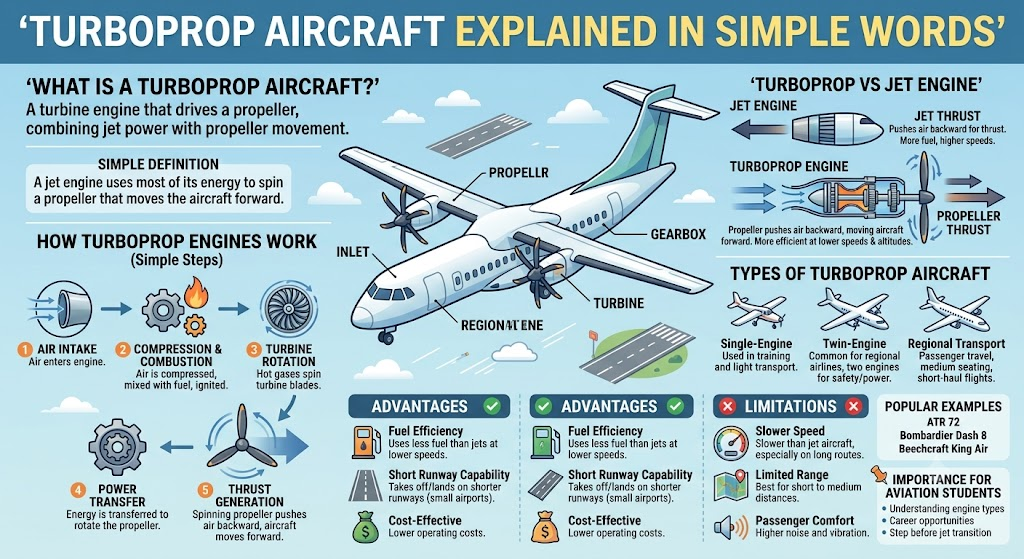
A turboprop aircraft is an airplane powered by a turbine engine that drives a propeller. It combines features of both jet engines and propeller aircraft.
Simple Definition
A turboprop uses a jet engine to generate power, but instead of producing only jet thrust, most of that energy is used to rotate a propeller that moves the aircraft forward.
Turboprop vs Jet Engine (Basic Idea)
- Jet engines push air backward to create thrust
- Turboprops use engine power to spin a propeller
- Turboprops are more efficient at lower speeds
- Jets are faster but consume more fuel
How Turboprop Engines Work
The working of a turboprop engine can be understood in simple steps:
1. Air Intake
Air enters the engine through the front intake.
2. Compression and Combustion
The air is compressed and mixed with fuel, then ignited to produce energy.
3. Turbine Rotation
The hot gases spin turbine blades inside the engine.
4. Power Transfer to Propeller
Most of the energy is transferred through a gearbox to rotate the propeller.
5. Thrust Generation
The spinning propeller pushes air backward, moving the aircraft forward.
This system makes turboprops highly efficient for regional and short-runway operations.
Types of Turboprop Aircraft
1. Single-Engine Turboprops
These aircraft use one turboprop engine.
- Simple design
- Used in training and light transport
- Efficient for small operations
2. Twin-Engine Turboprops
These are more common in commercial aviation.
- Two engines for safety and power
- Used in regional airlines
- Better performance and range
3. Regional Transport Turboprops
Designed for passenger travel between cities.
- Medium seating capacity
- Used for short-haul flights
- Ideal for regional connectivity
Advantages of Turboprop Aircraft
Fuel Efficiency
Turboprops consume less fuel than jet aircraft at lower speeds.
Short Runway Capability
They can take off and land on shorter runways, making them ideal for smaller airports.
Cost-Effective Operations
Lower operating costs compared to jets make them popular in regional aviation.
Reliable Performance
They perform well in diverse weather and airport conditions.
Limitations of Turboprop Aircraft
Slower Speed
Turboprops are slower than jet aircraft, especially on long routes.
Limited Range
They are best suited for short to medium distances.
Passenger Comfort
Higher noise and vibration compared to modern jet aircraft.
Weather Sensitivity
Although reliable, they may be more affected by turbulence at lower altitudes.
Common Uses of Turboprop Aircraft
Regional Airlines
Used for connecting smaller cities with major hubs.
Cargo Transport
Efficient for short-distance freight movement.
Military Operations
Used for transport, surveillance, and utility missions.
Pilot Training
Advanced training stage for aviation students before jet transition.
Popular Turboprop Aircraft Examples
ATR 72
One of the most widely used regional turboprop aircraft.
- Seats around 70 passengers
- Known for fuel efficiency
- Common in regional airlines worldwide
Bombardier Dash 8
A strong and reliable turboprop aircraft.
- Excellent short runway performance
- Used in harsh weather conditions
- Popular in regional aviation
Beechcraft King Air
A versatile twin-engine turboprop.
- Used in business aviation and training
- Comfortable and reliable
- Suitable for short regional flights
Why Aviation Students Should Learn About Turboprops
For aviation students, turboprop knowledge is essential for career growth.
Understanding Engine Types
Students learn how turbine engines differ from piston engines.
Career Relevance
Many regional airlines operate turboprop aircraft, creating job opportunities.
Transition to Jet Aircraft
Turboprops help students understand turbine-based flight systems before moving to jets.
Improved Technical Knowledge
Students gain deeper understanding of aircraft systems and performance.
Frequently Asked Questions (FAQs)
1. What is a turboprop aircraft in simple words?
A turboprop aircraft is an airplane that uses a turbine engine to power a propeller. It combines jet engine technology with propeller-driven efficiency for short to medium flights.
2. How is a turboprop different from a jet aircraft?
A turboprop uses a propeller for thrust, while a jet aircraft generates thrust directly from jet exhaust. Turboprops are slower but more fuel-efficient at lower speeds.
3. Why are turboprop aircraft important in aviation?
They are important because they are cost-effective, fuel-efficient, and ideal for regional flights and short runway operations, especially in smaller airports.
4. Are turboprop aircraft safe to fly?
Yes, turboprop aircraft are very safe. They are widely used in commercial aviation, military, and training due to their reliable engine systems and strong performance.
5. What are the main uses of turboprop aircraft?
They are commonly used in regional passenger flights, cargo transport, military operations, and advanced pilot training programs.
6. Which is faster, a turboprop or a jet?
Jets are faster than turboprop aircraft. However, turboprops are more efficient for short-distance flights and lower-altitude operations.
7. What are some popular turboprop aircraft?
Popular models include ATR 72, Bombardier Dash 8, and Beechcraft King Air, all widely used in regional aviation and training.
8. Why should aviation students learn about turboprop aircraft?
Because they help students understand turbine engine systems and prepare them for advanced flying roles in regional and commercial aviation.
9. Do turboprop aircraft use jet fuel?
Yes, most turboprop engines use aviation turbine fuel (jet fuel), similar to jet aircraft.
10. Are turboprops still used in modern aviation?
Yes, turboprops are widely used today, especially for regional routes, cargo operations, and short-runway airports where jets are less efficient.
Conclusion
Turboprop aircraft play a vital role in modern aviation, especially in regional transport and pilot training. They combine the efficiency of propellers with the power of turbine engines, making them ideal for short to medium-distance flights.
For aviation students, learning about turboprops is an important step in understanding advanced aircraft systems and preparing for a professional flying career. While they may not be as fast as jet aircraft, their efficiency, reliability, and versatility make them an essential part of the aviation industry.

