
Introduction
Multi-engine aircraft play a crucial role in modern aviation training and commercial flying. Unlike single-engine aircraft, these airplanes are equipped with two or more engines, providing greater power, redundancy, and operational capability. For aviation students, understanding multi-engine aircraft is an important step toward becoming a professional commercial pilot.
As students progress from basic training on single-engine aircraft, multi-engine flying introduces more advanced systems, higher performance, and increased responsibility. It is a key milestone in pilot development and is often required for airline career pathways.
In this guide, we will explore what multi-engine aircraft are, how they work, their types, key differences from single-engine aircraft, training requirements, advantages, challenges, and career benefits for aviation students.
What is a Multi-Engine Aircraft?
A multi-engine aircraft is an airplane that uses two or more engines to generate thrust and fly. These engines work together to provide improved performance, reliability, and safety compared to single-engine aircraft.
How It Works
- Each engine produces thrust independently
- Engines are usually mounted on wings or fuselage
- If one engine fails, the other can still provide partial or full control
- Pilots manage engine power and balance continuously during flight
Multi-engine aircraft are designed to ensure better safety and efficiency, especially during long-distance or commercial flights.
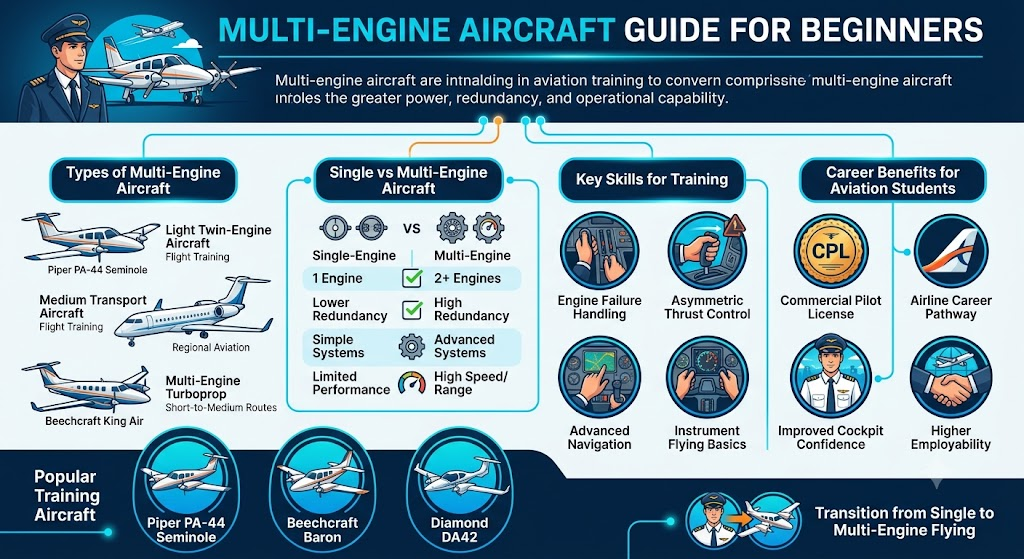
Types of Multi-Engine Aircraft
1. Light Twin-Engine Aircraft
These are commonly used in flight training.
- Designed for pilot instruction
- Smaller and easier to handle than commercial jets
- Example: Piper PA-44 Seminole
2. Medium Transport Aircraft
Used in regional aviation and cargo transport.
- Higher passenger capacity
- More complex systems
- Requires advanced pilot certification
3. Multi-Engine Turboprop Aircraft
These use turbine engines with propellers.
- Efficient for short to medium routes
- Used in regional airlines and cargo operations
- Example: Beechcraft King Air series
Why Beginners Learn Multi-Engine Flying
Multi-engine training is an essential part of a pilot’s journey.
Career Requirement
Most commercial airlines require multi-engine certification for hiring pilots.
Increased Safety
Multiple engines provide redundancy in case one engine fails.
Skill Advancement
Students learn advanced flight handling and decision-making skills.
Key Differences: Single vs Multi-Engine Aircraft
| Feature | Single-Engine Aircraft | Multi-Engine Aircraft |
|---|---|---|
| Engines | 1 | 2 or more |
| Safety | Lower redundancy | High redundancy |
| Complexity | Simple systems | Advanced systems |
| Training Level | Beginner | Intermediate to advanced |
| Performance | Limited | High speed and range |
| Cost | Lower | Higher |
Multi-engine aircraft require more skill, attention, and training discipline.
Key Skills Required for Multi-Engine Training
Engine Failure Handling
Students must learn how to control the aircraft if one engine stops working.
Asymmetric Thrust Control
Managing imbalance when one engine produces more thrust than the other.
Advanced Navigation
Using sophisticated flight instruments and systems.
Instrument Flying Basics
Flying using cockpit instruments without relying on visual references.
Advantages of Multi-Engine Aircraft
Higher Safety Through Redundancy
If one engine fails, the aircraft can still continue flying safely.
Better Performance
Higher speed, altitude capability, and payload capacity.
Long-Distance Capability
Suitable for regional and international flights.
Airline Readiness
Prepares students for commercial aviation environments.
Challenges for Beginners
Increased Workload
Pilots must monitor multiple engines and systems simultaneously.
Complex Systems
More instruments and controls compared to single-engine aircraft.
Higher Training Cost
Multi-engine aircraft are more expensive to operate.
Greater Responsibility
Engine failure scenarios require quick and accurate decision-making.
Popular Multi-Engine Training Aircraft
Piper PA-44 Seminole
A widely used training aircraft for multi-engine certification.
- Stable and predictable handling
- Dual-engine configuration for training scenarios
- Standard in many flight schools
Beechcraft Baron
A high-performance twin-engine aircraft.
- Powerful engines
- Used for advanced training and business aviation
- Known for speed and reliability
Diamond DA42
A modern, fuel-efficient twin-engine aircraft.
- Glass cockpit technology
- Excellent safety and efficiency
- Popular in advanced flight schools
Career Benefits for Aviation Students
Multi-engine training significantly enhances career opportunities.
Requirement for Commercial Pilot License (CPL)
Multi-engine certification is often mandatory for airline jobs.
Airline Career Pathway
Prepares students for jet aircraft operations.
Improved Cockpit Confidence
Students gain experience handling complex flight situations.
Higher Employability
Multi-engine trained pilots are preferred in aviation industries.
Safety Aspects in Multi-Engine Flying
Safety remains the top priority in multi-engine training.
- Continuous engine monitoring
- Emergency training scenarios
- Instructor supervision during all flights
- Strict maintenance protocols
Students are trained to handle real-world emergencies with confidence.
Transition from Single-Engine to Multi-Engine Flying
The transition phase is a major step in pilot development.
What Changes for Students
- Increased cockpit workload
- More advanced instrumentation
- Engine management responsibilities
- Higher decision-making pressure
This phase builds maturity and prepares students for airline-level flying.
Conclusion
Multi-engine aircraft represent an advanced stage in pilot training and are essential for anyone aiming for a professional aviation career. For aviation students, mastering these aircraft builds critical skills such as engine management, advanced navigation, and emergency handling.
While multi-engine flying is more complex than single-engine training, it offers significant benefits in safety, performance, and career opportunities. It serves as a bridge between basic flight training and commercial airline operations.
For aspiring pilots, learning multi-engine aircraft is not just a requirement—it is a key milestone toward becoming a professional and confident aviator.

