
Introduction
Airplanes and helicopters are two of the most recognized aircraft in the world, but they work in very different ways. Both are designed to fly, carry people or goods, and support many aviation activities, yet their design, movement, speed, range, landing needs, and operating style are not the same. Airplanes are commonly used for long-distance travel, commercial airlines, cargo transport, and pilot training. Helicopters are widely used for rescue missions, medical transport, police work, tourism, military operations, and reaching places where runways are not available. Understanding the difference between airplanes and helicopters helps students, travelers, aviation beginners, and aircraft enthusiasts learn how each aircraft type serves a unique purpose.
What Is an Airplane?
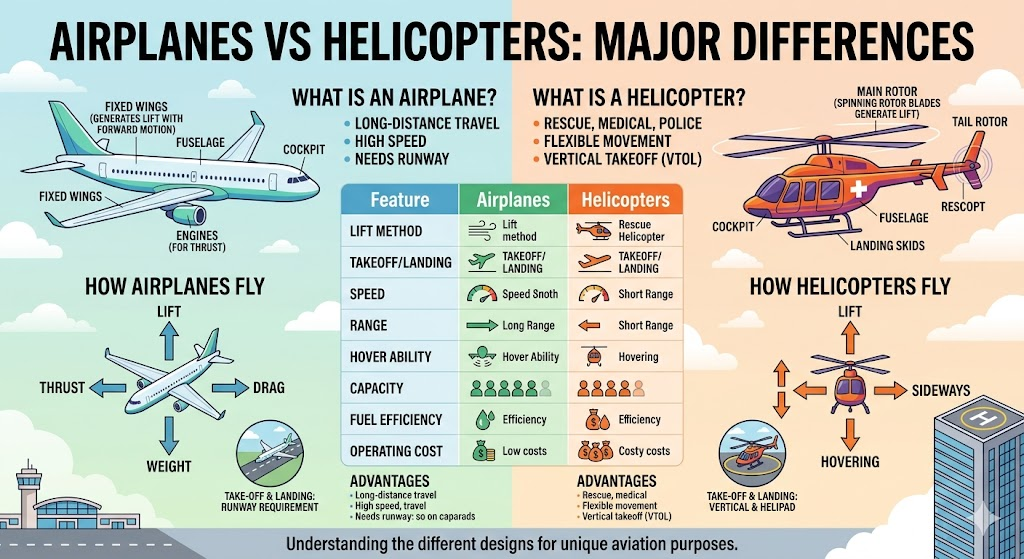
An airplane is a fixed-wing aircraft that flies by using wings to generate lift. The wings do not rotate like a helicopter rotor. Instead, the airplane moves forward through the air, and the shape of the wings helps create lift.
Airplanes usually need a runway for takeoff and landing. They are designed to travel faster and farther than helicopters, making them suitable for long-distance travel, commercial flights, cargo operations, and private aviation.
Main parts of an airplane include:
- Wings
- Fuselage
- Engines
- Tail section
- Landing gear
- Cockpit
- Flight control surfaces
Airplanes come in many types, such as small training aircraft, private jets, passenger airliners, cargo aircraft, military aircraft, and agricultural aircraft.
What Is a Helicopter?
A helicopter is a rotary-wing aircraft that uses spinning rotor blades to generate lift. Unlike airplanes, helicopters do not need long runways for takeoff or landing. They can take off vertically, land vertically, hover in one place, and fly in different directions with great flexibility.
Helicopters are useful in areas where airplanes cannot easily operate. They can land on helipads, rooftops, ships, open fields, and remote locations.
Main parts of a helicopter include:
- Main rotor
- Tail rotor
- Fuselage
- Engine
- Landing skids or wheels
- Cockpit
- Transmission system
- Flight controls
Common types of helicopters include training helicopters, medical helicopters, military helicopters, rescue helicopters, police helicopters, and tourism helicopters.
How Airplanes Fly
Airplanes fly by using forward motion and fixed wings. The engine creates thrust, which moves the airplane forward. As air flows over and under the wings, lift is created. When lift becomes greater than the aircraft’s weight, the airplane rises into the air.
The main forces involved in airplane flight are:
- Lift
- Weight
- Thrust
- Drag
Airplanes need enough speed before they can lift off. That is why they usually require runways. During flight, pilots use control surfaces such as ailerons, elevators, and rudders to control direction, climb, descent, and turns.
How Helicopters Fly
Helicopters fly differently because their rotor blades act like rotating wings. When the rotor spins, it creates lift. This allows the helicopter to rise vertically without needing a runway.
A helicopter can:
- Take off vertically
- Land vertically
- Hover in one place
- Move forward
- Move backward
- Move sideways
- Turn while hovering
The pilot controls the helicopter using the cyclic, collective, pedals, and throttle. Helicopter flying requires continuous coordination because the aircraft can move in several directions at once.
Major Differences Between Airplanes and Helicopters
1- Design
Airplanes have fixed wings and usually a long body designed for speed and stability. Helicopters have rotating blades and a compact body designed for vertical movement and flexibility.
2- Lift Generation
Airplanes generate lift through fixed wings and forward motion. Helicopters generate lift through rotating rotor blades.
3- Takeoff and Landing
Airplanes usually need runways for takeoff and landing. Helicopters can take off and land vertically in smaller spaces.
4- Speed
Airplanes are generally faster than helicopters. This makes airplanes better for long-distance travel and scheduled passenger flights.
5- Range
Airplanes usually have a longer range than helicopters. They can travel greater distances without refueling, especially commercial and private aircraft.
6- Hovering Ability
Helicopters can hover in one place. Airplanes cannot hover because they need continuous forward movement to stay in the air.
7- Passenger Capacity
Airplanes can carry more passengers than helicopters. Large commercial airplanes can carry hundreds of people, while helicopters usually carry fewer passengers.
8- Fuel Efficiency
Airplanes are usually more fuel efficient for long-distance travel. Helicopters consume more fuel because rotor systems require a lot of power.
9- Operating Cost
Helicopters often have higher operating and maintenance costs. Their rotor systems, transmission components, and moving parts require frequent inspection and care.
10- Pilot Training
Both airplanes and helicopters require professional training, but helicopter flying can be more complex because of hovering, vertical movement, and constant control coordination.
Comparison Table
| Feature | Airplanes | Helicopters |
|---|---|---|
| Lift Method | Fixed wings create lift through forward motion | Rotating rotor blades create lift |
| Takeoff | Usually needs a runway | Can take off vertically |
| Landing | Usually needs a runway | Can land vertically |
| Speed | Generally faster | Generally slower |
| Range | Longer range | Shorter range |
| Hover Ability | Cannot hover | Can hover |
| Passenger Capacity | Higher capacity | Lower capacity |
| Fuel Efficiency | More efficient for long distances | Less efficient for long distances |
| Operating Cost | Usually lower per distance traveled | Usually higher |
| Best Use | Long-distance travel and cargo | Rescue, medical, remote access, short-distance missions |
Advantages of Airplanes
Long-Distance Travel
Airplanes are best suited for long-distance travel. They can fly between cities, countries, and continents efficiently.
Higher Speed
Airplanes are faster than helicopters, which makes them ideal for commercial travel, business trips, cargo transport, and emergency logistics over long routes.
Better Fuel Efficiency
For longer distances, airplanes are generally more fuel efficient than helicopters. Their aerodynamic design helps reduce drag and improve performance.
Larger Passenger Capacity
Airplanes can carry more passengers and cargo. Commercial aircraft are designed to transport large numbers of people safely and efficiently.
Strong Commercial Use
Airplanes are the backbone of commercial aviation. Airlines, cargo companies, flight schools, private operators, and governments all depend on airplanes.
Advantages of Helicopters
Vertical Takeoff and Landing
The biggest advantage of helicopters is their ability to take off and land vertically. They do not need long runways, which makes them useful in cities, mountains, ships, and remote areas.
Hovering Ability
Helicopters can stay in one place in the air. This is useful for rescue operations, medical evacuation, police observation, news coverage, and inspections.
Access to Remote Locations
Helicopters can reach places where airplanes cannot land. They are used in forests, offshore platforms, disaster zones, and mountain areas.
Emergency Services
Helicopters are very important for emergency medical services, search and rescue, firefighting support, and disaster response.
Flexible Movement
Helicopters can move forward, backward, sideways, and vertically. This makes them highly flexible for special missions.
Common Uses of Airplanes
Airplanes are used in many industries and activities.
- Commercial passenger travel
- Cargo transportation
- Military operations
- Pilot training
- Private aviation
- Business travel
- Agricultural spraying
- Aerial survey
- Disaster relief transport
- Air ambulance flights in some cases
Airplanes are best when speed, range, and carrying capacity are important.
Common Uses of Helicopters
Helicopters are used where flexibility and vertical movement are needed.
- Emergency medical transport
- Search and rescue
- Police and law enforcement
- Military missions
- Tourism flights
- Offshore oil and gas transport
- Firefighting support
- Mountain rescue
- News reporting
- Construction lifting support
Helicopters are best for short-distance, urgent, or difficult-location operations.
Which Is Safer: Airplanes or Helicopters?
Safety depends on many factors, including aircraft maintenance, pilot training, weather conditions, mission type, and operating environment. Airplanes and helicopters are both designed with safety standards, but they often operate in different conditions.
Airplanes usually fly from airports with controlled runways and planned routes. Helicopters often operate in more challenging environments such as remote areas, city rooftops, rescue zones, mountains, and offshore locations.
Because of these differences, safety should not be judged only by aircraft type. Proper maintenance, skilled pilots, good weather decisions, and strong operating procedures are more important.
Cost Comparison
Purchase Cost
Airplanes and helicopters both vary widely in price depending on size, model, purpose, and technology. Small training airplanes may cost less than many helicopters, while large commercial aircraft are far more expensive.
Maintenance Cost
Helicopters usually require more complex maintenance because of their rotor system, gearbox, transmission, and many moving parts.
Fuel Cost
Helicopters often use more fuel for short-distance operations because hovering and vertical flight require high power. Airplanes are usually more fuel efficient for longer routes.
Training Cost
Helicopter training is often more expensive than airplane training because helicopter operating costs are higher. Airplane training is usually more common and widely available.
Operating Expenses
Operating expenses include fuel, maintenance, insurance, hangar or parking fees, pilot salaries, and inspection costs. Helicopters often cost more to operate per hour.
Choosing Between an Airplane and a Helicopter
For Personal Travel
Airplanes are usually better for personal travel over longer distances. Helicopters are better for short trips where landing space is limited.
For Business Travel
Airplanes are preferred for business travel between cities or countries. Helicopters are useful for city transfers, remote site visits, and quick access to places without airports.
For Emergency Services
Helicopters are extremely useful for emergency services because they can land close to accident sites or hospitals. Airplanes may be used for longer medical transport routes.
For Cargo Operations
Airplanes are better for carrying larger cargo over long distances. Helicopters are better for delivering supplies to remote or difficult areas.
For Aviation Students
Students interested in commercial airlines usually start with airplane training. Students interested in rescue, offshore, police, military, or utility work may explore helicopter training.
Interesting Facts About Airplanes and Helicopters
- Airplanes usually need forward speed to stay in the air.
- Helicopter rotor blades act like rotating wings.
- Helicopters can hover, but airplanes cannot.
- Airplanes are generally faster than helicopters.
- Helicopters can land in smaller spaces.
- Large airplanes can carry hundreds of passengers.
- Helicopters are commonly used in rescue missions.
- Airplanes are better for long-distance travel.
- Helicopters are useful in areas without runways.
- Both aircraft require skilled pilots and strict maintenance.
Future of Airplanes and Helicopters
Aviation technology is changing quickly. Both airplanes and helicopters are becoming safer, smarter, and more efficient.
Future developments may include:
- Electric aircraft
- Hybrid propulsion systems
- Advanced flight controls
- Better navigation systems
- Sustainable aviation fuels
- Autonomous flight technology
- Improved safety systems
- Quieter aircraft designs
Electric airplanes may support short regional flights, while electric vertical takeoff aircraft may change urban air mobility. Helicopter technology is also improving with better materials, digital cockpit systems, and more efficient engines.
FAQs
1- What is the biggest difference between an airplane and a helicopter?
The biggest difference is how they create lift. Airplanes use fixed wings and need forward motion to fly, while helicopters use rotating rotor blades to create lift. This allows helicopters to take off vertically, land vertically, and hover in one place.
2- Why can helicopters hover?
Helicopters can hover because their rotor blades spin and create lift even when the aircraft is not moving forward. The rotor system acts like moving wings, allowing the helicopter to stay in one place in the air.
3- Are airplanes faster than helicopters?
Yes, airplanes are generally faster than helicopters. Their fixed-wing design and aerodynamic shape allow them to travel at higher speeds, making them better for long-distance passenger and cargo travel.
4- Which aircraft is more fuel efficient?
Airplanes are usually more fuel efficient for long-distance travel. Helicopters require more power for hovering and vertical flight, which often makes them less fuel efficient over longer distances.
5- Can helicopters travel long distances?
Helicopters can travel long distances, but their range is usually shorter than airplanes. They may need more frequent refueling and are generally used for shorter, more flexible missions.
6- Why do airplanes need runways?
Airplanes need runways because they require forward speed to generate lift through their wings. A runway gives the airplane enough space to accelerate for takeoff and slow down after landing.
7- Are helicopters more expensive to operate?
Yes, helicopters are often more expensive to operate because they have complex rotor systems, more moving parts, and higher maintenance needs. Their fuel consumption can also be higher for certain operations.
8- Which is easier to fly?
Both require proper training, but helicopters are often considered more complex because they can hover and move in multiple directions. Airplanes may be easier for beginners to understand because they are more stable in forward flight.
9- What industries use helicopters the most?
Helicopters are widely used in emergency medical services, search and rescue, police work, military missions, offshore transport, tourism, firefighting, and remote-area operations.
10- Which aircraft should a beginner learn about first?
A beginner can start by learning about both, but airplanes are often easier to understand first because their flight principles are more straightforward. Helicopters are also fascinating, especially for students interested in rescue, defense, or specialized aviation roles.
Conclusion
Airplanes and helicopters are both important aircraft, but they are designed for different purposes. Airplanes are best for speed, long-distance travel, larger passenger capacity, cargo movement, and commercial aviation. Helicopters are best for flexibility, vertical takeoff and landing, hovering, emergency response, and reaching places without runways. The main difference lies in how they generate lift and how they operate in the air. Airplanes depend on fixed wings and forward motion, while helicopters use rotating blades and can move in more flexible ways. For aviation students and enthusiasts, understanding these differences is a great first step toward learning how aircraft work. Both machines show the power of aviation technology and continue to play a major role in transportation, safety, and exploration.

