
Introduction
Rotary-wing aircraft are one of the most interesting aircraft categories in aviation. Unlike fixed-wing aircraft, which need forward speed and wings to create lift, rotary-wing aircraft use rotating blades called rotors. These rotors allow many rotary-wing aircraft to take off vertically, land vertically, hover in one place, and move in different directions.
This unique ability makes rotary-wing aircraft extremely useful in real-world situations. They are widely used for rescue missions, emergency medical transport, military operations, tourism, law enforcement, firefighting, offshore transportation, and travel to remote areas. A helicopter can land where an airplane cannot, making it valuable in mountains, forests, rooftops, ships, accident zones, and disaster-affected locations.
For beginners, understanding rotary-wing aircraft is an important step in learning aviation. This guide explains what rotary-wing aircraft are, how they work, their main parts, types, controls, advantages, limitations, safety basics, training use, and future trends in simple language.
What Is a Rotary-Wing Aircraft?
A rotary-wing aircraft is an aircraft that creates lift using rotating wings or blades. These rotating blades are called rotors. Instead of using fixed wings like an airplane, a rotary-wing aircraft uses rotor blades that spin and push air downward. This creates lift and allows the aircraft to rise into the air.
In simple words, a rotary-wing aircraft is a flying machine that uses spinning blades to fly.
The most common example of a rotary-wing aircraft is a helicopter. However, helicopters are not the only type. Gyrocopters, compound helicopters, tiltrotor aircraft, and unmanned rotary-wing drones are also examples of rotary-wing aircraft.
Rotary-wing aircraft can usually perform movements that fixed-wing aircraft cannot easily do, such as:
- Vertical takeoff
- Vertical landing
- Hovering
- Slow-speed flight
- Sideways movement
- Backward movement
- Landing in small spaces
These abilities make them useful for special missions where flexibility and precision are required.
Why Rotary-Wing Aircraft Are Important
Rotary-wing aircraft are important because they can operate in places where normal airplanes cannot. They do not always need long runways, and many can land in small open areas. This makes them highly valuable in emergency, defense, medical, tourism, and remote transport operations.
Emergency Medical Services
Helicopters are often used as air ambulances. They can transport patients quickly from accident sites, remote villages, highways, mountains, or disaster zones to hospitals.
Search and Rescue
Rotary-wing aircraft are useful for finding and rescuing people in difficult locations such as forests, mountains, oceans, flood areas, and collapsed structures.
Military Operations
Military helicopters and rotary-wing aircraft are used for troop movement, supply transport, surveillance, rescue, and tactical missions.
Tourism
Helicopters are commonly used for sightseeing tours over cities, mountains, coastlines, waterfalls, and tourist destinations.
Police and Law Enforcement
Police helicopters support traffic monitoring, search operations, crowd observation, and law enforcement missions.
Offshore Transportation
Rotary-wing aircraft are used to transport workers and supplies to offshore oil platforms, ships, and remote sea locations.
Disaster Response
During floods, earthquakes, storms, and landslides, helicopters can deliver food, medicine, rescue teams, and emergency supplies.
Firefighting
Some helicopters carry water buckets or firefighting systems to help control forest fires and reach areas that ground vehicles cannot access.
Remote Area Access
Rotary-wing aircraft can reach remote areas with limited road or runway access, making them valuable for medical, research, construction, and transport work.
How Rotary-Wing Aircraft Work
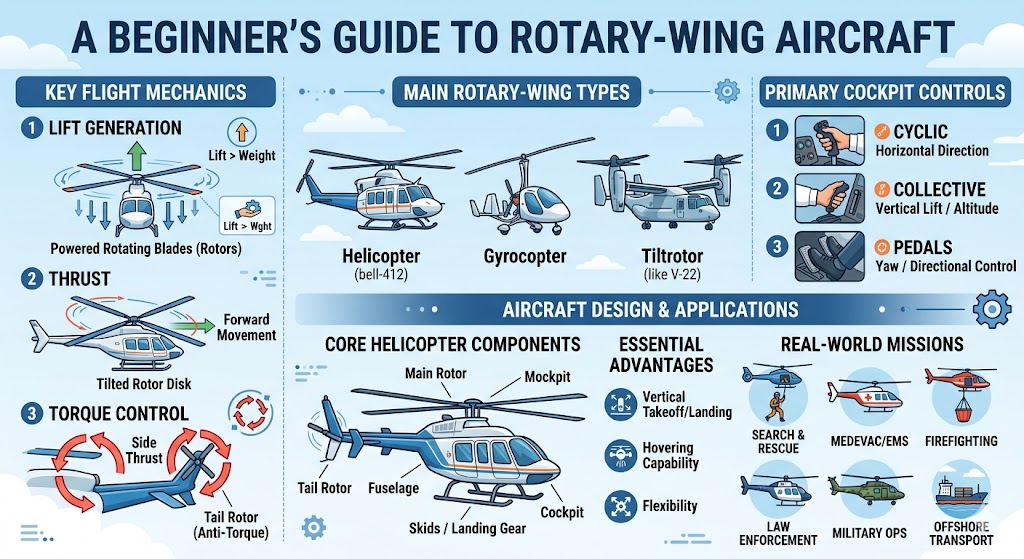
Rotary-wing aircraft work by spinning rotor blades at high speed. These blades act like rotating wings. As they move through the air, they create lift. When lift becomes greater than the aircraft’s weight, the aircraft rises.
The main rotor is usually located above the aircraft. It produces most of the lift. In many helicopters, the engine powers the main rotor through a transmission system. As the rotor blades spin, they push air downward and create an upward force.
Several key concepts help explain rotary-wing flight:
- Rotor system
- Lift generation
- Thrust
- Torque
- Anti-torque system
- Hovering
- Directional control
Rotor System
The rotor system includes the rotor blades, rotor hub, mast, and control mechanisms. It is the main part that allows a helicopter or rotary-wing aircraft to fly.
Lift Generation
Lift is created when the rotor blades spin and move air downward. The shape of the blades helps produce lift in a way similar to airplane wings, but the wings are rotating instead of fixed.
Thrust
In rotary-wing aircraft, thrust can be directed in different ways. By tilting the rotor disk, the aircraft can move forward, backward, or sideways.
Torque
Torque is the twisting force created when the engine turns the main rotor. In a helicopter, this force can make the fuselage want to rotate in the opposite direction of the rotor.
Anti-Torque System
To control torque, many helicopters use a tail rotor. The tail rotor produces sideways force that prevents the helicopter body from spinning uncontrollably.
Hovering
Hovering means staying in one place in the air. A helicopter can hover when lift balances weight and the pilot carefully controls movement.
Directional Control
Directional control allows the pilot to point the aircraft in the desired direction. This is usually managed with anti-torque pedals, cyclic control, and collective control.
Main Parts of a Rotary-Wing Aircraft
Rotary-wing aircraft have several important parts. Beginners should understand the basic function of each part.
Main Rotor
The main rotor is the large spinning blade system on top of most helicopters. It creates lift and helps control movement.
Rotor Blades
Rotor blades are long airfoil-shaped parts that spin around the rotor hub. They create lift as they move through the air.
Rotor Mast
The rotor mast connects the rotor system to the aircraft and transfers power from the transmission to the rotor blades.
Swashplate
The swashplate is a control mechanism that changes the angle of the rotor blades. It helps the pilot control lift and direction.
Tail Rotor
The tail rotor is a smaller rotor usually located at the tail of a helicopter. It helps control torque and keeps the aircraft from spinning.
Fuselage
The fuselage is the main body of the aircraft. It holds the cockpit, passengers, cargo, engine systems, fuel system, and equipment.
Cockpit
The cockpit is where the pilot controls the aircraft. It contains flight controls, instruments, communication systems, navigation equipment, and engine controls.
Engine
The engine provides power to turn the rotor system. Helicopters may use piston engines, turboshaft engines, hybrid systems, or electric motors depending on size and design.
Transmission System
The transmission transfers power from the engine to the main rotor and tail rotor. It also helps control rotor speed.
Landing Skids or Landing Gear
Many helicopters use landing skids instead of wheels. Some larger helicopters use wheeled landing gear. These systems support the aircraft during landing and ground operations.
Fuel System
The fuel system stores and supplies fuel to the engine. It includes tanks, pumps, lines, filters, and fuel controls.
Avionics
Avionics are electronic systems used for navigation, communication, flight monitoring, weather awareness, and safety.
Types of Rotary-Wing Aircraft
Rotary-wing aircraft come in different types. Each type has a unique design and purpose.
1- Helicopters
Helicopters are the most common rotary-wing aircraft. They use one or more main rotors to create lift and control movement.
Helicopters can take off vertically, land vertically, hover, move forward, move backward, and fly sideways. They are used in rescue, medical transport, tourism, law enforcement, military operations, firefighting, and remote transportation.
2- Gyrocopters
A gyrocopter, also called an autogyro, has a free-spinning rotor that creates lift through autorotation. Unlike a helicopter, the main rotor is not normally powered by the engine during flight. A separate propeller provides forward thrust.
Gyrocopters are often used for recreational flying, sport aviation, and training. They are usually smaller and simpler than helicopters.
3- Compound Helicopters
Compound helicopters combine normal helicopter rotor systems with extra features such as wings or additional propellers. These additions help improve speed, range, and performance.
They are designed to offer better forward-flight efficiency while still keeping many helicopter-like abilities.
4- Tiltrotor Aircraft
Tiltrotor aircraft combine helicopter and airplane features. Their rotors can tilt upward for vertical takeoff and landing, then tilt forward for airplane-like flight.
This design allows them to take off like a helicopter and fly faster and farther like an airplane. Tiltrotor aircraft are used mainly in specialized transport and military roles.
5- Unmanned Rotary-Wing Aircraft
Unmanned rotary-wing aircraft include drones that use rotors to fly. Many common drones are rotary-wing aircraft because they use multiple spinning propellers.
They are used for:
- Photography
- Mapping
- Inspection
- Agriculture
- Security
- Surveying
- Disaster monitoring
- Research
Because they can hover and move precisely, rotary-wing drones are useful for many commercial and industrial tasks.
Helicopters Explained
Helicopters are the most familiar rotary-wing aircraft. They are highly flexible because they can operate in ways that airplanes cannot.
Vertical Takeoff and Landing
Helicopters can take off and land vertically. This means they do not need long runways. They can operate from helipads, rooftops, fields, ships, hospitals, and remote areas.
Hovering Capability
One of the biggest advantages of helicopters is hovering. Hovering allows the helicopter to stay almost still in the air. This is useful for rescue, filming, police work, inspection, and medical operations.
Forward Flight
To move forward, the rotor disk tilts slightly forward. This creates a forward force and moves the helicopter ahead.
Sideways Flight
Helicopters can move sideways by tilting the rotor disk left or right. This is useful during precise landings and low-speed operations.
Backward Flight
Helicopters can also move backward by tilting the rotor disk backward. This ability is useful during controlled maneuvers and positioning.
Rescue Operations
Helicopters are widely used in rescue missions because they can reach difficult areas quickly and hover over locations where landing is not possible.
Passenger Transport
Some helicopters are used for passenger transport, tourism, private travel, and offshore operations.
Military Applications
Military helicopters are used for transport, rescue, surveillance, supply movement, and tactical missions.
Gyrocopters Explained
Gyrocopters are rotary-wing aircraft that use an unpowered rotor for lift and a propeller for forward movement. The rotor spins because air flows upward through it during forward motion. This process is called autorotation.
Gyrocopters are usually smaller than helicopters and are often used for recreational aviation and training. They cannot normally hover like helicopters, but they can fly at low speeds and require shorter takeoff and landing distances than many fixed-wing aircraft.
Key points about gyrocopters:
- Use autorotation for lift
- Use a propeller for thrust
- Often used for sport flying
- Usually simpler than helicopters
- Cannot hover like helicopters
- Useful for aviation learning and recreation
Tiltrotor Aircraft Explained
Tiltrotor aircraft are special aircraft that combine the strengths of helicopters and airplanes. Their rotors can point upward for vertical takeoff and landing. After takeoff, the rotors can tilt forward so the aircraft can fly more like an airplane.
This gives tiltrotor aircraft two major advantages:
- Vertical takeoff and landing like a helicopter
- Faster forward flight like an airplane
Tiltrotor aircraft are useful for long-distance missions where runway access may be limited. They are more complex than normal helicopters, but they offer greater speed and range.
Rotary-Wing Aircraft vs Fixed-Wing Aircraft
| Category | Rotary-Wing Aircraft | Fixed-Wing Aircraft |
|---|---|---|
| Lift Generation | Uses rotating rotor blades | Uses fixed wings and forward speed |
| Runway Requirement | Usually does not need a long runway | Usually needs a runway |
| Hovering Capability | Can hover in one place | Usually cannot hover |
| Speed | Generally slower | Generally faster |
| Range | Usually shorter range | Usually longer range |
| Fuel Efficiency | Less efficient for long distances | More efficient for long distances |
| Landing Flexibility | Can land in small spaces | Needs suitable runway or landing strip |
| Common Applications | Rescue, medical, police, military, tourism | Passenger travel, cargo, training, long-distance flights |
| Training Focus | Hovering, vertical lift, low-speed control | Runway operations, navigation, cruise flight |
In simple words, rotary-wing aircraft are best for flexibility, hovering, and special missions, while fixed-wing aircraft are best for speed, range, and efficient long-distance travel.
How Rotary-Wing Aircraft Take Off
Rotary-wing aircraft take off differently from airplanes. Many helicopters can rise vertically without needing a runway.
Rotor Startup
The engine starts and begins powering the rotor system. The rotor blades slowly increase speed until they reach the correct operating range.
Blade Rotation
As the blades rotate faster, they begin moving air downward and producing lift.
Lift Generation
The pilot increases lift by using the collective control. This changes the blade angle so the rotor produces more lift.
Collective Input
The collective control raises or lowers the overall pitch angle of the rotor blades. Increasing collective creates more lift.
Vertical Climb
When lift becomes greater than weight, the aircraft rises vertically from the ground.
Transition to Forward Flight
After takeoff, the pilot uses the cyclic control to tilt the rotor disk forward. This moves the aircraft into forward flight.
How Rotary-Wing Aircraft Hover
Hovering is one of the most important features of rotary-wing aircraft. A helicopter hovers when it stays almost motionless in the air.
To hover, the rotor must create enough lift to balance the aircraft’s weight. The pilot must also control small movements caused by wind, torque, and aircraft balance.
During hovering, the pilot uses:
- Collective to control height
- Cyclic to control position
- Anti-torque pedals to control direction
- Throttle or engine control to maintain power if applicable
Hovering requires practice because the aircraft reacts to small control movements. Student pilots usually spend a lot of time learning hover control.
How Rotary-Wing Aircraft Move
Rotary-wing aircraft can move in several directions because the rotor disk can be tilted.
Forward Flight
The pilot moves the cyclic forward, tilting the rotor disk forward. This creates forward movement.
Backward Flight
The pilot moves the cyclic backward, tilting the rotor disk backward. This moves the aircraft backward.
Sideways Flight
The pilot moves the cyclic left or right, tilting the rotor disk sideways. This moves the aircraft sideways.
Vertical Climb
The pilot increases collective to create more lift. The aircraft rises vertically.
Vertical Descent
The pilot reduces collective carefully. Lift decreases, and the aircraft descends.
Turning
The pilot uses anti-torque pedals to rotate the aircraft nose left or right. In forward flight, turns also involve coordinated cyclic movement.
Flight Controls in Rotary-Wing Aircraft
Rotary-wing aircraft controls are different from fixed-wing aircraft controls. Helicopters usually have four main controls.
Collective
The collective controls the overall lift produced by the rotor blades. When the pilot raises the collective, the blade angle increases and the aircraft climbs. When the collective is lowered, lift decreases and the aircraft descends.
Cyclic
The cyclic controls the direction of movement. It tilts the rotor disk forward, backward, left, or right. This allows the aircraft to move in different directions.
Anti-Torque Pedals
Anti-torque pedals control the direction of the aircraft nose. They adjust the tail rotor or anti-torque system to control yaw.
Throttle
In some helicopters, the throttle controls engine power directly. In many modern helicopters, engine power is managed automatically to maintain rotor speed.
Common Instruments in Rotary-Wing Aircraft
Rotary-wing aircraft cockpits include instruments that help pilots monitor flight, engine, navigation, and safety information.
Airspeed Indicator
The airspeed indicator shows how fast the aircraft is moving through the air.
Altimeter
The altimeter shows the aircraft’s height above sea level.
Vertical Speed Indicator
The vertical speed indicator shows whether the aircraft is climbing or descending.
Attitude Indicator
The attitude indicator shows the aircraft’s position compared to the horizon.
Heading Indicator
The heading indicator shows the direction the aircraft is facing.
Engine Instruments
Engine instruments show engine temperature, pressure, speed, fuel level, and performance information.
Navigation Displays
Navigation displays help pilots follow routes, locate landing areas, and maintain situational awareness.
Communication Systems
Communication systems allow pilots to speak with air traffic control, other aircraft, and ground teams.
Autopilot Systems
Some advanced rotary-wing aircraft include autopilot systems that help with stability, navigation, and workload reduction.
Rotary-Wing Aircraft Engine Types
Rotary-wing aircraft use different engine types depending on size, performance needs, and mission type.
Piston Engines
Piston engines are commonly used in smaller helicopters and training helicopters. They are generally suitable for light-duty operations and beginner training.
Turboshaft Engines
Turboshaft engines are common in larger helicopters. They are powerful, reliable, and suitable for rescue, military, transport, and commercial operations.
Hybrid Systems
Hybrid systems combine traditional engines with electric power. These systems are being explored to improve efficiency and reduce emissions.
Electric Concepts
Electric rotary-wing aircraft are being developed for short-distance travel, urban air mobility, training, and low-noise operations. Many small drones already use electric motors.
Advantages of Rotary-Wing Aircraft
Rotary-wing aircraft offer several major advantages.
Vertical Takeoff and Landing
They can take off and land vertically, which reduces the need for long runways.
Hovering
They can stay in one place in the air, making them valuable for rescue, inspection, filming, and police work.
Access to Difficult Locations
Rotary-wing aircraft can reach mountains, forests, ships, rooftops, accident sites, and remote areas.
Precision Operations
They can move slowly and carefully, which is useful for landing, lifting, inspecting, and rescue operations.
Rescue Capability
Helicopters can rescue people from places where ground vehicles or airplanes cannot reach.
Flexible Movement
They can move forward, backward, sideways, up, and down with great control.
Urban Operations
Rotary-wing aircraft can operate from helipads, hospitals, and city landing zones.
Limitations of Rotary-Wing Aircraft
Rotary-wing aircraft are highly useful, but they also have limitations.
Lower Speed Than Airplanes
Most helicopters are slower than fixed-wing airplanes, especially for long-distance travel.
Higher Operating Costs
Helicopters often cost more to operate because of fuel use, maintenance needs, and mechanical complexity.
Shorter Range
Many rotary-wing aircraft cannot fly as far as fixed-wing aircraft without refueling.
More Mechanical Complexity
Rotor systems, transmissions, tail rotors, and control mechanisms make rotary-wing aircraft mechanically complex.
Weather Sensitivity
Strong winds, poor visibility, storms, and certain weather conditions can affect helicopter operations.
Higher Maintenance Needs
Rotor systems and moving parts require regular inspection and maintenance.
Rotary-Wing Aircraft Safety Basics
Safety is very important in rotary-wing aviation. Pilots, engineers, and operators follow strict safety practices.
Pre-Flight Inspections
Before flight, pilots and maintenance teams check rotor blades, fuel, oil, controls, landing gear, instruments, and general aircraft condition.
Rotor Safety
Rotor blades can be dangerous when spinning. Ground crews and passengers must follow proper safety procedures around helicopters.
Weather Planning
Pilots check wind, visibility, clouds, storms, and landing conditions before flying.
Maintenance Checks
Regular maintenance is essential because rotary-wing aircraft have many moving parts.
Fuel Management
Pilots must plan fuel carefully for the mission, route, reserve, and possible delays.
Emergency Procedures
Pilots train for engine failure, autorotation, tail rotor problems, weather changes, and emergency landings.
Pilot Training
Rotary-wing pilots need proper training in hovering, low-speed control, emergency procedures, navigation, and landing.
Air Traffic Communication
Pilots communicate with air traffic control, helipads, airports, and ground teams to maintain safe operations.
Rotary-Wing Aircraft in Pilot Training
Rotary-wing pilot training teaches students how to control helicopters safely and confidently.
Basic Hovering
Students learn to keep the helicopter stable in one place. This is one of the most challenging early skills.
Vertical Takeoff
Students practice lifting off smoothly from the ground using collective, cyclic, and pedals.
Landing Practice
Students learn controlled vertical and forward landings in different conditions.
Turns
Students practice turning while hovering and during forward flight.
Navigation
Students learn how to plan routes, follow directions, read charts, and use navigation systems.
Emergency Procedures
Students practice handling engine problems, autorotation, and landing in emergency situations.
Cross-Country Flights
Students learn to fly longer routes between different locations while managing fuel, weather, communication, and navigation.
Rotary-Wing Aircraft Maintenance Basics
Maintenance is a critical part of rotary-wing aviation.
Rotor Inspections
Rotor blades, hubs, and related parts must be inspected carefully for damage, wear, cracks, or imbalance.
Engine Checks
Engines are checked for oil, temperature, pressure, performance, and general condition.
Transmission Inspections
The transmission system transfers power to the rotors, so it must be inspected regularly.
Tail Rotor Inspections
Tail rotor systems are checked for proper operation, damage, and safety.
Fuel System Checks
Fuel tanks, lines, filters, pumps, and fuel quality must be checked.
Avionics Inspections
Navigation, communication, displays, and electrical systems must be tested.
Scheduled Maintenance
Rotary-wing aircraft follow scheduled maintenance programs based on flight hours, calendar time, and inspection requirements.
Common Rotary-Wing Aircraft Terms for Beginners
Rotor
A rotor is a spinning blade system that creates lift.
Hover
Hover means staying almost still in the air.
Collective
The collective controls the overall lift from the rotor blades.
Cyclic
The cyclic controls the direction of movement.
Tail Rotor
The tail rotor helps control torque and keeps the helicopter from spinning.
Torque
Torque is a twisting force created by the main rotor system.
Autorotation
Autorotation is a flight condition where the rotor keeps spinning because of airflow, even if engine power is reduced or lost.
Rotor Disk
The rotor disk is the circular area covered by the spinning rotor blades.
Lift
Lift is the upward force that helps the aircraft fly.
Thrust
Thrust is the force that moves the aircraft.
Skids
Skids are landing supports used by many helicopters instead of wheels.
Swashplate
The swashplate changes the angle of rotor blades and helps control movement.
Vertical Takeoff
Vertical takeoff means rising straight up from the ground.
Vertical Landing
Vertical landing means descending straight down to land.
Career Paths Related to Rotary-Wing Aviation
Rotary-wing aviation offers many career opportunities.
Helicopter Pilot
Helicopter pilots fly rotary-wing aircraft for transport, tourism, private operations, and commercial work.
Rescue Pilot
Rescue pilots operate helicopters in search and rescue missions, often in difficult terrain or emergency conditions.
Air Ambulance Pilot
Air ambulance pilots transport patients and medical teams quickly during emergencies.
Military Aviator
Military aviators fly helicopters and other rotary-wing aircraft for defense, transport, rescue, and tactical missions.
Offshore Transport Pilot
Offshore pilots transport workers and supplies to oil platforms, ships, and remote sea locations.
Flight Instructor
Flight instructors train student pilots in helicopter handling, hovering, navigation, and emergency procedures.
Aircraft Maintenance Engineer
Maintenance engineers inspect, repair, and maintain helicopter systems, engines, rotors, transmissions, and avionics.
Aviation Safety Specialist
Aviation safety specialists help manage risk, improve procedures, and support safe operations.
Aviation Operations Manager
Operations managers coordinate flight planning, scheduling, crew management, safety, and mission support.
Future of Rotary-Wing Aircraft
Rotary-wing aviation is changing with new technology and cleaner designs.
Electric Helicopters
Electric helicopters and electric vertical-lift aircraft may reduce noise and emissions in short-distance operations.
Hybrid Propulsion
Hybrid systems may improve fuel efficiency and extend operating range.
Autonomous Rotary-Wing Systems
Autonomous drones and future aircraft may support delivery, inspection, surveillance, and emergency response.
Advanced Rotor Technology
Improved rotor designs may reduce noise, improve lift, and increase performance.
Urban Air Mobility
Urban air mobility focuses on aircraft that can move people or goods within cities using vertical takeoff and landing systems.
Improved Safety Systems
Modern aircraft are adding better sensors, warning systems, stability support, and digital controls.
Lightweight Materials
New materials can reduce aircraft weight and improve efficiency.
FAQs
1- What is a rotary-wing aircraft?
A rotary-wing aircraft is an aircraft that uses rotating blades called rotors to create lift. The most common example is a helicopter. These aircraft can often take off vertically, land vertically, hover, and move in different directions.
2- How does a helicopter fly?
A helicopter flies by spinning its rotor blades. The blades push air downward and create lift. The pilot controls blade angle and rotor direction using the collective, cyclic, and pedals. This allows the helicopter to climb, descend, hover, turn, and move forward.
3- What is the difference between rotary-wing and fixed-wing aircraft?
Rotary-wing aircraft use rotating blades to create lift, while fixed-wing aircraft use fixed wings and forward speed. Helicopters are rotary-wing aircraft, and airplanes are fixed-wing aircraft. Rotary-wing aircraft can hover and land in small areas, while fixed-wing aircraft are usually faster and better for long-distance flight.
4- Can rotary-wing aircraft hover?
Yes, many rotary-wing aircraft, especially helicopters, can hover. Hovering means staying nearly still in the air. This ability is useful for rescue missions, medical operations, filming, police work, inspection, and landing in tight spaces.
5- What is a tail rotor?
A tail rotor is a smaller rotor located at the tail of many helicopters. It helps control torque created by the main rotor. Without a tail rotor or another anti-torque system, the helicopter body could spin in the opposite direction of the main rotor.
6- What is autorotation?
Autorotation is a condition where the rotor keeps spinning because of airflow rather than engine power. It is an important emergency procedure in helicopter flying. During autorotation, a trained pilot can guide the helicopter toward a safer landing area.
7- What are rotary-wing aircraft used for?
Rotary-wing aircraft are used for rescue missions, medical transport, military operations, tourism, police work, firefighting, offshore transport, disaster response, remote-area access, inspection, and aerial photography. Their ability to hover and land in small spaces makes them very useful.
8- Are helicopters safer than airplanes?
Both helicopters and airplanes can be safe when they are properly maintained and operated by trained pilots. Their risks are different because they operate in different environments. Helicopters often fly lower, land in tighter spaces, and perform special missions, so training and maintenance are very important.
9- What engine types are used in helicopters?
Helicopters may use piston engines, turboshaft engines, hybrid systems, or electric motors. Small training helicopters often use piston engines. Larger commercial, rescue, and military helicopters commonly use turboshaft engines because they provide strong and reliable power.
10- How do helicopter pilots control the aircraft?
Helicopter pilots use the collective, cyclic, anti-torque pedals, and sometimes throttle. The collective controls lift, the cyclic controls direction, and the pedals control the nose direction. These controls work together to manage hovering, climbing, turning, descending, and forward flight.
11- What careers involve rotary-wing aviation?
Rotary-wing aviation careers include helicopter pilot, rescue pilot, air ambulance pilot, military aviator, offshore transport pilot, flight instructor, aircraft maintenance engineer, aviation safety specialist, and aviation operations manager. These careers require proper training and strong safety awareness.
12- What is the future of rotary-wing aircraft?
The future of rotary-wing aircraft includes electric helicopters, hybrid propulsion, autonomous drones, urban air mobility, advanced rotor systems, improved safety technology, and lightweight materials. These developments may make rotary-wing aviation cleaner, quieter, safer, and more efficient.
Conclusion
Rotary-wing aircraft are unique flying machines that use rotating blades to create lift. They are different from fixed-wing aircraft because they can often take off vertically, land vertically, hover, and move with great flexibility. Helicopters are the most common rotary-wing aircraft, but gyrocopters, compound helicopters, tiltrotor aircraft, and rotary-wing drones also belong to this category. For beginners, learning about rotary-wing aircraft helps build a strong understanding of aviation beyond normal airplanes. These aircraft play an important role in rescue missions, medical transport, military operations, tourism, law enforcement, firefighting, offshore work, and remote-area access. By understanding their parts, controls, working principles, advantages, limitations, and safety basics, aviation learners can develop a clear foundation for future study or careers in rotary-wing aviation.

