
Introduction
Commercial aircraft are one of the most important parts of modern transportation. They help people travel across cities, countries, and continents quickly and safely. Every day, millions of passengers depend on commercial airplanes for business trips, holidays, education, medical travel, family visits, and global connectivity. For aviation beginners, understanding commercial aircraft is the first step toward learning how airlines operate, how aircraft are designed, and how modern aviation keeps the world connected. This guide explains commercial aircraft in simple language so students, travelers, aviation enthusiasts, and future pilots can understand the basics clearly.
What Is a Commercial Aircraft?
A commercial aircraft is an aircraft used by airlines or aviation companies to transport passengers, cargo, or both for business purposes. These aircraft are designed for regular operations, long service life, safety, comfort, and efficiency.
Commercial aircraft are different from private aircraft because they are usually operated by airlines and are used for paid passenger or cargo services. A private aircraft is generally used by individuals, companies, or private groups for personal or business travel.
Commercial aircraft are important because they support:
- Passenger transportation
- Business travel
- Tourism
- Cargo movement
- Global trade
- Emergency logistics
- Regional connectivity
History of Commercial Aviation
Commercial aviation started with small passenger aircraft and short routes. In the early stages, flying was expensive and limited to fewer passengers. Over time, aircraft became larger, safer, faster, and more comfortable.
As technology improved, airlines began operating longer routes and carrying more passengers. Jet engines changed aviation by making aircraft faster and more efficient. Today, modern commercial aircraft can fly across oceans, operate in different weather conditions, and carry hundreds of passengers with advanced safety systems.
The growth of commercial aviation has made air travel more accessible and has helped connect the global economy.
Types of Commercial Aircraft
Commercial aircraft come in different sizes and designs. Each type serves a specific purpose depending on route distance, passenger capacity, airport size, and airline business needs.
Narrow-Body Aircraft
Narrow-body aircraft are commonly used for short and medium-distance flights. They usually have a single aisle inside the cabin and are popular for domestic and regional routes.
Common examples include:
- Boeing 737
- Airbus A320 family
These aircraft are widely used because they are efficient, reliable, and suitable for busy routes between cities.
Wide-Body Aircraft
Wide-body aircraft are larger airplanes with two aisles. They are mainly used for long-distance and international flights. These aircraft can carry more passengers and more cargo compared to narrow-body aircraft.
Common examples include:
- Boeing 777
- Boeing 787 Dreamliner
- Airbus A350
- Airbus A330
Wide-body aircraft are designed for long-haul comfort, fuel efficiency, and international airline operations.
Regional Aircraft
Regional aircraft are smaller commercial aircraft used for short routes and smaller airports. They help connect smaller cities with larger airline hubs.
Common examples include:
- Embraer E-Jets
- ATR series
Regional aircraft are important because they make air travel available in areas where large aircraft may not be practical.
Cargo Aircraft
Cargo aircraft are designed to carry goods instead of passengers. They support global logistics, e-commerce, medical supply movement, industrial transport, and emergency relief operations.
Cargo aircraft may be specially built for freight or converted from passenger aircraft. They are a key part of international trade and supply chains.
Major Commercial Aircraft Manufacturers
Several companies design and manufacture commercial aircraft. These manufacturers play a major role in shaping global aviation.
Boeing
Boeing is one of the world’s most recognized commercial aircraft manufacturers. It produces aircraft used by airlines for short, medium, and long-distance routes.
Popular Boeing aircraft include:
- Boeing 737
- Boeing 777
- Boeing 787 Dreamliner
Boeing aircraft are widely used by airlines around the world and are known for their role in both passenger and cargo aviation.
Airbus
Airbus is another major commercial aircraft manufacturer with a strong global presence. It produces aircraft for domestic, regional, and international airline operations.
Popular Airbus aircraft include:
- Airbus A320 family
- Airbus A330
- Airbus A350
- Airbus A380
Airbus aircraft are known for modern cockpit design, efficiency, passenger comfort, and airline-friendly operations.
Embraer
Embraer is well known for regional aircraft. Its aircraft are commonly used for short routes, smaller airports, and regional airline networks.
Popular Embraer aircraft include:
- Embraer E-Jets
- E2 family aircraft
Embraer plays an important role in connecting smaller cities and supporting regional aviation growth.
ATR
ATR specializes in turboprop aircraft. These aircraft are often used for short-distance regional flights and airports with smaller runways.
Popular ATR aircraft include:
- ATR 42
- ATR 72
ATR aircraft are useful for regional connectivity, especially where jet aircraft may not be cost-effective.
Main Parts of a Commercial Aircraft
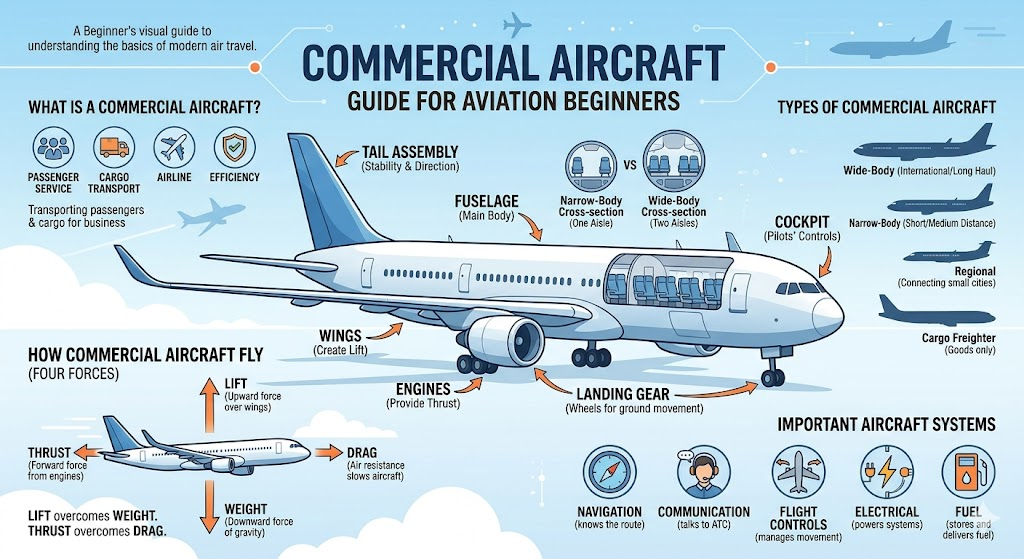
A commercial aircraft is made of many important parts. Each part has a specific role in safe and efficient flying.
Fuselage
The fuselage is the main body of the aircraft. It holds passengers, cargo, cockpit, cabin, and important systems. In simple words, it is the central structure of the airplane.
Wings
Wings help create lift, which allows the aircraft to fly. They also hold fuel tanks in many aircraft and support control surfaces that help pilots manage direction and movement.
Engines
Engines provide thrust, which moves the aircraft forward. Most modern commercial aircraft use jet engines or turboprop engines depending on aircraft type and route requirement.
Cockpit
The cockpit is where pilots control the aircraft. It contains flight instruments, navigation systems, communication systems, and control panels.
Landing Gear
Landing gear includes the wheels and supporting structure used during takeoff, landing, and ground movement. It is designed to handle heavy loads and landing impact.
Tail Assembly
The tail assembly helps maintain aircraft stability and direction. It includes vertical and horizontal stabilizers that help control the aircraft in flight.
How Commercial Aircraft Fly
Commercial aircraft fly because of four main forces:
Lift
Lift is the upward force that helps an aircraft rise into the air. Wings are designed to create lift when air moves over them.
Weight
Weight is the downward force caused by gravity. Aircraft must generate enough lift to overcome weight.
Thrust
Thrust is the forward force produced by engines. It moves the aircraft through the air.
Drag
Drag is air resistance that slows the aircraft down. Aircraft are designed with smooth shapes to reduce drag and improve efficiency.
When lift, weight, thrust, and drag are balanced properly, the aircraft can take off, climb, cruise, descend, and land safely.
Important Aircraft Systems
Modern commercial aircraft depend on many advanced systems. These systems help pilots operate the aircraft safely and efficiently.
Navigation Systems
Navigation systems help pilots know where the aircraft is, where it is going, and how to follow the correct route.
Communication Systems
Communication systems allow pilots to talk with air traffic control, airport towers, and other aircraft.
Flight Control Systems
Flight control systems help pilots control aircraft movement, including turning, climbing, descending, and stabilizing the aircraft.
Hydraulic Systems
Hydraulic systems use fluid pressure to operate important aircraft parts such as landing gear, brakes, and control surfaces.
Electrical Systems
Electrical systems power cockpit instruments, lighting, communication equipment, cabin systems, and other aircraft functions.
Fuel Systems
Fuel systems store and deliver fuel to the engines. They are carefully designed for safety and efficiency.
Safety Systems
Safety systems include warning alerts, fire detection, emergency equipment, backup systems, and monitoring tools that help protect passengers and crew.
Commercial Aircraft Safety
Commercial aviation is one of the most carefully regulated industries. Aircraft safety depends on strict rules, trained professionals, advanced technology, and regular maintenance.
Important safety factors include:
- Pilot training
- Aircraft maintenance
- Air traffic control
- Safety inspections
- Emergency procedures
- Weather monitoring
- Advanced cockpit systems
- Strict airline operating standards
Before every flight, aircraft go through checks to ensure they are ready for safe operation. Airlines also follow maintenance schedules to keep aircraft in proper condition.
Life Cycle of a Commercial Aircraft
A commercial aircraft goes through many stages during its life.
Design
Engineers design the aircraft based on safety, performance, passenger capacity, fuel efficiency, and airline needs.
Manufacturing
Aircraft parts are manufactured and assembled with strict quality controls.
Testing
Before entering service, the aircraft goes through ground tests, flight tests, safety checks, and certification processes.
Airline Service
After approval, the aircraft enters airline service and begins carrying passengers or cargo.
Maintenance
Aircraft require regular maintenance, inspections, repairs, and system checks throughout their operating life.
Upgrades
Airlines may upgrade cabin interiors, avionics, seating, entertainment systems, and operational technology.
Retirement
After many years of service, aircraft may be retired, sold, converted into cargo aircraft, or recycled.
Environmental Impact and Sustainability
Commercial aircraft use fuel and produce emissions, so the aviation industry is working to become more sustainable. Modern aircraft are designed to be more fuel-efficient and quieter than older models.
Sustainability efforts include:
- Fuel-efficient engines
- Lightweight aircraft materials
- Improved route planning
- Sustainable aviation fuel
- Better aircraft design
- Reduced noise technology
- Research into electric and hybrid aircraft
The future of aviation will focus strongly on reducing environmental impact while keeping air travel safe and efficient.
Future of Commercial Aircraft
The future of commercial aircraft is expected to include smarter systems, cleaner technologies, and better passenger experiences.
Important future trends include:
- Artificial intelligence support in aviation operations
- Sustainable aviation fuel
- More fuel-efficient aircraft
- Electric and hybrid aircraft research
- Improved cabin comfort
- Advanced safety monitoring
- Autonomous support systems
- Better maintenance prediction tools
Although fully autonomous passenger aircraft may take time, technology will continue to support pilots and improve operational safety.
Career Opportunities Related to Commercial Aircraft
Commercial aircraft create many career opportunities in aviation. Students and beginners can explore different roles based on their interests and skills.
Popular career options include:
- Airline pilot
- Aircraft maintenance engineer
- Aircraft technician
- Aerospace engineer
- Cabin crew member
- Air traffic controller
- Aviation operations specialist
- Airport management professional
- Flight dispatcher
- Aviation safety officer
Aviation is not only about pilots. Many skilled professionals work together to keep commercial aircraft flying safely.
Why Aircrafto.com Is a Valuable Resource
Aircrafto.com can become a helpful learning platform for aviation beginners, students, travelers, and aircraft enthusiasts. Readers can use it to understand aircraft types, aviation technology, airline operations, aircraft systems, and future aviation trends.
Aircrafto.com can help readers with:
- Beginner aviation education
- Aircraft knowledge
- Commercial aircraft comparisons
- Aviation career awareness
- Aircraft technology updates
- Easy explanations for complex aviation topics
Common Mistakes Aviation Beginners Make
Beginners often misunderstand commercial aviation because aircraft systems and airline operations can seem complex at first.
Common mistakes include:
- Confusing commercial aircraft with private aircraft
- Thinking all airplanes are the same
- Ignoring the importance of aircraft maintenance
- Believing aviation myths without checking facts
- Not understanding the role of air traffic control
- Assuming bigger aircraft are always better
- Overlooking regional aircraft importance
- Confusing jet aircraft and turboprop aircraft
Learning the basics step by step helps beginners understand aviation more clearly.
Frequently Asked Questions
1- What is a commercial aircraft?
A commercial aircraft is an aircraft used by airlines or aviation companies to carry passengers, cargo, or both for business purposes. These aircraft are designed for regular service, safety, efficiency, and long-distance or regional transportation.
2- What is the difference between commercial and private aircraft?
Commercial aircraft are generally used by airlines for paid passenger or cargo services. Private aircraft are usually used by individuals, companies, or private groups for personal or business travel.
3- Which companies manufacture commercial aircraft?
Major commercial aircraft manufacturers include Boeing, Airbus, Embraer, and ATR. Each company focuses on different aircraft categories such as narrow-body jets, wide-body jets, regional jets, and turboprops.
4- What is a wide-body aircraft?
A wide-body aircraft is a large commercial airplane with two aisles inside the cabin. These aircraft are commonly used for long-distance and international flights because they can carry more passengers and cargo.
5- What is a narrow-body aircraft?
A narrow-body aircraft is a commercial airplane with a single aisle. It is commonly used for short and medium-distance routes, especially domestic and regional airline services.
6- How safe are commercial airplanes?
Commercial airplanes are considered very safe because they follow strict regulations, maintenance schedules, pilot training standards, and advanced safety procedures. Multiple backup systems are also used to improve flight safety.
7- How long does a commercial aircraft last?
A commercial aircraft can remain in service for many years depending on maintenance, usage, airline operations, and manufacturer guidelines. Regular inspections and repairs help extend aircraft service life.
8- What is the largest passenger aircraft?
The Airbus A380 is widely known as one of the largest passenger aircraft. It was designed to carry a large number of passengers on long-distance international routes.
9- How do commercial aircraft stay in the air?
Commercial aircraft stay in the air because their wings create lift, engines produce thrust, and pilots manage flight controls. The balance of lift, weight, thrust, and drag allows the aircraft to fly safely.
10- What is the future of commercial aviation?
The future of commercial aviation will focus on fuel efficiency, sustainable aviation fuel, advanced aircraft technology, better passenger comfort, smarter systems, and reduced environmental impact.
Conclusion
Commercial aircraft are the backbone of modern air transportation. They connect people, cities, businesses, and countries through safe and efficient travel. For aviation beginners, learning about aircraft types, major manufacturers, aircraft parts, flight systems, safety, and future technology builds a strong foundation in aviation knowledge. Whether you want to become a pilot, engineer, aviation student, or simply understand airplanes better, this guide gives you a clear starting point. Aircrafto.com can continue helping beginners explore the exciting world of commercial aviation with simple, practical, and informative content.

