
Introduction
Private aircraft are an important part of aviation, especially for personal travel, business transportation, pilot training, charter flying, and emergency services. Many new aviation learners think private aircraft are only luxury jets, but private aviation includes small training airplanes, turboprops, business jets, and many other aircraft types. Understanding private aircraft helps beginners learn how aviation works beyond commercial airlines. This guide explains private aircraft in simple language, including their types, uses, costs, safety, ownership models, and career opportunities.
What Is a Private Aircraft?
A private aircraft is an aircraft used for personal, business, training, charter, or non-airline purposes. Unlike commercial aircraft, which usually carry passengers or cargo for airlines, private aircraft are operated by individuals, companies, flying schools, charter operators, or aviation organizations.
Private aircraft are important in general aviation, which includes flying activities outside regular airline and military operations.
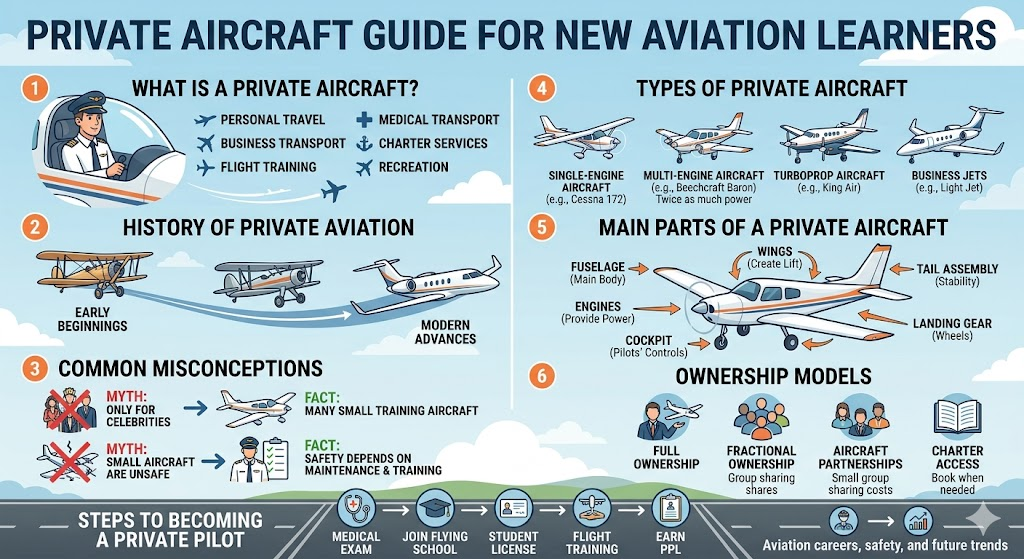
Private aircraft may be used for:
- Personal travel
- Business trips
- Flight training
- Medical transportation
- Charter services
- Aerial survey
- Tourism
- Recreation
History of Private Aviation
Private aviation started when early aircraft became available for personal and business use. In the beginning, flying was limited to trained pilots, aviation pioneers, and wealthy individuals. Over time, aircraft became safer, more reliable, and more practical for training, travel, and business.
The growth of general aviation helped more people learn to fly. Small aircraft became popular for pilot training, local travel, and recreational flying. Later, business jets and turboprops gave companies a faster and more flexible way to travel.
Today, private aviation includes everything from small single-engine training aircraft to advanced long-range business jets.
Types of Private Aircraft
Private aircraft come in different sizes, designs, and performance levels. Each type is used for different needs.
Single-Engine Aircraft
Single-engine aircraft have one engine and are commonly used for flight training, personal flying, and short-distance travel.
Examples include:
- Cessna 172
- Piper Archer
These aircraft are popular because they are easier to operate, suitable for beginners, and widely used in flying schools.
Multi-Engine Aircraft
Multi-engine aircraft have two or more engines. They offer better performance, more power, and additional training value for pilots who want to move toward professional aviation.
Examples include:
- Beechcraft Baron
- Piper Seneca
These aircraft are often used for advanced pilot training, private travel, and business flying.
Turboprop Aircraft
Turboprop aircraft use turbine engines connected to propellers. They are useful for regional travel, short runways, and efficient operations.
Examples include:
- Pilatus PC-12
- King Air Series
Turboprops are popular in private aviation because they combine good speed, reliability, and runway flexibility.
Light Jets
Light jets are small jet aircraft used for business and private travel. They are faster than piston aircraft and suitable for short to medium-distance routes.
Examples include:
- Cessna Citation Series
- Embraer Phenom Series
Light jets are often used by business travelers, charter companies, and private owners.
Midsize and Large Business Jets
Midsize and large business jets are designed for longer distances, more passengers, and better cabin comfort.
Examples include:
- Gulfstream Series
- Bombardier Challenger Series
These aircraft are commonly used by companies, high-net-worth individuals, charter operators, and long-distance business travelers.
Common Uses of Private Aircraft
Private aircraft are used for many practical purposes, not just luxury travel.
Personal Travel
Individuals may use private aircraft for flexible travel, family trips, or reaching locations that are not easily connected by airlines.
Business Transportation
Companies use private aircraft to save time, visit multiple cities, and support executive travel.
Flight Training
Many flying schools use private aircraft such as single-engine trainers to teach student pilots.
Medical Transportation
Private aircraft can support air ambulance services, patient transfers, and urgent medical travel.
Charter Operations
Charter companies provide private aircraft access without ownership. Customers can book aircraft for specific trips.
Tourism and Recreation
Private aircraft are also used for sightseeing, adventure travel, and recreational flying.
Main Parts of a Private Aircraft
Private aircraft have several important parts that work together for safe flight.
Fuselage
The fuselage is the main body of the aircraft. It holds passengers, pilots, cargo, and important systems.
Wings
Wings create lift and help the aircraft fly. They may also contain fuel tanks and control surfaces.
Engines
Engines provide power and thrust. Private aircraft may use piston engines, turboprop engines, or jet engines.
Cockpit
The cockpit is where pilots control the aircraft. It includes instruments, controls, communication equipment, and navigation systems.
Landing Gear
Landing gear includes the wheels and support structure used during takeoff, landing, and taxiing.
Tail Assembly
The tail assembly helps control stability and direction during flight.
How Private Aircraft Fly
Private aircraft fly using the same basic forces as other airplanes.
Lift
Lift is the upward force created mainly by the wings. It helps the aircraft rise and stay in the air.
Weight
Weight is the downward force caused by gravity. The aircraft must create enough lift to overcome weight.
Thrust
Thrust is the forward force produced by the engine or engines. It moves the aircraft through the air.
Drag
Drag is air resistance that slows the aircraft. Aircraft are designed to reduce drag and fly efficiently.
When these forces are managed correctly, the aircraft can take off, climb, cruise, descend, and land safely.
Private Aircraft Ownership Models
Private aircraft can be accessed or owned in different ways.
Full Ownership
Full ownership means one person or company owns the aircraft completely. This gives maximum control but also includes full responsibility for maintenance, insurance, storage, crew, and operations.
Fractional Ownership
Fractional ownership allows multiple owners to share an aircraft or aircraft program. Each owner gets access based on their share. It can reduce the burden of full ownership.
Aircraft Partnerships
In aircraft partnerships, a small group of people jointly own and manage an aircraft. Costs and usage are shared among partners.
Aircraft Leasing
Leasing allows individuals or companies to use an aircraft for a fixed period without purchasing it fully. It may be useful for business or temporary aviation needs.
Charter Access Programs
Charter programs allow users to book private aircraft when needed. This is suitable for people who do not want ownership responsibilities.
Costs Associated With Private Aircraft
Private aircraft involve several cost categories. The total cost depends on aircraft type, usage, location, maintenance, and operating model.
Common cost areas include:
- Aircraft purchase cost
- Fuel expenses
- Maintenance
- Insurance
- Hangar or parking fees
- Pilot training
- Crew salary if required
- Navigation and airport charges
- Inspection and compliance costs
- Engine and parts replacement
- Interior and avionics upgrades
For new learners, it is important to understand that aircraft ownership includes ongoing responsibility, not just purchase price.
Advantages of Private Aircraft
Private aircraft offer several benefits depending on the user’s needs.
Key advantages include:
- Flexible travel schedule
- Time savings
- Access to smaller airports
- Privacy
- Convenience
- Business productivity
- Direct routing options
- Better control over travel planning
- Useful for remote locations
For businesses, private aircraft can save time when multiple meetings or locations are involved.
Limitations of Private Aircraft
Private aircraft also have limitations that learners should understand.
Common limitations include:
- Higher operating costs
- Maintenance responsibility
- Weather limitations
- Pilot qualification requirements
- Regulatory compliance
- Insurance requirements
- Limited passenger capacity in smaller aircraft
- Need for proper storage and inspections
Private aviation offers flexibility, but it also requires serious planning and safety discipline.
Private Aircraft Safety
Private aircraft safety depends on proper training, maintenance, planning, and regulatory compliance. Small aircraft are not automatically unsafe. Safety depends on how well the aircraft is maintained and operated.
Important safety factors include:
- Qualified pilots
- Regular aircraft maintenance
- Pre-flight inspections
- Weather planning
- Flight planning
- Communication with air traffic control when required
- Proper training
- Emergency procedure awareness
- Compliance with aviation rules
Good safety culture is essential in private aviation.
How to Become a Private Pilot
Students who want to fly private aircraft can follow a structured training path.
Step 1: Meet Eligibility Requirements
Check the minimum age, education, language, and medical requirements based on aviation authority rules.
Step 2: Complete Medical Examination
A medical examination confirms that the student is fit to fly. This should be done before major training investment.
Step 3: Join a Flying School
Choose a flying school with approval, qualified instructors, good aircraft availability, safety standards, and transparent fees.
Step 4: Obtain Student Pilot License
A Student Pilot License allows the student to begin formal flight training under approved conditions.
Step 5: Complete Flight Training
Students learn aircraft handling, takeoff, landing, navigation, emergency procedures, communication, and flight safety.
Step 6: Earn Private Pilot License
After completing required training, exams, and checks, students can earn a Private Pilot License and fly under license privileges.
Career Opportunities Related to Private Aviation
Private aviation supports many career options. Students interested in aviation can explore roles beyond airline flying.
Career opportunities include:
- Private pilot
- Flight instructor
- Charter pilot
- Corporate pilot
- Aircraft maintenance technician
- Aircraft management professional
- Aviation consultant
- Flight operations coordinator
- Air ambulance pilot
- Aviation safety officer
Private aviation can be a strong career field for those interested in business aviation, training, and specialized flying.
Future of Private Aviation
Private aviation is changing with new technology and sustainability goals.
Future trends include:
- Sustainable aviation fuel
- Electric aircraft research
- Hybrid aircraft development
- Advanced avionics
- Smart navigation systems
- Better safety monitoring
- Improved fuel efficiency
- Digital flight planning tools
- Cleaner aircraft technologies
The future of private aviation will focus on safer, smarter, and more efficient flying.
Private Aircraft vs Commercial Aircraft
Private aircraft and commercial aircraft serve different purposes.
| Factor | Private Aircraft | Commercial Aircraft |
|---|---|---|
| Main Purpose | Personal, business, training, charter flying | Airline passenger and cargo transport |
| Passenger Capacity | Usually smaller | Usually larger |
| Flexibility | High | Fixed schedules and routes |
| Ownership | Individuals, companies, schools, operators | Airlines or aviation companies |
| Airport Access | Can use smaller airports | Usually uses major airports |
| Cost | Higher per passenger | Lower per passenger on scheduled routes |
| Privacy | High | Shared passenger cabin |
| Operation Style | Customized trips | Scheduled operations |
Private aircraft are best for flexibility and personalized travel, while commercial aircraft are best for mass transportation.
How Aircrafto.com Helps Aviation Learners
Aircrafto.com can help new aviation learners understand aircraft types, flying basics, private aviation, commercial aircraft, aircraft systems, and aviation career paths. Beginners need simple explanations because aviation can feel technical at first.
Aircrafto.com can support learners with:
- Aircraft basics
- Aviation learning guides
- Aircraft comparisons
- Pilot career guidance
- Private aviation education
- Aviation industry trends
- Beginner-friendly aircraft knowledge
Common Misconceptions About Private Aircraft
There are many myths about private aircraft. New learners should understand the facts.
Common misconceptions include:
- Private aircraft are only for celebrities
- Private aviation always means luxury jets
- Small aircraft are automatically unsafe
- Private pilots do not need serious training
- Private aircraft do not follow rules
- Owning an aircraft is only about buying it
- All private aircraft are expensive jets
- Private flying does not need planning
In reality, private aviation includes training aircraft, business aircraft, medical aircraft, charter aircraft, and recreational aircraft.
Frequently Asked Questions
1- What is a private aircraft?
A private aircraft is an aircraft used for personal, business, training, charter, or non-airline purposes. It may be owned by individuals, companies, flying schools, or aviation operators.
2- How is a private aircraft different from a commercial aircraft?
Private aircraft are usually used for flexible personal, business, training, or charter flying. Commercial aircraft are mainly used by airlines to carry passengers or cargo on scheduled routes.
3- Can anyone own a private aircraft?
A person or company can own a private aircraft if they meet legal, financial, operational, and regulatory requirements. Ownership also includes maintenance, insurance, storage, and compliance responsibilities.
4- What is the most common training aircraft?
The Cessna 172 is one of the most common training aircraft used by flying schools. It is popular because it is reliable, beginner-friendly, and widely available.
5- Are private aircraft safe?
Private aircraft can be safe when they are properly maintained, operated by trained pilots, and flown under good weather planning and aviation rules. Safety depends on training, maintenance, and responsible operation.
6- How do private pilots get licensed?
Private pilots usually complete eligibility checks, medical examination, ground school, flight training, exams, and practical flight checks before earning a Private Pilot License.
7- What are the main operating costs?
Main operating costs include fuel, maintenance, insurance, hangar fees, inspections, pilot training, airport charges, and parts replacement. Costs vary depending on aircraft type and usage.
8- What is fractional ownership?
Fractional ownership allows multiple owners to share access to an aircraft or aircraft program. It can reduce the burden of full ownership while still providing private aircraft access.
9- What is general aviation?
General aviation includes civil aviation activities outside scheduled airline and military operations. It covers private flying, flight training, business aviation, charter flying, aerial survey, and medical transport.
10- Is private aviation growing?
Private aviation continues to evolve with business travel needs, flight training demand, charter access, advanced avionics, and new aircraft technologies. Growth may vary by region and market conditions.
Conclusion
Private aircraft are an important part of aviation and offer much more than luxury travel. They support flight training, business transportation, medical services, charter operations, tourism, and personal flying. For new aviation learners, understanding private aircraft builds a strong foundation in general aviation and helps explain how different aircraft types serve different needs. Private aviation also offers many career opportunities for pilots, technicians, instructors, and aviation professionals. By learning the basics of aircraft types, ownership models, costs, safety, and flying principles, beginners can explore aviation with more confidence. Aircrafto.com can continue guiding learners with simple, practical, and educational aviation content.

