
Introduction
Aircraft are one of the most important inventions in modern transportation. They help people travel across countries, move goods quickly, support defense operations, rescue people during emergencies, assist in agriculture, and make scientific exploration possible. From small training airplanes to large passenger jets, helicopters, cargo aircraft, drones, and gliders, aircraft come in many forms and serve many purposes.
For beginners, the idea of how a heavy machine flies in the sky may seem confusing. However, aircraft work because of basic principles of physics, engineering, aerodynamics, and control. Every aircraft needs a way to create lift, move forward, stay balanced, and be controlled safely. Once you understand the main parts of an aircraft and the four forces of flight, the working of aircraft becomes much easier to understand.
This guide explains what an aircraft is, how it works, what its main parts are, how pilots control it, and why aircraft are so important in daily life, business, defense, travel, and technology.
What Is an Aircraft?
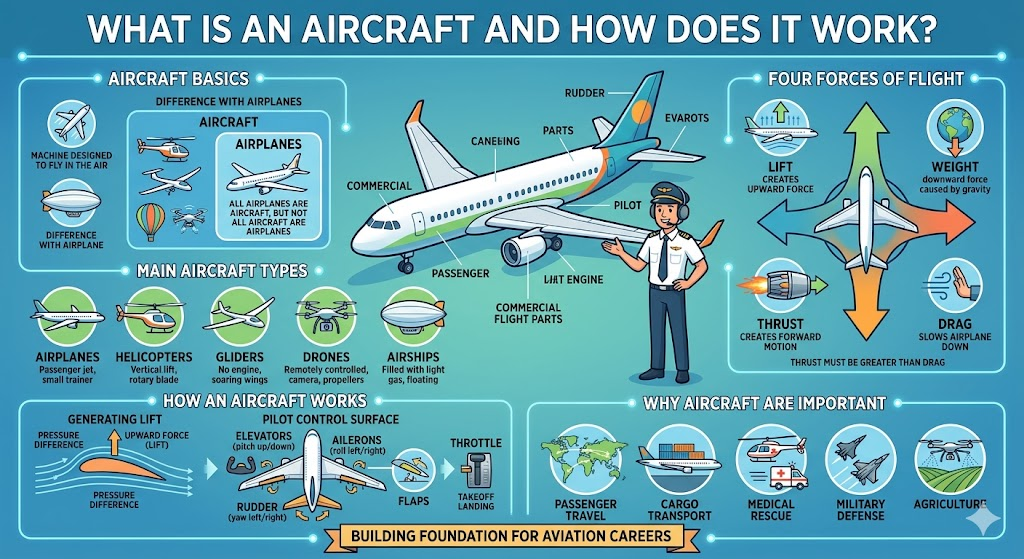
An aircraft is any machine that is designed to fly through the air. It can fly by using lift, thrust, and control systems. Aircraft may be powered by engines, like airplanes and helicopters, or they may fly without engines, like gliders and balloons.
In simple words, an aircraft is a flying machine. It can carry people, goods, equipment, cameras, weapons, sensors, or scientific instruments. Some aircraft are operated by pilots, while others are unmanned and controlled remotely or by computer systems.
Aircraft can be grouped in many ways:
- Powered aircraft such as airplanes, helicopters, and drones
- Unpowered aircraft such as gliders and balloons
- Fixed-wing aircraft such as airplanes
- Rotary-wing aircraft such as helicopters
- Manned aircraft operated by pilots onboard
- Unmanned aircraft such as drones
The word aircraft is a broad term. It includes airplanes, helicopters, drones, gliders, airships, balloons, seaplanes, and many other flying machines.
Basic Definition of Aircraft
A beginner-friendly definition of aircraft is:
An aircraft is a machine that can fly in the air by using lift and control systems to move, balance, and stay airborne.
Many people use the words aircraft and airplane as if they mean the same thing, but they are not exactly the same. An airplane is only one type of aircraft. Aircraft is the larger category.
For example:
- An airplane is an aircraft with fixed wings and engines.
- A helicopter is an aircraft with rotating blades.
- A glider is an aircraft that flies without an engine.
- A drone is an unmanned aircraft.
- An airship is an aircraft that floats using lighter-than-air gas.
So, all airplanes are aircraft, but not all aircraft are airplanes.
Main Types of Aircraft
Aircraft are designed for different purposes. Some are made for passenger travel, some for cargo, some for training, some for defense, and some for special missions. Below are the main types of aircraft explained in simple language.
1- Airplanes
Airplanes are fixed-wing aircraft. They have wings that stay in one position and engines that provide forward motion. As the airplane moves forward, air flows over the wings and creates lift.
Airplanes are commonly used for:
- Passenger travel
- Cargo transport
- Pilot training
- Business aviation
- Military operations
- Tourism and charter flights
Airplanes can be small, like two-seat training aircraft, or very large, like commercial passenger jets.
2- Helicopters
Helicopters are rotary-wing aircraft. Instead of fixed wings, they use rotating blades called rotors to create lift. Because of this design, helicopters can take off and land vertically.
Helicopters are useful for:
- Rescue missions
- Medical emergencies
- Military operations
- News coverage
- Police work
- Tourism flights
- Remote area transport
A major advantage of helicopters is that they do not need long runways like airplanes.
3- Gliders
Gliders are aircraft that fly without engines. They are usually launched by another aircraft, a winch, or from a high location. Once in the air, they use rising air currents and aerodynamic design to stay airborne.
Gliders are used for:
- Flight training
- Recreational flying
- Aerodynamics learning
- Sport aviation
Gliders teach pilots how to understand air movement, lift, control, and smooth flying.
4- Drones
Drones are unmanned aircraft. They may be controlled remotely by a human operator or fly using programmed instructions. Drones can be small enough to fit in a bag or large enough for professional and military operations.
Drones are used for:
- Photography
- Video recording
- Delivery testing
- Agriculture monitoring
- Security inspection
- Mapping
- Disaster response
- Military surveillance
Drones are becoming more popular because they are flexible, affordable, and useful in many industries.
5- Airships
Airships are lighter-than-air aircraft. They float because they are filled with gas that is lighter than air. Unlike balloons, many airships have engines and steering systems.
Airships are used for:
- Advertising
- Observation
- Research
- Tourism
- Special monitoring missions
They fly slowly compared to airplanes, but they can stay in the air for long periods.
6- Seaplanes
Seaplanes are aircraft that can take off from and land on water. They may have floats or a boat-like body. Seaplanes are useful in areas where normal runways are not available.
They are commonly used for:
- Island transport
- Remote tourism
- Rescue work
- Water-based travel
- Cargo movement in remote regions
Seaplanes are especially useful in coastal areas, lakes, and island destinations.
7- Military Aircraft
Military aircraft are designed for defense and combat-related missions. They may be fast, strong, heavily equipped, and built for special operations.
Military aircraft include:
- Fighter jets
- Transport aircraft
- Surveillance aircraft
- Refueling aircraft
- Military helicopters
- Trainer aircraft
They are used for defense, border protection, rescue missions, surveillance, and strategic operations.
8- Cargo Aircraft
Cargo aircraft are designed to carry goods instead of passengers. They have large storage areas, strong floors, and special loading systems.
Cargo aircraft are used for:
- E-commerce delivery
- International trade
- Medical supply transport
- Heavy equipment movement
- Disaster relief material delivery
They play a major role in global logistics.
9- Private Jets
Private jets are aircraft used for business travel, luxury travel, charter services, and personal transportation. They are usually smaller than commercial airliners but offer flexible scheduling and private travel.
Private jets are used by:
- Business executives
- Government officials
- Celebrities
- Charter customers
- Emergency travel users
They are valued for privacy, speed, and convenience.
10- Training Aircraft
Training aircraft are specially used to teach new pilots. They are usually simple, stable, and easy to control.
Training aircraft help students learn:
- Basic flying
- Takeoff and landing
- Navigation
- Emergency handling
- Aircraft control
- Communication with air traffic control
Most pilots begin their flying journey in small training aircraft.
Main Parts of an Aircraft
Every aircraft has many parts, but beginners should first understand the main components. Each part has a specific role in helping the aircraft fly safely.
Fuselage
The fuselage is the main body of the aircraft. It holds the cockpit, passengers, cargo, equipment, and other internal systems. In passenger aircraft, the cabin is inside the fuselage.
The fuselage must be strong, lightweight, and aerodynamic. It gives the aircraft its main structure and connects other parts such as wings, tail, and landing gear.
Wings
Wings are one of the most important parts of a fixed-wing aircraft. They help create lift, which allows the aircraft to rise into the air.
The shape of the wing is designed to control airflow. Wings may also contain fuel tanks, flaps, ailerons, and other systems.
Tail Section
The tail section helps keep the aircraft stable. It usually includes the vertical stabilizer and horizontal stabilizer.
The tail helps control:
- Direction
- Balance
- Stability
- Pitch movement
- Yaw movement
Without a proper tail design, an aircraft would be difficult to control.
Engine
The engine provides power to move the aircraft forward or rotate the helicopter blades. Aircraft engines may be piston engines, turboprop engines, jet engines, or electric motors.
Engines create thrust, which helps the aircraft overcome drag and move through the air.
Landing Gear
Landing gear includes wheels, struts, brakes, and support systems used during takeoff, landing, and ground movement. Some aircraft have fixed landing gear, while others have retractable landing gear that folds into the aircraft during flight.
Landing gear supports the weight of the aircraft on the ground.
Cockpit
The cockpit is where the pilot controls the aircraft. It contains instruments, controls, screens, communication equipment, navigation systems, and safety controls.
In modern aircraft, cockpits may include advanced digital displays and autopilot systems.
Control Surfaces
Control surfaces are movable parts that help control the aircraft. These include ailerons, elevators, rudders, flaps, and spoilers.
They help the aircraft turn, climb, descend, slow down, and stay balanced.
Fuel System
The fuel system stores and delivers fuel to the engine. In many airplanes, fuel is stored inside the wings. The system includes fuel tanks, pumps, valves, filters, and fuel lines.
A safe and reliable fuel system is essential for flight.
Avionics
Avionics are the electronic systems used in aircraft. These include navigation, communication, weather radar, flight displays, autopilot, and monitoring systems.
Modern avionics help pilots fly more safely and efficiently.
Propeller or Jet Engine
Some aircraft use propellers, while others use jet engines. A propeller pushes air backward to move the aircraft forward. A jet engine takes in air, compresses it, mixes it with fuel, burns it, and pushes high-speed exhaust backward to create thrust.
Both systems help the aircraft move forward.
How Does an Aircraft Work?
An aircraft works by managing four main forces of flight:
- Lift
- Weight
- Thrust
- Drag
These four forces decide whether an aircraft can take off, climb, cruise, descend, or land.
Lift
Lift is the upward force that helps an aircraft rise into the air. In airplanes, lift is mainly created by the wings. When air flows over and under the wing, the wing shape helps create pressure differences and upward force.
Without lift, an aircraft cannot fly.
Weight
Weight is the downward force caused by gravity. It includes the weight of the aircraft, passengers, cargo, fuel, and equipment.
For an aircraft to take off, lift must become greater than weight.
Thrust
Thrust is the forward force created by engines or propellers. It moves the aircraft through the air.
Thrust helps the aircraft gain speed, and speed helps the wings create lift.
Drag
Drag is the air resistance that slows the aircraft down. It works opposite to thrust. Aircraft are designed with smooth shapes to reduce drag and improve efficiency.
For smooth flight, thrust must balance or overcome drag.
How Aircraft Generate Lift
Aircraft wings are shaped to help air move smoothly around them. This wing shape is called an airfoil. When the aircraft moves forward, air flows over and under the wing.
The wing shape and angle of attack help create lift. The angle of attack is the angle between the wing and the incoming air. If the angle is correct, the wing creates lift efficiently. If the angle becomes too high, airflow can separate from the wing and cause a stall.
Lift depends on several factors:
- Wing shape
- Airspeed
- Wing size
- Angle of attack
- Air density
- Aircraft weight
This is why aircraft need enough speed before takeoff. As speed increases, airflow over the wings increases, and lift becomes strong enough to raise the aircraft into the air.
How Aircraft Move Forward
Aircraft move forward using thrust. Thrust is produced by engines.
There are two common engine systems used in many aircraft:
Propeller Engines
A propeller engine spins blades that push air backward. As air is pushed backward, the aircraft moves forward. Propeller aircraft are often used for training, short-distance travel, agriculture, and smaller airports.
Propeller aircraft are usually efficient at lower speeds and shorter distances.
Jet Engines
Jet engines are used in many commercial airliners and military jets. A jet engine pulls in air, compresses it, mixes it with fuel, burns the mixture, and pushes hot gases backward at high speed. This creates strong forward thrust.
Jet engines are powerful and suitable for high-speed and long-distance flying.
How Aircraft Are Controlled
Pilots control aircraft using several controls and control surfaces. These controls help the aircraft move in three main ways: roll, pitch, and yaw.
Roll
Roll is the movement where one wing goes up and the other wing goes down. Pilots control roll using ailerons, which are located on the wings.
When the pilot moves the control yoke or stick left or right, the ailerons move and help the aircraft turn.
Pitch
Pitch is the up-and-down movement of the aircraft nose. Pilots control pitch using the elevator, which is located on the tail.
When the nose moves up, the aircraft climbs. When the nose moves down, the aircraft descends.
Yaw
Yaw is the left-right movement of the aircraft nose. Pilots control yaw using the rudder, which is located on the vertical tail.
The rudder is controlled using foot pedals in the cockpit.
Flaps
Flaps are located on the wings and are used during takeoff and landing. They increase lift at lower speeds and help the aircraft land safely.
Throttle
The throttle controls engine power. More throttle increases thrust, while less throttle reduces thrust.
Control Yoke or Stick
The control yoke or stick allows the pilot to control pitch and roll. It is one of the main flight controls in the cockpit.
Pedals
Pedals control the rudder and help manage yaw. They are also used during ground movement in some aircraft.
How Aircraft Take Off
Takeoff is the process of moving from the ground into the air. It happens in several steps.
First, the aircraft lines up on the runway. The pilot increases engine power using the throttle. As the aircraft moves forward, it gains speed. Air starts flowing faster over the wings, and lift increases.
When the aircraft reaches the correct takeoff speed, the pilot gently raises the nose. This action is called rotation. As lift becomes greater than weight, the aircraft leaves the runway and begins climbing.
A typical takeoff includes:
- Runway alignment
- Engine power increase
- Acceleration
- Lift generation
- Rotation
- Initial climb
- Landing gear retraction if applicable
Takeoff requires careful speed control, engine monitoring, runway awareness, and communication with air traffic control.
How Aircraft Fly in the Air
Once in the air, the aircraft must maintain balance, speed, direction, and altitude. During normal flight, lift balances weight, and thrust balances drag.
Pilots manage:
- Altitude
- Speed
- Direction
- Engine power
- Fuel usage
- Weather conditions
- Navigation
- Air traffic instructions
Modern aircraft often use autopilot systems during cruise flight. However, pilots still monitor the aircraft, communicate with air traffic control, manage systems, and handle changes in weather or flight route.
Aircraft are designed to be stable in the air. The wings, tail, control surfaces, engine placement, and weight balance all work together to keep the aircraft flying smoothly.
How Aircraft Land
Landing is the process of bringing the aircraft safely back to the ground. It requires planning, speed control, altitude control, and accurate runway alignment.
During landing, the pilot reduces engine power and begins descending. Flaps are usually extended to increase lift at slower speeds. The landing gear is lowered if it is retractable.
As the aircraft approaches the runway, the pilot controls speed and descent rate. Just before touchdown, the pilot slightly raises the nose to reduce descent speed. This is called the flare.
After touchdown, the aircraft slows down using brakes, aerodynamic drag, reverse thrust in some aircraft, and runway distance.
A typical landing includes:
- Descent planning
- Approach setup
- Speed reduction
- Flap extension
- Landing gear lowering
- Runway alignment
- Touchdown
- Braking
- Taxiing to parking area
Landing is one of the most important skills in aviation training.
Difference Between Aircraft and Airplane
The difference between aircraft and airplane is simple.
An aircraft is any machine that can fly through the air. An airplane is a specific type of aircraft with fixed wings and engines.
Examples of aircraft include:
- Airplanes
- Helicopters
- Drones
- Gliders
- Balloons
- Airships
- Seaplanes
Examples of airplanes include:
- Passenger jets
- Training airplanes
- Cargo planes
- Private jets
- Fighter jets
So, all airplanes are aircraft, but helicopters, drones, and gliders are also aircraft even though they are not airplanes.
Why Aircraft Are Important
Aircraft are important because they make fast transportation possible. They connect people, cities, countries, businesses, and emergency services.
Passenger Travel
Aircraft allow people to travel long distances in a short time. Air travel supports tourism, education, business, family travel, and international movement.
Cargo Transport
Cargo aircraft move goods quickly across the world. They support global trade, e-commerce, medical supply chains, and emergency deliveries.
Medical Rescue
Aircraft, especially helicopters and air ambulances, help transport patients quickly during medical emergencies. They are useful in remote areas, accident zones, and disaster situations.
Military Defense
Military aircraft support national defense, border security, surveillance, transport, and rescue missions.
Pilot Training
Training aircraft help students learn flying skills and prepare for aviation careers.
Disaster Response
Aircraft can deliver food, medicine, rescue teams, and emergency supplies to affected areas during floods, earthquakes, storms, and other disasters.
Agriculture
Aircraft and drones are used in agriculture for crop monitoring, spraying, mapping, and land inspection.
Research and Exploration
Aircraft help scientists study weather, forests, oceans, wildlife, and the atmosphere.
Tourism
Helicopters, seaplanes, and small aircraft are often used for sightseeing and adventure tourism.
Business Travel
Private and business aircraft help companies save time and reach multiple locations efficiently.
Common Aircraft Terms for Beginners
Altitude
Altitude means the height of the aircraft above sea level or ground level.
Airspeed
Airspeed is the speed of the aircraft through the air.
Runway
A runway is a long prepared surface used by aircraft for takeoff and landing.
Taxiing
Taxiing means moving the aircraft on the ground before takeoff or after landing.
Takeoff
Takeoff is when an aircraft leaves the ground and starts flying.
Landing
Landing is when an aircraft returns safely to the ground.
Cockpit
The cockpit is the area where pilots control the aircraft.
Cabin
The cabin is the area where passengers sit.
Wing
The wing is the part of an aircraft that helps create lift.
Engine
The engine provides power and thrust for the aircraft.
Flight Control
Flight controls help pilots manage direction, altitude, and movement.
Autopilot
Autopilot is a system that helps control the aircraft automatically during certain parts of flight.
Aircraft Safety Basics
Aircraft safety is based on strict rules, training, maintenance, technology, and monitoring. Aviation is highly regulated because safety is the top priority.
Several things help make aircraft safe:
- Proper pilot training
- Regular maintenance checks
- Aircraft inspections
- Air traffic control guidance
- Weather monitoring
- Navigation systems
- Communication systems
- Emergency procedures
- Safety checklists
- Reliable aircraft design
Before every flight, pilots and maintenance teams check important systems. During flight, pilots monitor instruments, fuel, engine performance, weather, and air traffic instructions.
Aircraft are also designed with backup systems. Many important systems have secondary or emergency support so that the aircraft can remain safe if one system has a problem.
Future of Aircraft Technology
Aircraft technology is improving quickly. Modern aviation is becoming more efficient, cleaner, smarter, and more automated.
Some important trends include:
Electric Aircraft
Electric aircraft use electric motors instead of traditional fuel-powered engines. They may help reduce noise and emissions, especially for short-distance flights.
Hybrid Engines
Hybrid aircraft use a combination of fuel engines and electric systems. This can improve fuel efficiency and reduce environmental impact.
Sustainable Aviation Fuel
Sustainable aviation fuel is being developed to reduce the carbon footprint of air travel.
Lightweight Materials
Modern aircraft use lightweight materials such as composites to reduce weight and improve fuel efficiency.
Advanced Cockpit Systems
Modern cockpits use digital displays, automation, navigation tools, and advanced safety systems to support pilots.
Drones and Unmanned Aircraft
Drones are becoming more important in delivery, inspection, agriculture, defense, mapping, and emergency response.
Automation and Smart Systems
Aircraft systems are becoming more intelligent. Automation helps with navigation, monitoring, performance management, and safety support.
Beginner’s Guide: How to Learn More About Aircraft
If you are new to aviation, there are many simple ways to start learning about aircraft.
You can begin with:
- Reading beginner aviation guides
- Learning the main parts of aircraft
- Studying the four forces of flight
- Watching educational aircraft videos
- Visiting aviation museums
- Reading pilot training basics
- Learning about airport operations
- Exploring flight simulators
- Understanding weather basics
- Joining aviation courses or workshops
If you are interested in becoming a pilot, aircraft mechanic, aerospace engineer, drone operator, or aviation professional, learning aircraft basics is the first step.
FAQs
1- What is an aircraft in simple words?
An aircraft is a machine that can fly through the air. It may use wings, rotors, gas, engines, or other systems to stay airborne. Airplanes, helicopters, drones, gliders, and airships are all examples of aircraft. In simple words, an aircraft is any flying machine designed to move through the sky.
2- What is the difference between an aircraft and an airplane?
Aircraft is a broad term that includes all flying machines. An airplane is one type of aircraft that has fixed wings and usually uses engines for forward movement. Helicopters, drones, gliders, and balloons are aircraft too, but they are not airplanes. So, every airplane is an aircraft, but every aircraft is not an airplane.
3- How does an aircraft fly?
An aircraft flies by using lift, thrust, weight, and drag. The wings create lift, the engine creates thrust, gravity creates weight, and air resistance creates drag. When lift becomes greater than weight and thrust overcomes drag, the aircraft can rise and move through the air.
4- What are the four forces of flight?
The four forces of flight are lift, weight, thrust, and drag. Lift pushes the aircraft upward, weight pulls it downward, thrust moves it forward, and drag slows it down. These four forces must be balanced properly for safe and stable flight.
5- What are the main parts of an aircraft?
The main parts of an aircraft include the fuselage, wings, tail section, engine, landing gear, cockpit, control surfaces, fuel system, and avionics. Each part has an important role. For example, wings create lift, engines provide thrust, and control surfaces help pilots guide the aircraft.
6- How do aircraft wings create lift?
Aircraft wings create lift by shaping and guiding airflow. As the aircraft moves forward, air flows over and under the wings. The wing shape and angle of attack help create an upward force. This force is called lift, and it allows the aircraft to rise into the air.
7- How does a pilot control an aircraft?
A pilot controls an aircraft using the control yoke or stick, pedals, throttle, and flight control surfaces. Ailerons control roll, elevators control pitch, and the rudder controls yaw. The throttle controls engine power, while flaps help during takeoff and landing.
8- What is the difference between a jet aircraft and a propeller aircraft?
A propeller aircraft uses spinning blades to push air backward and move forward. A jet aircraft uses a jet engine that pushes high-speed exhaust backward to create thrust. Propeller aircraft are often used for training and shorter flights, while jet aircraft are common for faster and longer-distance travel.
9- Are drones considered aircraft?
Yes, drones are considered aircraft because they are machines that fly through the air. Most drones are unmanned aircraft, meaning there is no pilot onboard. They may be controlled remotely or programmed to fly automatically. Drones are used in photography, agriculture, inspection, mapping, and security.
10- Why are aircraft important in modern life?
Aircraft are important because they make fast travel and transport possible. They help move passengers, cargo, medical supplies, rescue teams, military equipment, and research tools. Aircraft support tourism, business, defense, emergency response, agriculture, and global trade.
11- How does an aircraft take off?
An aircraft takes off by gaining speed on the runway. As it moves faster, air flows over the wings and creates lift. When the lift becomes strong enough, the pilot raises the nose of the aircraft and it leaves the ground. After takeoff, the aircraft climbs to a safe altitude.
12- How does an aircraft land?
An aircraft lands by reducing speed and descending toward the runway. The pilot uses flaps, landing gear, throttle, and control surfaces to manage the approach. Just before touchdown, the pilot gently raises the nose to reduce the landing impact. After landing, brakes and other systems slow the aircraft down.
Conclusion
Aircraft are powerful and useful flying machines that have changed the way people travel, trade, learn, explore, and respond to emergencies. An aircraft may be an airplane, helicopter, drone, glider, airship, or another type of flying machine. Although aircraft may look complex, their basic working principle depends on lift, weight, thrust, and drag. Wings create lift, engines create thrust, control surfaces guide movement, and pilots manage speed, direction, altitude, and safety. Understanding aircraft basics is helpful for students, travelers, aviation beginners, pilot trainees, and anyone curious about how flying machines work. As technology improves, aircraft will continue to become safer, cleaner, smarter, and more efficient for the future of aviation.

