
Introduction
Aircraft come in many shapes, sizes, and designs because every aircraft is built for a specific purpose. Some aircraft are designed to carry passengers across the world, while others are made for cargo transport, pilot training, rescue missions, defense, farming, tourism, research, or personal flying. A large passenger airplane, a rescue helicopter, a drone, a glider, and a hot air balloon may all look very different, but they all belong to the aircraft family.
For beginners, understanding aircraft types can make aviation easier and more interesting. Once you know how aircraft are classified, you can quickly understand why some aircraft need runways, why helicopters can hover, why drones are unmanned, and why gliders can fly without engines. This guide explains the different types of aircraft in simple language so students, aviation beginners, travelers, flying enthusiasts, and pilot trainees can understand the basics clearly.
What Is an Aircraft?
An aircraft is any machine that can fly through the air. It may fly using wings, rotors, engines, buoyancy, air currents, or a combination of these systems. Aircraft can be small or large, simple or highly advanced, manned or unmanned, powered or unpowered.
In simple words, an aircraft is a flying machine.
Aircraft include:
- Airplanes
- Helicopters
- Drones
- Gliders
- Balloons
- Airships
- Seaplanes
- Military aircraft
- Cargo aircraft
- Private jets
The term aircraft is broad. Many people think aircraft means only airplane, but that is not correct. An airplane is only one type of aircraft. Helicopters, drones, balloons, and gliders are also aircraft.
Why Are There Different Types of Aircraft?
Aircraft are designed differently because they do different jobs. A passenger airplane must carry many people safely and comfortably. A cargo aircraft must carry heavy goods. A helicopter must be able to take off vertically and land in tight spaces. A drone must fly without a pilot onboard. A glider must stay in the air without an engine.
Different aircraft are designed based on many factors, such as:
- Purpose of use
- Size and carrying capacity
- Speed requirement
- Flying range
- Engine type
- Wing design
- Takeoff and landing needs
- Passenger or cargo space
- Operating environment
- Maintenance cost
- Safety requirements
For example, a long-distance passenger aircraft needs powerful engines, large wings, a strong fuselage, and enough fuel capacity. A rescue helicopter needs rotors, hovering ability, and safe low-speed control. A drone needs lightweight construction, sensors, cameras, and remote-control systems.
This is why aviation has many aircraft categories.
Main Classification of Aircraft
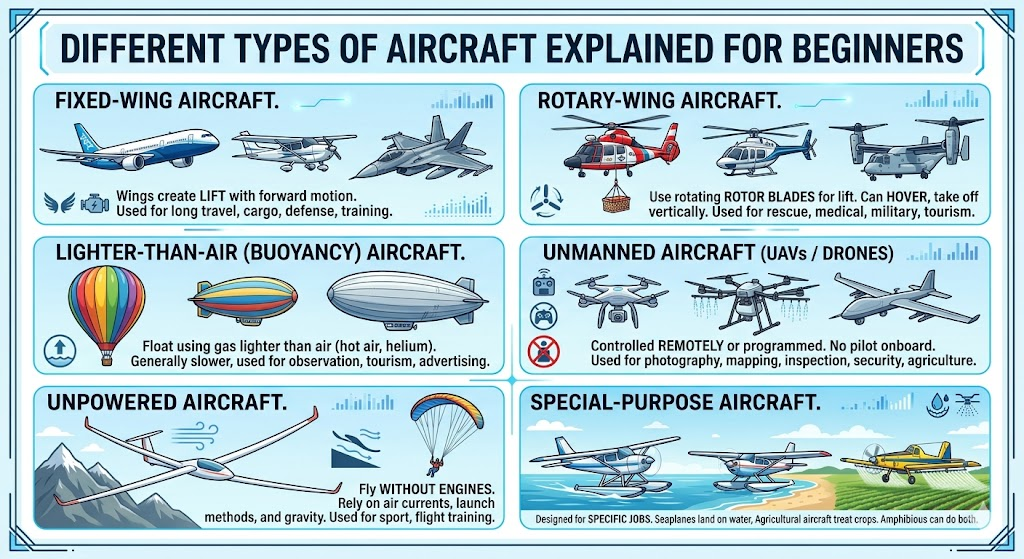
Aircraft can be classified in several ways. The most common classifications are fixed-wing aircraft, rotary-wing aircraft, lighter-than-air aircraft, unmanned aircraft, powered aircraft, and unpowered aircraft.
Fixed-Wing Aircraft
Fixed-wing aircraft have wings that remain in a fixed position. These wings create lift when air flows over them. Most fixed-wing aircraft need forward speed to fly and usually require a runway for takeoff and landing.
Common examples of fixed-wing aircraft include:
- Passenger airplanes
- Cargo aircraft
- Private jets
- Training aircraft
- Fighter jets
- Seaplanes
- Agricultural aircraft
Fixed-wing aircraft are commonly used for long-distance travel, cargo transport, pilot training, business travel, and defense.
Rotary-Wing Aircraft
Rotary-wing aircraft use rotating blades called rotors to create lift. Unlike fixed-wing airplanes, many rotary-wing aircraft can take off and land vertically. They can also hover in one place, which makes them very useful for rescue and special missions.
Common examples include:
- Helicopters
- Gyrocopters
- Tiltrotor aircraft
Rotary-wing aircraft are used for medical rescue, military work, tourism, police operations, firefighting, remote-area transport, and emergency response.
Lighter-Than-Air Aircraft
Lighter-than-air aircraft float because they use gases that are lighter than normal air. Instead of relying mainly on wings or rotors, they use buoyancy to stay in the sky.
Examples include:
- Balloons
- Airships
- Blimps
These aircraft are generally slower than airplanes, but they are useful for observation, tourism, advertising, research, and special missions.
Unmanned Aircraft
Unmanned aircraft do not carry a pilot onboard. They are controlled remotely or fly using programmed instructions. Drones are the most common example of unmanned aircraft.
Unmanned aircraft are used for:
- Photography
- Mapping
- Agriculture
- Inspection
- Security
- Delivery testing
- Disaster monitoring
- Military surveillance
- Industrial surveys
Drones have become popular because they are flexible, affordable, and useful in many industries.
Powered Aircraft
Powered aircraft use engines or motors to create movement. These engines help the aircraft move forward, rotate blades, or generate thrust.
Examples of powered aircraft include:
- Propeller aircraft
- Jet aircraft
- Turboprop aircraft
- Helicopters
- Powered drones
- Private jets
- Commercial airplanes
Powered aircraft are commonly used for passenger travel, cargo operations, training, rescue work, business aviation, and defense.
Unpowered Aircraft
Unpowered aircraft fly without engines. They depend on air currents, launch methods, gravity, or buoyancy to stay in the air.
Examples include:
- Gliders
- Sailplanes
- Balloons
Gliders use rising air currents to remain airborne. Balloons float because of hot air or lighter-than-air gas. These aircraft are often used for training, recreation, tourism, and aviation learning.
Detailed Types of Aircraft
1- Passenger Aircraft
Passenger aircraft are designed to carry people from one place to another. They are commonly used by airlines for domestic and international travel. These aircraft are built for safety, comfort, speed, and efficiency.
Passenger aircraft can be small regional airplanes or large long-distance airliners. Short-haul aircraft are used for shorter routes, medium-haul aircraft serve regional and cross-country routes, and long-haul aircraft are designed for long international flights.
Common features of passenger aircraft include:
- Passenger cabin
- Cockpit
- Wings
- Jet or turboprop engines
- Landing gear
- Navigation systems
- Safety equipment
- Baggage storage area
Passenger aircraft are important because they connect cities, countries, families, businesses, and travelers around the world.
2- Cargo Aircraft
Cargo aircraft are designed to carry goods instead of passengers. They are used for transporting packages, machinery, medical supplies, vehicles, mail, food products, and emergency relief materials.
Cargo aircraft usually have large cargo doors, strong floors, wide storage areas, and loading systems. Some cargo aircraft are specially built for freight, while others are converted from passenger airplanes.
Cargo aircraft are used by:
- Logistics companies
- E-commerce businesses
- Military transport units
- Medical supply chains
- Disaster relief agencies
- International trade operators
They play a major role in global shipping and emergency supply delivery.
3- Training Aircraft
Training aircraft are used to teach new pilots how to fly. They are usually smaller, simpler, stable, and easier to control than large commercial aircraft. Student pilots use them to learn basic flying skills step by step.
Training aircraft help students practice:
- Takeoff
- Landing
- Climbing
- Descending
- Turning
- Navigation
- Communication
- Emergency procedures
- Aircraft control
Many pilots begin their aviation journey in small training aircraft. These aircraft are designed to be reliable, forgiving, and suitable for learning.
4- Private Jets
Private jets are aircraft used for business travel, personal travel, charter services, and time-sensitive journeys. They are usually smaller than commercial passenger aircraft but offer more privacy, flexibility, and convenience.
Private jets are commonly used by:
- Business executives
- Entrepreneurs
- Government officials
- Celebrities
- Charter customers
- Medical travel users
The main advantage of private jets is flexibility. They can often operate from smaller airports and follow schedules based on passenger needs instead of airline timetables.
5- Fighter Aircraft
Fighter aircraft are military aircraft designed for speed, maneuverability, and defense operations. They are used by air forces for protection, surveillance, interception, and combat-related missions.
Fighter aircraft are usually fast, powerful, and highly advanced. They are designed to perform sharp turns, climb quickly, and operate in challenging environments.
Common roles of fighter aircraft include:
- Air defense
- Patrol missions
- Training missions
- Strategic operations
- Surveillance support
- Military protection
For beginners, fighter aircraft can be understood as high-performance military airplanes built for defense and tactical missions.
6- Helicopters
Helicopters are rotary-wing aircraft that use spinning rotor blades to create lift. Unlike airplanes, helicopters do not need long runways. They can take off vertically, land vertically, fly slowly, and hover in one place.
Helicopters are used for:
- Rescue missions
- Medical transport
- Tourism flights
- Police work
- Military operations
- Firefighting support
- News coverage
- Remote-area travel
The ability to hover makes helicopters extremely useful in emergencies. They can land in places where airplanes cannot, such as rooftops, mountains, forests, and small open spaces.
7- Seaplanes
Seaplanes are aircraft that can take off from and land on water. They are useful in areas where normal runways are not available. Some seaplanes have floats attached under the fuselage, while others have boat-like bodies.
Seaplanes are commonly used for:
- Island transport
- Lake travel
- Remote tourism
- Rescue missions
- Water-based sightseeing
- Cargo delivery to remote areas
They are especially useful in coastal regions, islands, lakes, rivers, and remote communities.
8- Gliders
Gliders are aircraft that fly without engines. They are usually launched into the air by another aircraft, a winch, or a slope. Once airborne, gliders use rising air currents to stay in the sky.
Gliders are commonly used for:
- Sport flying
- Flight training
- Aerodynamics learning
- Recreational aviation
- Student pilot experience
Gliding teaches pilots how to understand air movement, lift, control, and smooth flying. Because there is no engine, pilots must carefully manage altitude and air currents.
9- Drones
Drones are unmanned aircraft that can fly without a pilot onboard. They may be controlled remotely or programmed to follow a flight path. Drones can be small consumer devices or large professional systems.
Drones are used in many fields, including:
- Aerial photography
- Video production
- Agriculture monitoring
- Land mapping
- Building inspection
- Security monitoring
- Disaster assessment
- Delivery testing
- Military surveillance
Drones are becoming one of the fastest-growing aircraft categories because they are practical, affordable, and useful for tasks that may be risky or expensive for manned aircraft.
10- Airships and Balloons
Airships and balloons are lighter-than-air aircraft. They float because they use hot air or gas that is lighter than the surrounding air.
Balloons usually move with the wind and have limited steering ability. Airships, on the other hand, often have engines and can be steered more easily.
They are used for:
- Tourism
- Advertising
- Observation
- Research
- Aerial filming
- Special events
These aircraft are slower than airplanes, but they provide a unique flying experience and can stay in the air for long periods.
11- Agricultural Aircraft
Agricultural aircraft are used in farming and crop management. They are often small, strong, and designed to fly at low altitudes over fields.
They are used for:
- Crop spraying
- Fertilizer spreading
- Seed distribution
- Field inspection
- Pest control
- Crop monitoring
In modern farming, drones are also used as agricultural aircraft. They help farmers monitor crops, check soil conditions, and spray smaller areas with accuracy.
12- Amphibious Aircraft
Amphibious aircraft can operate on both land and water. They may have wheels for runway operations and floats or a boat-like body for water landings.
These aircraft are useful for:
- Island travel
- Remote area transport
- Rescue operations
- Tourism
- Coastal patrol
- Water-based cargo delivery
Amphibious aircraft are very flexible because they can use both runways and water surfaces.
13- Experimental Aircraft
Experimental aircraft are used for testing, research, innovation, and new aviation ideas. They may be built to test new materials, engines, wing designs, control systems, or flight concepts.
Experimental aircraft are important because they help improve aviation technology. Many future aircraft designs begin as experimental projects.
They are used for:
- Aerospace research
- Technology testing
- Flight design studies
- New engine testing
- Lightweight material testing
- Aviation education
Not all experimental aircraft are used commercially. Many are used in controlled testing environments.
14- Electric Aircraft
Electric aircraft use electric motors instead of traditional fuel-powered engines. Some are fully electric, while others use hybrid systems that combine electric motors with fuel-powered engines.
Electric aircraft are being explored for:
- Short-distance flights
- Training flights
- Urban air mobility
- Lower-noise operations
- Cleaner aviation
- Future regional transport
Electric aviation is still developing, but it has strong potential for reducing noise, improving efficiency, and supporting cleaner flight operations in the future.
Comparison Table of Different Types of Aircraft
| Aircraft Type | Main Purpose | How It Flies | Common Users | Best For |
|---|---|---|---|---|
| Passenger Aircraft | Carrying people | Fixed wings and engines | Airlines and travelers | Commercial air travel |
| Cargo Aircraft | Carrying goods | Fixed wings and engines | Logistics companies | Freight and supply transport |
| Training Aircraft | Pilot training | Fixed wings and propeller engines | Flight schools | Learning to fly |
| Private Jets | Personal and business travel | Jet engines and fixed wings | Business travelers | Flexible private travel |
| Fighter Aircraft | Defense operations | High-speed jet engines | Military forces | Air defense and tactical missions |
| Helicopters | Rescue and special missions | Rotating rotor blades | Rescue teams and military | Vertical takeoff and hovering |
| Seaplanes | Water-based travel | Fixed wings with floats or hull | Tourism and remote operators | Islands, lakes, and coastal areas |
| Gliders | Sport and training | Wings and air currents | Aviation learners and hobby pilots | Engine-free flying |
| Drones | Remote and unmanned tasks | Rotors or fixed wings | Businesses and operators | Photography, mapping, inspection |
| Airships and Balloons | Tourism and observation | Buoyancy | Tour operators and researchers | Slow scenic flying and observation |
Difference Between Aircraft, Airplane, and Helicopter
The terms aircraft, airplane, and helicopter are related, but they do not mean the same thing.
Aircraft
Aircraft is the broad category. It includes any machine that can fly through the air. Airplanes, helicopters, drones, gliders, balloons, and airships are all aircraft.
Airplane
An airplane is a fixed-wing aircraft. It uses wings to create lift and usually uses engines to move forward. Most airplanes need a runway for takeoff and landing.
Examples include:
- Passenger airplanes
- Cargo airplanes
- Training airplanes
- Private jets
- Fighter jets
Helicopter
A helicopter is a rotary-wing aircraft. It uses rotating blades instead of fixed wings. Helicopters can take off vertically, land vertically, and hover in one place.
Examples include:
- Rescue helicopters
- Medical helicopters
- Military helicopters
- Tourism helicopters
In simple words, aircraft is the main category, airplane is one type of aircraft, and helicopter is another type of aircraft.
How to Identify Different Aircraft Types
Beginners can identify aircraft types by looking at basic design features.
Wing Shape
Fixed-wing aircraft have wings that remain in place. Helicopters do not have fixed wings; they use rotor blades. Gliders usually have long, narrow wings.
Engine Position
Engines may be located under the wings, on the tail, in the nose, or above the aircraft body. Jet aircraft often have engines under the wings or near the rear. Propeller aircraft may have engines at the front.
Number of Engines
Some aircraft have one engine, while others have two, three, or four engines. Large commercial and cargo aircraft usually have multiple engines.
Size
Passenger aircraft and cargo aircraft are usually larger. Training aircraft and drones are usually smaller. Private jets can range from small to large depending on their use.
Tail Design
Different aircraft have different tail shapes. The tail helps with stability and control. Some military and private aircraft have unique tail designs.
Landing Gear
Normal aircraft use wheels for runways. Seaplanes may have floats. Amphibious aircraft may have both wheels and floats.
Rotor Blades
If an aircraft has large rotating blades on top, it is usually a helicopter. If it has multiple small rotors, it may be a drone.
Cabin or Cargo Layout
Passenger aircraft have seating cabins. Cargo aircraft have large storage areas and cargo doors. Private jets have smaller, more comfortable cabins.
Water Landing Floats
Aircraft with floats or boat-like bodies may be seaplanes or amphibious aircraft.
Military or Civilian Design
Military aircraft often look sharper, faster, and more compact. Civilian aircraft are usually designed for comfort, transport, training, or business use.
Which Type of Aircraft Is Best for Which Use?
Different aircraft are best suited for different needs.
Commercial Travel
Passenger aircraft are best for commercial travel because they can carry many people safely and efficiently over short, medium, and long distances.
Pilot Training
Training aircraft are best for student pilots because they are stable, simple, and suitable for learning basic flying skills.
Cargo Delivery
Cargo aircraft are best for transporting goods, packages, equipment, and emergency supplies over long distances.
Emergency Rescue
Helicopters are best for emergency rescue because they can hover, land in small spaces, and reach difficult locations quickly.
Business Travel
Private jets are best for business travel because they offer flexible scheduling, privacy, and access to smaller airports.
Tourism
Helicopters, seaplanes, balloons, and small aircraft are commonly used for tourism and sightseeing flights.
Agriculture
Agricultural aircraft and drones are best for crop spraying, field inspection, crop monitoring, and farm management.
Defense
Fighter aircraft, military helicopters, transport aircraft, and surveillance drones are used for defense and security missions.
Remote Area Transport
Seaplanes, helicopters, and amphibious aircraft are useful for remote areas where normal runways may not be available.
Aerial Photography
Drones and helicopters are commonly used for aerial photography, filming, inspection, and mapping.
Common Aircraft Terms for Beginners
Fixed-Wing
Fixed-wing means the aircraft has wings that stay in one position. Airplanes are fixed-wing aircraft.
Rotary-Wing
Rotary-wing means the aircraft uses rotating blades to create lift. Helicopters are rotary-wing aircraft.
Rotor
A rotor is a rotating blade system used by helicopters and some drones to create lift.
Fuselage
The fuselage is the main body of the aircraft. It holds passengers, cargo, cockpit, and equipment.
Cockpit
The cockpit is the area where the pilot controls the aircraft.
Cabin
The cabin is the area where passengers sit.
Cargo Hold
The cargo hold is the storage area used for luggage, packages, or freight.
Landing Gear
Landing gear includes wheels, struts, and support systems used during takeoff, landing, and ground movement.
Airframe
The airframe is the main structure of the aircraft, including the fuselage, wings, and tail.
Propeller
A propeller is a rotating blade system that pushes air backward to move the aircraft forward.
Jet Engine
A jet engine creates thrust by pushing high-speed exhaust gases backward.
Turboprop
A turboprop aircraft uses a turbine engine to drive a propeller. It is commonly used for regional flights and smaller aircraft.
UAV
UAV means unmanned aerial vehicle. It is another term for a drone or unmanned aircraft.
Lift
Lift is the upward force that helps an aircraft rise and stay in the air.
Thrust
Thrust is the forward force created by an engine or propeller.
Importance of Aircraft in Modern Life
Aircraft are important because they connect people, places, businesses, and emergency services. Different aircraft types support different parts of modern life.
Global Travel
Passenger aircraft allow people to travel between cities and countries quickly. They support tourism, education, family travel, and international business.
Trade and Logistics
Cargo aircraft help move goods across the world. They support online shopping, medical supply chains, manufacturing, and emergency deliveries.
Medical Emergencies
Helicopters and air ambulances can transport patients quickly during emergencies. They are especially useful in remote areas and accident locations.
Military Defense
Military aircraft protect airspace, support rescue missions, transport equipment, and assist in national security operations.
Disaster Response
Aircraft can deliver food, medicine, rescue teams, and emergency supplies during floods, earthquakes, storms, and other disasters.
Tourism
Helicopters, balloons, seaplanes, and small aircraft provide sightseeing and adventure travel experiences.
Agriculture
Agricultural aircraft and drones help farmers monitor crops, spray fields, and manage land more efficiently.
Research
Aircraft are used for weather studies, environmental monitoring, wildlife surveys, mapping, and scientific missions.
Education and Training
Training aircraft help future pilots, engineers, mechanics, and aviation professionals learn practical aviation skills.
Business Mobility
Private jets and business aircraft help professionals travel quickly and manage time-sensitive schedules.
Future of Aircraft Types
The future of aviation is moving toward cleaner, smarter, and more efficient aircraft. New technologies are changing how aircraft are designed and operated.
Electric Aircraft
Electric aircraft use electric motors and batteries. They may reduce noise and support cleaner short-distance flying.
Hybrid Aircraft
Hybrid aircraft combine traditional engines with electric systems. They may help improve fuel efficiency and reduce environmental impact.
Autonomous Drones
Autonomous drones can fly using programmed instructions and smart sensors. They may become more useful in delivery, inspection, agriculture, and emergency response.
Urban Air Mobility
Urban air mobility focuses on small aircraft that can carry people or goods within cities. These aircraft may use electric vertical takeoff and landing systems.
Sustainable Aviation Fuel
Sustainable aviation fuel is being developed to reduce the environmental impact of aviation.
Advanced Helicopters
Future helicopters may become faster, safer, quieter, and more efficient with improved rotor designs and advanced control systems.
Lightweight Materials
Aircraft manufacturers are using lighter materials to improve fuel efficiency and performance.
Smarter Cockpit Systems
Modern cockpit systems are becoming more digital, automated, and data-driven. These systems help pilots monitor flight information more clearly and safely.
FAQs
1- What are the main types of aircraft?
The main types of aircraft include airplanes, helicopters, drones, gliders, balloons, airships, seaplanes, cargo aircraft, passenger aircraft, training aircraft, private jets, and fighter aircraft. These aircraft are designed for different purposes such as travel, training, rescue, defense, cargo, tourism, and research.
2- What is the difference between an aircraft and an airplane?
Aircraft is a broad term for any machine that can fly through the air. An airplane is one type of aircraft that has fixed wings and usually uses engines for forward movement. Helicopters, drones, gliders, and balloons are also aircraft, but they are not airplanes.
3- Are helicopters considered aircraft?
Yes, helicopters are considered aircraft. They are rotary-wing aircraft because they use rotating blades to create lift. Helicopters are different from airplanes because they can take off vertically, land vertically, hover, and operate in smaller spaces.
4- Are drones considered aircraft?
Yes, drones are aircraft because they fly through the air. Most drones are unmanned aircraft, meaning they do not carry a pilot onboard. They can be controlled remotely or programmed to fly automatically for photography, inspection, mapping, agriculture, and security.
5- What is a fixed-wing aircraft?
A fixed-wing aircraft is an aircraft with wings that stay in a fixed position. These wings create lift when air flows over them. Airplanes, cargo aircraft, private jets, fighter jets, and training aircraft are common examples of fixed-wing aircraft.
6- What is a rotary-wing aircraft?
A rotary-wing aircraft uses rotating blades to create lift. Helicopters are the most common example. Rotary-wing aircraft are useful because they can hover, take off vertically, land vertically, and operate in places where normal runways are not available.
7- What type of aircraft is used for pilot training?
Training aircraft are used for pilot training. These aircraft are usually small, stable, simple to control, and suitable for beginners. Student pilots use them to learn takeoff, landing, turning, navigation, communication, and emergency procedures.
8- What type of aircraft is used for cargo transport?
Cargo aircraft are used for cargo transport. They are designed with large storage areas, strong floors, wide doors, and loading systems. Cargo aircraft carry goods, packages, medical supplies, machinery, and emergency relief materials across short and long distances.
9- What is the difference between a private jet and a passenger aircraft?
A private jet is usually used for personal, business, or charter travel with fewer passengers and flexible schedules. A passenger aircraft is generally used by airlines to carry many passengers on scheduled routes. Both are aircraft, but they serve different travel needs.
10- What are seaplanes used for?
Seaplanes are used for travel in areas with lakes, rivers, islands, and coastal regions. They can take off from and land on water. They are useful for tourism, remote area transport, rescue missions, and travel where normal runways are not available.
11- What is an unpowered aircraft?
An unpowered aircraft is an aircraft that flies without an engine. Gliders and balloons are common examples. Gliders use air currents to stay in the sky, while balloons float using hot air or lighter-than-air gas.
12- Which aircraft type is best for beginners to learn about?
Training aircraft are usually the best aircraft type for beginners to learn about because they are simple, stable, and easy to understand. Beginners can also study passenger aircraft, helicopters, drones, and gliders to understand the main differences between aircraft types.
Conclusion
Aircraft are designed in many different types because every flying machine has a different purpose. Passenger aircraft carry people, cargo aircraft move goods, training aircraft teach new pilots, helicopters support rescue missions, drones perform unmanned tasks, gliders fly without engines, and seaplanes operate on water. Understanding these aircraft types helps beginners see how aviation works in real life. Each aircraft has its own design, flying method, advantages, and best-use case. Whether you are a student, traveler, pilot trainee, aviation enthusiast, or general learner, knowing the different types of aircraft is a strong first step toward understanding the world of aviation. As technology continues to grow, aircraft will become cleaner, smarter, safer, and more useful across travel, business, defense, farming, research, and emergency response.

