
Introduction
Single-engine aircraft are the foundation of flight training for most aviation students across the world. These aircraft are designed with one engine, making them simpler, lighter, and more cost-effective compared to multi-engine aircraft. For aspiring pilots, they represent the first real step into the cockpit after simulator training and ground school.
For aviation students, understanding single-engine aircraft is not just about learning how to fly—it is about building core flying skills, confidence, and decision-making ability in real-world conditions. These aircraft are widely used in flight schools because they offer the perfect balance of safety, control, and learning efficiency.
In this guide, we will explore what single-engine aircraft are, how they work, their types, advantages, limitations, and why they are essential in pilot training.
What is a Single-Engine Aircraft?
A single-engine aircraft is an airplane powered by one engine, typically mounted at the front (tractor configuration) or sometimes at the rear (pusher configuration). This engine provides the thrust required to move the aircraft through the air.
Basic Working Concept
- The engine powers a propeller (in most training aircraft)
- The propeller generates thrust by pushing air backward
- Lift is generated by the wings as air flows over them
- Control surfaces (ailerons, elevator, rudder) guide the aircraft
Key Difference from Multi-Engine Aircraft
| Feature | Single-Engine Aircraft | Multi-Engine Aircraft |
|---|---|---|
| Engines | 1 | 2 or more |
| Complexity | Low | High |
| Cost | Affordable | Expensive |
| Maintenance | Easier | Complex |
| Training Use | Beginner level | Advanced level |
Single-engine aircraft are ideal for early-stage pilot training because they help students master basic flying principles without overwhelming systems.
Types of Single-Engine Aircraft
Single-engine aircraft come in different configurations depending on their design and purpose.
1. Piston Engine Aircraft
These are the most common training aircraft used in flight schools.
- Powered by a piston engine similar to car engines
- Uses aviation gasoline (Avgas)
- Best for beginner pilot training
- Easy to operate and maintain
2. Turboprop Single-Engine Aircraft
These aircraft use a turbine engine connected to a propeller.
- More powerful than piston aircraft
- Suitable for longer distances and higher performance
- Used in advanced training and utility roles
3. Trainer Aircraft
Specifically designed for student pilots.
- Dual controls for instructor and student
- Highly stable flight characteristics
- Forgiving handling for beginners
Why Aviation Students Start with Single-Engine Aircraft
Single-engine aircraft are the starting point for nearly every pilot because they offer a controlled learning environment.
Ease of Control
These aircraft respond predictably to control inputs, making them easier for beginners to handle.
Cost Efficiency
Operating a single-engine aircraft is significantly cheaper than multi-engine aircraft, making flight training more accessible.
Safety and Learning Environment
Their lower speed and simpler systems allow instructors to focus on teaching fundamental flying skills.
Skill Building Foundation
Students learn essential piloting skills such as:
- Takeoff and landing procedures
- Basic navigation
- Emergency handling
- Airspace awareness
Key Features Aviation Students Should Learn
Training in single-engine aircraft focuses on developing core aviation skills.
Flight Controls
- Yoke or Stick: Controls pitch and roll
- Rudder Pedals: Controls yaw movement
- Throttle: Controls engine power
Basic Aerodynamics
Students learn how airflow affects lift, drag, and stability.
Takeoff and Landing Techniques
- Proper runway alignment
- Speed control
- Flare technique during landing
Navigation Basics
- Reading flight maps
- Understanding headings
- Using basic instruments like compass and altimeter
Advantages of Single-Engine Aircraft Training
Single-engine aircraft provide several important benefits for aviation students.
Lower Operational Cost
Fuel consumption and maintenance costs are significantly lower.
Simple System Design
Fewer systems mean less complexity, making it easier to understand aircraft behavior.
Strong Skill Foundation
Students develop strong fundamentals before transitioning to advanced aircraft.
Wide Availability
Most flight schools around the world use single-engine trainers.
Limitations and Challenges
While single-engine aircraft are ideal for beginners, they do have limitations.
Limited Speed and Range
These aircraft are not designed for long-distance or high-speed travel.
Weather Sensitivity
Small aircraft are more affected by turbulence and weather conditions.
Payload Restrictions
They cannot carry heavy loads compared to larger aircraft.
Limited Advanced Systems
They lack complex avionics found in commercial aircraft.
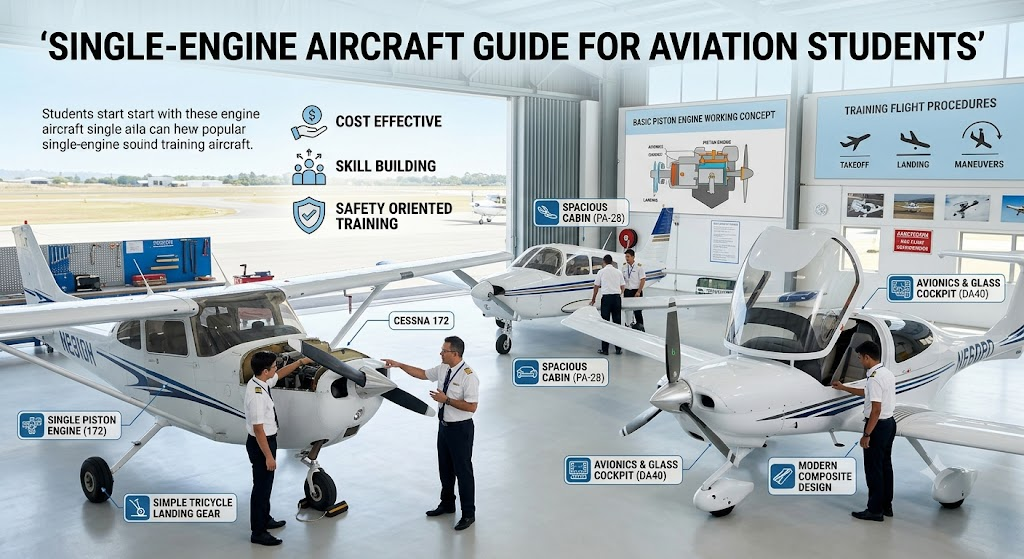
Popular Single-Engine Aircraft Used in Training
Cessna 172
One of the most widely used training aircraft in the world.
- Highly stable and reliable
- Easy handling for beginners
- Excellent visibility from cockpit
- Ideal for basic flight training
Piper PA-28
Another popular training aircraft used globally.
- Comfortable cockpit design
- Smooth handling characteristics
- Suitable for training and personal flying
Diamond DA40
A modern training aircraft with advanced features.
- Fuel-efficient design
- Glass cockpit instrumentation
- Lightweight composite structure
- Excellent safety record
Career Benefits for Aviation Students
Training on single-engine aircraft plays a crucial role in shaping a pilot’s career.
Strong Foundation for Advanced Training
Students transition more smoothly into complex aircraft later.
Better Understanding of Flight Dynamics
Hands-on experience builds strong conceptual knowledge.
Increased Confidence
Early exposure to real flying builds decision-making confidence.
Essential for Commercial Pilot License (CPL)
Most CPL programs begin with single-engine aircraft training before multi-engine endorsement.
Practical Learning Experience in Flight Schools
In real flight training environments, students experience:
- Pre-flight inspections
- Engine startup procedures
- Taxiing on runway
- Controlled takeoff and landing
- In-flight maneuvers like turns, climbs, and descents
- Emergency simulations
These exercises help students become disciplined and safety-conscious pilots.
Safety Aspects in Single-Engine Training
Safety is a major focus in aviation training.
- Dual-control systems allow instructors to take over if needed
- Strict maintenance schedules ensure aircraft reliability
- Pre-flight checks reduce technical risks
- Training is conducted in controlled airspace
Flight schools prioritize safety above all else, making single-engine aircraft ideal for learning.
Transition from Single-Engine to Multi-Engine Aircraft
Once students master single-engine flying, they move to multi-engine aircraft training.
Key Transition Skills
- Engine management differences
- Increased system complexity
- Advanced navigation techniques
- Higher workload handling
Single-engine training ensures this transition is smooth and structured.
Frequently Asked Questions (FAQs)
1. What is a single-engine aircraft in simple terms?
A single-engine aircraft is an airplane that uses only one engine to generate thrust and fly. It is commonly used in pilot training because it is simpler to operate and easier to understand for beginners.
2. Why are single-engine aircraft used for aviation students?
They are used because they are cost-effective, easier to control, and ideal for learning basic flying skills. Aviation students can focus on fundamentals like takeoff, landing, and navigation without complex systems.
3. Is flying a single-engine aircraft safe for beginners?
Yes, it is safe when training is conducted under certified flight instructors. These aircraft are designed for training, and strict safety procedures are followed during every flight session.
4. Which is the most popular single-engine training aircraft?
The Cessna 172 is the most widely used training aircraft in the world. It is known for its stability, reliability, and beginner-friendly handling.
5. What skills do students learn in single-engine aircraft training?
Students learn essential skills such as flight controls, takeoff and landing techniques, basic navigation, emergency handling, and understanding aircraft instruments.
6. How long does it take to learn flying a single-engine aircraft?
The duration varies depending on the training program and student progress, but basic single-engine training for a private pilot license typically takes several months of consistent practice.
7. Can a pilot fly commercial aircraft after single-engine training?
Yes, but single-engine training is just the first step. Pilots must complete further training, including multi-engine aircraft and commercial pilot license (CPL) requirements.
8. What are the main limitations of single-engine aircraft?
They have limited speed, range, and payload capacity. They are also more affected by weather conditions compared to larger, multi-engine aircraft.
9. Do all pilots start with single-engine aircraft?
In most flight training programs, yes. Almost every pilot begins their journey with single-engine aircraft to build strong foundational flying skills.
10. What makes single-engine aircraft ideal for learning?
Their simple design, predictable handling, lower operating cost, and strong safety record make them the best choice for beginner pilot training.
Conclusion
Single-engine aircraft are the backbone of aviation training and play a vital role in shaping future pilots. For aviation students, these aircraft provide the perfect balance of simplicity, safety, and practical learning experience.
From mastering basic flight controls to understanding aerodynamics and navigation, single-engine aircraft build the essential foundation required for a successful aviation career. While they may have limitations in speed and capacity, their importance in pilot education cannot be overstated.
For any aspiring pilot, beginning with single-engine aircraft is not just a requirement—it is the first step toward becoming a confident and skilled aviator.

