
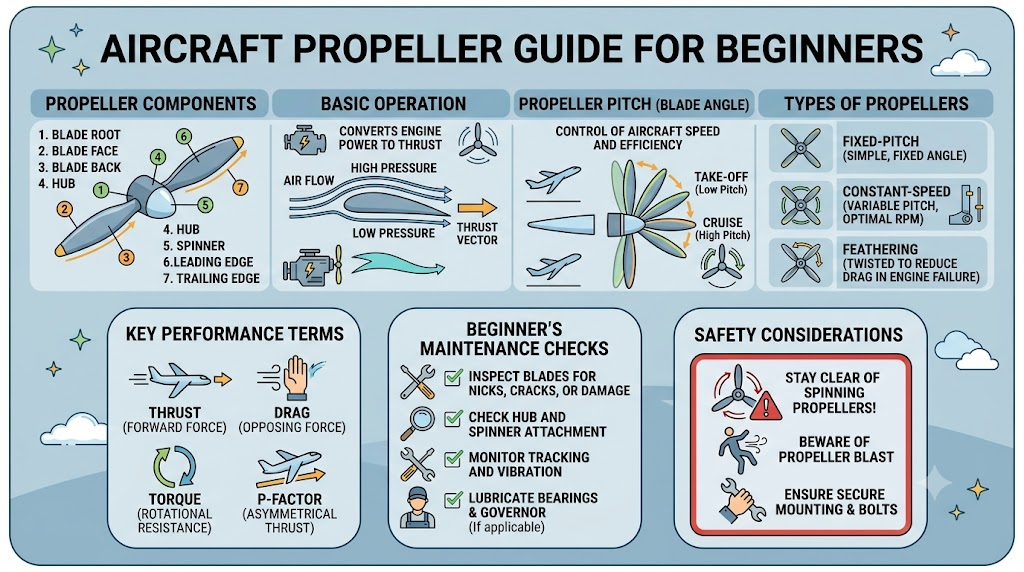
Introduction
An aircraft propeller is one of the most important components in a propeller-driven aircraft because it converts engine power into forward thrust. Although a propeller may look simple, its shape, pitch, size, and rotation strongly influence how an aircraft performs. Understanding these basics helps new pilots and aviation enthusiasts understand what happens between the engine and the air. This guide explains how aircraft propellers work, their main types and parts, and why proper maintenance matters.
What Is an Aircraft Propeller?
An aircraft propeller is a rotating aerodynamic device connected to an aircraft engine. Its primary job is to produce thrust that moves the aircraft forward through the air.
A propeller consists of two or more blades attached to a central hub. When the engine rotates the propeller, the blades move through the air at high speed. Their specially designed airfoil shape generates an aerodynamic force that has a forward component called thrust.
A propeller works somewhat like a rotating wing. A conventional wing produces lift that supports an aircraft’s weight, while a propeller blade produces aerodynamic force that helps move the aircraft forward.
The engine supplies the power, while the propeller converts much of that power into useful thrust. Because of this relationship, the engine and propeller must work together as a suitable combination.
How Does an Aircraft Propeller Work?
The basic principle behind a propeller is relatively straightforward.
The aircraft engine turns the propeller shaft, causing the propeller blades to rotate. Each blade has a specific shape and angle that allows it to interact with the surrounding air.
As the blade rotates, it moves through the air along a circular path. The blade’s airfoil shape creates a pressure difference around it and generates an aerodynamic force. A portion of this force acts in the forward direction, producing thrust.
The amount of thrust a propeller produces depends on several factors, including engine power, propeller diameter, blade shape, pitch, rotational speed, and aircraft forward speed.
Propeller operation also involves an important balance. A propeller needs to absorb the power produced by the engine efficiently. If the propeller is poorly matched to the engine or operating conditions, some of the available power may not be converted into useful thrust.
Main Parts of an Aircraft Propeller
Although propellers vary between aircraft, several basic components are common.
Propeller Blades
The blades are the aerodynamic surfaces that interact directly with the air. Their shape and pitch determine how effectively the propeller can produce thrust.
Hub
The hub is the central part of the propeller. It connects the blades to the propeller shaft and transfers engine power to the blades.
Blade Root
The blade root is the section where a blade connects to the hub. It experiences significant mechanical loads during operation.
Blade Tip
The blade tip is the outermost part of the blade. Because it travels through the air at a high speed, its design can influence efficiency, noise, and aerodynamic performance.
Leading Edge
The leading edge is the part of the blade that meets the air first as the propeller rotates.
Trailing Edge
The trailing edge is the rear edge of the blade relative to its movement through the air.
Spinner
Some aircraft have a streamlined cover called a spinner over the propeller hub. It helps reduce aerodynamic drag around the hub area and gives the front of the aircraft a smoother shape.
Types of Aircraft Propellers
Aircraft use different propeller designs depending on their engine, aircraft configuration, performance requirements, and intended operation.
Fixed-Pitch Propellers
A fixed-pitch propeller has blades set at a predetermined pitch. The pilot cannot normally change the blade pitch during flight.
These propellers have a relatively simple design and are common on many training and light aircraft. Their simplicity can make them easier to operate and maintain.
However, a fixed-pitch propeller represents a compromise. The pitch that works well for takeoff may not be ideal for high-speed cruise, and the opposite can also be true.
Ground-Adjustable Propellers
Ground-adjustable propellers allow their blade pitch to be adjusted while the aircraft is on the ground. Once the desired setting is established, the pitch remains fixed during flight.
This design offers more flexibility than a permanently fixed-pitch propeller while remaining relatively simple.
Variable-Pitch Propellers
A variable-pitch propeller allows the blade angle to change during operation. This gives the propeller greater flexibility across different flight conditions.
For example, a propeller can use a relatively fine pitch during some phases of flight and a coarser pitch during cruise, depending on the aircraft’s system and operating requirements.
Constant-Speed Propellers
A constant-speed propeller is a type of variable-pitch system designed to maintain a selected engine rotational speed within its operating range.
The system automatically changes blade pitch as necessary to help maintain the selected RPM when flight conditions or power settings change.
This can improve propeller efficiency across a wider range of operating conditions, although the system is more complex than a basic fixed-pitch arrangement.
Two-Blade and Multi-Blade Propellers
Propellers can have two, three, four, or more blades. The number of blades affects factors such as power absorption, diameter requirements, noise, weight, and aircraft design.
More blades do not automatically mean that an aircraft will perform better in every situation. Designers select the number and shape of blades based on the overall aircraft and engine requirements.
Fixed-Pitch vs Variable-Pitch Propellers
The difference between these two designs is particularly important for beginners.
A fixed-pitch propeller keeps its blade pitch essentially unchanged during flight. The engine and propeller therefore operate with a fixed aerodynamic relationship.
A variable-pitch propeller can change its blade angle to suit different operating conditions. This gives the aircraft greater flexibility in using engine power.
| Feature | Fixed-Pitch Propeller | Variable-Pitch Propeller |
|---|---|---|
| Blade pitch during flight | Generally fixed | Can be changed |
| Design complexity | Lower | Higher |
| Pilot control | Simpler | More control or automatic control depending on system |
| Operating flexibility | More limited | Greater |
| Maintenance | Generally simpler | Generally more complex |
| Typical use | Many light and training aircraft | Performance-oriented and more advanced aircraft |
The choice between the two depends on the aircraft’s design and intended mission. Neither system is universally better.
What Is Propeller Pitch?
Propeller pitch describes the geometric angle or theoretical distance associated with how far a propeller would advance during one complete revolution under ideal conditions.
For beginners, it can help to think of pitch as the blade’s working angle in relation to its rotational movement.
A fine pitch generally allows the engine to turn at a higher RPM and can be useful when the aircraft needs strong performance at lower speeds, such as during takeoff.
A coarse pitch generally allows the propeller to take a larger theoretical bite of air per revolution. It can be useful during cruise conditions, depending on the propeller and aircraft system.
The actual aerodynamic behavior is more complicated than this simple explanation because airspeed, engine power, blade design, and many other factors affect propeller operation.
Aircraft Propeller and Engine Relationship
The engine and propeller operate as a connected system.
The engine produces mechanical power. That power reaches the propeller through the propeller shaft, and in some aircraft it may pass through a reduction gearbox before reaching the propeller.
Some piston-engine aircraft use a direct-drive arrangement in which the propeller rotates at engine crankshaft speed. Other aircraft designs use gearing to reduce propeller RPM.
This relationship matters because propellers are designed to operate effectively within particular ranges of power and rotational speed.
A propeller that is well matched to its engine can convert engine power into thrust efficiently. A poor match can reduce performance and place unwanted demands on the engine or propeller system.
Propeller Rotation and Thrust
When a propeller rotates, each blade moves through the air while following a circular path.
Because the blade has an airfoil-like cross-section and a particular pitch, it develops aerodynamic force. The propeller’s combined blade forces create a net force directed generally forward.
That forward force is thrust.
Propeller efficiency depends partly on how effectively the propeller accelerates air rearward without wasting excessive energy. The design therefore involves a balance between blade size, shape, pitch, rotational speed, aircraft speed, and engine power.
The air does not simply get pushed backward by a flat surface. The aerodynamic shape of the blade plays an important role in creating the required force.
How Propellers Affect Aircraft Performance
Propeller characteristics can influence several aspects of aircraft performance.
Takeoff Performance
During takeoff, the aircraft needs sufficient thrust at relatively low forward speed. Propeller pitch and engine power influence how effectively the propeller can produce that thrust.
Climb Performance
After takeoff, the aircraft requires enough excess thrust or power to climb. Propeller efficiency can therefore affect the aircraft’s ability to gain altitude.
Cruise Performance
During cruise, the aircraft operates at a higher forward speed. The propeller must continue converting engine power into useful thrust efficiently.
Fuel Efficiency
A well-matched propeller can help an aircraft use available engine power efficiently. Propeller design is therefore one factor that can influence fuel consumption.
Noise
Propeller diameter, blade shape, rotational speed, and tip speed can affect the noise produced by a propeller.
Aircraft Handling
Propeller rotation can also create aerodynamic effects that influence aircraft handling. Depending on the aircraft, pilots may need to account for effects such as torque, slipstream, and gyroscopic effects.
Common Materials Used in Aircraft Propellers
Aircraft propellers can be manufactured from several materials.
Aluminum Alloys
Aluminum propellers are common in many aircraft because aluminum alloys can provide a useful combination of strength, relatively low weight, and durability.
They still require inspection for corrosion, dents, cracks, and other forms of damage.
Wood
Wooden propellers have a long history in aviation. Properly manufactured and maintained wooden propellers can provide useful aerodynamic performance and relatively low weight.
They require careful protection and inspection because moisture and physical damage can affect their condition.
Composite Materials
Modern propellers may use composite materials such as advanced fiber-reinforced structures. These materials can allow designers to create sophisticated blade shapes while controlling weight and strength.
The exact construction varies significantly between manufacturers and propeller models.
Common Propeller Problems and Damage
Propellers operate under significant aerodynamic and mechanical loads, so their condition deserves careful attention.
Common problems can include:
- Cracks or structural damage
- Corrosion
- Nicks and dents
- Foreign-object damage
- Blade deformation
- Propeller imbalance
- Excessive vibration
- Incorrect or damaged pitch mechanisms
Even a small defect can matter because propeller blades rotate at high speed. Damage can become more serious if it is not identified and handled correctly.
Pilots should follow the inspection procedures and limitations specified for their aircraft. Repairs, balancing, pitch adjustments, and other maintenance work should be performed by appropriately qualified aviation maintenance personnel according to approved procedures.
Why Propeller Inspection and Maintenance Matter
A propeller is a critical rotating component, so regular inspection helps identify problems before they become more serious.
Maintenance personnel may examine the propeller for visible damage, corrosion, cracks, blade condition, attachment issues, and other problems specified by the applicable maintenance documentation.
Propeller balancing also matters because an imbalance can contribute to vibration. Excessive vibration can affect the propeller, engine, airframe, instruments, and overall aircraft condition.
Maintenance requirements vary according to the propeller model, aircraft, operating environment, and applicable regulations. For this reason, aircraft owners and pilots should rely on the aircraft and propeller manufacturer’s approved documentation rather than general advice for specific maintenance decisions.
Common Mistakes Beginners Make When Learning About Propellers
New aviation students sometimes develop misconceptions about propellers.
One common mistake is assuming that every propeller works in exactly the same way. Propeller systems vary considerably between aircraft.
Another mistake is treating pitch as simply the same thing as blade angle at every point along the blade. Propeller geometry is more complicated, and blade angle can vary from the root toward the tip.
Some beginners also assume that adding more blades always improves performance. In reality, the number of blades involves trade-offs involving diameter, power absorption, weight, noise, efficiency, and aircraft design.
It is also easy to overlook the relationship between engine RPM and propeller RPM. In some aircraft they are directly related, while geared systems can use a reduction ratio.
Finally, beginners should never assume that a small propeller nick, vibration, or unusual sound is harmless. Such issues should receive appropriate attention.
Important Factors to Consider When Understanding Propellers
Several factors determine how a propeller behaves on an aircraft.
Aircraft size and type: A propeller designed for a small trainer will not necessarily suit a larger or differently configured aircraft.
Engine power: The propeller must be capable of absorbing the engine’s available power within its approved operating range.
Propeller diameter: Diameter influences the amount of air the propeller can interact with and affects aircraft installation requirements.
Number of blades: Additional blades can help meet particular power and diameter requirements but may also introduce trade-offs involving weight, complexity, and efficiency.
Pitch: Blade pitch influences the relationship between propeller RPM, engine operation, and aircraft speed.
Aircraft speed: A propeller behaves differently at different forward speeds, so its design must suit the aircraft’s intended operating range.
Operating mission: A training aircraft, utility aircraft, and high-performance aircraft may have very different propeller requirements.
Maintenance requirements: The propeller must be inspected and maintained according to its approved documentation.
The most effective propeller is therefore not simply the largest, fastest, or most complicated one. It is the one properly matched to the aircraft, engine, and intended operation.
| Propeller Factor | What It Influences | Why It Matters |
|---|---|---|
| Diameter | Airflow and power absorption | Must suit the aircraft and engine installation |
| Pitch | RPM and operating performance | Helps determine how the propeller performs across flight conditions |
| Number of blades | Power absorption, weight, noise, and design | Must be selected for the aircraft’s requirements |
| Blade shape | Aerodynamic efficiency | Affects how effectively the propeller produces thrust |
| Material | Weight, strength, and durability | Influences construction and maintenance requirements |
| RPM | Blade speed and aerodynamic performance | Must remain within approved operating limits |
| Aircraft airspeed | Propeller operating condition | Changes the aerodynamic behavior of the propeller |
Frequently Asked Questions
1. What does an aircraft propeller do?
An aircraft propeller converts engine power into aerodynamic thrust. The rotating blades interact with the air and generate a force that moves the aircraft forward.
2. How does an aircraft propeller create thrust?
The rotating blades have an aerodynamic shape and pitch that generate force as they move through the air. A component of this force acts forward and produces thrust.
3. What is propeller pitch?
Propeller pitch describes the geometric setting associated with how far a propeller would theoretically advance during one revolution. It strongly influences the relationship between propeller RPM and aircraft operating conditions.
4. What is the difference between a fixed-pitch and variable-pitch propeller?
A fixed-pitch propeller has a blade pitch that generally remains unchanged during flight. A variable-pitch propeller can change blade angle to adapt to different operating conditions.
5. Why do some aircraft have two blades while others have more?
The number of blades depends on factors such as engine power, propeller diameter, aircraft design, noise, weight, and performance requirements. More blades do not automatically provide better performance in every situation.
6. Can a propeller affect fuel efficiency?
Yes. Propeller design and operating conditions affect how efficiently engine power becomes useful thrust. A properly matched propeller can contribute to efficient aircraft operation.
7. Why does propeller vibration matter?
Unusual or excessive vibration can indicate issues such as imbalance, damage, or other mechanical problems. Because the propeller rotates at high speed, vibration should not be ignored.
8. What materials are aircraft propellers made from?
Depending on the design, propellers can be made from materials including aluminum alloys, wood, and composite materials.
9. How often should aircraft propellers be inspected?
Inspection requirements depend on the aircraft, propeller model, operating conditions, and applicable maintenance rules. Pilots and owners should follow the approved maintenance documentation for the specific aircraft and propeller.
10. Can pilots change propeller pitch during flight?
In aircraft equipped with a variable-pitch or constant-speed propeller system, the pilot may have a means of controlling propeller pitch or RPM, depending on the aircraft design. Fixed-pitch propellers do not provide this in-flight pitch adjustment.
Conclusion
An aircraft propeller may appear to be a simple rotating component, but it performs an important aerodynamic and mechanical job. It takes power from the engine and converts that power into useful thrust, allowing the aircraft to move through the air.
For beginners, understanding the basics of blades, pitch, RPM, thrust, propeller types, and engine interaction provides a strong foundation in aircraft systems. Propeller design also affects takeoff, climb, cruise performance, efficiency, noise, and handling.
Most importantly, propellers require proper inspection and maintenance because they operate under substantial loads and high rotational speeds. Learning how they work is not only useful for aviation students and enthusiasts but also helps new pilots develop a better understanding of the aircraft they fly.

