
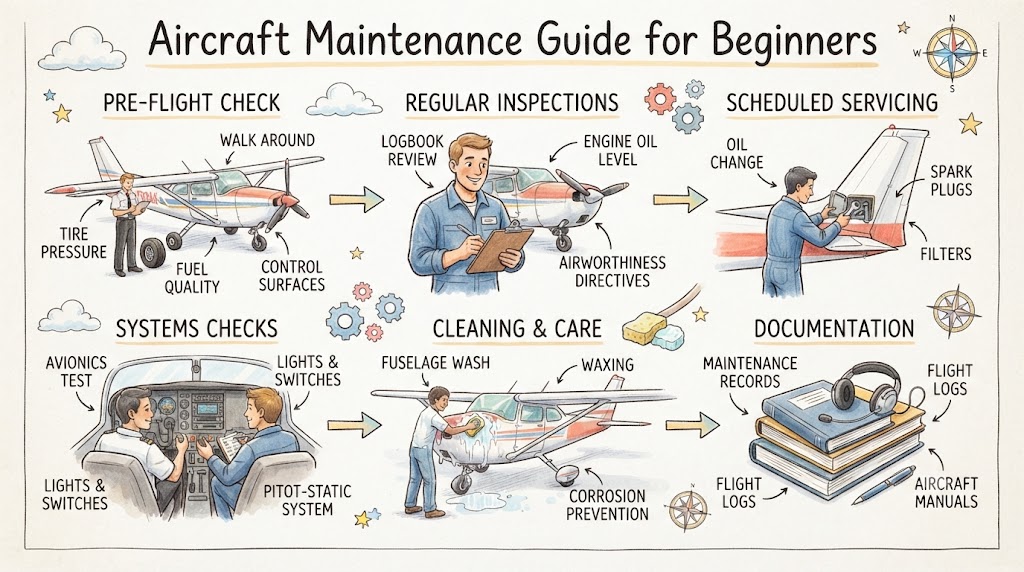
Introduction
Aircraft maintenance is the organized process of inspecting, servicing, repairing, and preserving an aircraft so it remains safe and reliable.
It covers much more than fixing something after it breaks. Maintenance also includes checking components for wear, replacing time-limited parts, lubricating moving areas, testing systems, complying with mandatory safety instructions, and documenting completed work.
A well-maintained aircraft should conform to its approved design and remain in a condition for safe operation. In the United States, the owner or operator is primarily responsible for keeping the aircraft airworthy, even when mechanics and repair organizations perform the actual work.
This guide explains the fundamentals of aircraft maintenance. Regulatory examples are based mainly on current FAA requirements. Maintenance authority, inspection intervals, and licensing rules can differ by country, so local civil aviation regulations must also be checked.
What Is Aircraft Maintenance?
Aircraft maintenance includes the work required to preserve or restore an aircraft, engine, propeller, appliance, or component.
It may involve:
- Inspection
- Servicing
- Troubleshooting
- Repair
- Part replacement
- Overhaul
- Preservation
- Adjustment
- Testing
- Modification
- Cleaning and corrosion control
Maintenance should be completed using approved methods, correct tools, suitable materials, current technical information, and properly qualified personnel.
The FAA regulates maintenance, preventive maintenance, rebuilding, and alterations under 14 CFR Part 43 for aircraft and products to which that part applies.
Why Aircraft Maintenance Is Important
Aircraft operate under demanding conditions. Their components experience vibration, pressure changes, temperature changes, aerodynamic loads, weather exposure, and repeated takeoff-and-landing cycles.
Regular maintenance helps identify problems such as:
- Cracks
- Corrosion
- Fluid leaks
- Loose fasteners
- Worn tires
- Damaged wiring
- Contaminated fuel
- Engine deterioration
- Control-system wear
- Avionics faults
A small defect can become more serious when it remains undetected. Maintenance aims to find and correct problems before they threaten safe operation.
FAA-certificated Aviation Maintenance Technicians work specifically to support the continued operational safety of aircraft and aviation products.
What Does Airworthy Mean?
An aircraft is generally considered airworthy when it:
- Conforms to its approved type design or other applicable approved configuration.
- Is in a condition for safe operation.
A standard airworthiness certificate remains effective only while the aircraft continues meeting its approved design and is maintained and altered according to the applicable regulations.
An aircraft can have a valid airworthiness certificate displayed inside it and still be unairworthy because of:
- An unresolved defect
- An overdue inspection
- An unapproved modification
- Noncompliance with an applicable Airworthiness Directive
- Damage affecting safe operation
- Improperly completed maintenance
The certificate alone does not prove that the aircraft is currently safe to fly.
Main Types of Aircraft Maintenance
Scheduled Maintenance
Scheduled maintenance is performed at planned intervals.
The interval may be based on:
- Flight hours
- Calendar time
- Engine cycles
- Landings
- Manufacturer recommendations
- Approved maintenance programs
- Regulatory requirements
Examples include annual inspections, 100-hour inspections, oil changes, filter replacements, and life-limited component replacement.
Unscheduled Maintenance
Unscheduled maintenance is performed when an unexpected defect or abnormal condition appears.
Examples include:
- Flat tire
- Fluid leak
- Failed radio
- Cracked windshield
- Abnormal engine vibration
- Warning-light activation
- Hard-landing inspection
- Bird-strike inspection
The aircraft may need to remain grounded until the problem is assessed and corrected.
Preventive Maintenance
Preventive maintenance consists of certain simple or minor preservation operations and replacement of small standard parts that do not involve complex assembly work.
Examples listed in FAA regulations can include certain tasks involving:
- Tires
- Lubrication
- Wheel bearings
- Safety belts
- Light bulbs and lenses
- Batteries
- Spark plugs
- Oil and oil filters
Only tasks specifically permitted by the applicable rules should be treated as pilot-performed preventive maintenance.
Corrective Maintenance
Corrective maintenance repairs a known fault.
It may include:
- Replacing a failed component
- Repairing damaged wiring
- Stopping a fluid leak
- Correcting an engine problem
- Repairing structural damage
- Restoring an inoperative instrument
Predictive or Condition-Based Maintenance
Predictive maintenance uses inspection results, operating data, oil analysis, vibration monitoring, temperature trends, or other information to identify deterioration.
The goal is to detect a developing problem before a complete failure occurs.
Who Can Perform Aircraft Maintenance?
Aircraft maintenance cannot automatically be performed by anyone who owns, flies, or understands the aircraft.
Under the FAA system, authorized persons can include:
- Certificated aviation mechanics
- Certificated repairmen within their authorized duties
- Approved repair stations
- Air carriers working under their approved programs
- People working under the direct supervision of an appropriately certificated mechanic or repairman
- Pilots performing specifically permitted preventive maintenance
An uncertificated person working under supervision cannot independently approve the aircraft for return to service and cannot perform certain required inspections.
Understanding A&P Mechanics
An FAA Aviation Mechanic certificate can carry two ratings:
- Airframe
- Powerplant
A mechanic holding both is commonly called an A&P mechanic.
Airframe Rating
The airframe rating covers areas such as:
- Aircraft structure
- Flight controls
- Landing gear
- Hydraulic systems
- Electrical systems
- Cabin systems
- Instruments
- Materials and fasteners
Powerplant Rating
The powerplant rating covers areas such as:
- Piston engines
- Turbine engines
- Propellers
- Fuel and induction systems
- Ignition systems
- Engine lubrication
- Engine cooling
- Exhaust systems
The FAA requires appropriate experience or graduation from an approved Aviation Maintenance Technician School, followed by knowledge, oral, and practical testing.
What Is Inspection Authorization?
Inspection Authorization, commonly called IA, is an additional authorization held by some experienced A&P mechanics.
An IA may be required for responsibilities such as:
- Performing and approving annual inspections
- Approving certain major repairs or alterations
- Completing specific inspection-related documentation
Holding an A&P certificate alone does not provide every inspection or approval privilege.
Can Pilots Perform Maintenance?
A pilot may be permitted to perform limited preventive maintenance under specific conditions.
Under FAA rules, most pilot-certificate holders may perform qualifying preventive maintenance on an aircraft they own or operate when the aircraft is not used under certain commercial operating parts. Sport-pilot privileges are more limited.
Before beginning any task, the pilot should confirm:
- The task is listed as preventive maintenance.
- The pilot is legally authorized to perform it.
- The pilot understands the procedure.
- Current maintenance instructions are available.
- Correct tools and parts are available.
- The task does not involve complex assembly.
- A proper maintenance-record entry can be completed.
- The aircraft can be correctly approved for return to service.
Being legally allowed to complete a task does not mean a person is technically prepared to complete it safely.
Maintenance Tasks Beginners Should Not Attempt Alone
A beginner should not independently attempt work involving:
- Flight-control rigging
- Internal engine repair
- Propeller repair
- Structural repair
- Fuel-system disassembly
- Pressurized systems
- Complex avionics wiring
- Magneto timing
- Major electrical faults
- Landing-gear retraction systems
- Fire-detection systems
- Major repairs or alterations
Incorrect maintenance can create a hidden defect that may not appear until the aircraft is in flight.
Common Aircraft Inspection Types
Preflight Inspection
A preflight inspection is normally completed before flight by the pilot.
It is an operational safety check rather than a replacement for a regulatory maintenance inspection.
The pilot may examine:
- Fuel quantity and quality
- Oil quantity
- Tires and brakes
- Flight controls
- Control-surface attachments
- Pitot tube and static ports
- Lights
- Propeller condition
- Fluid leaks
- General structural condition
- Required documents
Any unexplained damage or abnormal indication should be evaluated before flight.
Postflight Inspection
A postflight check can identify problems that developed during the flight.
Pilots may look for:
- New fluid leaks
- Tire damage
- Bird impact
- Loose panels
- Brake overheating
- Propeller damage
- Unusual smells
- Failed lights
- Warning messages
Reporting a problem immediately helps maintenance personnel investigate it while the details are still fresh.
Annual Inspection
Most civil aircraft operating under general FAA rules require an annual inspection within the preceding 12 calendar months unless an approved alternative, such as a progressive inspection, applies.
An annual inspection must be performed and approved by a person holding the necessary inspection authority. Its scope includes detailed examination of the aircraft’s structure, systems, engine, controls, landing gear, and other areas specified by regulation.
100-Hour Inspection
A 100-hour inspection is generally required for certain aircraft used to carry persons for hire or to provide flight instruction for hire when the person providing the instruction supplies the aircraft.
Its scope is similar to an annual inspection, but the approval requirements differ.
FAA rules permit limited additional flight time to reach a location where the inspection can be completed, but the excess time is counted toward the following 100-hour period.
Progressive Inspection
A progressive inspection divides a complete inspection into smaller scheduled sections.
Instead of opening and inspecting the entire aircraft at one time, different areas are examined at approved intervals.
The program must ensure that the aircraft continues to be airworthy and meets the applicable inspection requirements.
Special Inspections
Additional inspections may be required after events such as:
- Hard landing
- Lightning strike
- Bird strike
- Propeller strike
- Severe turbulence
- Engine overspeed
- Overweight landing
- Suspected structural damage
- Flight through volcanic ash
- Operation outside approved limits
The required procedure should come from the aircraft manufacturer, engine manufacturer, propeller manufacturer, or other approved maintenance data.
Understanding Airworthiness Directives
An Airworthiness Directive, or AD, is a legally enforceable rule issued to correct an unsafe condition in an aircraft, engine, propeller, or installed appliance.
An AD may require:
- One-time inspection
- Repetitive inspection
- Part replacement
- Modification
- Operating limitation
- Specific maintenance procedure
- Removal of a component from service
Owners and operators must identify every AD applicable to the aircraft, engine, propeller, and installed equipment—not only the aircraft model itself.
Failure to comply with an applicable AD can make the aircraft unairworthy.
Service Bulletins and Service Letters
Manufacturers publish service information describing inspections, improvements, modifications, or known technical issues.
Common documents include:
- Service Bulletins
- Service Letters
- Service Instructions
- Maintenance Alerts
These documents are not automatically equivalent to Airworthiness Directives. Their legal status depends on the aircraft, operation, regulations, approved program, warranty conditions, and whether an AD or another requirement incorporates them.
They should still be reviewed carefully because they may contain important safety information.
Aircraft Maintenance Manuals
Maintenance should be based on current technical information.
Common references include:
- Aircraft Maintenance Manual
- Engine Maintenance Manual
- Propeller Manual
- Component Maintenance Manual
- Structural Repair Manual
- Wiring Diagram Manual
- Illustrated Parts Catalogue
- Service Bulletins
- Airworthiness Directives
- Approved inspection checklists
Using an outdated manual can lead to incorrect limits, procedures, torque values, part numbers, or inspection requirements.
Important Aircraft Maintenance Areas
Airframe
The airframe includes the main physical structure of the aircraft.
Maintenance personnel inspect areas such as:
- Fuselage
- Wings
- Tail surfaces
- Doors
- Windows
- Control-surface attachments
- Skin and structural members
- Fasteners
- Composite materials
Common concerns include cracks, dents, corrosion, loose fasteners, delamination, and previous repair damage.
Engine
Engine maintenance can involve:
- Oil and filter changes
- Compression testing
- Ignition-system inspection
- Spark-plug servicing
- Leak checks
- Borescope inspection
- Fuel-system adjustment
- Temperature and pressure analysis
- Engine-mount inspection
Unusual noise, vibration, oil consumption, temperature, or metal in an oil filter may require further investigation.
Propeller
Propellers operate under high rotational and aerodynamic loads.
Inspections look for:
- Nicks
- Cracks
- Corrosion
- Erosion
- Loose hardware
- Oil leakage
- Blade damage
- Spinner damage
A small propeller defect should not be casually filed, sanded, or repaired without an approved procedure.
Flight Controls
Flight-control maintenance may cover:
- Ailerons
- Elevator or stabilator
- Rudder
- Flaps
- Trim systems
- Cables
- Pulleys
- Pushrods
- Hinges
- Control stops
After maintenance, correct direction of movement, range, security, and freedom of operation must be verified.
Landing Gear and Brakes
Common inspection points include:
- Tire condition
- Tire pressure
- Brake wear
- Hydraulic leaks
- Wheel bearings
- Struts
- Steering system
- Retraction mechanism
- Gear doors
- Safety switches
Landing gear experiences significant loads during every takeoff, landing, and taxi operation.
Fuel System
Fuel-system maintenance may include checking:
- Tanks
- Fuel caps
- Drains
- Pumps
- Selectors
- Filters
- Lines
- Vents
- Quantity indicators
- Leakage
Fuel contamination, water, blocked vents, or leaking lines can interrupt fuel delivery to the engine.
Electrical System
Electrical maintenance may involve:
- Battery condition
- Alternator or generator output
- Wiring
- Connections
- Relays
- Switches
- Circuit protection
- Bonding and grounding
- Lighting
Burning smells, hot wires, repeated circuit-breaker trips, or fluctuating voltage should be investigated rather than repeatedly reset or ignored.
Avionics
Avionics maintenance covers equipment such as:
- Communication radios
- Navigation receivers
- GPS units
- Transponders
- Autopilots
- Flight displays
- Traffic systems
- Weather radar
- Audio panels
Avionics work may require specialized test equipment, software, approved data, and appropriately qualified technicians.
Corrosion Prevention
Corrosion is the gradual deterioration of metal through chemical or electrochemical reaction.
It is encouraged by:
- Moisture
- Salt
- Pollution
- Battery chemicals
- Poor drainage
- Damaged protective coatings
- Long periods of inactivity
Regular cleaning, inspection, drainage, lubrication, and protective treatment can reduce corrosion damage.
Aircraft Maintenance Records
Maintenance records form part of the aircraft’s continuing airworthiness history.
Records may document:
- Work performed
- Parts installed or removed
- Inspection completion
- Airworthiness Directive compliance
- Major repairs and alterations
- Component times
- Life-limited parts
- Current inspection status
- Approval for return to service
FAA regulations require owners or operators to retain specified records of maintenance, preventive maintenance, alterations, and required inspections.
A maintenance entry generally includes:
- Description or reference to the work
- Date of completion
- Name of the person performing the work
- Certificate information when applicable
- Signature approving the work for return to service
Incomplete records can make it difficult to prove inspection status, AD compliance, component history, or legal airworthiness.
Approval for Return to Service
Completing physical work does not automatically make the aircraft legal to fly.
An appropriately authorized person must determine that the work was completed correctly and make the required maintenance entry or approval for return to service.
The FAA notes that a person without the required certificate cannot independently approve an aircraft, engine, propeller, appliance, or component for return to service.
Depending on the work, a post-maintenance operational check or test flight may also be required.
Post-Maintenance Checks
After maintenance, pilots and mechanics should be especially alert for unexpected conditions.
Checks may include:
- Correct fluid levels
- Properly secured cowlings and panels
- Tools and materials removed
- Correct flight-control movement
- Normal engine indications
- Electrical-system operation
- Radio and navigation checks
- Brake operation
- Absence of leaks
- Normal warning-light test
- Correct hardware and safety devices
The first flight after significant maintenance deserves careful planning, conservative weather limits, and attention to suitable landing options.
Common Maintenance Mistakes
Using the Wrong Part
A component that appears physically similar may have a different specification or approval status.
Using Outdated Instructions
Old manuals may contain superseded procedures, limits, or part numbers.
Incorrect Torque
Too little torque can allow movement. Excessive torque can damage threads, fittings, components, or structures.
Poor Tool Control
A forgotten tool can jam controls, damage wiring, or move inside the airframe.
Failure to Use Safety Devices
Cotter pins, safety wire, locking tabs, and other devices prevent critical hardware from loosening.
Ignoring Small Leaks
A minor leak may be the first sign of a worsening system fault.
Repeated Circuit-Breaker Resetting
A tripped breaker can indicate an electrical fault. Repeated resetting may increase heat or fire risk.
Incomplete Documentation
Correct work without the required record entry may leave the aircraft’s legal status unclear.
Rushing the Final Inspection
Many maintenance errors occur when panels, connections, tools, and control movements are not checked after the work is complete.
Basic Maintenance Safety Rules
- Use the correct manual for the exact aircraft and component.
- Confirm the aircraft is secured before beginning work.
- Disconnect or isolate electrical power when required.
- Protect against accidental engine starting.
- Use suitable personal protective equipment.
- Keep fuel away from ignition sources.
- Use properly calibrated tools where required.
- Tag disconnected wires, hoses, and controls.
- Account for every tool and loose item.
- Do not substitute unapproved parts or materials.
- Complete independent inspections when required.
- Make the proper maintenance-record entry.
- Stop and seek qualified help when uncertain.
Beginner Aircraft Condition Checklist
A beginner can learn to observe the aircraft without performing unauthorized maintenance.
Look for:
- New fluid beneath the aircraft
- Loose or missing fasteners
- Damaged tires
- Worn brakes
- Propeller nicks
- Cracks or dents
- Corrosion
- Chafed wiring
- Damaged hoses
- Loose antennas
- Blocked openings
- Control-surface damage
- Unusual engine indications
- Warning lights
- Abnormal noises or smells
Report observations accurately without diagnosing a system beyond your knowledge.
How Students Can Learn Aircraft Maintenance
Study Basic Aircraft Systems
Begin with:
- Airframe construction
- Piston-engine fundamentals
- Electrical systems
- Fuel systems
- Flight controls
- Landing gear
- Instruments
- Propellers
Observe Qualified Mechanics
Watching an experienced mechanic can help students understand proper tool use, inspection technique, documentation, and safety discipline.
Learn to Read Manuals
Technical manuals are organized differently from general textbooks. Students should practise locating:
- Procedures
- Limits
- Warnings
- Torque values
- Diagrams
- Part numbers
- Inspection intervals
Practise Under Supervision
Hands-on experience should be completed under the supervision and authority required by applicable regulations.
Develop a Questioning Habit
When something looks different, ask:
- Is this normal?
- Has it changed since the last flight?
- Is there a related instrument indication?
- Is the condition documented?
- Does a qualified mechanic need to inspect it?
Frequently Asked Questions
What is aircraft maintenance?
Aircraft maintenance is the inspection, servicing, repair, preservation, testing, and replacement work required to keep an aircraft safe and airworthy.
Who is responsible for maintaining an aircraft?
Under FAA general operating rules, the aircraft owner or operator is primarily responsible for maintaining it in an airworthy condition.
Can a pilot change aircraft oil?
A qualified pilot may be allowed to change oil under preventive-maintenance privileges when all applicable conditions are met. The pilot must use the correct procedure and complete the required maintenance record.
What is an annual inspection?
It is a detailed inspection generally required within each 12-calendar-month period for aircraft operating under applicable FAA general rules.
What is the difference between an annual and 100-hour inspection?
Their inspection scopes are similar, but the 100-hour requirement applies to particular for-hire operations. An annual inspection requires the appropriate inspection authorization for approval.
What does A&P mean?
A&P means Airframe and Powerplant, the two ratings available on an FAA Aviation Mechanic certificate.
What is an Airworthiness Directive?
An Airworthiness Directive is a legally enforceable requirement issued to correct an unsafe condition in an aircraft or related product.
Can an aircraft fly with an inoperative item?
Possibly, but only when permitted by the aircraft’s equipment requirements, approved procedures, operating rules, and any applicable Minimum Equipment List. A qualified person should determine the correct legal and maintenance action.
Why are aircraft maintenance records important?
They show completed maintenance, inspection status, component history, modifications, and compliance with mandatory requirements.
Can a beginner repair an aircraft alone?
A beginner should perform work only when legally authorized, technically competent, and properly supervised where required. Complex or safety-critical tasks should be left to qualified maintenance professionals.
Key Takeaways
Aircraft maintenance is essential for keeping an aircraft reliable, compliant, and safe.
Beginners should remember:
- The owner or operator remains responsible for airworthiness.
- Maintenance and inspection are not the same as a pilot’s preflight check.
- Only authorized people may perform and approve most maintenance.
- Pilots have limited preventive-maintenance privileges.
- Annual, 100-hour, progressive, and special inspections serve different purposes.
- Airworthiness Directives are mandatory when applicable.
- Current manuals and approved data must be used.
- Maintenance records are part of the aircraft’s airworthiness history.
- Final checks and correct documentation are as important as the physical repair.
- Uncertainty should lead to qualified assistance—not experimentation.
Conclusion
Aircraft maintenance combines technical knowledge, careful inspection, accurate workmanship, regulatory compliance, and complete documentation. Beginners do not need to become mechanics immediately, but every pilot and aviation student should understand how maintenance affects airworthiness. Learning to notice defects, report them clearly, follow approved procedures, and respect the limits of personal authority builds safer habits throughout an aviation career.

