
Introduction
An aircraft engine is one of the most important systems that makes powered flight possible. It provides the power or thrust needed to keep an aircraft moving through the air. For aviation students, understanding basic engine principles is essential for building strong technical knowledge. Learning how engines work also helps students better understand aircraft performance, engine instruments, and flight operations.
What Is an Aircraft Engine?
An aircraft engine is a mechanical system designed to produce power or thrust for an aircraft. Depending on the engine type, that power may turn a propeller or directly produce thrust through the movement of high-speed exhaust gases.
The basic purpose remains the same: provide the energy required for flight.
Aircraft engines convert the chemical energy stored in fuel into mechanical energy and, in some engine types, directly into thrust. The exact process depends on whether the aircraft uses a piston engine, turboprop, turbojet, turbofan, or another type of powerplant.
Aviation students should understand that the engine is only one part of the complete propulsion system. Propellers, fuel systems, ignition systems, electrical systems, lubrication systems, and other components work together to support reliable engine operation.
Main Types of Aircraft Engines
Aircraft use different engine designs depending on their size, mission, speed, and operating requirements.
Piston Engines
Piston engines are common in many training aircraft and general aviation airplanes. They use pistons moving inside cylinders to convert fuel energy into mechanical power.
The crankshaft transfers this mechanical power to the propeller, which produces thrust by accelerating air backward.
Piston engines are particularly useful for aviation students because their basic operating cycle provides a straightforward introduction to internal combustion engines.
Turboprop Engines
A turboprop engine is a gas turbine engine that uses much of its available power to drive a propeller.
Air enters the engine, gets compressed, mixes with fuel, and burns in the combustion section. The expanding gases drive turbine stages, which provide shaft power to turn the propeller.
Turboprops are commonly associated with regional aircraft and utility airplanes because they can provide efficient performance at appropriate speeds and altitudes.
Turbojet Engines
A turbojet produces thrust primarily through high-speed exhaust gases.
The engine compresses incoming air, adds fuel, burns the mixture, and sends the expanding gases through the turbine and exhaust system. The exhaust leaves the engine at high velocity, creating thrust.
Turbojets played an important role in the development of jet aviation, although many modern aircraft use other turbine-engine designs for improved efficiency and performance characteristics.
Turbofan Engines
Turbofan engines power many modern commercial and military aircraft.
A large fan at the front moves a substantial amount of air. Some air passes through the engine core, while another portion travels around the core. This arrangement allows the engine to produce thrust efficiently for many modern aircraft applications.
Aviation students should understand that turbofans combine the principles of a gas turbine core with a large fan system.
Turboshaft Engines
Turboshaft engines are designed mainly to produce shaft power rather than direct jet thrust.
They are commonly associated with helicopters, where the engine provides power to the rotor system through a transmission.
Although the application differs from a conventional airplane engine, the basic gas turbine principles remain important.
How a Piston Aircraft Engine Works
A typical four-stroke piston engine operates through four basic stages: intake, compression, power, and exhaust.
Intake
During the intake stroke, the piston moves downward while the intake valve opens. The engine draws the required air-fuel mixture or air into the cylinder, depending on the engine design.
Compression
The intake valve closes as the piston moves upward. The mixture or air becomes compressed inside the cylinder.
Compression prepares the contents of the cylinder for combustion.
Power
Near the end of the compression stroke, ignition initiates combustion in a spark-ignition piston engine. The rapidly expanding gases push the piston downward.
This movement produces mechanical energy that is transferred through the connecting rod to the crankshaft.
Exhaust
The exhaust valve opens as the piston moves upward again. The burned gases leave the cylinder through the exhaust system, preparing the cylinder for another cycle.
This process repeats continuously while the engine operates.
Key Piston Engine Components
Important components include cylinders, pistons, connecting rods, crankshaft, valves, spark plugs, and the fuel and induction systems.
Each component performs a specific function, but the engine depends on their coordinated operation.
How a Gas Turbine Engine Works
Gas turbine engines operate differently from piston engines, although both convert fuel energy into useful power.
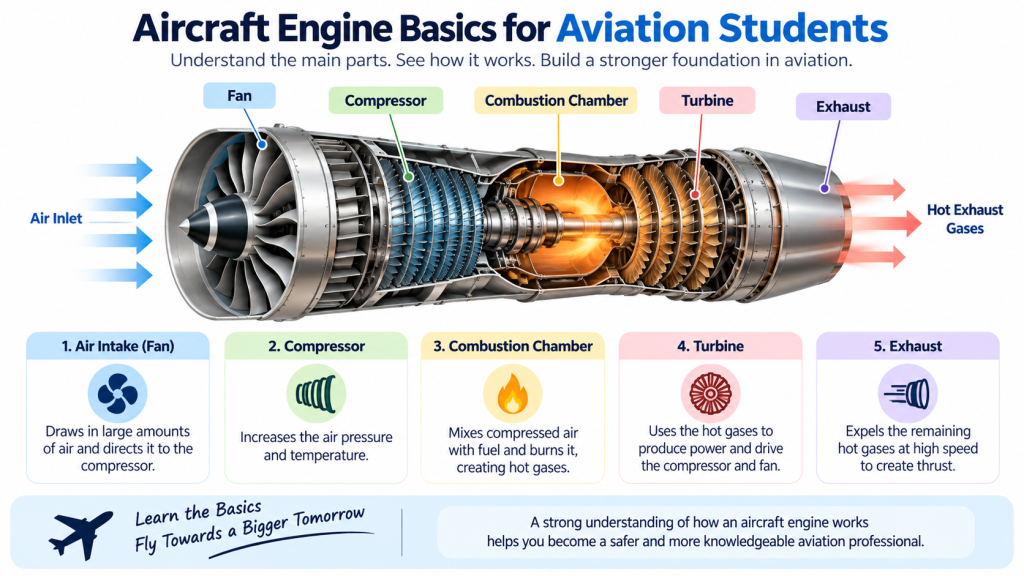
A simplified gas turbine process includes air intake, compression, combustion, expansion through turbines, and exhaust.
Air Intake
Air enters the engine through the inlet. The inlet helps deliver air to the compressor under appropriate conditions.
Compression
The compressor increases the pressure of the incoming air.
Compressing the air creates suitable conditions for efficient combustion.
Combustion
Fuel enters the combustion section and mixes with the compressed air. The mixture burns continuously rather than in individual cylinder cycles.
The combustion process significantly increases the temperature and energy of the gases.
Turbine
The hot gases pass through turbine stages. Some of their energy turns the turbine, which helps drive the compressor and, depending on the engine type, other components such as a propeller or shaft.
Exhaust
The remaining gases move toward the exhaust system. In engines that produce direct jet thrust, the exhaust flow contributes significantly to thrust.
Understanding this sequence gives aviation students a basic foundation for studying more advanced turbine-engine subjects.
Important Aircraft Engine Components
Aircraft engines contain many components, and their exact arrangement depends on the engine design.
Compressor
The compressor raises the pressure of air entering a gas turbine engine. It plays an important role in preparing air for combustion.
Combustion Chamber
The combustion chamber is where fuel burns with compressed air in a gas turbine engine. It provides the high-energy gases required for the next stages of engine operation.
Turbine
The turbine extracts energy from hot gases. That energy can drive the compressor and provide shaft power, depending on the engine design.
Exhaust Nozzle
The exhaust system guides gases away from the engine. In certain turbine engines, the nozzle also helps convert gas energy into useful jet velocity.
Propeller
A propeller converts engine shaft power into aerodynamic thrust. It does this by accelerating air backward as it rotates.
Crankshaft
In a piston engine, the crankshaft converts the reciprocating motion of the pistons into rotary motion.
Cylinders and Pistons
Cylinders contain the pistons and provide the space where combustion and pressure changes occur in a piston engine.
Fuel System
The fuel system delivers fuel to the engine in the required manner. Different engines use different fuel-system designs.
Lubrication System
The lubrication system supplies oil to important moving components. It helps reduce friction and assists with heat management and component protection.
Cooling System
Engine cooling helps maintain operating temperatures within appropriate limits. Piston engines and turbine engines use different approaches to manage heat.
Engine Power, Thrust, and Performance
Aviation students often encounter the terms horsepower, shaft horsepower, and thrust. These concepts are related to propulsion but do not mean exactly the same thing.
Horsepower is a unit used to describe mechanical power. It is commonly associated with piston engines.
Shaft horsepower describes mechanical power available at an engine’s output shaft. It is particularly relevant to engines that drive propellers or rotor systems.
Thrust is a force that moves an aircraft through the air. Jet engines primarily produce thrust through their exhaust flow, while propeller-driven aircraft obtain thrust from the propeller.
RPM, or revolutions per minute, indicates how quickly a rotating component such as an engine crankshaft or propeller is turning.
Engine performance also depends on factors such as air density, temperature, altitude, engine condition, fuel flow, and the particular engine design.
Students should avoid treating one engine indication as a complete measure of engine performance. Different parameters provide different information.
Engine Instruments Aviation Students Should Know
Engine instruments provide important information about engine operation. Students should understand what these indications represent rather than simply memorizing their names.
RPM
RPM indicates rotational speed. In a piston aircraft, it is commonly associated with crankshaft and propeller speed.
Oil Pressure
Oil pressure provides information about the lubrication system and oil circulation. Abnormal readings can indicate a condition that requires attention according to the aircraft’s procedures.
Oil Temperature
Oil temperature shows the temperature of the engine oil. Monitoring it helps provide information about engine thermal conditions.
Cylinder Head Temperature
Cylinder head temperature is particularly relevant to piston-engine operation. It provides information about the temperature of the cylinder head and helps pilots monitor engine thermal conditions.
Exhaust Gas Temperature
Exhaust gas temperature, or EGT, measures the temperature of exhaust gases at a particular point in the exhaust system. It can provide useful information about combustion and engine operation.
Manifold Pressure
Manifold pressure is commonly associated with piston engines, particularly those equipped with certain induction systems. It indicates pressure in the engine’s intake manifold.
Fuel Flow
Fuel-flow information indicates the rate at which fuel is being consumed by the engine. It can help pilots monitor engine operation and fuel use.
The exact instruments available vary according to the aircraft and engine type.
Aircraft Engine Starting Basics
Starting an aircraft engine requires several systems to work together.
A piston engine generally needs the appropriate combination of air, fuel, ignition, and mechanical rotation to begin operating. The starter initially turns the engine so that the combustion cycle can begin.
Turbine engines follow a different starting process. The starter first brings the compressor to an appropriate rotational speed. Once suitable conditions exist, fuel and ignition are introduced according to the aircraft’s approved operating procedure.
Students should remember that actual engine-starting procedures vary between aircraft. Pilots must follow the aircraft flight manual, checklist, and instructor guidance rather than relying on general explanations.
Why Lubrication and Cooling Matter
Engine components operate under significant mechanical and thermal loads. Lubrication and cooling therefore play important roles in reliable engine operation.
Engine oil reduces friction between moving components and helps carry heat away from certain engine parts. It also contributes to the protection and cleanliness of internal components.
Cooling systems help control engine temperatures. Piston engines may use air cooling, liquid cooling, or combinations of different methods depending on their design.
Gas turbine engines also require careful management of temperatures because their internal components operate under demanding thermal conditions.
For aviation students, the main concept is simple: excessive heat, inadequate lubrication, or abnormal operating conditions can affect engine performance and component life.
Common Engine Problems Students Should Understand
Students do not need to become maintenance specialists during their initial training, but they should understand common engine-related concepts.
Overheating
An engine can operate outside its intended temperature range for various reasons. Excessive temperature can affect performance and may place additional stress on engine components.
Low Oil Pressure
Low oil pressure can indicate a problem with the lubrication system or another engine-related condition. Pilots must respond according to the aircraft’s approved procedures.
Excessive Oil Temperature
High oil temperature can provide an indication of abnormal thermal conditions. The significance depends on the engine and the circumstances.
Abnormal RPM
An unexpected RPM change can indicate a change in engine or propeller operation. Pilots should interpret the indication together with other engine parameters.
Engine Roughness
Rough engine operation can have different causes, including ignition, fuel, induction, or mechanical issues in piston engines. The appropriate response depends on the aircraft and operating situation.
Fuel-Related Problems
Insufficient fuel delivery, contamination, or other fuel-system issues can affect engine operation. Aviation students should understand the importance of proper fuel management and monitoring.
Turbine Engine Problems
Turbine engines can experience issues involving temperature, pressure, airflow, fuel delivery, compressor operation, or turbine performance. These systems require specialized knowledge and aircraft-specific procedures.
Common Mistakes Aviation Students Make
Learning aircraft engines can feel complicated at first. Some common mistakes can make the subject more difficult than it needs to be.
Memorizing Without Understanding
Students sometimes memorize component names without understanding what each component actually does. Understanding the relationship between components makes technical knowledge easier to remember.
Confusing Power and Thrust
Horsepower and thrust are not interchangeable terms. Students should understand how mechanical power and aerodynamic thrust relate to different propulsion systems.
Mixing Engine Types
A piston engine and a turbine engine operate according to different principles. Students should clearly separate their operating cycles and components.
Ignoring Engine Instruments
Engine instruments are not just numbers on a panel. They provide information about engine condition and operation.
Focusing Only on Theory
Technical knowledge becomes easier to understand when students connect classroom concepts with actual aircraft systems and flight training.
Ignoring Aircraft-Specific Information
General engine knowledge provides a foundation, but each aircraft has its own limitations, systems, procedures, and documentation. Students should always use the approved information for the aircraft they are studying.
Important Considerations for Aviation Students
Aircraft engines are complex systems, and basic knowledge is only the beginning.
First, remember that not every aircraft engine operates in the same way. Even engines within the same general category can have significant differences.
Second, learn the basic principles before trying to memorize large numbers of technical terms. Understanding how air, fuel, combustion, power, and exhaust interact provides a stronger foundation.
Third, always consider engine indications in context. A single reading does not necessarily explain the complete condition of an engine.
Finally, practical aircraft operation should always follow the aircraft’s approved documentation and the guidance of qualified instructors and maintenance professionals. General educational information cannot replace aircraft-specific procedures.
Frequently Asked Questions
1. What is the main purpose of an aircraft engine?
The main purpose of an aircraft engine is to provide the power or thrust required for flight. Depending on the engine type, it may drive a propeller, rotor system, or produce thrust directly.
2. What are the main types of aircraft engines?
Common types include piston engines, turboprops, turbojets, turbofans, and turboshaft engines. Each type uses a different method to convert fuel energy into useful power or thrust.
3. What is the difference between a piston engine and a turbine engine?
A piston engine uses reciprocating pistons inside cylinders, while a gas turbine uses continuous airflow through a compressor, combustion section, turbine, and exhaust system.
4. How does a four-stroke aircraft engine work?
A four-stroke piston engine operates through intake, compression, power, and exhaust strokes. These stages repeat continuously while the engine operates.
5. What is the difference between horsepower and thrust?
Horsepower measures mechanical power, while thrust is a force that moves the aircraft through the air. Propeller-driven aircraft use engine power to turn the propeller and generate thrust.
6. Why is engine oil important?
Engine oil reduces friction, helps manage heat, and protects moving components in the lubrication system.
7. What does RPM indicate?
RPM means revolutions per minute. It indicates how quickly a rotating component, such as an engine crankshaft or propeller, is rotating.
8. What does a compressor do in a turbine engine?
A compressor increases the pressure of incoming air before it reaches the combustion section. This supports the combustion process and overall engine operation.
9. Why should aviation students study aircraft engines?
Engine knowledge helps students understand aircraft systems, performance, engine instruments, technical subjects, and basic propulsion principles.
10. Are all aircraft engines operated in the same way?
No. Operating characteristics and procedures vary significantly between piston, turboprop, turbojet, turbofan, and turboshaft engines, as well as between individual aircraft models.
Conclusion
Understanding aircraft engine basics gives aviation students an important foundation for their technical education. Students should learn how different engines convert fuel energy into mechanical power or thrust and understand the role of their major components.
The goal is not simply to memorize engine terminology. A stronger approach is to understand how the major systems work together and how engine indications relate to aircraft operation. As students progress through their aviation training, this basic knowledge can support more advanced study of aircraft systems, performance, and flight operations.

