
Introduction
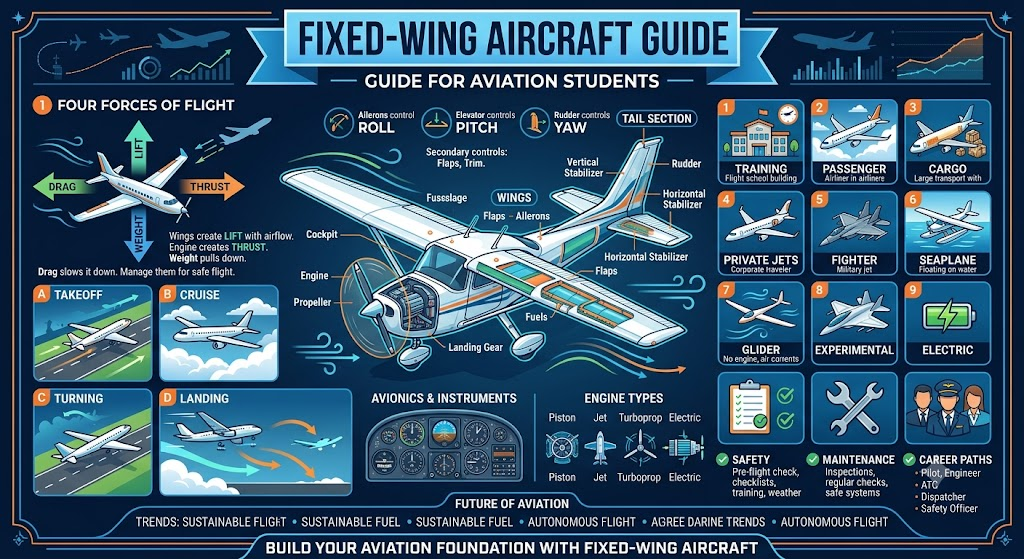
Fixed-wing aircraft are the most common aircraft that aviation students study during the early stages of learning. Most airplanes used for passenger travel, pilot training, cargo transport, private aviation, military missions, research, and agricultural work are fixed-wing aircraft. They are called fixed-wing aircraft because their wings stay in a fixed position and create lift as air flows over them during forward movement.
For aviation students, understanding fixed-wing aircraft is very important because it builds the foundation for flight training, aircraft maintenance, aerodynamics, navigation, safety, and aviation career planning. Whether you want to become a pilot, aircraft maintenance engineer, aerospace engineer, flight instructor, aviation safety officer, or airline operations professional, learning how fixed-wing aircraft work will help you understand the basics of flight more clearly.
This guide explains fixed-wing aircraft in simple language. It covers their meaning, main parts, working principle, flight controls, engine types, takeoff, landing, safety basics, maintenance basics, and career paths related to fixed-wing aviation.
What Is a Fixed-Wing Aircraft?
A fixed-wing aircraft is an aircraft that has wings that remain fixed in position during flight. These wings do not rotate like helicopter blades. Instead, they create lift when the aircraft moves forward and air flows over the wing surface.
In simple words, a fixed-wing aircraft is an aircraft with non-moving wings that help it fly.
Most airplanes are fixed-wing aircraft. They usually need forward motion to generate lift. This means they must move through the air at enough speed before they can take off and stay airborne.
Common examples of fixed-wing aircraft include:
- Training airplanes
- Passenger airplanes
- Cargo airplanes
- Private jets
- Fighter aircraft
- Seaplanes
- Agricultural aircraft
- Gliders
- Experimental aircraft
- Electric airplanes
Fixed-wing aircraft may use propellers, jet engines, turboprop engines, electric motors, or hybrid systems depending on their size, purpose, and design.
Why Are Fixed-Wing Aircraft Important for Aviation Students?
Fixed-wing aircraft are important for aviation students because they are used in many areas of aviation learning and professional flying. Most student pilots begin their training on small fixed-wing aircraft because they are stable, practical, and suitable for learning basic flight controls.
Aviation students should understand fixed-wing aircraft because they are connected to:
- Pilot training
- Commercial aviation
- Aircraft maintenance
- Flight safety
- Aerodynamics
- Navigation
- Aircraft systems
- Weather decision-making
- Airport operations
- Aviation career preparation
For pilot trainees, fixed-wing aircraft help develop flying skills such as takeoff, landing, turning, climbing, descending, radio communication, and emergency handling. For maintenance students, they help explain aircraft systems, engine checks, control surfaces, landing gear, fuel systems, and inspection procedures.
For aerospace learners, fixed-wing aircraft provide a practical way to understand lift, drag, thrust, weight, wing design, aircraft stability, and flight performance.
How Fixed-Wing Aircraft Work
Fixed-wing aircraft work by using forward motion and wing design to create lift. When the aircraft moves forward, air flows over and under the wings. The wing shape, also called an airfoil, helps create an upward force called lift. When lift becomes greater than the aircraft’s weight, the aircraft can rise into the air.
The basic working of fixed-wing aircraft depends on four forces of flight:
- Lift
- Weight
- Thrust
- Drag
These four forces work together during every stage of flight, including takeoff, climb, cruise, descent, and landing.
Lift
Lift is the upward force that helps the aircraft fly. In fixed-wing aircraft, lift is mainly created by the wings. The faster the aircraft moves through the air, the more airflow passes over the wings, which helps generate lift.
Lift depends on:
- Wing shape
- Airspeed
- Angle of attack
- Wing size
- Air density
- Aircraft weight
Without enough lift, a fixed-wing aircraft cannot take off or stay in the air.
Weight
Weight is the downward force caused by gravity. It includes the weight of the aircraft, fuel, passengers, cargo, equipment, and baggage.
For an aircraft to take off, lift must become greater than weight. During level flight, lift and weight are usually balanced.
Thrust
Thrust is the forward force created by the aircraft engine. In propeller aircraft, the propeller pushes air backward to move the aircraft forward. In jet aircraft, the jet engine pushes high-speed exhaust gases backward to create forward movement.
Thrust helps the aircraft gain speed, and speed helps the wings generate lift.
Drag
Drag is the resistance created by air as the aircraft moves forward. Drag works opposite to thrust. Aircraft are designed with smooth shapes to reduce drag and improve performance.
During flight, thrust must overcome drag so the aircraft can maintain speed.
Main Parts of a Fixed-Wing Aircraft
A fixed-wing aircraft has many parts that work together to make flight possible. Aviation students should understand the basic function of each part.
Fuselage
The fuselage is the main body of the aircraft. It holds the cockpit, passengers, cargo, fuel systems, equipment, and aircraft structure. In a passenger aircraft, the cabin is inside the fuselage. In training aircraft, the fuselage is usually smaller and simpler.
The fuselage connects major parts such as the wings, tail section, landing gear, and engine.
Wings
The wings are the main lift-producing parts of a fixed-wing aircraft. They are designed with an airfoil shape so that airflow can create lift.
Wings may also contain:
- Fuel tanks
- Ailerons
- Flaps
- Slats
- Spoilers
- Structural supports
Wings are one of the most important parts aviation students study when learning aerodynamics.
Cockpit
The cockpit is where the pilot controls the aircraft. It contains flight instruments, control yoke or stick, throttle, pedals, communication systems, navigation equipment, warning systems, and engine controls.
In modern aircraft, cockpits may include digital displays, autopilot systems, weather information, and advanced navigation tools.
Engine
The engine provides power for the aircraft. It creates thrust either by turning a propeller, driving a turbine, or producing jet exhaust.
Small training aircraft commonly use piston engines. Commercial aircraft often use jet engines or turboprop engines. Future aircraft may use electric or hybrid systems.
Propeller or Jet Engine
A propeller is a rotating blade system that pulls or pushes air backward to move the aircraft forward. Propeller aircraft are common in training, regional flying, and small aircraft operations.
A jet engine works by taking in air, compressing it, mixing it with fuel, burning the mixture, and pushing exhaust backward at high speed. Jet engines are common in passenger jets, private jets, cargo aircraft, and fighter aircraft.
Tail Section
The tail section helps control stability and direction. It usually includes the vertical stabilizer, horizontal stabilizer, rudder, and elevator.
The tail helps keep the aircraft balanced and prevents unwanted movement during flight.
Horizontal Stabilizer
The horizontal stabilizer is the horizontal part of the tail. It helps control pitch stability, which means it helps manage the up-and-down movement of the aircraft nose.
Vertical Stabilizer
The vertical stabilizer is the upright fin on the tail. It helps control yaw stability, which means it helps keep the aircraft nose from swinging left or right unexpectedly.
Ailerons
Ailerons are movable surfaces on the wings. They control roll, which is the movement where one wing goes up and the other wing goes down.
Pilots use ailerons to help turn the aircraft.
Elevator
The elevator is located on the horizontal stabilizer. It controls pitch, which is the up-and-down movement of the aircraft nose.
When the elevator moves, the aircraft nose can rise or lower.
Rudder
The rudder is located on the vertical stabilizer. It controls yaw, which is the left-right movement of the aircraft nose.
Pilots control the rudder using foot pedals.
Flaps
Flaps are movable surfaces on the wings. They are mainly used during takeoff and landing. Flaps increase lift at lower speeds and help the aircraft fly safely during slower flight phases.
Landing Gear
Landing gear includes wheels, struts, brakes, and support systems. It supports the aircraft on the ground and helps during taxiing, takeoff, and landing.
Some aircraft have fixed landing gear, while others have retractable landing gear that folds into the aircraft during flight.
Fuel System
The fuel system stores and supplies fuel to the engine. It includes fuel tanks, fuel lines, valves, pumps, filters, and fuel gauges.
In many fixed-wing aircraft, fuel is stored in the wings.
Avionics
Avionics are the electronic systems used in aircraft. They include navigation, communication, weather radar, flight displays, transponders, autopilot, and monitoring systems.
Avionics help pilots fly safely and accurately.
Types of Fixed-Wing Aircraft
Fixed-wing aircraft come in many types. Each type is designed for a specific purpose.
1- Training Aircraft
Training aircraft are used by student pilots to learn how to fly. These aircraft are usually small, stable, simple to operate, and suitable for beginner flight lessons.
Training aircraft help students learn:
- Basic aircraft control
- Takeoff
- Landing
- Turns
- Climbs
- Descents
- Navigation
- Emergency procedures
- Radio communication
They are very important in flight schools because they help students build confidence and practical flying skills.
2- Passenger Aircraft
Passenger aircraft are used by airlines to carry people from one place to another. These aircraft may operate short, medium, or long-distance routes depending on their size and design.
Passenger aircraft are designed for:
- Safety
- Comfort
- Fuel efficiency
- Long-range travel
- Reliable operations
- Passenger capacity
They are one of the most visible types of fixed-wing aircraft in modern aviation.
3- Cargo Aircraft
Cargo aircraft are designed to carry goods instead of passengers. They transport packages, machinery, medical supplies, food products, military equipment, and emergency relief materials.
Cargo aircraft usually have:
- Large cargo doors
- Strong floors
- Wide storage space
- Loading systems
- Long-range capability
- Heavy-lift design
They are important for global trade, logistics, e-commerce, and disaster response.
4- Private Jets
Private jets are fixed-wing aircraft used for business travel, personal travel, charter services, and time-sensitive journeys. They are usually smaller than commercial airliners but offer flexibility and privacy.
Private jets are commonly used by:
- Business executives
- Entrepreneurs
- Government officials
- Charter passengers
- Medical travel users
- High-priority travelers
They can often operate from smaller airports and follow flexible schedules.
5- Fighter Aircraft
Fighter aircraft are military fixed-wing aircraft designed for speed, maneuverability, and defense missions. They are used by air forces for air defense, patrol, training, surveillance support, and tactical operations.
Fighter aircraft are usually fast, powerful, and highly responsive. Aviation students may study fighter aircraft to understand high-performance aerodynamics and advanced aircraft systems.
6- Agricultural Aircraft
Agricultural aircraft are used in farming and field operations. They are often designed to fly low and carry spray equipment or monitoring systems.
They are used for:
- Crop spraying
- Seed spreading
- Fertilizer application
- Pest control
- Field inspection
- Farm mapping
Modern agriculture also uses drones, but fixed-wing agricultural aircraft remain important for large field operations.
7- Seaplanes
Seaplanes are fixed-wing aircraft that can take off from and land on water. They may have floats under the fuselage or a boat-like body called a hull.
Seaplanes are useful in:
- Island regions
- Lake areas
- Coastal communities
- Remote tourism
- Water rescue
- Remote cargo transport
They are helpful where runways are not available.
8- Gliders
Gliders are fixed-wing aircraft without engines. They use air currents and aerodynamic design to stay in the air.
Gliders are used for:
- Sport aviation
- Aerodynamics training
- Flight experience
- Student learning
- Recreational flying
Gliding helps aviation students understand lift, drag, energy management, and smooth aircraft control.
9- Experimental Aircraft
Experimental aircraft are used for testing, research, innovation, and learning. They may test new materials, engines, wing designs, control systems, or aviation concepts.
They are important because they help improve future aircraft technology and support aerospace development.
10- Electric Fixed-Wing Aircraft
Electric fixed-wing aircraft use electric motors instead of traditional fuel-powered engines. Some are fully electric, while others may use hybrid systems.
Electric aircraft are being explored for:
- Cleaner flight
- Lower noise
- Short-distance travel
- Training flights
- Urban and regional mobility
- Future aviation development
Electric aviation is still developing, but it is an important area for aviation students to understand.
Fixed-Wing Aircraft vs Rotary-Wing Aircraft
Fixed-wing and rotary-wing aircraft are both important, but they work differently.
| Category | Fixed-Wing Aircraft | Rotary-Wing Aircraft |
|---|---|---|
| Wing Design | Fixed wings remain in position | Rotating blades create lift |
| Lift Generation | Lift is created by airflow over wings | Lift is created by spinning rotors |
| Takeoff Method | Usually needs runway and forward speed | Can often take off vertically |
| Landing Needs | Usually needs runway or landing strip | Can land in small open spaces |
| Speed | Usually faster | Usually slower |
| Range | Usually longer range | Usually shorter range |
| Hovering Ability | Cannot normally hover | Can hover in one place |
| Common Uses | Passenger travel, cargo, training, private flying | Rescue, medical flights, police, military, tourism |
| Training Focus | Runway operations, navigation, cruise flight | Hovering, vertical lift, low-speed control |
| Best Use Case | Long-distance and efficient travel | Tight-space and special mission operations |
In simple words, fixed-wing aircraft are better for speed, range, and efficient travel, while rotary-wing aircraft are better for hovering, rescue missions, and landing in small spaces.
How Fixed-Wing Aircraft Take Off
Takeoff is the process of moving from the ground into the air. A fixed-wing aircraft usually needs a runway to build enough speed for lift.
The takeoff process includes several steps.
Taxiing to the Runway
Before takeoff, the aircraft moves slowly on the ground from the parking area to the runway. This movement is called taxiing.
Engine Power Increase
Once aligned with the runway, the pilot increases engine power using the throttle. The aircraft begins moving forward faster.
Acceleration
As the aircraft accelerates, air flows faster over the wings. This increases lift.
Airflow Over Wings
The wing shape helps guide airflow. As the speed increases, the wings generate more lift.
Lift Generation
When lift becomes strong enough, the aircraft is ready to leave the ground.
Rotation
Rotation is when the pilot gently raises the aircraft nose at the correct speed. This helps the aircraft lift off the runway.
Initial Climb
After leaving the ground, the aircraft begins climbing to a safe altitude.
Landing Gear Retraction
In aircraft with retractable landing gear, the wheels may be pulled into the aircraft after takeoff to reduce drag.
How Fixed-Wing Aircraft Stay in the Air
Once airborne, a fixed-wing aircraft stays in the air by balancing lift, weight, thrust, and drag. During cruise flight, lift usually balances weight, and thrust balances drag.
The pilot manages:
- Airspeed
- Altitude
- Direction
- Engine power
- Fuel use
- Weather conditions
- Navigation
- Aircraft balance
- Communication
Trim helps reduce the control pressure needed to keep the aircraft stable. Flight instruments help the pilot monitor altitude, speed, heading, attitude, climb rate, and engine performance.
Modern fixed-wing aircraft may use autopilot systems during cruise flight, but pilots still monitor the aircraft and remain responsible for safe operation.
How Fixed-Wing Aircraft Turn
Fixed-wing aircraft turn mainly by banking. Banking means one wing goes down and the other wing goes up. This is controlled by ailerons.
A proper turn uses:
- Ailerons
- Rudder
- Elevator
- Bank angle
- Coordinated control
Ailerons in Turning
Ailerons help roll the aircraft left or right. When one aileron moves up and the other moves down, the aircraft banks.
Rudder in Turning
The rudder helps keep the aircraft nose aligned during the turn. It prevents slipping or skidding.
Elevator in Turning
The elevator helps maintain altitude during the turn. Without proper elevator control, the aircraft may lose altitude.
Bank Angle
Bank angle is the angle between the aircraft wings and the horizon. A shallow bank creates a gentle turn, while a steep bank creates a sharper turn.
Coordinated Turn
A coordinated turn means the ailerons, rudder, and elevator are used smoothly together. Aviation students practice coordinated turns to improve safety and control.
How Fixed-Wing Aircraft Land
Landing is the process of bringing the aircraft safely back to the ground. It requires planning, speed control, runway alignment, and smooth control.
Descent Planning
The pilot plans the descent based on altitude, distance, weather, airport conditions, and air traffic instructions.
Approach
The aircraft lines up with the runway and descends toward it at a controlled speed.
Speed Reduction
The pilot reduces engine power and adjusts the aircraft configuration to slow down safely.
Flap Extension
Flaps are extended to increase lift and drag. This helps the aircraft fly safely at lower speeds during landing.
Landing Gear Lowering
If the aircraft has retractable landing gear, the pilot lowers the landing gear before landing.
Final Approach
Final approach is the last part of the approach when the aircraft is aligned with the runway and descending toward touchdown.
Flare
Just before touchdown, the pilot gently raises the nose to reduce the descent rate. This is called the flare.
Touchdown
Touchdown happens when the wheels contact the runway.
Braking
After touchdown, the pilot uses brakes and other systems to slow the aircraft.
Taxiing After Landing
After slowing down, the aircraft exits the runway and taxis to the parking area or terminal.
Flight Controls in Fixed-Wing Aircraft
Flight controls help pilots guide and stabilize the aircraft. They are usually divided into primary and secondary controls.
Primary Flight Controls
Primary flight controls manage the main movements of the aircraft.
Ailerons
Ailerons control roll. They are located on the wings and help the aircraft bank left or right.
Elevator
The elevator controls pitch. It moves the nose of the aircraft up or down.
Rudder
The rudder controls yaw. It moves the aircraft nose left or right and helps keep turns coordinated.
Secondary Flight Controls
Secondary flight controls help improve aircraft performance during different phases of flight.
Flaps
Flaps increase lift and drag. They are used during takeoff and landing.
Slats
Slats are located on the leading edge of the wing. They help improve lift at lower speeds.
Spoilers
Spoilers reduce lift and increase drag. They are often used during descent and after landing.
Trim Tabs
Trim tabs help reduce pilot workload by holding control surfaces in a desired position. They make it easier to maintain stable flight.
Common Instruments in Fixed-Wing Aircraft
Aviation students should understand basic cockpit instruments because they help pilots fly safely.
Airspeed Indicator
The airspeed indicator shows how fast the aircraft is moving through the air.
Altimeter
The altimeter shows the aircraft’s altitude.
Attitude Indicator
The attitude indicator shows the aircraft’s position compared to the horizon. It helps the pilot understand whether the aircraft is level, climbing, descending, or banking.
Heading Indicator
The heading indicator shows the direction the aircraft is pointing.
Vertical Speed Indicator
The vertical speed indicator shows whether the aircraft is climbing or descending and how quickly.
Turn Coordinator
The turn coordinator helps the pilot understand turn rate and coordination.
Engine Instruments
Engine instruments show important information such as engine speed, oil pressure, oil temperature, fuel quantity, and engine performance.
Navigation Display
Navigation displays help pilots follow routes, waypoints, airports, and navigation signals.
Communication Radio
The communication radio allows pilots to speak with air traffic control, other aircraft, and airport operators.
Autopilot System
The autopilot system can help control aircraft heading, altitude, speed, and route during certain phases of flight. Pilots still monitor the aircraft and remain responsible for safe flight.
Fixed-Wing Aircraft Engine Types
Fixed-wing aircraft use different engine types depending on size, purpose, speed, and range.
Piston Engine
Piston engines are common in small training aircraft and general aviation aircraft. They are similar in basic concept to car engines but designed for aviation use.
Piston engines often drive propellers and are commonly used for flight training.
Turboprop Engine
A turboprop engine uses a turbine engine to drive a propeller. Turboprops are common in regional aircraft, utility aircraft, cargo aircraft, and some training aircraft.
They are efficient for shorter routes and operations from smaller airports.
Jet Engine
Jet engines are common in commercial airliners, private jets, cargo aircraft, and military aircraft. They create strong thrust and are suitable for high-speed and long-distance flying.
Electric Motor
Electric motors are used in some modern and experimental aircraft. They are quieter and may reduce emissions for short-distance operations.
Hybrid Engine
Hybrid engines combine traditional fuel-powered systems with electric power. They are being studied as part of future aviation development.
Advantages of Fixed-Wing Aircraft
Fixed-wing aircraft have many advantages, especially for travel, training, transport, and long-distance operations.
Higher Speed
Fixed-wing aircraft are usually faster than helicopters and many other aircraft types. This makes them useful for passenger travel and cargo transport.
Longer Range
Many fixed-wing aircraft can travel long distances efficiently. This makes them suitable for domestic and international flights.
Better Fuel Efficiency for Long-Distance Travel
For long-distance operations, fixed-wing aircraft are often more efficient than rotary-wing aircraft.
Larger Passenger and Cargo Capacity
Large fixed-wing aircraft can carry many passengers or heavy cargo over long distances.
Stable Cruise Flight
Fixed-wing aircraft are designed for stable cruise flight, which makes them suitable for training, travel, and transport.
Useful for Pilot Training
Most student pilots begin with fixed-wing aircraft because they are practical for learning flight basics.
Suitable for Commercial Aviation
Airlines mainly use fixed-wing aircraft because they are efficient, fast, and capable of carrying many passengers.
Limitations of Fixed-Wing Aircraft
Fixed-wing aircraft are highly useful, but they also have some limitations.
Usually Need Runways
Most fixed-wing aircraft need runways for takeoff and landing. This limits where they can operate compared to helicopters.
Cannot Hover Like Helicopters
Fixed-wing aircraft usually cannot hover in one place because they need forward motion to create lift.
Require Forward Speed for Lift
A fixed-wing aircraft must keep moving through the air to generate lift. If speed becomes too low, the aircraft may stall.
Need Planned Takeoff and Landing Space
Runway length, surface condition, wind direction, and aircraft weight must be considered before takeoff and landing.
Less Suitable for Tight Landing Areas
Fixed-wing aircraft are not ideal for small spaces, rooftops, or very restricted landing zones.
Weather and Runway Conditions Matter
Strong winds, heavy rain, poor visibility, snow, and runway condition can affect fixed-wing aircraft operations.
Fixed-Wing Aircraft Safety Basics
Safety is one of the most important areas of aviation learning. Fixed-wing aircraft operations follow strict safety practices.
Pre-Flight Inspection
Before flight, pilots inspect the aircraft to check fuel, oil, tires, control surfaces, wings, lights, instruments, and general condition.
Pilot Training
Pilots must complete proper training before operating aircraft. Training includes flight handling, navigation, weather, communication, emergency procedures, and aircraft systems.
Aircraft Maintenance
Regular maintenance ensures that aircraft systems work properly. Maintenance teams inspect engines, airframes, avionics, landing gear, and controls.
Weather Checking
Pilots check weather conditions before and during flight. Weather affects visibility, wind, turbulence, clouds, storms, and runway conditions.
Weight and Balance Calculation
Weight and balance are important for safe flight. If the aircraft is overloaded or not balanced properly, performance and control may be affected.
Fuel Planning
Pilots must carry enough fuel for the planned flight, alternate routes, reserves, and unexpected delays.
Communication With Air Traffic Control
Air traffic control helps pilots maintain safe separation, follow routes, and operate safely in controlled airspace.
Emergency Procedures
Pilots learn emergency procedures for engine problems, instrument failures, weather changes, communication issues, and landing emergencies.
Checklists
Checklists help pilots complete important steps in the correct order. They reduce mistakes and improve safety.
Regular Inspections
Aircraft must go through scheduled inspections to confirm they are safe and airworthy.
Fixed-Wing Aircraft in Pilot Training
Fixed-wing aircraft play a major role in pilot training. Student pilots use them to learn practical flight skills from basic handling to advanced navigation.
Basic Handling
Students learn how to control the aircraft using the yoke or stick, rudder pedals, throttle, and trim.
Straight and Level Flight
Straight and level flight teaches students how to maintain altitude, heading, and speed.
Turns
Students practice shallow, medium, and coordinated turns using ailerons, rudder, and elevator.
Climbs and Descents
Students learn how to change altitude safely by adjusting pitch and power.
Takeoff and Landing Practice
Takeoff and landing are key parts of flight training. Students practice runway alignment, rotation, climb, approach, flare, touchdown, and braking.
Navigation
Students learn how to follow routes, read charts, use navigation instruments, and plan flights.
Radio Communication
Radio communication teaches students how to speak clearly with air traffic control and other aviation services.
Emergency Procedures
Students practice handling simulated emergencies such as engine failure, forced landing, radio failure, and abnormal situations.
Solo Flight Preparation
Before solo flight, students must show that they can control the aircraft safely without an instructor onboard.
Fixed-Wing Aircraft Maintenance Basics
Aviation students interested in maintenance should understand basic inspection areas.
Engine Checks
Engine checks include oil level, fuel condition, cooling, ignition, engine mounts, and general performance.
Wing Inspection
Wing inspection includes checking the wing surface, leading edge, trailing edge, fuel caps, and structural condition.
Control Surface Checks
Ailerons, elevator, rudder, flaps, and trim tabs must move correctly and safely.
Fuel System Inspection
Fuel tanks, fuel lines, drains, caps, filters, and fuel quantity must be checked.
Landing Gear Checks
Tires, brakes, struts, wheels, and gear structure must be inspected for safe ground operation.
Avionics Checks
Communication, navigation, transponder, displays, and electrical systems must function properly.
Airframe Inspection
The airframe must be checked for cracks, dents, corrosion, loose parts, and structural issues.
Scheduled Maintenance
Aircraft follow scheduled maintenance programs based on operating time, calendar intervals, and regulatory requirements.
Common Fixed-Wing Aircraft Terms for Students
Airfoil
An airfoil is the shape of a wing designed to produce lift when air flows over it.
Angle of Attack
Angle of attack is the angle between the wing and the incoming airflow. It affects how much lift the wing produces.
Stall
A stall happens when the wing loses smooth airflow and cannot produce enough lift. It usually happens when the angle of attack becomes too high.
Lift
Lift is the upward force that helps an aircraft fly.
Drag
Drag is air resistance that slows the aircraft down.
Thrust
Thrust is the forward force created by the engine or propeller.
Pitch
Pitch is the up-and-down movement of the aircraft nose.
Roll
Roll is the movement where one wing goes up and the other wing goes down.
Yaw
Yaw is the left-right movement of the aircraft nose.
Bank Angle
Bank angle is the tilt of the aircraft during a turn.
Trim
Trim helps reduce the control pressure needed to keep the aircraft stable.
Flaps
Flaps are wing surfaces used to increase lift and drag, especially during takeoff and landing.
Runway
A runway is a prepared surface used for aircraft takeoff and landing.
Taxiing
Taxiing means moving the aircraft on the ground.
Cruise
Cruise is the main part of flight when the aircraft is flying at a steady altitude and speed.
Approach
Approach is the phase of flight when the aircraft prepares to land.
Final Approach
Final approach is the last straight path toward the runway before landing.
Career Paths Related to Fixed-Wing Aircraft
Studying fixed-wing aircraft can support many aviation career paths.
Commercial Pilot
Commercial pilots fly aircraft professionally. They may work for airlines, charter companies, cargo operators, or private aviation companies.
Flight Instructor
Flight instructors train student pilots and help them build flying skills.
Aircraft Maintenance Engineer
Aircraft maintenance engineers inspect, repair, and maintain aircraft systems to keep them safe and airworthy.
Aerospace Engineer
Aerospace engineers design, test, and improve aircraft, engines, materials, and flight systems.
Air Traffic Controller
Air traffic controllers guide aircraft safely through controlled airspace and airport areas.
Airline Operations Professional
Airline operations professionals manage scheduling, flight planning, ground operations, crew coordination, and aircraft movement.
Aviation Safety Officer
Aviation safety officers monitor safety practices, investigate risks, and help improve aviation safety systems.
Aircraft Dispatcher
Aircraft dispatchers help plan flights, check weather, calculate fuel, monitor routes, and support pilots from the ground.
Drone and UAV Specialist
Fixed-wing knowledge can also support drone and UAV careers, especially for larger unmanned fixed-wing systems.
Aviation Researcher
Aviation researchers study aircraft performance, safety, materials, flight systems, and future technologies.
Future of Fixed-Wing Aircraft
The future of fixed-wing aviation is focused on cleaner, safer, smarter, and more efficient aircraft.
Electric Fixed-Wing Aircraft
Electric aircraft may reduce noise and emissions, especially for short-distance flights and training operations.
Hybrid Aircraft
Hybrid aircraft combine traditional engines with electric power to improve efficiency and reduce fuel use.
Sustainable Aviation Fuel
Sustainable aviation fuel is being developed to reduce the environmental impact of aviation.
Lightweight Materials
Modern aircraft use lighter materials to reduce weight and improve fuel efficiency.
Advanced Avionics
Digital avionics help pilots with navigation, communication, monitoring, and safety.
Autonomous Flight Systems
Automation may support future aircraft operations, especially in monitoring, navigation, and unmanned flight.
More Efficient Wing Designs
Improved wing designs can reduce drag, increase lift efficiency, and improve aircraft performance.
Cleaner and Quieter Aircraft
Future fixed-wing aircraft may use improved engines, electric systems, better aerodynamics, and advanced materials to reduce noise and pollution.
FAQs
1- What is a fixed-wing aircraft?
A fixed-wing aircraft is an aircraft with wings that remain fixed in position during flight. These wings create lift when air flows over them. Most airplanes are fixed-wing aircraft, including training airplanes, passenger aircraft, cargo aircraft, private jets, fighter aircraft, and gliders.
2- How does a fixed-wing aircraft fly?
A fixed-wing aircraft flies by moving forward through the air. As air flows over the wings, the wing shape creates lift. The engine provides thrust, gravity creates weight, and air resistance creates drag. When lift and thrust are managed correctly, the aircraft can take off, climb, cruise, descend, and land.
3- What is the difference between fixed-wing and rotary-wing aircraft?
Fixed-wing aircraft have wings that stay in one position and usually need forward speed to fly. Rotary-wing aircraft use rotating blades to create lift and can often take off vertically. Airplanes are fixed-wing aircraft, while helicopters are rotary-wing aircraft.
4- Are all airplanes fixed-wing aircraft?
Yes, most airplanes are fixed-wing aircraft because they have wings that remain fixed in position. These wings create lift when the airplane moves forward. Passenger airplanes, cargo airplanes, training airplanes, fighter jets, and private jets are all fixed-wing aircraft.
5- What are the main parts of a fixed-wing aircraft?
The main parts of a fixed-wing aircraft include the fuselage, wings, cockpit, engine, tail section, landing gear, control surfaces, fuel system, and avionics. Each part has a specific role. Wings create lift, the engine creates thrust, and control surfaces help guide the aircraft.
6- What are fixed-wing aircraft used for?
Fixed-wing aircraft are used for passenger travel, pilot training, cargo transport, business travel, military operations, agriculture, research, tourism, and emergency supply delivery. They are widely used because they are efficient, fast, and suitable for long-distance flight.
7- Why do fixed-wing aircraft need runways?
Most fixed-wing aircraft need runways because they require forward speed to generate lift. During takeoff, the aircraft accelerates on the runway until enough air flows over the wings. During landing, the runway provides space for touchdown, braking, and safe stopping.
8- Can fixed-wing aircraft hover?
Most fixed-wing aircraft cannot hover because they need forward motion to create lift. Helicopters can hover because their rotating blades create lift even when the aircraft is not moving forward. Some special aircraft may have vertical lift technology, but normal fixed-wing aircraft cannot hover.
9- What type of fixed-wing aircraft is used for pilot training?
Small training airplanes are commonly used for pilot training. They are usually simple, stable, and easy to control. These aircraft help student pilots learn takeoff, landing, turning, climbing, descending, navigation, radio communication, and emergency procedures.
10- What are the four forces of flight?
The four forces of flight are lift, weight, thrust, and drag. Lift pushes the aircraft upward, weight pulls it downward, thrust moves it forward, and drag slows it down. These forces must be balanced properly for safe flight.
11- What engine types are used in fixed-wing aircraft?
Fixed-wing aircraft may use piston engines, turboprop engines, jet engines, electric motors, or hybrid engines. Small training aircraft often use piston engines. Regional aircraft may use turboprops. Commercial jets, cargo jets, and private jets commonly use jet engines.
12- Is a glider a fixed-wing aircraft?
Yes, a glider is a fixed-wing aircraft because it has wings that remain fixed in position. Unlike most aircraft, a glider does not use an engine for normal flight. It stays in the air by using air currents, lift, and careful energy management.
Conclusion
Fixed-wing aircraft are one of the most important aircraft categories in aviation. They use fixed wings to create lift and rely on forward movement, thrust, and aerodynamic design to fly safely. For aviation students, learning about fixed-wing aircraft is essential because it builds a strong foundation in flight principles, aircraft parts, controls, instruments, safety, maintenance, and pilot training. From small training airplanes to large passenger jets, cargo aircraft, private jets, gliders, and future electric aircraft, fixed-wing aviation supports travel, trade, education, defense, agriculture, and research. Understanding how these aircraft work helps students become more confident, informed, and prepared for aviation careers. Whether your goal is to fly, maintain, design, manage, or study aircraft, fixed-wing aircraft knowledge is a powerful first step in your aviation journey.

