
Introduction
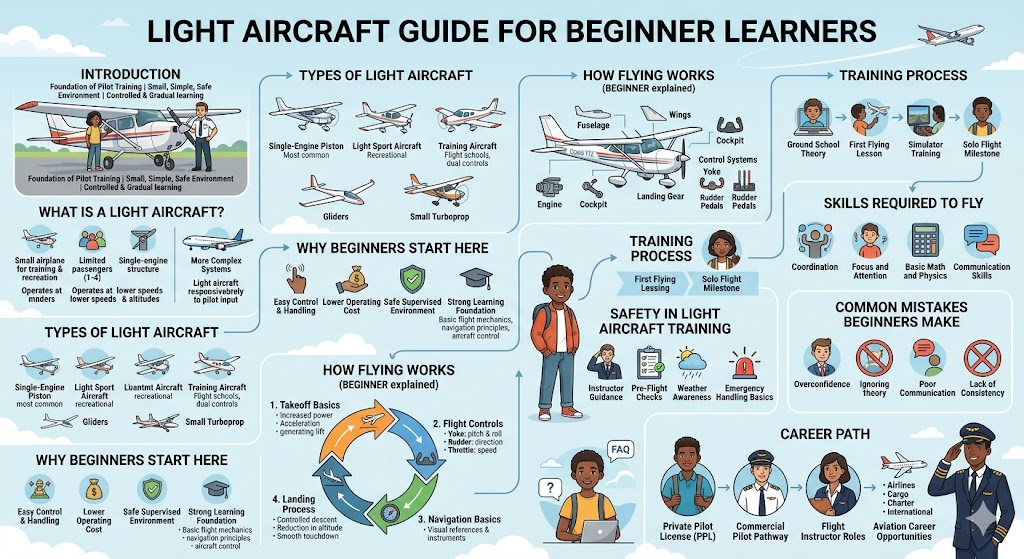
Light aircraft are the foundation of modern pilot training and one of the most important starting points for anyone who dreams of becoming a pilot. These aircraft are small, simple, and designed to help beginners understand the fundamentals of flying in a controlled and safe environment.
For beginner learners, especially those with little or no aviation experience, light aircraft offer the perfect balance between practicality and learning. They are widely used in flight schools around the world because they allow students to gradually build confidence, develop core flying skills, and understand how an aircraft behaves in real conditions.
As aviation continues to grow globally, learning through light aircraft remains the most trusted and effective pathway for future pilots.
What is a Light Aircraft?
A light aircraft is a small airplane designed for short to medium-distance flights, usually carrying a limited number of passengers or used for training purposes.
Basic Characteristics
- Lightweight structure compared to commercial aircraft
- Typically carries 1 to 4 passengers
- Single-engine or small multi-engine design
- Operates at lower speeds and altitudes
- Easier control systems for training purposes
Difference from Commercial Aircraft
Unlike large commercial jets, light aircraft are:
- Simpler to operate
- Less complex in systems
- Used mainly for training, recreation, and private flying
- More responsive to pilot input
This simplicity makes them ideal for beginners.
Types of Light Aircraft
Understanding different types of light aircraft helps beginners choose the right training path.
Single-Engine Piston Aircraft
- Most common training aircraft
- Powered by one piston engine
- Used for pilot training and short flights
Light Sport Aircraft
- Designed for recreational flying
- Easier controls and lighter structure
- Suitable for beginners and hobby pilots
Training Aircraft
- Specifically built for flight schools
- Dual controls for instructor and student
- High safety standards for learning environments
Gliders (Optional Introduction)
- Engine-less aircraft
- Uses air currents to stay in flight
- Helps understand aerodynamics and control
Small Turboprop Aircraft
- Slightly advanced category
- Uses turbine engine
- Used for regional transport and training progression
Why Beginners Start with Light Aircraft
Light aircraft are the first step in aviation training for several important reasons.
Easy Control and Handling
They respond quickly to pilot inputs, making them easier to learn.
Lower Operating Cost
Fuel and maintenance costs are lower compared to larger aircraft.
Safe Training Environment
Designed with dual controls and instructor supervision.
Strong Learning Foundation
Students learn:
- Basic flight mechanics
- Navigation principles
- Aircraft control techniques
Basic Parts of a Light Aircraft
Understanding aircraft structure is essential for beginners.
Fuselage
The main body of the aircraft that holds passengers, cockpit, and cargo.
Wings
Provide lift and help the aircraft stay in the air.
Engine
Powers the aircraft and generates thrust.
Cockpit
Where the pilot controls the aircraft using instruments and controls.
Landing Gear
Allows safe takeoff, landing, and ground movement.
Control Systems
Includes:
- Yoke or control stick
- Rudder pedals
- Throttle controls
How Flying a Light Aircraft Works (Beginner Explanation)
Flying a light aircraft involves understanding basic phases of flight.
Takeoff Basics
- Engine power is increased
- Aircraft accelerates on runway
- Lift generated by wings allows takeoff
Flight Controls
- Yoke controls pitch and roll
- Rudder controls direction
- Throttle controls speed
Navigation Basics
Pilots follow visual references and basic instruments to stay on course.
Landing Process
- Gradual reduction in altitude
- Controlled descent
- Smooth touchdown on runway
Training Process Using Light Aircraft
Light aircraft are the backbone of pilot training programs.
Ground School Basics
Students learn theory subjects like:
- Air navigation
- Meteorology
- Aviation rules
- Aircraft systems
First Flying Lesson
- Instructor demonstrates controls
- Student learns basic handling
Simulator Training
Used to practice scenarios safely before real flying.
Solo Flight Introduction
A major milestone where students fly alone under supervision approval.
Skill Building Stages
- Basic maneuvers
- Navigation flights
- Emergency procedures
Skills Required to Fly Light Aircraft
Becoming a pilot requires more than just technical knowledge.
Coordination
Hands, eyes, and mind must work together smoothly.
Focus and Attention
Pilots must constantly monitor instruments and surroundings.
Basic Math and Physics Understanding
Helps in navigation, speed, altitude, and fuel calculations.
Communication Skills
Clear communication with air traffic control is essential.
Safety in Light Aircraft Training
Safety is the most important part of aviation training.
Instructor Guidance
Every flight is supervised by trained instructors.
Pre-Flight Checks
Aircraft is inspected before every flight.
Weather Awareness
Flights depend heavily on safe weather conditions.
Emergency Handling Basics
Students are trained to respond to unexpected situations calmly.
10. Common Mistakes Beginners Make
New learners often face challenges in the early stages.
Overconfidence
Trying advanced maneuvers too early can be risky.
Ignoring Theory
Strong theoretical knowledge is essential for safe flying.
Poor Communication
Miscommunication can lead to operational errors.
Lack of Practice Consistency
Irregular training slows down skill development.
Career Path After Learning Light Aircraft
Training on light aircraft is the first step toward a professional aviation career.
Private Pilot License (PPL)
Allows individuals to fly small aircraft privately.
Commercial Pilot Pathway
Leads to airline and commercial aviation careers.
Flight Instructor Roles
Experienced pilots can train new students.
Aviation Career Opportunities
- Airlines
- Cargo operations
- Charter services
- International aviation jobs
FAQ Section
1. What is a light aircraft used for?
Light aircraft are mainly used for pilot training, recreational flying, and short-distance travel.
2. Is it difficult to learn flying in a light aircraft?
No, they are designed specifically for beginners and training purposes.
3. How long does it take to learn flying?
It depends on training progress, but generally it takes several months to a few years.
4. Do I need a science background to fly?
Science helps, especially physics and math, but motivation and training are more important.
5. Are light aircraft safe?
Yes, they are widely used in training under strict safety supervision.
6. Can beginners fly alone?
Yes, after proper training and instructor approval, solo flights are allowed.
7. What is the cost of learning flying?
It varies based on country and training school, but it requires significant investment.
8. What skills are important for pilots?
Focus, discipline, communication, and decision-making are essential.
9. What comes after learning light aircraft?
Students can progress toward commercial pilot licenses and advanced aircraft.
10. Are light aircraft used in airlines?
No, they are mainly used for training and private flying, not commercial airline operations.
Conclusion
Light aircraft play a vital role in shaping future pilots by providing a safe, simple, and effective learning platform. For beginner learners, they represent the first real step into the world of aviation.
By understanding aircraft basics, practicing consistently, and building strong foundational skills, students can confidently progress toward advanced pilot training and aviation careers.
Every professional pilot once started with a light aircraft—making this stage one of the most important milestones in an aviation journey.

