
Introduction
Cargo aircraft play a vital role in keeping the global economy connected. While passenger aircraft carry people, cargo aircraft are designed specifically to transport goods, packages, machinery, medical supplies, and essential products across cities and countries. For aviation students, understanding cargo aircraft is important because it opens the door to careers in cargo airlines, logistics aviation, aircraft operations, and aviation management.
In today’s fast-moving world, industries like e-commerce, manufacturing, healthcare, and international trade depend heavily on air cargo. This guide explains cargo aircraft in a simple way, covering their types, working systems, advantages, limitations, and career opportunities.
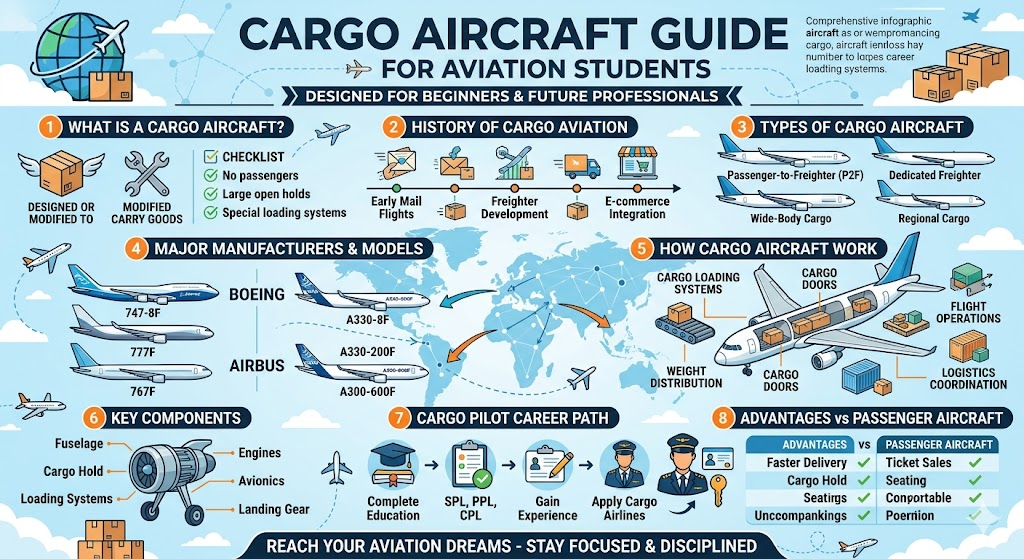
What Is a Cargo Aircraft?
A cargo aircraft is an airplane designed or modified to carry goods instead of passengers. These aircraft are built to handle heavy loads, large packages, and specialized freight that requires fast and secure transportation.
Unlike passenger aircraft, cargo planes:
- Do not carry passengers
- Have large open cargo holds
- Use special loading systems
- Focus on weight and balance efficiency
- Operate dedicated freight routes
Cargo aircraft are a key part of air freight operations, enabling fast global delivery.
History of Cargo Aviation
Cargo aviation began when aircraft were first used to transport mail and small goods over long distances. As aviation technology improved, airlines realized the need for dedicated aircraft to carry freight.
Key developments include:
- Early mail delivery flights using modified aircraft
- Growth of global trade after World War periods
- Introduction of dedicated freighter aircraft
- Expansion of global logistics companies
- Modern integration with e-commerce supply chains
Today, cargo aviation is a billion-dollar industry supporting global trade and emergency logistics.
Types of Cargo Aircraft
Cargo aircraft come in different categories depending on design and purpose.
Passenger-to-Freighter (P2F) Aircraft
These are converted passenger aircraft modified to carry cargo. Seats are removed, and cargo loading systems are installed.
Examples:
- Boeing 737 P2F conversions
- Airbus A320 freighter conversions
They are widely used due to cost efficiency and availability.
Dedicated Freighter Aircraft
These aircraft are built specifically for cargo operations and are not used for passenger travel.
Examples:
- Boeing 747 Freighter
- Boeing 767 Freighter
They offer higher payload capacity and specialized cargo design.
Wide-Body Cargo Aircraft
Wide-body freighters are large aircraft used for long-distance and heavy cargo transport.
Examples:
- Boeing 747-8F
- Airbus A330-200F
They are commonly used for international logistics.
Regional Cargo Aircraft
These are smaller aircraft used for short-distance cargo delivery between regional airports.
Examples:
- ATR cargo variants
- Embraer regional freighters
They support fast delivery between nearby cities.
Major Cargo Aircraft Manufacturers
Several major aircraft manufacturers dominate the cargo aviation industry.
Boeing Freighter Aircraft
Boeing is a leading manufacturer in cargo aviation.
Popular models:
- Boeing 747 Freighter
- Boeing 767 Freighter
- Boeing 777 Freighter
Boeing cargo aircraft are widely used for long-haul international freight operations.
Airbus Cargo Aircraft
Airbus also produces efficient cargo aircraft used globally.
Popular models:
- Airbus A330 Freighter
- Airbus A300-600F
These aircraft are known for fuel efficiency and modern design.
Other Manufacturers
- Antonov (heavy cargo aircraft like AN-124)
- Embraer (regional cargo solutions)
- Converted aircraft programs by various aviation companies
Antonov aircraft are especially known for heavy cargo transport capability.
How Cargo Aircraft Work
Cargo aircraft operate using the same basic principles as passenger aircraft but are optimized for freight transport.
Key systems include:
Cargo Loading Systems
Special rollers, belts, and containers help load and unload cargo efficiently.
Weight Distribution
Proper balance is essential to ensure safe flight performance.
Cargo Doors
Large doors allow easy loading of heavy or oversized goods.
Flight Operations
Pilots and ground staff coordinate closely to ensure safe and efficient transport.
Logistics Coordination
Cargo flights are part of a larger logistics chain involving warehouses, trucks, and airports.
Main Components of Cargo Aircraft
Fuselage
The main structure of the aircraft, designed to hold cargo instead of passengers.
Cargo Hold
A large internal space where goods are stored securely.
Loading Systems
Mechanical systems used to move cargo into and out of the aircraft.
Engines
Provide thrust and power for flight operations.
Avionics
Advanced navigation and communication systems for safe flight.
Landing Gear
Supports heavy loads during takeoff, landing, and ground operations.
Role of Cargo Aircraft in Global Trade
Cargo aircraft are essential for global supply chains.
They are used for:
- E-commerce deliveries
- Medical supply transportation
- Electronics and machinery shipping
- Automotive parts logistics
- Emergency disaster relief
- International trade operations
Without cargo aviation, global trade would be significantly slower.
Advantages of Cargo Aircraft
Cargo aviation offers several benefits:
- Extremely fast delivery compared to ships or trucks
- Global connectivity for time-sensitive goods
- Reliable transport for essential supplies
- Supports international trade and commerce
- Enables emergency logistics and medical support
Limitations of Cargo Aircraft
Despite their importance, cargo aircraft also have limitations:
- High fuel and operational costs
- Limited cargo weight capacity
- Weather dependency
- Expensive maintenance requirements
- Infrastructure needs at airports
Cargo Aircraft vs Passenger Aircraft
| Feature | Cargo Aircraft | Passenger Aircraft |
|---|---|---|
| Purpose | Goods transport | Passenger travel |
| Interior | Cargo space | Seating cabins |
| Revenue | Freight charges | Ticket sales |
| Design | Reinforced structure | Comfort-focused design |
| Operations | Logistics-based | Passenger service-based |
Cargo Pilot Career Path
A cargo pilot operates aircraft that transport goods instead of passengers.
Steps to Become a Cargo Pilot
- Complete aviation education
- Obtain Student Pilot License (SPL)
- Earn Private Pilot License (PPL)
- Complete Commercial Pilot License (CPL)
- Gain flight experience
- Apply for cargo airline roles
Skills Required
- Strong navigation knowledge
- Cargo weight understanding
- Communication skills
- Decision-making ability
- Situational awareness
Cargo aviation is a strong career path for pilots who prefer logistics and operational flying.
Safety in Cargo Aviation
Safety is a top priority in cargo operations.
Important safety practices include:
- Proper cargo inspection
- Weight and balance checks
- Regular aircraft maintenance
- Flight route planning
- Weather monitoring
- Regulatory compliance
Cargo aircraft follow strict international aviation safety standards.
Future of Cargo Aviation
Cargo aviation is evolving rapidly due to technology and global demand.
Future trends include:
- Drone-based cargo delivery systems
- AI-powered logistics management
- Sustainable aviation fuels
- Fully automated warehouses
- Smart airport cargo handling systems
- Electric and hybrid cargo aircraft research
The future of cargo aviation will be faster, smarter, and more automated.
How Aircrafto.com Helps Aviation Students
Aircrafto.com helps aviation learners understand complex aircraft topics in simple language. It provides structured knowledge about aircraft systems, aviation operations, and aviation careers.
It supports students by explaining:
- Aircraft types and functions
- Cargo aviation basics
- Airline operations
- Aviation career pathways
- Beginner-friendly aviation concepts
Frequently Asked Questions
1- What is a cargo aircraft?
A cargo aircraft is designed or modified to transport goods instead of passengers.
2- How is cargo aircraft different from passenger aircraft?
Cargo aircraft carry freight, while passenger aircraft carry people.
3- What are the types of cargo aircraft?
They include P2F aircraft, dedicated freighters, wide-body cargo jets, and regional cargo aircraft.
4- Which aircraft are used for cargo operations?
Common examples include Boeing 747 Freighter and Airbus A330 Freighter.
5- What is a freighter aircraft?
A freighter aircraft is a plane specifically built or converted for cargo transport.
6- How does cargo loading work?
Cargo is loaded using special systems like rollers, belts, and containers.
7- What is a cargo pilot?
A cargo pilot flies aircraft that transport goods instead of passengers.
8- Is cargo aviation safe?
Yes, cargo aviation follows strict safety regulations and maintenance standards.
9- What is P2F conversion?
It is the process of converting passenger aircraft into cargo aircraft.
10- Is cargo aviation a good career?
Yes, it offers strong opportunities in logistics, airlines, and international aviation.
Conclusion
Cargo aircraft are a critical part of modern aviation, supporting global trade, logistics, and emergency services. From small regional freighters to large wide-body jets, these aircraft ensure goods move quickly and efficiently across the world. For aviation students, understanding cargo aircraft builds a strong foundation in aircraft systems, airline operations, and aviation careers.
As global demand for fast delivery continues to grow, cargo aviation will become even more important in the future. Learning about cargo aircraft today can open doors to exciting career opportunities in aviation, logistics, and aircraft operations.

