
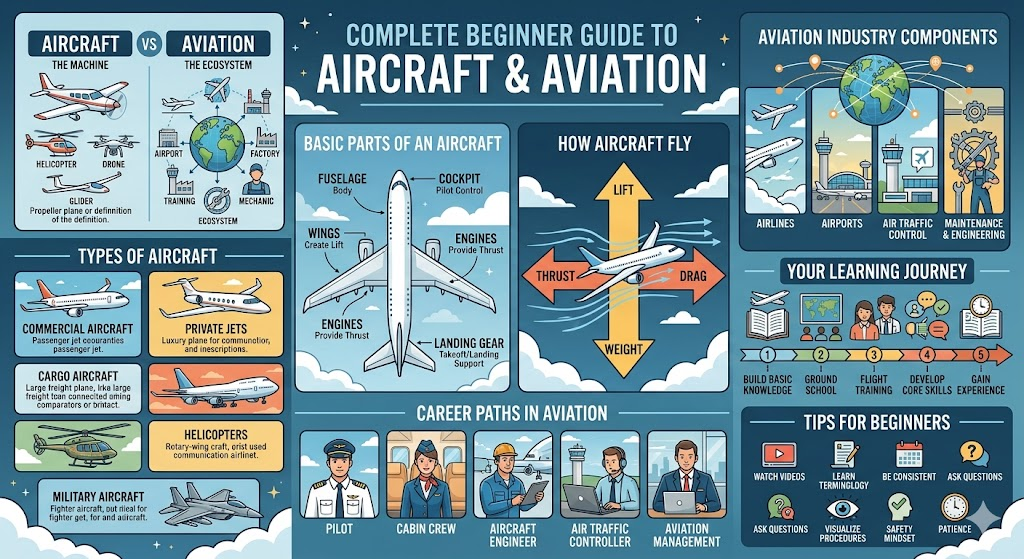
Introduction
Aircraft and aviation are among the most fascinating fields in the modern world. Every time a plane takes off, thousands of systems, technologies, and skilled professionals work together to make safe flight possible. For beginners, aviation may look highly technical and complex, but at its core, it is based on simple principles of physics, engineering, and communication.
This guide is designed for anyone who wants to understand aircraft and aviation from the ground up. Whether you are a student, aviation enthusiast, future pilot, or simply curious about how airplanes work, this blog will give you a clear and structured foundation.
In this guide, you will learn:
- What aircraft and aviation really mean
- Types of aircraft and their uses
- Basic parts of an aircraft
- How airplanes actually fly
- Overview of the aviation industry
- How beginners can start learning aviation
- Career opportunities in this field
By the end, you will have a strong beginner-level understanding of aviation and a clear direction if you want to explore it further.
What is Aircraft and Aviation?
What is an Aircraft?
An aircraft is any machine designed to fly in the air. It can carry passengers, cargo, or perform specialized tasks such as rescue missions, surveillance, or military operations.
Aircraft include:
- Airplanes
- Helicopters
- Drones
- Gliders
What is Aviation?
Aviation refers to the entire system and industry related to flying. It includes:
- Aircraft design and manufacturing
- Flight operations
- Airport management
- Air traffic control
- Pilot training
- Maintenance and safety systems
In simple words:
- Aircraft = the machine that flies
- Aviation = the entire ecosystem of flying
Types of Aircraft
Different aircraft are designed for different purposes. Understanding these types is the first step in learning aviation.
| Type of Aircraft | Purpose | Example Use |
|---|---|---|
| Commercial Aircraft | Passenger transport | Airlines like Boeing or Airbus jets |
| Private Jets | Luxury and business travel | Corporate executives |
| Cargo Aircraft | Transport goods | Logistics and freight companies |
| Helicopters | Vertical flight and rescue | Medical emergencies, military use |
| Military Aircraft | Defense operations | Fighter jets, surveillance aircraft |
Key Insight:
Each aircraft type is optimized for speed, range, payload, or flexibility depending on its mission.
Basic Parts of an Aircraft
Understanding aircraft structure is essential for beginners.
1. Fuselage
The main body of the aircraft where passengers and cargo are stored.
2. Wings
Wings generate lift, which allows the aircraft to rise into the air.
3. Engines
Engines provide thrust, pushing the aircraft forward.
4. Cockpit
The control center where pilots operate the aircraft.
5. Landing Gear
Wheels and support systems used during takeoff and landing.
Simple Breakdown:
| Part | Function |
|---|---|
| Fuselage | Holds passengers and structure |
| Wings | Generate lift |
| Engines | Provide thrust |
| Cockpit | Pilot control area |
| Landing Gear | Takeoff and landing support |
How Aircraft Fly
Aircraft flight is based on four fundamental forces:
Lift is the upward force that allows the aircraft to rise into the air.
Weight is the downward force caused by gravity.
Thrust is the forward force produced by engines.
Drag is the air resistance that slows the aircraft.
How It Works Together:
- Wings generate lift when air flows over them
- Engines produce thrust to move forward
- Gravity pulls the aircraft down (weight)
- Air resistance slows it down (drag)
When lift becomes greater than weight, the aircraft takes off.
Introduction to the Aviation Industry
The aviation industry is a large global system that connects people, goods, and services across the world.
Key Components:
1. Airlines
Companies that operate passenger and cargo flights.
2. Airports
Facilities where aircraft take off, land, and are maintained.
3. Air Traffic Control
Professionals who guide aircraft safely in the sky and on the ground.
4. Maintenance & Engineering
Teams responsible for aircraft safety, repairs, and inspections.
Why Aviation Industry Matters:
- Connects global economies
- Enables fast travel
- Supports international trade
- Provides millions of jobs worldwide
How to Start Learning Aviation
Beginners can start learning aviation step by step.
Step 1: Build Basic Knowledge
Understand aircraft types, flight principles, and aviation terms.
Step 2: Join Ground School
Learn theory subjects like:
- Navigation
- Meteorology
- Air regulations
- Aircraft systems
Step 3: Flight Training
Practical training with certified instructors.
Step 4: Develop Core Skills
- Communication
- Decision-making
- Situational awareness
- Discipline
Step 5: Gain Experience
Log flight hours and practice real flying scenarios.
Career Opportunities in Aviation
Aviation offers multiple career paths depending on interest and qualification.
1. Pilot
Responsible for flying aircraft safely.
2. Cabin Crew
Ensures passenger safety and comfort.
3. Aircraft Maintenance Engineer
Maintains and repairs aircraft systems.
4. Air Traffic Controller
Manages aircraft movement in airspace.
5. Aviation Management
Handles airport operations and airline administration.
Common Myths About Aviation
Myth 1: Aviation is only for experts
Reality: Beginners can start with proper training.
Myth 2: Flying is too expensive
Reality: Costs vary; scholarships and structured programs exist.
Myth 3: You need strong math skills
Reality: Basic math is enough for starting training.
Myth 4: Aviation is risky
Reality: Aviation is one of the most regulated and safest industries.
Tips for Beginners in Aviation
- Start with basic concepts, not advanced theory
- Watch aircraft training videos
- Learn aviation terminology slowly
- Stay consistent with study
- Ask questions during training
- Practice visualization of flight procedures
- Focus on safety mindset first
- Be patient with learning progress
Frequently Asked Questions (FAQs)
1. What is aircraft in simple words?
An aircraft is a machine designed to fly in the sky and carry passengers, cargo, or perform special tasks.
2. What is aviation?
Aviation is the entire system and industry related to aircraft, flying operations, and air transportation.
3. How do airplanes stay in the air?
Airplanes stay in the air because of lift generated by wings when air flows over them.
4. Is aviation hard to learn?
It can be challenging at first, but step-by-step training makes it easier for beginners.
5. What are the main types of aircraft?
Commercial, private jets, cargo planes, helicopters, and military aircraft.
6. Can anyone learn aviation?
Yes, anyone with basic education, fitness, and interest can start learning aviation.
7. What is the first step in aviation training?
Understanding basic aviation concepts and joining ground school.
8. Do pilots need medical fitness?
Yes, medical fitness is required to ensure safe flying capability.
9. What is ground school?
It is classroom training where students learn aviation theory.
10. What careers are available in aviation?
Pilot, cabin crew, engineer, air traffic controller, and aviation management roles.
Conclusion
Aircraft and aviation represent one of the most advanced and exciting fields in the world. From understanding how airplanes fly to exploring different aircraft types and career paths, beginners can build a strong foundation step by step. Aviation is not just about flying—it is about discipline, safety, precision, and global connectivity.
For anyone starting their journey, the key is to begin with curiosity and consistent learning. With the right guidance and practice, aviation can become both a rewarding career and a lifelong passion.

