
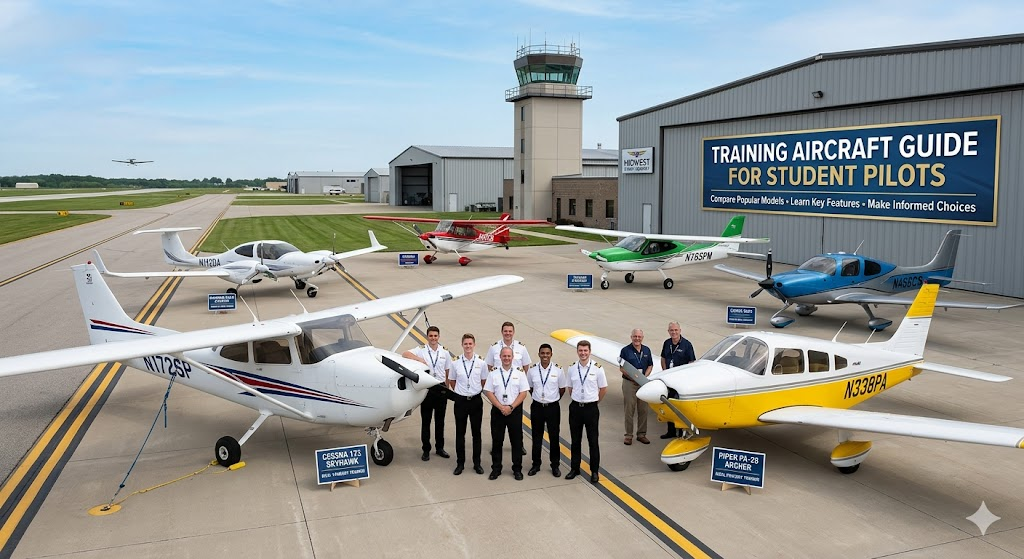
Introduction
Choosing the right training aircraft is one of the most important parts of a student pilot’s learning journey. A good training aircraft helps beginners build confidence, understand flight controls, practice safe landings, and develop strong decision-making skills in the cockpit. Flight schools usually prefer aircraft that are stable, reliable, affordable to operate, easy to maintain, and forgiving for new pilots.
Most student pilots begin their journey in single-engine piston aircraft such as the Cessna 172, Piper PA-28, or Diamond DA40 because these aircraft are widely used for primary training and are known for predictable handling. Modern trainers such as the Tecnam P-Mentor and Diamond DA40 NG are also becoming popular because they offer updated avionics, fuel efficiency, and IFR training capability.
What Is a Training Aircraft?
A training aircraft is an airplane designed or commonly used to teach new pilots how to fly. These aircraft are usually smaller, simpler, and more cost-effective than commercial or business aircraft.
Training aircraft are used for:
- Basic flight control practice
- Takeoff and landing training
- Navigation exercises
- Emergency procedures
- Solo flight preparation
- Instrument flight training
- Multi-engine training
- Commercial pilot preparation
Unlike large passenger aircraft, training airplanes are built around learning. They usually have excellent cockpit visibility, simple controls, predictable performance, and strong safety characteristics.
Why Training Aircraft Matter for Student Pilots
The aircraft a student trains in can affect learning speed, confidence, safety awareness, and total training cost. A beginner-friendly aircraft allows students to understand basic flying skills without being overwhelmed by complex systems.
A good training aircraft helps students learn:
- How the aircraft responds to control inputs
- How to maintain altitude, heading, and airspeed
- How to perform safe takeoffs and landings
- How to recognize stalls and recover safely
- How to manage emergencies
- How to communicate and navigate confidently
For student pilots, the best aircraft is not always the most advanced one. The best aircraft is usually the one that matches the student’s training stage, budget, and future goals.
Characteristics of a Good Training Aircraft
1- Stability
A stable aircraft helps students maintain control more easily. It should naturally return to a balanced flight condition after small disturbances.
2- Forgiving Handling
Student pilots make mistakes during early training. A good trainer should respond smoothly and give the student time to correct errors.
3- Low Operating Cost
Flight training can be expensive. Aircraft with lower fuel burn, simple maintenance, and wide parts availability help reduce training costs.
4- Good Visibility
Clear cockpit visibility helps students during traffic scanning, turns, landings, and ground reference maneuvers.
5- Reliable Engine and Systems
Flight schools need aircraft that can fly many hours every week. Reliability reduces cancellations and improves student progress.
6- Simple Maintenance
A trainer should be easy for maintenance teams to inspect, repair, and return to service.
7- Safety Features
Modern trainers may include GPS, ADS-B, glass cockpit displays, stall warning systems, autopilot, and sometimes whole-aircraft parachute systems.
Types of Training Aircraft
Single-Engine Training Aircraft
Single-engine aircraft are the most common choice for beginner pilots. They are used for private pilot training, basic navigation, takeoffs, landings, stalls, and emergency procedures.
Popular examples include:
- Cessna 172 Skyhawk
- Piper PA-28 Cherokee or Archer
- Diamond DA40
- Cessna 152
- Tecnam P-Mentor
The Cessna 172 and Piper PA-28 are widely used because of their forgiving handling, strong training history, and availability at many flight schools.
Multi-Engine Training Aircraft
Multi-engine trainers are used after students gain basic flying experience. These aircraft help pilots learn engine-out procedures, multi-engine performance, advanced navigation, and commercial pilot skills.
Popular examples include:
- Piper Seminole
- Diamond DA42
- Tecnam P2006T
- Beechcraft Baron
Multi-engine aircraft are more expensive to operate but are important for students who want to become commercial pilots or airline pilots.
Tailwheel Training Aircraft
Tailwheel aircraft have a different landing gear design where the small wheel is at the back. These aircraft help students improve stick-and-rudder skills, directional control, and landing discipline.
Examples include:
- Citabria
- Super Decathlon
Tailwheel training is not always required, but it can make pilots more skilled and aware of aircraft control.
Advanced Glass Cockpit Trainers
Glass cockpit trainers use digital displays instead of traditional round analog gauges. These aircraft help students prepare for modern aviation environments.
Examples include:
- Diamond DA40 NG
- Cirrus SR20
- Tecnam P-Mentor
- Diamond DA42
Glass cockpit aircraft are useful for students planning airline, corporate, or advanced instrument training.
Top Training Aircraft Used by Flight Schools
| Aircraft | Seats | Engine Type | Training Level | Key Advantages |
|---|---|---|---|---|
| Cessna 172 Skyhawk | 4 | Single-engine piston | Beginner to advanced | Stable, widely available, forgiving |
| Piper PA-28 Cherokee / Archer | 4 | Single-engine piston | Beginner to advanced | Durable, predictable, cost-effective |
| Diamond DA40 | 4 | Single-engine piston | Beginner to instrument | Modern design, good visibility, efficient |
| Diamond DA42 | 4 | Multi-engine piston | Multi-engine and instrument | Modern avionics, twin-engine training |
| Piper Seminole | 4 | Multi-engine piston | Commercial and multi-engine | Common multi-engine trainer |
| Cirrus SR20 | 4 | Single-engine piston | Advanced training | Glass cockpit, parachute system, modern systems |
| Tecnam P-Mentor | 2 | Single-engine piston | Primary to IFR training | Efficient, modern avionics, IFR capable |
| Beechcraft Baron | 4 to 6 | Multi-engine piston | Advanced multi-engine | Strong performance, complex systems |
| Citabria | 2 | Single-engine piston | Tailwheel training | Stick-and-rudder skill building |
| Super Decathlon | 2 | Single-engine piston | Tailwheel and aerobatic training | Upset recovery and advanced handling |
1- Cessna 172 Skyhawk
The Cessna 172 is one of the most recognized training aircraft in the world. It is popular because it is stable, easy to fly, and widely available at flight schools.
Its high-wing design gives excellent ground visibility, making it helpful for navigation, traffic spotting, and landing practice. Many students complete their first solo flight in a Cessna 172.
Best for:
- Private pilot training
- Beginner students
- Cross-country practice
- Instrument training
2- Piper PA-28 Cherokee / Archer
The Piper PA-28 is another popular aircraft for student pilots. Unlike the Cessna 172, it has a low-wing design, giving students a different cockpit view and flight feel.
The PA-28 is known for predictable handling and durability. Many flight schools use it for private pilot, instrument, and commercial training.
Best for:
- Primary flight training
- Students who prefer low-wing aircraft
- Cross-country training
- Instrument training
3- Diamond DA40
The Diamond DA40 is a modern single-engine aircraft used by many flight schools. It offers excellent visibility, efficient performance, and modern avionics options.
Its composite design and cockpit layout make it attractive for students who want a modern training experience.
Best for:
- Modern flight schools
- Glass cockpit training
- Instrument training
- Students preparing for advanced aviation careers
4- Diamond DA42
The Diamond DA42 is a multi-engine aircraft commonly used for advanced training. It is suitable for students moving from single-engine aircraft to twin-engine operations.
It is often used for commercial pilot training, multi-engine ratings, and instrument training.
Best for:
- Multi-engine training
- Commercial pilot preparation
- Advanced instrument training
- Students aiming for airline careers
5- Piper Seminole
The Piper Seminole is a traditional multi-engine trainer used by many flight schools. It helps students learn twin-engine operations, engine failure procedures, and advanced cockpit management.
Best for:
- Multi-engine rating
- Commercial pilot training
- Engine-out procedure practice
- Advanced student pilots
6- Cirrus SR20
The Cirrus SR20 is a modern training aircraft often used by schools that focus on advanced avionics and technically advanced aircraft training.
It includes modern cockpit systems and a whole-aircraft parachute system, making it useful for students who want experience with advanced safety and navigation systems.
Best for:
- Advanced private pilot training
- Glass cockpit familiarization
- Transition training
- Students interested in modern aircraft systems
7- Tecnam P-Mentor
The Tecnam P-Mentor is a modern two-seat trainer designed for efficient pilot training. It offers IFR capability, modern avionics, and low operating cost potential. Tecnam lists the P-Mentor as a two-seat IFR trainer with a 100 hp engine and a maximum range of about 950 nautical miles.
Best for:
- Primary flight training
- IFR training
- Cost-conscious flight schools
- Modern training fleets
8- Beechcraft Baron
The Beechcraft Baron is a powerful twin-engine aircraft used for advanced pilot training. It is not usually a beginner aircraft, but it is useful for students learning complex systems and higher-performance multi-engine operations.
Best for:
- Advanced commercial training
- Multi-engine experience
- Complex aircraft transition
- Professional pilot preparation
9- Citabria
The Citabria is commonly used for tailwheel and basic aerobatic training. It helps students improve control coordination, rudder use, and landing accuracy.
Best for:
- Tailwheel endorsement
- Stick-and-rudder skills
- Basic aerobatic awareness
- Advanced handling practice
10- Super Decathlon
The Super Decathlon is useful for aerobatic training, upset recovery, and tailwheel practice. It helps pilots understand unusual attitudes and aircraft control beyond standard training.
Best for:
- Upset recovery training
- Aerobatic training
- Tailwheel training
- Advanced handling confidence
Glass Cockpit vs Analog Cockpit Training Aircraft
| Feature | Glass Cockpit | Analog Cockpit |
|---|---|---|
| Display Type | Digital screens | Traditional round gauges |
| Best For | Modern avionics training | Basic flying fundamentals |
| Cost | Usually higher | Usually lower |
| Learning Curve | More systems to understand | Simpler for beginners |
| Airline Preparation | Strong | Moderate |
| Situational Awareness | High | Depends on pilot skill |
| Maintenance Cost | Can be higher | Often simpler |
| Ideal Student | Career-focused pilot | Beginner building fundamentals |
Glass Cockpit Benefits
Glass cockpit aircraft help students understand modern navigation, digital flight displays, moving maps, and integrated avionics. This is useful for students planning airline, corporate, or advanced instrument careers.
Analog Cockpit Benefits
Analog aircraft help students focus on basic flying skills. They teach attitude flying, instrument scanning, and manual navigation without too much screen dependency.
Which Is Better for Student Pilots?
Both are useful. A student can start on analog instruments to build core flying skills and later transition to glass cockpit aircraft for modern avionics training.
Why Flight Schools Prefer Certain Aircraft
Flight schools choose aircraft based on practical business and training needs. The most common reasons include:
- Low fuel consumption
- Affordable maintenance
- Strong safety record
- Easy parts availability
- Instructor familiarity
- Student-friendly handling
- High dispatch reliability
- Suitability for multiple training levels
Aircraft such as the Cessna 172, Piper PA-28, and Diamond DA40 remain popular because they balance cost, reliability, and training value.
Cost of Training on Different Aircraft Types
| Aircraft Type | Typical Cost Level | Fuel Use | Best Training Use |
|---|---|---|---|
| Cessna 152 | Low | Low | Basic private pilot training |
| Cessna 172 | Moderate | Moderate | Private, instrument, cross-country |
| Piper PA-28 | Moderate | Moderate | Private and instrument training |
| Diamond DA40 | Moderate to high | Efficient | Modern primary and instrument training |
| Cirrus SR20 | High | Moderate to high | Advanced glass cockpit training |
| Piper Seminole | High | High | Multi-engine training |
| Diamond DA42 | High | Efficient for twin category | Multi-engine and instrument training |
| Beechcraft Baron | Very high | High | Advanced multi-engine training |
Actual training cost depends on location, aircraft condition, fuel price, instructor fee, insurance, and flight school pricing.
How to Choose the Right Training Aircraft
For Private Pilot Students
Choose a stable and affordable aircraft such as:
- Cessna 172
- Piper PA-28
- Cessna 152
- Diamond DA40
For Career Pilot Students
Look for a school with a mixed fleet that includes:
- Single-engine trainers
- Glass cockpit aircraft
- Multi-engine trainers
- IFR-capable aircraft
For Budget-Conscious Students
Focus on:
- Aircraft availability
- Lower hourly rental cost
- Reliable scheduling
- Simple maintenance
- Good instructor support
For Airline-Focused Students
Choose aircraft that support:
- Instrument training
- Multi-engine training
- Glass cockpit experience
- Crew-style cockpit discipline
- Scenario-based training
Safety Features Found in Modern Training Aircraft
Modern training aircraft may include:
- GPS navigation
- ADS-B traffic awareness
- Electronic flight displays
- Autopilot
- Stall warning systems
- Emergency locator transmitters
- Terrain awareness
- Engine monitoring systems
- Ballistic parachute systems in some aircraft
Safety also depends heavily on instructor quality, maintenance standards, weather decision-making, and student discipline.
Future Trends in Training Aircraft
Electric Training Aircraft
Electric trainers are gaining attention because they may reduce operating costs, noise, and emissions. However, adoption depends on battery performance, certification, charging infrastructure, and flight school readiness.
Fuel-Efficient Trainers
Flight schools are increasingly interested in aircraft that reduce fuel burn and maintenance downtime. Tecnam promotes its flight school aircraft around fuel efficiency and lower operating cost goals.
Modern Avionics
More training aircraft now include digital displays, GPS, autopilot, and advanced navigation systems.
Simulation Integration
Flight simulators are becoming more important in pilot training. Students can practice procedures, emergencies, and instrument flying before entering the aircraft.
Sustainable Aviation Fuels
Some flight schools are exploring cleaner fuels and more efficient engines to reduce environmental impact.
Common Mistakes Student Pilots Should Avoid
- Choosing a school only because it has expensive aircraft
- Ignoring aircraft availability
- Training on aircraft that are frequently unavailable
- Not comparing hourly aircraft rates
- Assuming glass cockpit training is always better
- Avoiding analog instruments completely
- Choosing aircraft without understanding training goals
- Ignoring maintenance reputation
- Not asking about fleet size
- Focusing only on aircraft type instead of instructor quality
Frequently Asked Questions
1- What aircraft do most student pilots learn in?
Many student pilots learn in aircraft such as the Cessna 172, Piper PA-28, Cessna 152, or Diamond DA40. These aircraft are popular because they are stable, reliable, and suitable for beginner training.
2- Is the Cessna 172 the best training aircraft?
The Cessna 172 is one of the best-known training aircraft, but the best aircraft depends on the student’s budget, school fleet, and goals. It is widely respected because of its forgiving handling and availability.
3- Should students learn on glass cockpit aircraft?
Glass cockpit training is useful, especially for students planning professional aviation careers. However, learning on analog instruments can also build strong basic flying skills.
4- Are training aircraft safe?
Training aircraft are generally safe when properly maintained and operated by qualified instructors and students. Safety depends on aircraft condition, school standards, weather decisions, and pilot discipline.
5- What is the cheapest aircraft for pilot training?
Older two-seat trainers such as the Cessna 152 are often among the lower-cost options. However, actual cost depends on the flight school, location, fuel prices, and aircraft availability.
6- What aircraft do airline pilots usually start with?
Many airline pilots begin in simple single-engine trainers such as the Cessna 172, Piper PA-28, or Diamond DA40 before moving to instrument and multi-engine aircraft.
7- How many hours are required before solo flight?
Solo timing varies by student skill, regulations, instructor approval, and flight school standards. Some students solo early, while others need more time to build confidence and consistency.
8- Are multi-engine trainers necessary?
Multi-engine trainers are necessary for pilots pursuing a multi-engine rating or many commercial aviation paths. They are not usually required during the first stage of private pilot training.
9- Can pilots train in electric aircraft?
Electric aircraft training is emerging in some markets, but availability is still limited. Most students today continue training in piston-engine aircraft.
10- How do flight schools select training aircraft?
Flight schools consider cost, safety, maintenance, fuel efficiency, student demand, instructor familiarity, insurance, and training requirements before selecting aircraft.
Conclusion
Training aircraft play a major role in shaping a student pilot’s confidence, skills, and overall learning experience. The best aircraft for beginners are usually stable, reliable, affordable, and easy to control. Aircraft such as the Cessna 172, Piper PA-28, Diamond DA40, Tecnam P-Mentor, and Diamond DA42 continue to support student pilots at different stages of training. Before choosing a flight school, students should compare the fleet, aircraft availability, instructor quality, maintenance standards, and total training cost. The right aircraft does not just help you complete flight hours; it helps you become a safer, smarter, and more confident pilot.

