
Introduction
Aircraft cockpit instruments are the pilot’s main source of flight information. They help pilots understand what the aircraft is doing, where it is going, how high it is flying, how fast it is moving, and whether the engine is working safely.
For beginners, the cockpit may look confusing at first. There are many dials, screens, switches, gauges, lights, and radio controls. But once you understand the purpose of each instrument, the cockpit becomes easier to read.
This Aircraft Cockpit Instruments Guide for Beginners explains the most important cockpit instruments in simple language. Whether you are a student pilot, aviation learner, flight simulator user, or someone curious about aircraft, this guide will help you understand the basics step by step.
What Are Aircraft Cockpit Instruments?
Aircraft cockpit instruments are devices that show important flight, engine, navigation, and safety information to the pilot.
They help pilots answer key questions such as:
- How fast is the aircraft flying?
- How high is the aircraft?
- Is the aircraft climbing or descending?
- Which direction is the aircraft heading?
- Is the aircraft level or turning?
- Is the engine working properly?
- Is there enough fuel?
- Where is the aircraft located?
- Is there any warning or emergency condition?
In simple words, cockpit instruments work like the eyes and health monitor of the aircraft. Without them, pilots would not have enough information to control the aircraft safely, especially in clouds, at night, or during bad weather.
Why Beginners Should Learn Cockpit Instruments Early
Learning cockpit instruments early is very useful for anyone starting an aviation journey. Before a beginner learns advanced flying, navigation, or emergency procedures, they must understand the basic information shown inside the cockpit.
Cockpit instruments help beginners:
- Build confidence before flight training
- Understand how pilots control aircraft
- Learn aviation language more easily
- Improve flight simulator practice
- Understand pilot decision-making
- Recognize safe and unsafe flight conditions
- Prepare for basic aviation lessons
A beginner does not need to memorize every technical detail on the first day. The better approach is to understand the purpose of each instrument first. Once the purpose is clear, the readings become much easier to learn.
Main Categories of Cockpit Instruments
Aircraft cockpit instruments are usually divided into different categories based on their purpose.
Flight Instruments
Flight instruments show how the aircraft is moving in the air. They include speed, altitude, direction, climb, descent, pitch, and bank information.
Engine Instruments
Engine instruments show the condition of the aircraft engine. They help pilots monitor fuel, oil pressure, temperature, RPM, and electrical systems.
Navigation Instruments
Navigation instruments help pilots find direction, follow routes, track position, and reach the destination safely.
Communication Instruments
Communication instruments help pilots talk to Air Traffic Control, nearby aircraft, and airport towers.
Warning and Safety Systems
These systems alert pilots when something needs attention, such as low fuel, engine problems, unsafe landing gear position, or system failure.
Digital Glass Cockpit Displays
Modern aircraft often use digital screens instead of many separate round instruments. These screens combine flight, navigation, engine, and safety information in one place.
The Six Basic Flight Instruments
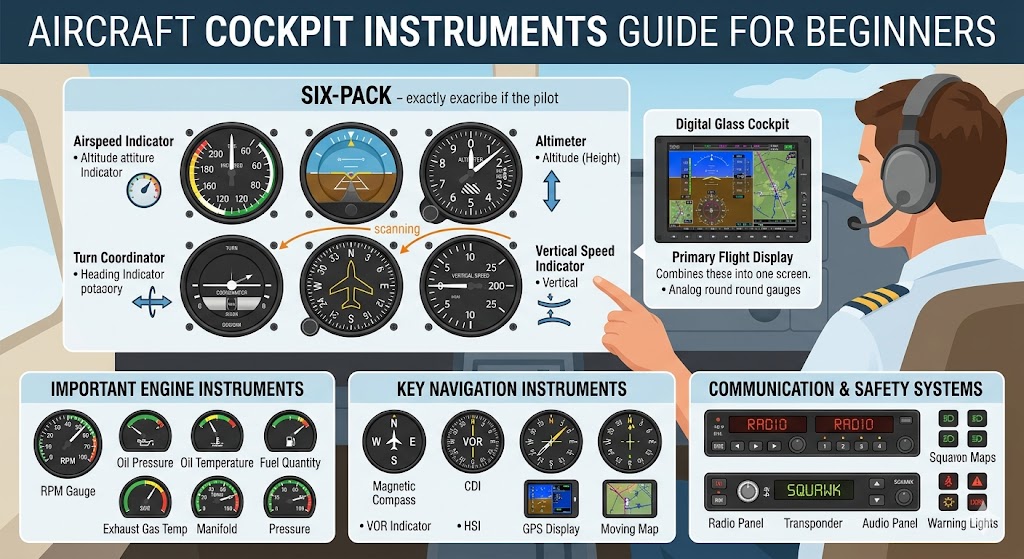
Many traditional aircraft cockpits are built around six basic flight instruments. These are often called the “six-pack” instruments because they are arranged together in front of the pilot.
The six basic flight instruments are:
- Airspeed Indicator
- Attitude Indicator
- Altimeter
- Turn Coordinator
- Heading Indicator
- Vertical Speed Indicator
Let’s understand each one in simple language.
Airspeed Indicator
The airspeed indicator shows how fast the aircraft is moving through the air. It is one of the most important pilot instruments because speed affects takeoff, climb, cruise, turns, and landing.
Airspeed is usually shown in knots. One knot is a unit of speed used in aviation and marine navigation.
Pilots use the airspeed indicator during:
- Takeoff roll
- Climb after takeoff
- Cruise flight
- Approach
- Landing
- Stall prevention
If the aircraft flies too slowly, it may lose lift and stall. If it flies too fast, it may put stress on the aircraft structure. This is why pilots constantly monitor airspeed.
Many airspeed indicators also have colored arcs. These colors help pilots understand safe speed ranges. For beginners, it is enough to know that pilots use these markings to stay within safe operating limits.
Attitude Indicator
The attitude indicator shows the aircraft’s position compared to the horizon. It tells the pilot whether the aircraft nose is up, nose down, level, or banking left or right.
This instrument is very useful when the pilot cannot see the natural horizon outside. For example, during cloudy weather, night flying, or poor visibility, the attitude indicator becomes extremely important.
The attitude indicator shows two main things:
- Pitch: whether the nose is up or down
- Bank: whether the aircraft is turning left or right
For beginners, think of the attitude indicator as an artificial horizon inside the cockpit. It helps the pilot keep the aircraft under control even when outside visual references are not clear.
Altimeter
The altimeter shows the aircraft’s altitude, which means height above a reference level. In most aviation use, altitude is shown in feet.
Pilots use the altimeter to maintain safe height during all phases of flight. It helps them avoid terrain, follow air traffic instructions, and fly at correct cruising levels.
The altimeter works based on air pressure. As the aircraft climbs, air pressure decreases. The instrument uses this pressure change to display altitude.
One important point beginners should know is that altimeters need correct pressure settings. If the wrong setting is used, the altitude reading may not be accurate. This is why pilots receive pressure settings from weather reports or Air Traffic Control.
Turn Coordinator
The turn coordinator shows whether the aircraft is turning and whether the turn is properly coordinated.
A coordinated turn means the aircraft is turning smoothly without slipping or skidding. The turn coordinator usually has a small aircraft symbol and a ball indicator.
The ball helps the pilot understand balance during a turn:
- Ball centered: turn is coordinated
- Ball left or right: aircraft may be slipping or skidding
For beginners, this instrument teaches an important flying concept: turning is not only about banking the aircraft. A good turn also needs proper rudder use for balance.
Heading Indicator
The heading indicator shows the direction in which the aircraft nose is pointing. It works like a more stable cockpit version of a compass.
Direction is shown in degrees:
- North is 360 or 0 degrees
- East is 90 degrees
- South is 180 degrees
- West is 270 degrees
Pilots use the heading indicator to follow assigned headings, navigate routes, and maintain direction during flight.
A normal magnetic compass can be affected by movement, acceleration, and turns. The heading indicator gives a smoother reading, but it must be checked and adjusted with the magnetic compass from time to time.
Vertical Speed Indicator
The vertical speed indicator shows whether the aircraft is climbing, descending, or flying level. It also shows the rate of climb or descent, usually in feet per minute.
For example:
- A positive reading means the aircraft is climbing
- A negative reading means the aircraft is descending
- A zero reading means the aircraft is maintaining altitude
Pilots use this instrument for smooth altitude changes. It is especially useful during climb, descent, approach, and landing preparation.
Beginners sometimes confuse airspeed with vertical speed. Airspeed shows forward movement through the air, while vertical speed shows upward or downward movement.
Important Engine Instruments
Flight instruments tell pilots how the aircraft is moving. Engine instruments tell pilots how the engine is performing.
Even if the aircraft is flying correctly, the pilot must keep checking engine health. Engine problems can become serious if they are ignored.
RPM Gauge
The RPM gauge shows how fast the engine is rotating. RPM means revolutions per minute.
In many smaller aircraft, RPM is used to monitor engine power. During takeoff, climb, cruise, and landing, pilots check RPM to make sure the engine is producing the expected power.
Oil Pressure Gauge
Oil pressure is very important for engine health. Oil reduces friction and helps engine parts move smoothly.
If oil pressure is too low, the engine may not be properly lubricated. This can lead to serious engine damage. Pilots treat abnormal oil pressure as an important warning.
Oil Temperature Gauge
Oil temperature shows how hot the engine oil is. If the oil becomes too hot, it may not protect the engine properly.
Pilots monitor oil temperature during engine start, climb, cruise, and high-power operations.
Fuel Quantity Indicator
The fuel quantity indicator shows how much fuel is available in the tanks.
Fuel management is one of the most important parts of safe flying. Pilots check fuel before flight, during flight, and before landing. They also plan extra fuel for delays, weather changes, or alternate airports.
Exhaust Gas Temperature
Exhaust gas temperature helps pilots monitor engine combustion. It is especially useful for adjusting the fuel-air mixture in some aircraft.
Beginners do not need to understand every advanced detail immediately, but they should know that this instrument helps pilots run the engine efficiently.
Manifold Pressure
Manifold pressure is mainly found in aircraft with more advanced piston engines, especially those with constant-speed propellers or turbocharged engines.
It shows pressure inside the engine intake system and helps pilots manage engine power.
Battery and Electrical Indicators
Aircraft need electrical power for radios, lights, navigation systems, and some instruments. Electrical indicators show battery condition, alternator output, or system voltage.
If there is an electrical problem, pilots must identify it early and follow proper procedures.
Navigation Instruments in Aircraft
Navigation instruments help pilots know where they are, where they are going, and how to follow the correct route.
Magnetic Compass
The magnetic compass is one of the oldest and most basic navigation instruments. It shows direction based on Earth’s magnetic field.
Even in modern aircraft, the magnetic compass is still important as a backup direction instrument.
VOR Indicator
VOR stands for Very High Frequency Omnidirectional Range. It is a radio navigation system used by pilots to follow routes and navigate between ground stations.
A VOR indicator helps pilots know whether they are on the correct course.
CDI
CDI means Course Deviation Indicator. It shows whether the aircraft is left or right of the selected navigation course.
If the needle is centered, the aircraft is on course. If the needle moves left or right, the pilot corrects the aircraft position.
HSI
HSI means Horizontal Situation Indicator. It combines heading and navigation information in one display.
It gives pilots a clearer picture of direction and course tracking.
GPS Display
GPS is widely used in modern aviation. It helps pilots see aircraft position, route, distance, ground speed, and estimated arrival time.
However, pilots are trained not to depend only on GPS. They must also understand basic navigation and backup instruments.
Moving Map Display
A moving map display shows the aircraft position on a digital map. It may include airports, airspace, terrain, navigation points, and flight route.
For beginners, this display is easy to understand because it looks similar to digital maps used in daily life, but aviation maps include much more specialized information.
Communication and Radio Instruments
Communication instruments help pilots stay connected with Air Traffic Control, airport towers, and other aircraft.
Radio Panel
The radio panel allows pilots to select communication frequencies. Each airport tower, ground control, and air traffic service uses specific frequencies.
Pilots tune the correct frequency to communicate during taxi, takeoff, climb, cruise, approach, and landing.
Transponder
A transponder sends aircraft identification and altitude information to radar systems. Air Traffic Control uses this information to track aircraft.
Pilots may be assigned a special transponder code. This helps controllers identify the aircraft on radar screens.
Audio Panel
The audio panel helps pilots manage which radios they listen to and which microphone they use. It is especially useful in aircraft with multiple communication and navigation radios.
Modern Glass Cockpit Instruments
A glass cockpit uses digital screens instead of many separate analog gauges. Modern aircraft often use these displays because they organize information clearly and reduce cockpit workload.
Primary Flight Display
The Primary Flight Display, or PFD, shows important flight information such as airspeed, altitude, attitude, heading, and vertical speed.
In simple words, the PFD combines many basic flight instruments into one digital screen.
Multi-Function Display
The Multi-Function Display, or MFD, may show navigation maps, engine data, weather information, traffic, terrain, and flight planning details.
It gives pilots a wider view of aircraft systems and route information.
EFIS
EFIS stands for Electronic Flight Instrument System. It is a digital system that displays flight information electronically.
For beginners, it is enough to understand that EFIS is the technology behind many modern glass cockpit displays.
Analog Cockpit vs Glass Cockpit
Both analog and glass cockpits are used in aviation. Each has its own benefits.
| Point | Analog Cockpit | Glass Cockpit |
|---|---|---|
| Display Style | Separate round gauges | Digital screens |
| Learning Experience | Good for understanding basics | Good for modern flying practice |
| Information Layout | Each instrument has one main job | Multiple data shown on screens |
| Failure Handling | Individual instrument failure may be easier to isolate | Screen failure can affect multiple displays |
| Pilot Workload | More manual scanning needed | Information is more integrated |
| Common Use | Older and training aircraft | Modern aircraft and advanced trainers |
For beginners, learning analog instruments first can build strong basic understanding. After that, glass cockpit systems become easier to understand.
How Pilots Read Cockpit Instruments During Flight
Pilots do not look at only one instrument. They use a method called instrument scanning.
Instrument scanning means checking several instruments in a regular pattern. This helps pilots build a complete picture of the aircraft’s condition.
For example, during climb, a pilot may check:
- Attitude indicator for pitch
- Airspeed indicator for safe climb speed
- Altimeter for increasing altitude
- Vertical speed indicator for climb rate
- Heading indicator for direction
- Engine instruments for power and temperature
Good pilots cross-check information. If one instrument shows something unusual, they compare it with other instruments before making a decision.
For beginners, this is one of the most important habits to learn. Do not stare at only one instrument. Keep scanning.
Common Mistakes Beginners Make While Learning Instruments
Learning cockpit instruments takes time. Beginners often make some common mistakes.
Focusing on One Instrument Only
Many beginners stare at one instrument for too long. This can cause them to miss changes in altitude, speed, or direction.
Confusing Airspeed and Vertical Speed
Airspeed shows forward speed through the air. Vertical speed shows climb or descent rate. These two are different and should not be confused.
Ignoring Engine Instruments
Some beginners focus only on flight instruments and forget engine instruments. Engine health is equally important for safe flying.
Depending Only on GPS
GPS is useful, but it should not be the only navigation source. Pilots must understand backup navigation methods.
Not Understanding Altimeter Settings
Wrong pressure settings can lead to wrong altitude readings. Beginners should learn why altimeter setting matters.
Reading Instruments Without Understanding Purpose
Memorizing instrument names is not enough. A beginner should understand what each instrument tells the pilot and why it matters.
Practical Tips for Learning Cockpit Instruments Faster
Learning cockpit instruments becomes easier with the right approach.
Learn One Instrument at a Time
Do not try to master every instrument in one day. Start with the six basic flight instruments, then move to engine and navigation instruments.
Use Cockpit Diagrams
A labeled cockpit diagram helps beginners remember where each instrument is located.
Practice With Flight Simulators
Flight simulators can help beginners understand how instruments change during takeoff, climb, turns, descent, and landing.
Watch Real Cockpit Videos
Cockpit videos can show how pilots scan instruments and use them during real flight operations.
Understand Before Memorizing
First ask, “What does this instrument help the pilot know?” Once the purpose is clear, the details become easier.
Practice Instrument Scan
Try looking at instruments in a pattern instead of randomly. This builds good cockpit awareness.
Compare Instruments Together
Do not read instruments separately. Learn how airspeed, attitude, altitude, and vertical speed are connected.
Sample Beginner Scenario
Imagine a student pilot sitting in a small training aircraft before takeoff.
Before starting the flight, the student checks the fuel quantity indicator to confirm enough fuel is available. The instructor points to the oil pressure and oil temperature gauges and explains that the engine must be healthy before takeoff.
During takeoff, the student watches the airspeed indicator. As the aircraft gains speed, the instructor calls out the speed at which the aircraft can lift off.
After takeoff, the student looks at the attitude indicator to maintain a safe climb attitude. The altimeter shows the aircraft gaining height, while the vertical speed indicator shows the climb rate.
During cruise, the student checks the heading indicator to maintain direction. The GPS and navigation display help confirm the route.
Before landing, the student watches airspeed carefully. The altimeter helps judge height, and the vertical speed indicator helps maintain a smooth descent.
This simple example shows how cockpit instruments work together. No single instrument gives the full picture. Pilots combine information from many instruments to fly safely.
Quick Cockpit Instruments Summary Table
| Instrument Name | What It Shows | Why It Matters |
|---|---|---|
| Airspeed Indicator | Speed through the air | Helps maintain safe flying speed |
| Attitude Indicator | Nose and bank position | Helps control aircraft attitude |
| Altimeter | Aircraft altitude | Helps maintain safe height |
| Turn Coordinator | Turn and balance | Helps make smooth coordinated turns |
| Heading Indicator | Aircraft direction | Helps follow correct heading |
| Vertical Speed Indicator | Climb or descent rate | Helps control altitude changes |
| RPM Gauge | Engine rotation speed | Helps monitor engine power |
| Oil Pressure Gauge | Engine oil pressure | Helps protect engine health |
| Fuel Quantity Indicator | Fuel available | Helps prevent fuel shortage |
| GPS Display | Aircraft position and route | Helps with navigation |
| Transponder | Aircraft identity and altitude data | Helps Air Traffic Control track aircraft |
| Warning Lights | System alerts | Helps pilots respond to problems |
Aircraft Cockpit Instruments Guide for Beginners: Key Learning Order
Beginners can learn cockpit instruments in this order:
- Start with the airspeed indicator, altimeter, and attitude indicator.
- Learn heading, turn coordination, and vertical speed.
- Understand fuel, oil, RPM, and engine health instruments.
- Move to navigation instruments like compass, GPS, CDI, and HSI.
- Learn radio, transponder, and communication systems.
- Finally, study glass cockpit screens such as PFD and MFD.
This learning order keeps the process simple and practical.
FAQs
1. What are the most important cockpit instruments for beginners?
The most important cockpit instruments for beginners are the airspeed indicator, attitude indicator, altimeter, heading indicator, turn coordinator, and vertical speed indicator.
2. What is the purpose of the airspeed indicator?
The airspeed indicator shows how fast the aircraft is moving through the air. It helps pilots maintain safe speed during takeoff, cruise, approach, and landing.
3. Why is the attitude indicator important?
The attitude indicator shows whether the aircraft is level, climbing, descending, or banking. It is very useful when the outside horizon is not visible.
4. What does an altimeter show?
An altimeter shows aircraft altitude. It helps pilots know how high the aircraft is flying.
5. What is the difference between heading and altitude?
Heading means the direction the aircraft is pointing. Altitude means the height of the aircraft.
6. Are glass cockpits easier than analog cockpits?
Glass cockpits can be easier because they show more information on screens. However, beginners should still understand basic analog instruments because they teach strong fundamentals.
7. Why do pilots scan instruments?
Pilots scan instruments to build a complete picture of aircraft speed, height, direction, attitude, and engine condition.
8. Can pilots fly only using GPS?
GPS is very useful, but pilots should not depend only on it. They must understand other navigation instruments and backup methods.
9. What instruments show engine health?
Engine health is shown by instruments such as RPM gauge, oil pressure gauge, oil temperature gauge, fuel indicator, exhaust gas temperature, and electrical system indicators.
10. How can beginners learn cockpit instruments faster?
Beginners can learn faster by using cockpit diagrams, practicing with simulators, watching cockpit videos, learning one instrument at a time, and understanding the purpose of each instrument.
Conclusion
Aircraft cockpit instruments may look complicated at first, but they become simple when learned step by step. Each instrument has a clear job. Some show flight movement, some show engine health, some help with navigation, and others support communication and safety.
This Aircraft Cockpit Instruments Guide for Beginners gives a strong foundation for understanding the cockpit. A beginner should first focus on the six basic flight instruments, then learn engine instruments, navigation systems, radio controls, and modern glass cockpit displays.
The most important lesson is that pilots do not depend on one instrument alone. They scan, compare, and cross-check information continuously. This habit helps them stay aware, make better decisions, and fly safely.
For anyone starting in aviation, understanding cockpit instruments is one of the first and most valuable steps toward becoming a confident aviation learner.

