
Introduction
Containerization has changed how modern software systems are built and deployed. Instead of running applications on fixed infrastructure, organizations now use container orchestration platforms that allow services to scale automatically, recover from failures, and run across multiple environments.
One of the most widely used container orchestration platforms is Kubernetes. It has become the standard platform for running cloud-native applications in production environments. Companies across industries use Kubernetes to manage containerized workloads and automate deployment, scaling, and infrastructure operations.
Because of this rapid adoption, organizations need engineers who understand how to operate Kubernetes clusters, manage container workloads, secure infrastructure, and troubleshoot distributed systems.
The Certified Kubernetes Administrator (CKA) Certification Training Course validates a professional’s ability to manage Kubernetes clusters in real-world environments. It focuses on cluster architecture, workload scheduling, networking, storage, and troubleshooting.
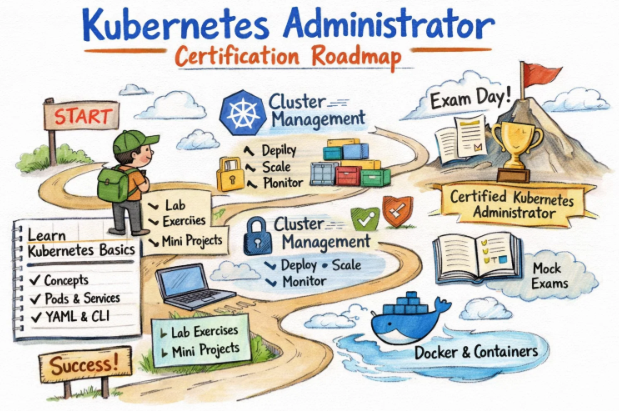
This guide explains the certification structure, preparation strategies, career benefits, and learning paths connected with the Certified Kubernetes Administrator certification program.
Certified Kubernetes Administrator (CKA) Certification
What it is
The Certified Kubernetes Administrator (CKA) certification validates a professional’s ability to manage Kubernetes clusters and operate containerized applications in production environments.
It focuses on real operational tasks such as cluster deployment, networking configuration, workload scheduling, and troubleshooting Kubernetes systems.
This certification proves the ability to run Kubernetes infrastructure efficiently and maintain highly available container platforms.
Who should take it
This certification is ideal for professionals responsible for managing cloud infrastructure and container orchestration environments.
Typical candidates include:
- DevOps Engineers
- Kubernetes Administrators
- Platform Engineers
- Site Reliability Engineers
- Cloud Infrastructure Engineers
- System Administrators
Skills you’ll gain
Preparing for this certification builds strong Kubernetes operational expertise.
Key skills include:
- Managing Kubernetes clusters
- Deploying and managing containerized workloads
- Configuring networking and service discovery
- Managing persistent storage
- Monitoring and troubleshooting Kubernetes clusters
- Implementing security controls and access policies
- Managing cluster scaling and node management
Real-world projects you should be able to do after it
After completing this certification, professionals should be able to implement real production Kubernetes environments.
Examples include:
- Deploying a Kubernetes cluster for microservices architecture
- Managing containerized applications using Kubernetes controllers
- Implementing load balancing and service networking
- Configuring persistent storage for stateful applications
- Monitoring cluster performance and resource usage
- Troubleshooting production incidents in Kubernetes clusters
Preparation Plan
7–14 Day Preparation Plan
Best suited for professionals who already work with Kubernetes regularly.
Focus areas:
- Kubernetes cluster architecture
- Pod scheduling and resource management
- Networking and services
- Storage and persistent volumes
- Practice troubleshooting scenarios
30 Day Preparation Plan
Recommended for engineers with basic Kubernetes knowledge.
Week breakdown:
- Week 1 – Kubernetes architecture and cluster components
- Week 2 – Workloads, pods, and services
- Week 3 – Networking, storage, and security
- Week 4 – Practice labs and troubleshooting exercises
60 Day Preparation Plan
Suitable for professionals transitioning from traditional infrastructure roles.
Focus areas:
- Container fundamentals and Kubernetes concepts
- Cluster setup and configuration
- Application deployment and scaling
- Monitoring and troubleshooting clusters
- Hands-on lab practice and exam simulations
Common Mistakes
Many candidates struggle with the CKA exam due to avoidable preparation mistakes.
Common mistakes include:
- Focusing only on theory instead of hands-on practice
- Ignoring Kubernetes networking concepts
- Not practicing troubleshooting scenarios
- Skipping cluster administration tasks
- Lack of familiarity with command-line operations
Hands-on experience is critical for success in this certification.
Best Next Certification After This
After completing the Certified Kubernetes Administrator certification, professionals can expand their skills into advanced areas.
Recommended options include:
Same Track
Advanced Kubernetes or container orchestration certifications
Cross Track
Cloud platform certifications or security certifications
Leadership Track
Cloud architecture or infrastructure leadership certifications
These options help professionals grow into platform architect and infrastructure leadership roles.
Choose Your Path
Technology professionals often follow different career paths depending on their interests and responsibilities.
DevOps Path
The DevOps path focuses on automation, CI/CD pipelines, and infrastructure orchestration. Engineers build systems that allow teams to release software quickly and reliably.
Kubernetes plays a major role in DevOps pipelines because it manages containerized applications.
DevSecOps Path
DevSecOps integrates security practices into DevOps pipelines. Professionals focus on protecting applications and infrastructure during the development lifecycle.
Security scanning, container security, and policy enforcement are key responsibilities.
SRE Path
Site Reliability Engineering focuses on reliability, monitoring, and operational stability. Engineers design systems that maintain high uptime and recover quickly from failures.
Kubernetes is widely used in SRE environments for managing scalable infrastructure.
AIOps / MLOps Path
AIOps and MLOps combine artificial intelligence with infrastructure automation. Engineers build intelligent monitoring systems and automated operational platforms.
Container orchestration plays an important role in deploying machine learning workloads.
DataOps Path
DataOps focuses on building reliable data processing pipelines. Engineers manage data infrastructure that supports analytics and machine learning workloads.
Kubernetes is often used to manage distributed data systems.
FinOps Path
FinOps focuses on managing cloud costs and infrastructure efficiency. Professionals monitor infrastructure usage and optimize resource allocation.
Container platforms like Kubernetes help organizations control resource consumption.
Role → Recommended Certifications
| Role | Recommended Certifications |
|---|---|
| DevOps Engineer | Kubernetes + DevOps certifications |
| Site Reliability Engineer | Kubernetes + SRE certifications |
| Platform Engineer | Kubernetes + Cloud architecture certifications |
| Cloud Engineer | Cloud platform certifications |
| Security Engineer | DevSecOps certifications |
| Data Engineer | Data platform certifications |
| FinOps Practitioner | Cloud financial management certifications |
| Engineering Manager | Cloud architecture and leadership certifications |
Top Institutions Providing Training and Certification Support
DevOpsSchool
DevOpsSchool provides hands-on training programs focused on DevOps tools, container orchestration, and cloud infrastructure. The training includes real-world labs, Kubernetes practice environments, and certification preparation.
Cotocus
Cotocus provides enterprise-level consulting and training services across cloud computing and DevOps automation. Professionals learn how to manage modern infrastructure and container platforms.
ScmGalaxy
ScmGalaxy focuses on DevOps tools and automation technologies. Their programs cover CI/CD pipelines, container orchestration, and infrastructure management.
BestDevOps
BestDevOps offers certification-focused training programs designed for professionals working with modern cloud and DevOps technologies.
DevSecOpsSchool
DevSecOpsSchool focuses on integrating security into DevOps pipelines and container environments.
SRESchool
SRESchool focuses on reliability engineering, monitoring, and incident management.
AIOpsSchool
AIOpsSchool provides training focused on automation using artificial intelligence and operational analytics.
DataOpsSchool
DataOpsSchool provides training for building scalable data pipelines and data infrastructure.
FinOpsSchool
FinOpsSchool focuses on cloud financial management and infrastructure cost optimization.
FAQs – Certified Kubernetes Administrator Certification
1. How difficult is the CKA certification?
The CKA exam is practical and requires hands-on Kubernetes experience. Candidates must perform real cluster management tasks during the exam
2.How long does preparation take?
Preparation time depends on experience. Engineers familiar with Kubernetes may prepare in a few weeks, while beginners may need more time.
3. Is Kubernetes experience required before taking the exam?
Yes. Practical Kubernetes experience is highly recommended for success in the certification.
4. What topics are covered in the CKA exam?
Topics include cluster architecture, workload scheduling, networking, storage, and troubleshooting.
5. Is this certification valuable for DevOps careers?
Yes. Kubernetes is widely used in modern DevOps environments, and certification demonstrates practical expertise.
6. Can beginners attempt the certification?
Beginners should first gain experience with containers and Kubernetes fundamentals.
7. Is the exam theoretical or practical?
The exam is performance-based, meaning candidates must complete real Kubernetes administration tasks.
8. Does the certification require Linux knowledge?
Yes. Basic Linux command-line skills are essential for managing Kubernetes clusters.
9. What roles benefit most from CKA certification?
DevOps engineers, platform engineers, SREs, and cloud engineers benefit significantly.
10. Is networking knowledge important for the exam?
Yes. Kubernetes networking is a major part of cluster management.
11. How does this certification help organizations?
Organizations benefit by hiring professionals who can manage container infrastructure and maintain reliable application platforms.
12. What career opportunities open after CKA?
Professionals can pursue roles such as Kubernetes administrator, DevOps engineer, platform engineer, and cloud infrastructure engineer.
Additional FAQs
13. Is Kubernetes the future of cloud infrastructure?
Kubernetes has become a core platform for container orchestration and cloud-native application management.
14. Does CKA improve salary prospects?
Yes. Kubernetes expertise is highly valued in the technology industry.
15. Can Kubernetes certifications help in cloud engineering roles?
Yes. Many cloud environments rely heavily on container orchestration platforms.
16. What tools should professionals learn along with Kubernetes?
Container tools, monitoring systems, and automation platforms are commonly used with Kubernetes.
17. Is Kubernetes knowledge required for DevOps engineers?
Most modern DevOps environments use Kubernetes, making it an important skill.
18. How often should Kubernetes skills be updated?
Technology evolves rapidly, so continuous learning and hands-on practice are important.
Conclusion
The Certified Kubernetes Administrator (CKA) certification is one of the most respected credentials for professionals working with container orchestration and cloud-native infrastructure. It validates the ability to manage Kubernetes clusters, deploy containerized workloads, and maintain reliable distributed systems.
Organizations increasingly rely on Kubernetes to run large-scale applications, making skilled Kubernetes administrators essential to modern technology teams.
Preparing for this certification helps engineers build practical expertise in cluster management, networking, storage, and troubleshooting. These skills are critical for operating scalable and resilient container platforms.
For professionals pursuing careers in DevOps, SRE, platform engineering, and cloud infrastructure, the CKA certification provides a strong foundation and opens opportunities in modern cloud-native environments.

