Introduction
A mobile phone must identify a suitable cellular network before it can connect to mobile services. It scans nearby signals, reads network information, and follows rules to select a network.
Three identifiers help explain this process: Mobile Country Code (MCC), Mobile Network Code (MNC), and Public Land Mobile Network (PLMN). Together, they help devices distinguish mobile networks and support connection procedures.
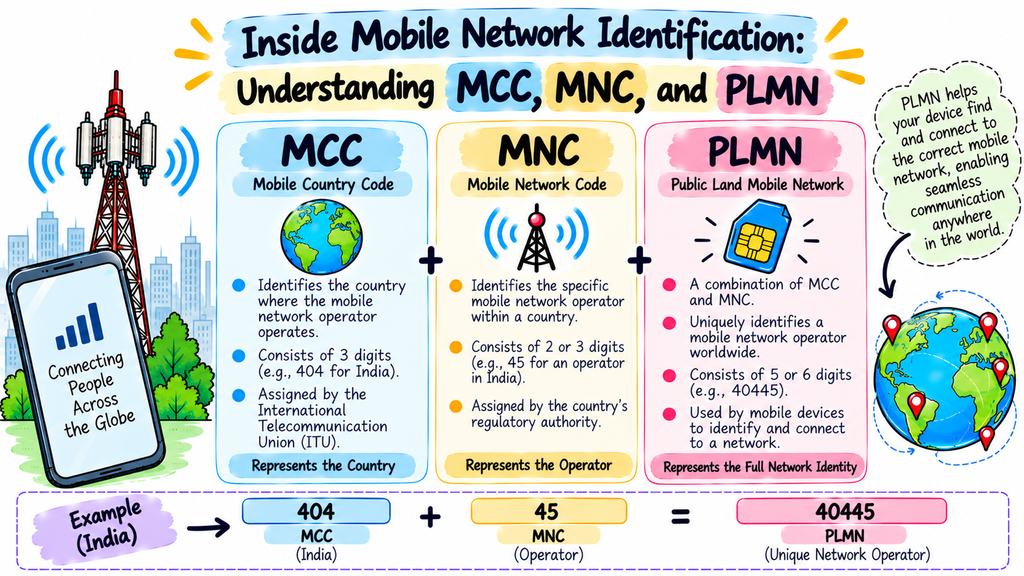
MCC represents a country or territory in the mobile numbering system. MNC distinguishes a network within the relevant numbering plan. PLMN combines both codes to create a network identity.
These identifiers matter in everyday mobile use, international roaming, network testing, and telecom operations. Understanding them also helps explain why a phone may detect a network but still fail to connect.
Start With MCC: Identifying the Country
The Mobile Country Code, or MCC, contains three digits. It identifies the country or territory associated with a mobile network.
When a phone searches for cellular service, it reads information that helps it recognize nearby networks. The MCC provides the country-level part of that information.
Where Does MCC Help?
MCC supports several mobile network tasks:
- Country recognition: It identifies the country or territory associated with a network.
- Network selection: It helps a device interpret network information while searching for service.
- International roaming: It helps systems distinguish networks associated with different countries.
- Network administration: Telecom teams use MCC values when they review network settings and records.
MCC does not identify a mobile subscriber. It provides country-level context for network identification.
Next Comes MNC: Distinguishing Mobile Networks
The Mobile Network Code, or MNC, identifies a mobile network within the relevant numbering plan. A device uses the MNC together with the MCC to distinguish networks.
An MNC typically contains two or three digits. The applicable numbering plan determines its length.
What Can MNC Tell You?
MNC adds network-level information to the country-level context that MCC provides.
Mobile devices and telecom systems use MNC values to:
- Distinguish networks within the same country.
- Recognize network identities during network discovery.
- Support network selection and registration.
- Help engineers investigate roaming and configuration issues.
You should not use an MNC alone to identify an operator worldwide. The MCC supplies the additional context needed to interpret the code correctly.
PLMN Brings Both Codes Together
A Public Land Mobile Network, or PLMN, provides cellular communication services through a mobile operator’s network. These services may include voice calls, text messages, and mobile internet access.
A PLMN identity combines the MCC and MNC.
PLMN identity = MCC + MNC
The combined identity helps a phone distinguish one public mobile network from another.
A Simple Example
Imagine that you travel abroad and switch on your phone. Your device detects signals from several mobile operators.
The phone reads network information, including PLMN identities. It then applies network-selection rules and checks factors such as SIM settings, roaming permissions, and operator preferences.
After choosing a suitable network, the phone attempts to register. The operator checks whether your subscription and access conditions allow the connection.
The PLMN identity helps the phone recognize the network, but it does not guarantee service. Coverage, roaming agreements, device compatibility, and account settings also affect the result.
A Quick Comparison of the Three Identifiers
Although MCC, MNC, and PLMN work together, each has a distinct purpose.
| Identifier | Main role | Format |
|---|---|---|
| MCC | Identifies a country or territory | Three digits |
| MNC | Distinguishes a mobile network within the numbering plan | Usually two or three digits |
| PLMN | Identifies a public mobile network | MCC combined with MNC |
Think of these identifiers as parts of a network address. MCC supplies the country context, MNC distinguishes the network, and PLMN brings both values together.
When you need to confirm an operator’s identity, check the full code against a reliable telecom reference. Do not guess the network from a partial value.
How Network Identifiers Work Across Mobile Technologies
Mobile networks have developed from earlier cellular systems to modern 4G and 5G services. Network identification remains an important part of this process.
How 4G LTE Uses PLMN
LTE devices read network information while searching for available service. They use PLMN identities as part of network selection and registration.
Operators also rely on network identity information when managing network access and supporting roaming arrangements.
How 5G Uses PLMN
5G networks also use PLMN identities to help devices recognize available mobile networks. Devices consider this information as they select networks and attempt registration.
Private and specialized network deployments may use additional identifiers or configuration rules. Even so, MCC and MNC remain important concepts for understanding public mobile network identity.
Why Roaming Depends on Network Recognition
International roaming lets subscribers use compatible networks outside their home operator’s service area, subject to their plans and operator agreements.
When a traveler enters another country, their phone may detect several local networks. PLMN identities help the device distinguish those networks.
The phone then follows its selection rules and attempts registration. The visited network and home operator may need a suitable roaming agreement before the subscriber can use mobile services.
If the phone cannot connect, network identity is only one part of the investigation. Engineers should also examine subscription permissions, roaming settings, device compatibility, and registration messages.
Troubleshooting: When Network Connections Fail
Network identifiers can help explain connectivity problems, but other factors often contribute to the issue.
The Phone Chooses an Unexpected Operator
Your device may select a different network because of preferred-network settings, roaming rules, or local availability.
What to review: Check automatic network selection, preferred operators, and roaming preferences.
The Phone Detects a Network but Cannot Register
A visible network does not always allow your phone to connect.
What to review: Check roaming permissions, SIM status, subscription settings, and registration error messages.
The Displayed Network Code Seems Wrong
An unfamiliar MCC or MNC may indicate a configuration issue or a misunderstanding of the numbering format.
What to review: Compare the complete identity with a trusted telecom reference. Confirm the correct MNC length for the relevant numbering plan.
The Device Shows No Service
A valid network identity cannot provide coverage where the phone cannot receive a usable signal.
What to review: Check local coverage, signal strength, device compatibility, possible outages, and SIM status.
The Phone Cannot Access a Specific Operator
A SIM plan, device configuration, or subscription restriction may prevent access to a particular network.
What to review: Verify the operator’s access rules, device compatibility, SIM settings, and account permissions.
Practical Guidance for Network Engineers
Telecom teams can use network identifiers more effectively by following a few basic practices.
- Consult reliable records: Use official telecom authorities or trusted operator documentation to verify assigned codes.
- Keep leading zeros: Treat MCC and MNC values as identifiers, not ordinary numbers.
- Check both codes: Use the complete MCC and MNC combination when identifying a network.
- Confirm the numbering format: Check whether the relevant numbering plan uses a two-digit or three-digit MNC.
- Inspect the wider connection process: Review signal quality, SIM settings, registration results, and roaming permissions.
- Use suitable diagnostic tools: Gather network information through device settings or authorized testing systems.
- Protect subscriber information: Keep network identities separate from personal subscriber data.
Readers who want to learn more about eSIM technology and mobile connectivity can visit esimglobo.com.
Frequently Asked Questions About MCC, MNC, and PLMN
What does MCC mean?
MCC stands for Mobile Country Code. It uses three digits to identify a country or territory within the mobile numbering system.
What does MNC mean?
MNC stands for Mobile Network Code. It distinguishes a mobile network within the relevant numbering plan.
What does PLMN stand for?
PLMN stands for Public Land Mobile Network. Its identity combines the MCC and MNC to identify a public mobile network.
How many digits does an MCC have?
An MCC always contains three digits.
Can an MNC have different lengths?
Yes. An MNC typically contains two or three digits, depending on the applicable numbering plan.
Does MCC identify an individual operator?
No. MCC provides country or territory context. MNC helps distinguish the mobile network.
Do 4G and 5G networks use PLMN?
Yes. Both LTE and 5G systems use PLMN identities to support mobile network identification and selection.
Does a valid PLMN mean my phone can connect?
No. Your phone also needs suitable coverage and network access. SIM settings, roaming permissions, and operator rules can affect registration.
Can network codes help diagnose roaming issues?
Yes. MCC and MNC help engineers identify the network involved. They must also examine roaming agreements, account permissions, and registration errors.
Do MCC and MNC identify phone owners?
No. These codes identify mobile networks. Mobile systems use separate identifiers for individual subscribers.
Final Thoughts: Why These Codes Still Matter
Mobile networks rely on clear identification to help devices recognize available operators. MCC provides country-level context, MNC distinguishes the network, and PLMN combines both into a complete network identity.
Knowing how these codes differ makes roaming and network selection easier to understand. It also gives telecom teams a useful starting point when they investigate connection problems.
As mobile services evolve, network identification continues to support the process that helps phones find and connect to suitable cellular networks.