
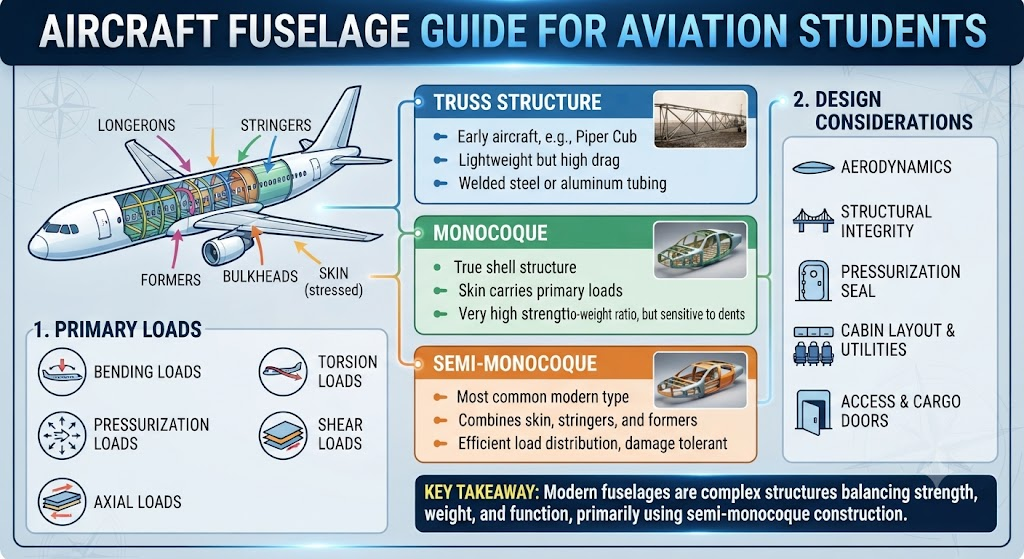
The aircraft fuselage is the main body of an airplane and connects many of its major structures and systems.
It provides space for passengers, crew, cargo, equipment, and other essential components.
Its structure must withstand aerodynamic, operational, and, in many aircraft, pressurization-related loads.
For aviation students, understanding the fuselage provides an important foundation for learning aircraft structures and design.
What Is an Aircraft Fuselage?
The fuselage is the central body or main structural section of an aircraft. In a conventional airplane, it typically contains the cockpit, passenger cabin, cargo areas, equipment compartments, and various aircraft systems.
The fuselage also provides structural connections for other major components. Depending on the aircraft design, the wings, empennage, landing gear, engines, and other systems may be attached directly or indirectly to the fuselage structure.
Although the fuselage is often thought of simply as the part where passengers sit, its structural function is much more important. It must help carry and distribute different loads throughout the aircraft.
The design of a fuselage depends on several factors, including:
- Aircraft size
- Intended mission
- Passenger and cargo requirements
- Operating altitude
- Pressurization requirements
- Aerodynamic requirements
- Structural requirements
- Material selection
- Weight considerations
A small training aircraft and a large commercial aircraft may look very different internally, even though both have a fuselage serving the same broad purpose.
Why Is the Fuselage Important in Aircraft Design?
The fuselage has several important functions beyond providing space for people and equipment.
Structural Support
The fuselage is part of the aircraft’s primary structural system. It helps transfer and distribute loads between different parts of the airplane.
For example, loads associated with the wings, landing gear, tail, engines, and other components must be transferred through appropriate structural members.
Passenger and Crew Accommodation
In passenger aircraft, the fuselage provides the cabin where passengers and crew operate.
The cabin layout affects the fuselage design because designers must consider seating, aisles, doors, emergency exits, overhead equipment, and other requirements.
Cargo Capacity
Many aircraft use portions of the fuselage for cargo transportation. Cargo compartments require appropriate structural support and arrangements for loading, securing, and distributing weight.
Aircraft Systems
The fuselage can contain or support numerous systems, including electrical equipment, environmental-control components, flight-control elements, avionics, hydraulic equipment, and other aircraft systems.
Pressurization
Many high-altitude aircraft use a pressurized cabin. In these aircraft, the fuselage must be designed to withstand the pressure difference between the cabin interior and the surrounding atmosphere.
Aerodynamic Considerations
The fuselage shape influences aerodynamic drag and airflow around the aircraft.
Designers therefore consider both structural requirements and aerodynamic performance when developing the fuselage shape.
Main Parts of an Aircraft Fuselage
An aircraft fuselage consists of multiple structural components working together. The exact arrangement varies according to aircraft type and construction method.
Fuselage Skin
The skin forms much of the outer surface of the fuselage.
In some aircraft structures, the skin carries a significant portion of the loads rather than simply acting as an outer covering. This is particularly important in semi-monocoque construction.
The skin also provides the aerodynamic surface of the fuselage and helps protect internal components from the external environment.
Frames
Frames are structural members arranged generally across the fuselage.
They help maintain the fuselage’s shape and provide support for the skin and other structural members.
Frames can also help distribute loads around areas such as doors, windows, and other openings.
Stringers
Stringers are longitudinal structural members that generally run along the length of the fuselage.
They support the fuselage skin and help resist and distribute structural loads.
Students often confuse stringers with frames. A simple way to remember the difference is that frames generally run across the fuselage, while stringers generally run longitudinally.
Longerons
Longerons are substantial longitudinal structural members.
Depending on the aircraft design, longerons can carry significant structural loads and contribute to the overall strength and stiffness of the fuselage.
They are generally more substantial than ordinary stringers, although the exact terminology and arrangement can vary between aircraft structures.
Bulkheads
Bulkheads are major structural partitions within the fuselage.
They can provide structural separation and support and may be especially important around areas requiring significant structural reinforcement.
In pressurized aircraft, certain bulkheads can have important pressure-related functions.
Floor Structure
The fuselage floor structure can support passenger seats, cargo, equipment, and other loads.
In passenger aircraft, the floor structure must accommodate operational loads while being integrated with the surrounding fuselage structure.
Fuselage Structural Design Concepts
Aircraft fuselages can be constructed using different structural approaches.
Monocoque Construction
In a traditional monocoque structure, the outer shell carries a large portion of the structural load.
The word “monocoque” can be understood as a shell-based structural concept.
A benefit of this approach is that the outer structure itself contributes significantly to strength. However, relying heavily on the skin can create challenges when openings or local damage are introduced.
Semi-Monocoque Construction
Semi-monocoque construction combines the load-carrying skin with internal structural members such as frames, stringers, and longerons.
This arrangement allows loads to be distributed through multiple structural components.
Many aircraft use forms of semi-monocoque construction because it provides an effective balance between strength, weight, stiffness, and maintainability.
Truss-Type Construction
Truss-type fuselages use a framework of structural members to carry loads.
The framework provides the primary structural support, while an outer covering can provide the aerodynamic surface.
Older aircraft and some specialized designs may use truss-type concepts.
Load-Bearing Skin
In modern aircraft structures, the outer skin may contribute substantially to carrying loads.
This is different from thinking of the skin as simply a protective cover. The interaction between the skin and internal structural members is an important part of aircraft structural design.
Common Fuselage Shapes
Fuselage shape is influenced by structural, aerodynamic, operational, and passenger requirements.
Circular Cross-Section
A circular or near-circular cross-section is commonly associated with pressurized aircraft because it can distribute pressure-related stresses efficiently.
The shape also provides a useful balance between structural requirements and interior volume.
Oval or Modified Circular Cross-Section
Some aircraft use shapes that are not perfectly circular.
An oval or modified circular design may provide advantages related to cabin dimensions, aerodynamics, equipment placement, or other design requirements.
Non-Circular Designs
Specialized aircraft can use different fuselage cross-sections based on their mission.
For example, aircraft designed around unusual cargo requirements may require a different internal arrangement or external shape.
There is therefore no single fuselage shape that is appropriate for every aircraft.
Aircraft Fuselage Materials
Aircraft designers select structural materials based on strength, weight, durability, manufacturing requirements, environmental resistance, and other factors.
Aluminum Alloys
Aluminum alloys have been widely used in aircraft structures because they offer a useful combination of relatively low weight, strength, manufacturability, and corrosion resistance when properly treated.
Many traditional aircraft structures use aluminum alloys extensively.
Advanced Aluminum Materials
Modern aircraft can use improved aluminum-based materials developed to provide specific combinations of strength, weight, fatigue performance, and corrosion resistance.
The exact material selection depends on the aircraft design.
Composite Materials
Composite materials combine different materials to achieve particular structural properties.
Carbon-fiber-reinforced materials are increasingly important in modern aircraft.
Composites can provide high strength-to-weight performance and good resistance to certain forms of corrosion. However, their behavior, manufacturing processes, inspection requirements, and damage mechanisms differ from those of traditional metallic structures.
Titanium
Titanium may be used in selected aircraft structural applications where its properties are particularly useful.
It offers good strength and temperature performance but is generally more expensive and more difficult to manufacture than many aluminum structures.
Steel
Steel can be found in selected aircraft structural applications where high strength or other specific properties are required.
Because steel is relatively heavy compared with many aerospace materials, its use is generally targeted toward applications where its particular properties justify the additional weight.
How Is an Aircraft Fuselage Constructed?
Fuselage manufacturing varies significantly between aircraft and manufacturers, but the general process involves creating and joining multiple structural components.
Structural components such as frames, stringers, bulkheads, and skin sections are manufactured according to the aircraft design.
For metallic structures, components may be joined using approved fastening and manufacturing techniques. Composite fuselage sections may involve different manufacturing processes, including composite layup and curing.
Fuselage sections can then be assembled and joined to create the larger aircraft body.
Openings for doors, windows, emergency exits, and other components require appropriate structural design and reinforcement.
After major structural assembly, aircraft manufacturers can install systems, insulation, interior components, wiring, equipment, and other items.
Quality control and inspection are important throughout the manufacturing process because structural accuracy and integrity are essential to aircraft safety.
Aircraft Fuselage and Pressurization
Many commercial and high-altitude aircraft operate with a pressurized cabin.
At higher altitudes, atmospheric pressure outside the aircraft is lower than the pressure maintained inside the cabin. This difference creates pressure loads on the fuselage.
The fuselage of a pressurized aircraft therefore functions partly as a pressure vessel.
Pressure Differential
Pressure differential refers to the difference between the pressure inside the cabin and the pressure outside the aircraft.
The fuselage structure must be designed to withstand this repeated loading during aircraft operation.
Pressure Bulkheads
Pressure bulkheads can form important boundaries within a pressurized aircraft.
Their design and location depend on the aircraft’s structural and pressurization system.
Doors and Windows
Doors and windows create openings in the fuselage structure. These openings require appropriate structural design because they interrupt the continuity of the surrounding structure.
Fatigue Considerations
Repeated pressurization and depressurization cycles can contribute to structural fatigue over time.
Aircraft manufacturers and maintenance organizations therefore use specific inspection and maintenance programs to monitor structural condition.
It is important to remember that not every aircraft is pressurized. Pressurization requirements depend on the aircraft’s design and operating conditions.
Loads Acting on an Aircraft Fuselage
The fuselage can experience many different types of loads during aircraft operation.
Tension
Tension occurs when a structural member is pulled apart by opposing forces.
Certain fuselage components can experience tensile loading depending on the aircraft’s condition and load distribution.
Compression
Compression occurs when forces push a structural component together.
Frames, longerons, and other structural members may experience compressive forces depending on the loading condition.
Shear
Shear forces act in a way that tends to cause adjacent parts of a structure to slide relative to each other.
Aircraft structural components must be designed to resist appropriate shear loads.
Bending
The fuselage can experience bending because of aerodynamic forces, weight distribution, landing loads, and interactions with other aircraft structures.
Torsion
Torsion is a twisting load.
Aircraft structures may experience torsional forces due to aerodynamic effects, propulsion, control inputs, or other operational conditions.
Pressurization Loads
In a pressurized aircraft, internal cabin pressure creates loads throughout the pressure vessel.
The fuselage structure must be designed to withstand these repeated pressure cycles.
Landing and Ground Loads
Landing, taxiing, and ground operations can introduce significant loads into the aircraft structure.
Landing gear loads must be appropriately transferred through the aircraft’s structural system.
Aerodynamic Loads
Airflow around the aircraft creates aerodynamic forces that are transmitted through the aircraft structure.
The fuselage participates in carrying and distributing some of these loads.
Aircraft Fuselage and Other Aircraft Structures
The fuselage does not operate as an isolated structure. It is integrated with the aircraft’s major structural components.
Fuselage and Wings
The wings generate significant aerodynamic forces. These forces must be transferred through the wing structure and into the aircraft’s main structural system.
The wing-fuselage connection is therefore a critical structural area.
Fuselage and Empennage
The empennage includes the aircraft’s horizontal and vertical stabilizing surfaces and associated control surfaces.
These components are connected to the aircraft through appropriate structural arrangements, often involving the aft fuselage.
Fuselage and Landing Gear
Landing gear transfers ground loads into the aircraft structure.
Depending on the aircraft design, landing gear may be attached to the fuselage, wings, or other major structural areas.
Fuselage and Engines
Engine location influences how engine-related loads are transferred.
Engines mounted on wings, pylons, or the rear fuselage require different structural arrangements to transmit their loads safely into the aircraft structure.
Aircraft Doors, Windows, and Emergency Exits
Doors, windows, and emergency exits are essential aircraft features, but they also create interruptions in the fuselage structure.
Passenger Doors
Passenger doors must be structurally integrated into the surrounding fuselage.
In pressurized aircraft, doors also require appropriate sealing and pressure-management features.
Cargo Doors
Cargo doors can be relatively large openings and therefore require substantial structural consideration.
Their design must accommodate operational requirements while maintaining appropriate structural integrity.
Emergency Exits
Emergency exits are designed to provide occupants with designated evacuation routes.
Their placement and structural integration must satisfy applicable aircraft design and safety requirements.
Windows
Aircraft windows must withstand environmental and structural conditions appropriate to their location.
In pressurized aircraft, windows are particularly important because they form part of the pressure boundary.
Structural Reinforcement
Because openings interrupt the normal flow of structural loads, surrounding areas can require additional structural reinforcement.
This helps distribute loads around the opening.
Aircraft Fuselage Inspection and Maintenance
Fuselage inspection is an important part of aircraft maintenance.
Maintenance professionals may inspect the structure for signs such as:
- Cracks
- Corrosion
- Dents
- Deformation
- Damaged or loose fasteners
- Composite delamination
- Damage around doors and windows
- Seal deterioration
- Evidence of abnormal loading
Corrosion
Corrosion can reduce the strength and service life of metallic structures if it is not properly identified and addressed.
Aircraft maintenance programs therefore include appropriate inspection and corrosion-control procedures.
Fatigue Damage
Repeated loading can contribute to fatigue over time.
This is particularly important for aircraft that experience many flight cycles, because repeated pressurization and operational loading can affect structural life.
Composite Damage
Composite structures can experience damage mechanisms that differ from conventional metallic structures.
Some damage may not be immediately obvious from a simple visual inspection, which is why approved inspection methods are important.
Maintenance Documentation
Actual aircraft structural inspection, repair, or modification must be performed using approved maintenance data and applicable procedures by appropriately qualified personnel.
A student-level understanding of fuselage structure is not a qualification to perform structural repairs.
Practical Example: Understanding Fuselage Loads
Consider a passenger aircraft operating at cruising altitude.
The cabin is maintained at a pressure higher than the surrounding atmosphere. This pressure difference places loads on the fuselage structure.
At the same time, the aircraft is experiencing aerodynamic forces while the wings, tail, landing gear, engines, passengers, cargo, and other components contribute to the overall structural loading.
The fuselage skin, frames, stringers, longerons, bulkheads, and other structural elements work together to carry and distribute these forces.
A simple way for a student to visualize this is to think of the fuselage as an integrated structural system rather than a collection of unrelated parts.
Each component has a role, but the components work together to provide the required strength and stiffness.
Understanding this relationship makes it easier to study aircraft structural design and maintenance concepts later in aviation training.
Aircraft Fuselage Components and Their Functions
| Fuselage Component | Basic Function | Student Learning Point |
|---|---|---|
| Skin | Forms the outer fuselage surface and may carry structural loads | The skin is more than just an aerodynamic covering in many designs |
| Frames | Maintain shape and support the fuselage structure | Frames generally run across the fuselage |
| Stringers | Provide longitudinal reinforcement and support the skin | Stringers generally run along the fuselage |
| Longerons | Provide substantial longitudinal structural support | They can carry significant structural loads |
| Bulkheads | Provide structural separation and support | Some bulkheads have important pressure-related functions |
| Floor Structure | Supports seats, cargo, equipment, and other loads | Floor structure is integrated with the surrounding fuselage |
Common Fuselage Learning Mistakes Aviation Students Should Avoid
1. Memorizing Components Without Understanding Their Functions
Students sometimes memorize terms such as frames, stringers, and longerons without understanding what each component actually does.
Understanding the function of each component makes the information easier to remember and apply.
2. Confusing Frames With Stringers
Frames and stringers have different orientations and structural roles.
A useful starting point is to remember that frames generally run across the fuselage, while stringers generally run longitudinally.
3. Assuming Every Aircraft Uses the Same Design
Aircraft structures vary considerably.
A training aircraft, wide-body airliner, military aircraft, and cargo aircraft may use different materials, shapes, and structural arrangements.
4. Ignoring Structural Loads
Learning component names without understanding the forces acting on them provides an incomplete understanding of aircraft structures.
Students should connect every major structural component with the loads it helps carry or distribute.
5. Treating the Fuselage Only as a Passenger Cabin
The fuselage is not simply a container for passengers.
It is an important structural element that integrates many aircraft components and systems.
6. Forgetting Pressurization Loads
Students studying commercial aircraft should understand that cabin pressurization creates repeated structural loading.
This is one reason pressure-vessel design and fatigue are important concepts in aircraft structures.
7. Assuming Composite Structures Behave Like Aluminum Structures
Composite materials have different properties and damage mechanisms.
Students should learn the basic differences between metallic and composite structures rather than treating them as identical.
8. Learning Structural Terms Without Studying Diagrams
Aircraft structures are easier to understand visually.
Using approved structural diagrams and aircraft drawings can help students recognize where frames, stringers, bulkheads, and other components are located.
9. Ignoring Fatigue and Corrosion
Fatigue and corrosion are important aircraft structural topics.
Understanding these concepts helps students appreciate why aircraft inspection and maintenance programs are necessary.
10. Ignoring Aircraft-Specific Documentation
General knowledge is useful, but actual aircraft structures must always be studied using aircraft-specific documentation where applicable.
Students should develop the habit of consulting approved manuals and training materials.
Common Fuselage Structural Concepts for Students
| Concept | Simple Explanation | Why It Matters |
| Monocoque Construction | A shell carries much of the structural load | Shows how the outer structure can contribute significantly to strength |
| Semi-Monocoque Construction | Skin works together with internal structural members | Helps distribute loads through multiple components |
| Frames | Cross-sectional structural members | Maintain shape and support the fuselage |
| Stringers | Longitudinal reinforcement members | Strengthen and support the fuselage skin |
| Longerons | Major longitudinal structural members | Provide substantial structural support |
| Pressurization | Maintaining cabin pressure above outside pressure | Creates important structural loading in pressurized aircraft |
| Structural Fatigue | Progressive damage caused by repeated loading | Important for understanding aircraft structural life |
| Corrosion | Deterioration of susceptible materials through environmental reactions | Can affect structural strength and requires appropriate inspection and control |
Important Considerations When Studying Aircraft Fuselage Structures
Aircraft-Specific Design Differences
There is no single fuselage design used by every aircraft.
Students should understand general structural principles while recognizing that specific construction methods vary between aircraft manufacturers and models.
Structural Materials
Different materials have different strength, weight, fatigue, corrosion, and inspection characteristics.
Understanding these differences is important for students studying aircraft structures.
Pressurization
Pressurized aircraft experience repeated pressure cycles.
Students should understand the basic relationship between cabin pressure, pressure differential, and fuselage structural loading.
Weight and Balance
The location and amount of passengers, cargo, fuel, and equipment can affect aircraft loading.
Structural design and aircraft operation therefore consider appropriate weight and balance requirements.
Structural Loads
Aircraft structures experience multiple types of loading simultaneously.
Students should become comfortable identifying tension, compression, shear, bending, and torsion.
Fatigue
Repeated loading can eventually affect structural components.
Aircraft structural design and maintenance programs take fatigue into account when determining inspection and service requirements.
Corrosion
Environmental exposure can affect metallic aircraft structures.
Proper inspection and corrosion-control practices are important aspects of aircraft maintenance.
Composite Material Behavior
Composite structures require specific knowledge because their damage mechanisms and inspection techniques can differ from metallic structures.
Inspection Requirements
Actual inspection requirements are aircraft-specific and must be based on approved maintenance documentation.
Aviation Regulations
Aircraft design, manufacturing, inspection, and maintenance are governed by applicable aviation standards and regulations.
Students should understand that textbook knowledge does not replace regulatory or aircraft-specific documentation.
Approved Repair Procedures
Structural repairs must be performed according to appropriate approved data and procedures by qualified personnel.
Students should never attempt to apply general educational information as an aircraft structural repair procedure.
Benefits and Limitations of Understanding Fuselage Structure
Benefits
A good understanding of fuselage structure can help aviation students:
- Understand how aircraft are constructed
- Connect structural components with their functions
- Understand basic aircraft loads
- Prepare for aircraft-structure examinations
- Understand the importance of inspection and maintenance
- Communicate more effectively about aircraft structural concepts
- Build a foundation for advanced aerospace subjects
Structural knowledge can also make it easier to understand why aircraft manufacturers use particular materials and construction methods.
Limitations
Basic fuselage knowledge has important limitations.
Understanding the function of a stringer, frame, or bulkhead does not qualify someone to inspect or repair an aircraft structure.
Aircraft structures can involve complex engineering calculations, material properties, fatigue analysis, damage-tolerance requirements, and regulatory considerations.
Actual maintenance work requires appropriate qualifications, aircraft-specific documentation, approved procedures, and professional oversight.
Student Learning Tips
Aviation students can make fuselage structure easier to understand by studying the subject progressively.
Start with the basic terms: skin, frame, stringer, longeron, bulkhead, and floor structure. Once these terms are familiar, study how they work together.
Use aircraft diagrams and structural illustrations to identify where the different components are located.
It is also useful to connect each component to the loads it may experience. Instead of simply memorizing “stringer,” ask what a stringer contributes to the overall structure.
Students should also compare monocoque, semi-monocoque, and truss-type concepts to understand why aircraft designers use different structural approaches.
When studying pressurized aircraft, pay particular attention to pressure differential, pressure bulkheads, windows, doors, and fatigue.
For aircraft-specific learning, use the applicable Pilot’s Operating Handbook, Aircraft Flight Manual, maintenance documentation, training materials, and instructor guidance.
Finally, practice explaining aircraft fuselage structure in your own words. If you can clearly explain what the fuselage does and how its main components work together, you have developed a much stronger foundation than simply memorizing definitions.
FAQs
1. What is the fuselage of an aircraft?
The fuselage is the main body of an aircraft. It commonly contains the cockpit, cabin, cargo areas, equipment, and aircraft systems while also serving as an important part of the aircraft’s structural system.
2. What is the main purpose of an aircraft fuselage?
The fuselage provides space for passengers, crew, cargo, and equipment while connecting and supporting other major aircraft structures. It also helps carry and distribute structural loads.
3. What are the main structural components of a fuselage?
Common components include skin, frames, stringers, longerons, bulkheads, and floor structures. The exact arrangement depends on the aircraft’s design and construction method.
4. What is a semi-monocoque fuselage?
A semi-monocoque fuselage uses the outer skin together with internal structural members such as frames, stringers, and longerons. The components work together to provide strength and distribute loads.
5. What is the difference between a frame and a stringer?
Frames generally extend across the fuselage cross-section and help maintain its shape. Stringers generally run longitudinally along the fuselage and provide reinforcement and support for the skin.
6. Why are many aircraft fuselages designed with a near-circular cross-section?
A near-circular cross-section can provide useful structural characteristics for pressurized aircraft because pressure loads can be distributed relatively efficiently around the structure. Other factors such as cabin layout and aerodynamics also influence fuselage shape.
7. What materials are commonly used to build aircraft fuselages?
Aircraft fuselages may use aluminum alloys, composite materials, titanium, steel, and other specialized materials. The choice depends on the aircraft’s design, performance requirements, manufacturing methods, and operating environment.
8. Why is fuselage pressurization important?
In a pressurized aircraft, cabin pressure is maintained above the outside atmospheric pressure at altitude. This creates a pressure differential that produces structural loads that the fuselage must be designed to withstand.
9. What types of loads act on an aircraft fuselage?
A fuselage can experience tension, compression, shear, bending, torsion, aerodynamic loads, landing and ground loads, and pressurization-related loads in applicable aircraft.
10. Why should aviation students study aircraft fuselage structure?
Understanding the fuselage gives students a foundation for learning aircraft construction, structural loads, materials, maintenance, and aircraft design. It is also useful for connecting theoretical aviation subjects with the physical structure of an aircraft.
Conclusion
The aircraft fuselage is much more than the main body of an airplane. It provides accommodation for passengers, crew, cargo, and equipment while forming an important part of the aircraft’s structural system.
Aviation students should understand the functions of the fuselage skin, frames, stringers, longerons, bulkheads, and floor structure, as well as the basic principles of monocoque and semi-monocoque construction. They should also understand how materials, pressurization, aerodynamic forces, and operational loads influence fuselage design.
A strong foundation in fuselage structure helps students understand aircraft design and maintenance more effectively. As students progress, they should build on these basic concepts using aircraft-specific manuals, approved training materials, qualified instruction, and applicable aviation requirements.

